
When Class I medical device recalls surge by 245% in just a few years, it's no longer just a statistic. It is a systemic, dangerous, and unacceptable failure of trust. You were promised a solution to your pain, yet you're now facing unexplained agony, the weight of revision surgery costs, and the cold silence of a massive corporation. It's easy to feel like just another number in a spreadsheet. We believe your suffering is real, your injuries are valid, and the burden of proving a medical device is defective shouldn't rest solely on your shoulders.
You deserve a clear roadmap through the legal fog. This guide provides the critical steps, evidence requirements, and legal frameworks necessary to hold manufacturers accountable. We'll explore the nuances of strict liability, the impact of the 2026 FDA Quality Management System Regulation, and the primary types of product defects. By understanding the path forward, you can shift the focus from your body's perceived failure to the mechanical reality of a broken product. You aren't alone in this fight, and you don't have to face powerful entities without a fierce, capable, and dedicated advocate by your side.
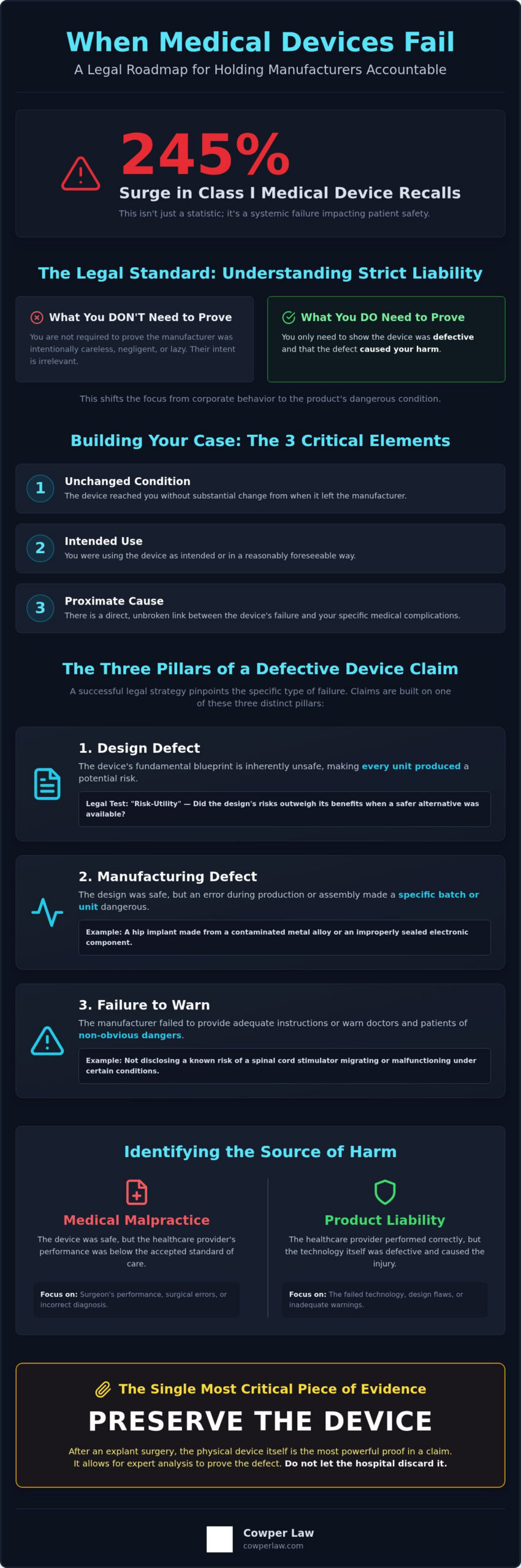
The legal landscape of product liability is built on a single, powerful premise: a consumer shouldn't bear the cost of a manufacturer's failure. When you're injured by an implant or a pump, the law doesn't force you to prove that a CEO was negligent or that a technician was lazy. Instead, we rely on the principle of strict liability. This standard shifts the focus from the manufacturer's behavior to the product's condition. If the device was defective and that defect caused you harm, the manufacturer is held responsible, regardless of their intent or level of care.
To succeed in proving a medical device is defective, we must demonstrate that the tool was "unreasonably dangerous" for its intended use. This means the device posed a risk that a reasonable person wouldn't expect, or that the risks significantly outweighed the benefits of the design. It's about accountability, persistence, and justice. We're here to bridge the gap between your physical suffering and the technical evidence required to hold a massive corporation responsible for the damage they've caused.
Many people believe that an FDA stamp of approval makes a device "lawsuit-proof." It doesn't. While the FDA's new Quality Management System Regulation (QMSR), which took effect on February 2, 2026, sets higher standards for production, it isn't a total shield for corporations. We often see devices cleared through the 510(k) process, which only requires showing the device is "substantially equivalent" to one already on the market. This is a far less rigorous path than full Premarket Approval (PMA). Even with PMA, federal preemption laws can be complex, but they aren't an absolute barrier to your recovery. We are experts at navigating these regulatory hurdles to find the path toward a successful claim.
Proving a medical device is defective requires a methodical approach to evidence. To build a formidable case, you must show three critical things:
We are meticulous, strategic, and relentless in gathering the medical records and expert testimony needed to prove this connection. Documenting the proximate cause is often the most challenging part of a case, as corporations will try to blame your biology or your surgeon. We don't let them. Our mission is to ensure the focus remains on the failed technology and the peace of mind you deserve.
Legal claims against multi-billion dollar corporations aren't one-size-fits-all. When we begin the work of proving a medical device is defective, we must categorize the failure into one of three distinct legal pillars. This precision is vital. It dictates our strategy, the experts we hire, and the internal documents we demand from the manufacturer during discovery. We don't just look for a mistake; we look for the specific point where the manufacturer prioritized their bottom line over your physical safety.
Identifying which pillar applies to your case is the first step in our partnership. Whether it's a structural flaw in a spinal cord stimulator or a labeling error on an insulin pump, we're here to hold these entities accountable. A skilled medical device injury lawyer acts as a shield, ensuring that you aren't intimidated by the legal teams of massive medical corporations.
A design defect occurs when the fundamental blueprint of the device is inherently unsafe. Even if the factory made the device perfectly according to the plans, the plans themselves were flawed. In these cases, we use the "Risk-Utility" test. We ask a simple question: Was there a safer alternative design available that the manufacturer ignored? If the risks of the design outweigh its benefits, the product is defective.
We see these systemic flaws frequently in products like hernia mesh or breast implants. When a design flaw affects every single unit produced, it often creates the foundation for how to join a medical device class action lawsuit. We've seen corporations rush products to market, ignoring safer alternatives to beat a competitor or save on production costs. This isn't just a mistake; it's a choice that leaves patients to deal with the consequences.
Manufacturing defects are different. These are errors that occur during production, assembly, or shipping of a specific unit or batch. Perhaps a low-grade material was substituted to save money, or a sterilization process failed in a specific facility. While the design might be sound, the specific device that entered your body was a "lemon" that failed to meet the manufacturer's own specifications.
Marketing defects, often called a "Failure to Warn," happen when a manufacturer downplays known surgical risks or provides inadequate instructions. Under the "Learned Intermediary" doctrine, manufacturers usually fulfill their duty by warning your doctor. However, if they withheld data from the medical community, they've failed you and your medical team. If you've experienced an adverse event, knowing How to Report Medical Device Problems to the FDA is an important step in creating a public record of their failure. If you're struggling with the aftermath of a device failure, reaching out for a professional case review can help you find the clarity you need to move forward.
One of the most frequent questions we hear from clients is whether their injury was caused by a surgeon's mistake or a faulty implant. It's a vital distinction that dictates the entire trajectory of your case. Medical malpractice is fundamentally about the "Person." It examines whether a healthcare provider deviated from the accepted standard of care. Product liability, however, is about the "Thing." When our firm focuses on proving a medical device is defective, we are scrutinizing the engineering, the materials, and the corporate choices that led to a mechanical failure.
Choosing to pursue a manufacturer rather than a physician can offer a strategic advantage. While doctors are bound by professional standards, manufacturers are held to the standard of strict liability. We don't have to prove the corporation was "careless" in the traditional sense; we only need to prove the device was unreasonably dangerous. This "David vs. Goliath" battle is where Cowper Law excels. We are fierce, dedicated, and relentless in our mission to hold powerful entities accountable for the human cost of their products.
The evidence required for these two types of claims is vastly different. In a malpractice case, we rely on other medical doctors to testify about surgical techniques. In a product liability case, we shift our focus to bio-mechanical engineers, materials scientists, and regulatory experts. These professionals can dissect a device's failure at a molecular level. Our discovery process moves beyond hospital surgical logs and into the internal emails, test results, and design blueprints of the corporation. It's also important to note that statutes of limitations can vary. The clock for a malpractice claim might start the day of surgery, while a product liability claim may allow for more time based on when you discovered the device itself was the culprit.
There are instances where the lines blur. A surgeon might improperly implant a device, or they might ignore a clear warning from the manufacturer. In these complex scenarios, we navigate multi-party liability to ensure every responsible party is held to account. If a device failure leads to a tragic loss of life, a wrongful death medical device lawyer provides the compassionate, steady support your family needs during a chaotic time. Part of this process involves ensuring you report device problems to the FDA, which helps document the failure for both your case and the public record. We maintain a results-first framing, ensuring that the ultimate outcome for your family is always our primary focus.
Winning a battle against a multi-billion dollar manufacturer requires more than just medical records; it requires a mountain of technical and corporate evidence. When we focus on proving a medical device is defective, we look deep into the manufacturer's own history. We utilize the FDA's MAUDE database to establish a pattern of failure, showing that your injury wasn't an isolated incident but part of a documented, recurring problem. We also fight to obtain internal corporate documents that prove the company had prior knowledge of the risks yet chose to keep the product on the market.
While corporate records tell the story of greed, your personal records tell the story of survival. We encourage every client to maintain a pain journal that captures the daily reality of their suffering, the loss of mobility, and the emotional toll of a failed implant. This documents the human element that cold clinical files often miss. If you're ready to take the first step toward accountability, our team at Cowper Law is here to provide the stability and strength you need during this journey.
The most critical piece of evidence is the device itself. During an explant surgery, hospitals often have a default policy to return failed devices to the manufacturer for "testing." We view this as a major risk for legal spoliation, where evidence is lost, altered, or destroyed. We act quickly to request a Preservation Order, ensuring the device is secured in a neutral facility under a strict chain of custody. We also rely on detailed pathology reports to prove how the device interacted with your tissue, providing a biological fingerprint of the failure that is difficult for corporations to dispute.
A trial-ready team understands that scientific data is the only language corporations respect. We partner with bio-mechanical engineers, materials scientists, and medical specialists to prove causation with total certainty. These experts are essential for countering the manufacturer's "defense experts," who often try to blame the patient's lifestyle, anatomy, or underlying health for the failure. We are fierce, focused, and relentless in our pursuit of the truth, ensuring that the technical reality of a broken product remains the center of the case. By combining high-level strategy with deep-seated empathy, we build a narrative that is both intellectually formidable and emotionally accessible.
At Cowper Law, we don't see cases; we see people. We are a national trial firm dedicated to the principle that an individual's safety should never be sacrificed for corporate profit. Proving a medical device is defective is a complex, grueling journey, but you don't have to walk it alone. We view every case as a partnership, offering a sophisticated blend of intellect, strategy, and heart. Our mission is to provide the stability you need while we take on the giants of "Big Pharma" and large-scale manufacturers who have failed in their duty to protect you.
We believe justice should not be a luxury reserved for the wealthy. That's why we operate on a contingency-based model; we only get paid if you win. This allows us to provide high-end, tailored service to those facing catastrophic injuries or the loss of a loved one without the added stress of upfront legal fees. Our reach is national, allowing us to represent individuals across the country in complex litigation. For instance, if you've been harmed by a faulty implant, a spinal cord stimulator recall lawyer from our team can help you navigate the specific requirements and evidence standards of these intricate claims.
Our strategy is built on durability, persistence, and loyalty. We combine the toughness required for high-stakes litigation with the softness required for genuine client support. In cases involving catastrophic injury or wrongful death, our advocacy is relentless, focused, and mission-driven. We take the time to emphasize the personalized nature of your journey because we know that every injury is unique. We aren't a high-volume practice; we are a boutique firm that prioritizes the peace of mind and long-term support of the individual over all else.
Time is a critical factor in legal recovery. Statutes of limitations create strict, unforgiving windows for filing a claim, and acting quickly is essential to preserving evidence and securing your rights. We invite you to schedule a confidential, no-obligation case evaluation with our team to discuss your options. We are your constant companion from the beginning to the end of this process, providing the calm strength and intellectually formidable presence needed to win. Your recovery is our primary focus, and we refuse to yield until justice is served and accountability is achieved.
You now understand that your recovery depends on shifting the focus from your body's perceived failure to the mechanical reality of a broken product. By prioritizing evidence preservation and leveraging the principle of strict liability, you've laid the groundwork for a formidable legal challenge. The process of proving a medical device is defective is a complex undertaking that demands scientific precision, corporate scrutiny, and unwavering persistence. We are here to bridge the gap between your physical pain and the technical evidence required to secure justice.
Cowper Law provides a sophisticated, capable, and protective shield against the powerful entities of "Big Pharma." We bring extensive national trial experience against major manufacturers to every partnership, acting as a relentless advocate for victims of catastrophic injuries. Because we utilize a contingency-based model, we don't get paid unless you do. Our commitment is to your peace of mind, your stability, and your ultimate recovery. Contact Cowper Law today for a free, compassionate case evaluation. You don't have to face this battle alone; we're ready to fight for the justice you deserve.
Your health is the priority, so see a specialist immediately to address pain or device failure. Once you're stable, start a detailed record of your symptoms and the device's performance. The most critical legal step is ensuring the device isn't returned to the manufacturer after removal. We help you issue a preservation order to keep the hardware as evidence. This is the foundation for proving a medical device is defective.
A formal FDA recall isn't a prerequisite for a lawsuit. Corporations often wait until thousands of injuries occur before admitting a flaw exists. In many cases, our investigation reveals internal data showing the company knew about risks years before a recall was issued. We focus on the specific harm the device caused you, regardless of whether the government has officially flagged the product as dangerous yet.
Time limits are strict, but the discovery rule may provide a path forward if you didn't immediately know the device caused your injury. This rule often pauses the clock until the moment a reasonable person would have discovered the defect. Because these laws vary by state and specific circumstances, you should have an attorney review your timeline. Don't assume you're too late without a professional evaluation of your journey.
Proving this defect requires showing that the manufacturer possessed data about specific risks but failed to communicate them to your physician. We look for gaps in the instructions for use and marketing materials. If the company prioritized sales over safety by hiding adverse event reports, they've breached their duty. We use corporate discovery to find internal memos that prove they silenced safety concerns to protect their profits.
If a manufacturer files for bankruptcy, your claim typically moves into a specialized trust or a structured settlement process. This doesn't mean your case is over; it simply changes the venue where compensation is distributed. These proceedings are technical and require a firm with experience in complex corporate restructuring. We stay by your side to ensure your claim is filed correctly within the bankruptcy court's specific and demanding deadlines.
Yes, you must fight to keep the hardware. Hospitals often try to send failed implants back to the manufacturer, which can result in the destruction of vital evidence. This physical object is the centerpiece of a product liability claim. We coordinate with your surgical team to ensure the device is placed in a secure environment under a proper chain of custody for later testing by our team of experts.
Compensation generally covers both economic and human costs. This includes medical bills, lost wages, and the cost of future revision surgeries. It also addresses non-economic damages like physical pain, emotional distress, and loss of quality of life. While we don't guarantee specific amounts, our goal is to secure a result that provides stability. Calculating damages for catastrophic injury is a rigorous process that accounts for every future surgery, therapy session, and life modification you may require. Proving a medical device is defective is the first step toward reclaiming the peace of mind you've lost.
These cases are marathons, not sprints. Complex litigation against global corporations can take anywhere from eighteen months to several years to reach a resolution. The timeline depends on the depth of discovery, the number of experts involved, and whether the case is part of a larger class action. We maintain a steady, methodical pace to build the strongest possible case while keeping you informed at every milestone.