
Imagine waking up in an ICU bed because the device designed to protect your health did the exact opposite. For many, a malfunctioning device isn't just a technical error; it's a life-altering emergency that leads to ketoacidosis, severe hypoglycemia, or even death. If you or a loved one suffered due to a device failure, filing an insulin pump injury lawsuit is a vital step toward reclaiming your life. You shouldn't have to carry the weight of mounting medical bills, physical trauma, and broken trust while massive corporations profit from defective technology.
We understand the fear, the frustration, and the exhaustion that follow a catastrophic medical failure. Our firm stands as a fierce defender for those harmed by corporate negligence, providing the intellect, heart, and strategy required to secure justice. In this guide, you'll learn about the status of Medtronic settlement developments and Dexcom G7 recalls in 2026, your legal rights as a patient, and how to hold manufacturers accountable. We're here to help you pursue the financial recovery, corporate accountability, and peace of mind you deserve. You've spent long enough fighting for your health; let us fight for your justice.
For many living with Type 1 or Type 2 diabetes, an insulin pump is more than a convenience; it's a lifeline. When that lifeline snaps due to a manufacturing defect or a software glitch, the results are often catastrophic. An insulin pump injury lawsuit is a specific type of product liability claim. It's a legal avenue for patients to hold manufacturers responsible for design flaws that turn life-sustaining tools into dangerous liabilities. These claims focus on the reality that a device marketed as "safe" was, in fact, defectively designed or poorly manufactured.
The industry has pivoted from mechanical tools to software-driven devices, introducing invisible risks that patients can't see. While automation promises better control, it relies on complex code and delicate hardware. A single line of faulty programming or a brittle plastic component can trigger a failure that the patient doesn't detect until a medical emergency occurs. This shift has created a new frontier of risk where technical errors lead to immediate, life-threatening physical harm.
We see these cases as a classic battle of David vs. Goliath. On one side are individuals and families whose lives have been upended by technology they trusted. On the other are multi-billion dollar med-tech firms with endless resources and legal teams. We believe that no corporation is too large to be held accountable for the harm they cause. We are relentless advocates for the individual, providing the intellect, heart, and strategy required to level the playing field.
When a pump fails to deliver the programmed dose, the body's chemistry begins to unravel quickly. Under-delivery leads to skyrocketing blood sugar levels, which can cause permanent organ failure, metabolic damage, and a harrowing condition known as DKA. Diabetic Ketoacidosis is a life-threatening state where the blood becomes acidic due to a lack of insulin. Conversely, over-delivery is an immediate crisis that can lead to:
These aren't just "side effects"; they're life-altering traumas that require expensive hospitalizations and long-term care.
A voluntary recall is a common corporate tactic, but it doesn't shield a manufacturer from liability. If you were harmed before a recall was issued, or if the manufacturer failed to warn you of known risks, they remain responsible for your damages. When the FDA issues a Class I recall designation, it's a formal recognition that the device is "unreasonably dangerous" and could cause serious injury or death. We don't just look at the recall notice; we investigate the "why" behind the failure. We look for evidence of negligence, ignored warnings, or cut corners in the production process. We are certain that the complexities of an insulin pump injury lawsuit require a firm that understands the intersection of medicine, technology, and law to ensure your journey results in the justice you deserve.
While Medtronic has historically dominated the headlines, the crisis of defective diabetes technology extends across the entire industry. Widespread failures are rarely isolated incidents. They are often the systemic result of manufacturing shortcuts where corporate profit margins are prioritized over patient safety. Whether the failure is a physical breakage or a digital glitch, the impact on the patient remains the same. When these devices fail, the promise of precision, reliability, and safety vanishes. We are dedicated to exposing these flaws through every insulin pump injury lawsuit we handle.
The Medtronic 630G and 670G models were plagued by a critical hardware flaw that compromised the very foundation of insulin delivery. The retainer ring, designed to lock the insulin cartridge into the pump, was prone to cracking or breaking. When this ring fails, the cartridge loses its seal. This misalignment leads to either a total lack of insulin or an unexpected, massive over-delivery. By 2026, litigation has matured significantly. We've seen a heartbreaking rise in documented cases of wrongful death linked directly to these mechanical failures. Current settlement trends suggest that the evidence of these design flaws is now undeniable, forcing a shift in how these corporations defend their negligence.
Hardware is only half the story in the modern med-tech landscape. The Tandem t:slim X2 insulin pump lawsuit highlights a different, equally dangerous set of digital problems. Patients have reported sudden battery depletion and software bugs that cause the device to crash without warning. In integrated Automated Insulin Delivery (AID) systems, software "loops" can malfunction. This can trigger dangerous over-delivery of insulin without any user input or awareness. This digital instability turns a tool meant for freedom into a source of constant, life-threatening anxiety. We believe that a software bug is just as much a "defect" as a broken piece of plastic.
An automated pump is only as smart as the data it receives from a Continuous Glucose Monitor (CGM). The Dexcom G7 has faced intense scrutiny and FDA warnings regarding calibration errors and premature sensor failure. If a sensor reports a "phantom" high blood sugar reading, the integrated pump may deliver a lethal dose of insulin to "correct" a problem that doesn't exist. A faulty sensor is just as dangerous as a faulty pump in an integrated system. One weak link compromises the entire chain of care, leaving the patient vulnerable to severe hypoglycemia. If your technology failed you, we are here to help you understand your rights in an insulin pump injury lawsuit.
When you decide to move forward with an insulin pump injury lawsuit, the first major decision isn't just if you sue, but how. The legal system offers different paths to justice, and the right choice depends entirely on the nature of your injury and the specifics of the device failure. It's not a one-size-fits-all process. While mass torts offer a streamlined approach to gathering evidence against massive corporations, individual lawsuits allow us to focus entirely on the specific, life-altering impact a defective device had on your family. Manufacturers often rely on the hope that an individual will feel too overwhelmed to fight. We exist to prove them wrong.
Mass tort litigation occurs when many plaintiffs sue one manufacturer for the same defective product. This is often organized as Multi-District Litigation (MDL). In an MDL, your case remains your own; it is not a class action where thousands of people split one small settlement. Instead, cases are grouped together for the "discovery" phase to save time and resources. This allows a firm like ours to pool evidence against a multi-billion dollar entity, making the fight more efficient and powerful.
There is strength in numbers. If you are considering how to join a medical device class action lawsuit or mass tort, you benefit from shared resources. When hundreds of patients report the same software glitch or hardware break, it becomes much harder for the manufacturer to claim the incident was an isolated user error.
While collective action is powerful, it isn't always the best fit for every victim. When analyzing class action vs individual lawsuit for medical device benefits, we look closely at the severity of the harm. Cases involving wrongful death, permanent brain damage from a hypoglycemic coma, or long-term organ failure often require the dedicated focus of an individual lawsuit.
In these high-value claims, your story needs to be told in its entirety. We tailor the narrative to your specific life-long medical needs, lost wages, and emotional trauma. We are certain that every client deserves a strategy that reflects their unique suffering. Whether your journey leads toward a mass tort or a standalone trial, we stand as your constant companion, ensuring the final outcome provides the peace of mind and financial security you need to heal.
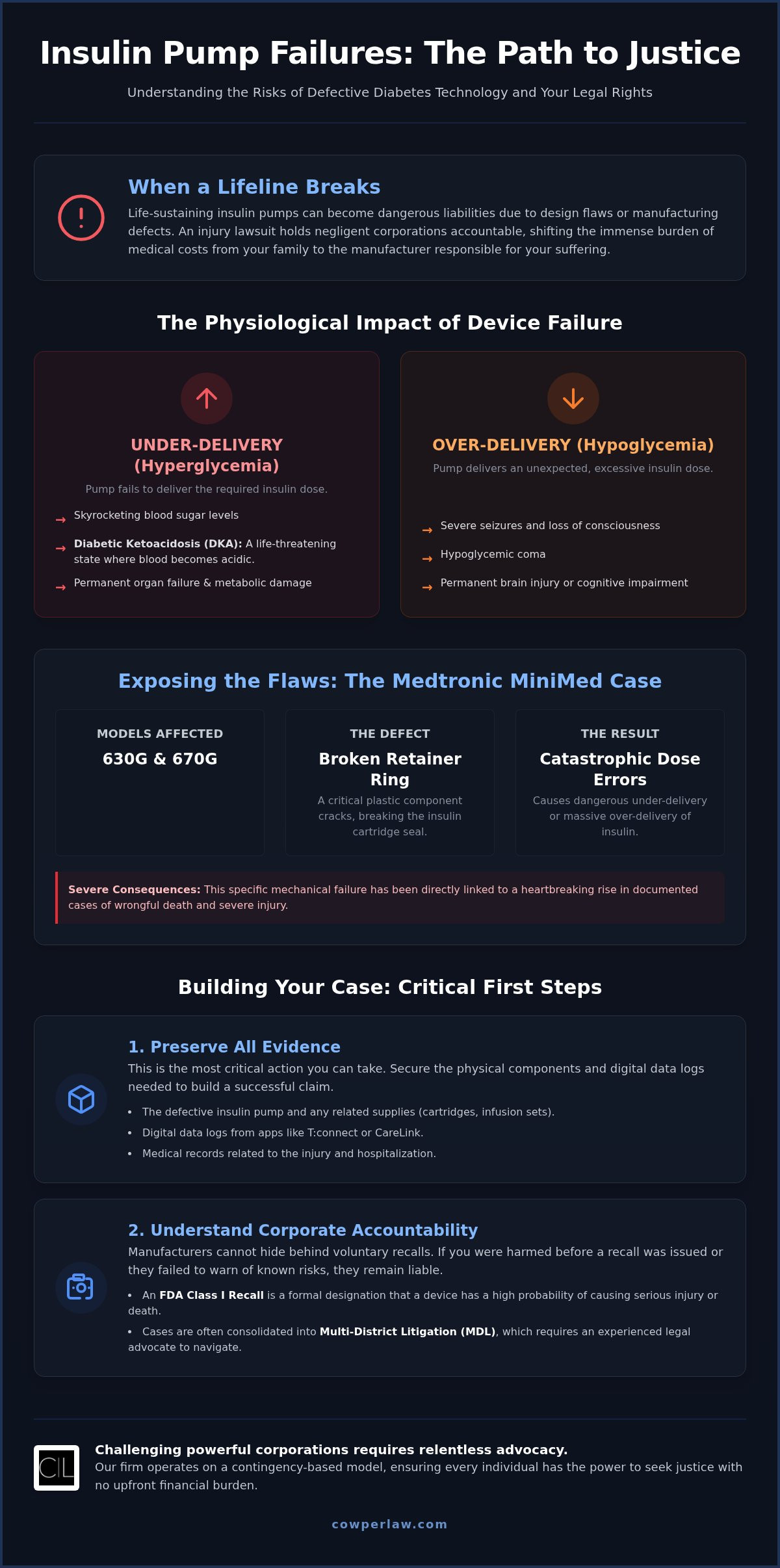
A successful insulin pump injury lawsuit isn't built on stories alone; it's built on a foundation of undeniable, technical evidence. Manufacturers often try to shift the blame onto the patient, claiming "user error" or "poor management." We are here to prove otherwise. To hold a multi-billion dollar corporation accountable, you must follow a methodical process of evidence preservation that covers the physical, digital, and medical aspects of the failure. We are dedicated to building a foundation of evidence that is intellectually formidable and impossible to ignore.
Your first and most vital step is the preservation of the physical device. Whether it’s a cracked Medtronic retainer ring or a Tandem pump with a depleted battery, that hardware is the "smoking gun" of your claim. You should also secure digital data logs immediately. These logs, found in the pump’s internal memory and cloud apps like T:connect or CareLink, provide a second-by-second account of what the device was doing versus what it was supposed to do. We then pair this data with comprehensive medical records from ER visits and your endocrinologist to create a seamless timeline of the failure.
Finally, we utilize expert witness testimony to bridge the gap between mechanical failure and medical trauma. These experts explain to a jury exactly how a software loop or a broken seal led to your specific injury. As we move through 2026, the Statute of Limitations becomes a critical factor. For many who suffered injuries during the peak of 2024 recalls, the window to file a claim is closing. Acting quickly ensures your right to justice isn't lost to a calendar date. If you're ready to hold these manufacturers accountable, our medical device injury litigation experts can help you preserve the evidence needed to win.
You must document everything. Keep your blood glucose logs from the hours immediately following the failure, as these provide proof of the physiological crisis. Never return the defective device to the manufacturer without legal counsel, even if they offer a free replacement. Spoliation of evidence occurs when a device is lost or destroyed, potentially ruining a legal claim. We are certain that keeping the physical device in your possession is the only way to protect the integrity of your case.
We take a "Compassionate Warrior" approach to valuing your claim, ensuring we account for every facet of your loss. This includes economic damages like hospital bills, lost wages, and the cost of future medical monitoring. However, we also fight for non-economic damages. These cover the pain, suffering, and emotional trauma that follow a near-death experience. We are certain that a legal victory should provide more than just a check; it should provide the peace of mind and security you need to move forward.
At Cowper Law, our mission is built on a singular, unwavering conviction: no corporation should be allowed to prioritize profits over human life. We are a national trial firm that specializes in medical device injury litigation, standing as a fierce defender for those whose trust was betrayed by defective technology. When you file an insulin pump injury lawsuit, you aren't just fighting for a settlement; you are fighting for accountability. We provide the intellectual strategy and the moral strength required to challenge multi-billion dollar med-tech entities. Our team is serious, focused, and intensely loyal to the families we represent.
We believe that justice should never be locked behind a financial barrier. This is why we operate on a contingency-based model, often referred to as "No Win, No Fee." You don't pay us a dime unless we secure a recovery for you. This approach allows us to focus entirely on your results while removing the stress of upfront legal costs. We have a national reach, representing injured patients across the United States. Whether you are dealing with a catastrophic injury or the loss of a loved one, our reach ensures that elite legal advocacy is available to you regardless of your location. We are not a high-volume practice; we are a high-stakes trial firm ready to go to court whenever necessary.
We understand that a medical crisis brings chaos, fear, and uncertainty. Our role is to provide the stability, order, and reassurance you need to focus on healing while we handle the legal complexities. We are certain that our triad of core values, compassion, expertise, and results, is what sets our advocacy apart. You are never just a case number or a file in our office. You are a partner in this fight, and we are your constant companion from the initial investigation to the final resolution. We balance the sharp intellect of a strategist with the deep heart of an advocate.
The path toward recovery begins with a simple, pressure-free consultation where we listen to your story and evaluate the strength of your insulin pump injury lawsuit. Within the first 30 days of your claim, we move quickly to preserve physical evidence, secure digital data logs, and establish a protective barrier between you and the manufacturer's insurance adjusters. We are ready to manage the intricate details of your case so you can reclaim your peace of mind. If you are seeking a partner who is both protective and highly capable, we are here to fight for the justice you deserve. Let us begin this journey together.
The transition from manual care to automated diabetes technology was supposed to provide freedom, not fear. When a device fails, the consequences are immediate and often catastrophic, leaving families to navigate a landscape of medical trauma and corporate silence. We are certain that you shouldn't have to carry this burden alone. By pursuing an insulin pump injury lawsuit, you are not only seeking the financial recovery needed for your medical expenses but also ensuring that negligent manufacturers are held to a higher standard of safety.
Our firm stands as a relentless defender of the individual against the largest med-tech corporations in the U.S. We are national trial lawyers focused on catastrophic injuries, providing the intellect and heart required to win complex cases. We operate on a contingency fee basis; you pay nothing unless we secure a victory for you. Contact Cowper Law today for a free, confidential consultation on your insulin pump injury claim. You have the power to demand justice, and we have the strength to help you achieve it. Your journey toward healing and accountability starts with a single step.
As of 2026, Medtronic MiniMed litigation has reached a critical stage where many early cases are moving toward potential settlement resolutions. While the company has faced thousands of claims regarding the 600 series retainer ring, new reports suggest they are actively negotiating to resolve long-standing disputes. We are monitoring these developments closely to ensure our clients receive the maximum possible recovery for the life-altering emergencies they endured due to these hardware failures.
You can absolutely pursue an insulin pump injury lawsuit even if you haven't yet returned or repaired a recalled device. A manufacturer’s voluntary recall doesn't erase their liability for the harm a defective product caused before the fix was implemented. In fact, a Class I recall designation often serves as powerful evidence that the device was unreasonably dangerous from the start. We focus on the injury you suffered, not just the status of the repair.
Settlement values are highly individual and depend on the severity of the medical emergency you experienced. Factors include the cost of hospitalizations for diabetic ketoacidosis, lost wages during recovery, and any long-term neurological or organ damage. While we cannot quote specific dollar amounts, we fight for a result that covers your full economic losses and the emotional trauma of a near-death experience. Our goal is to ensure you are made whole again.
While having the physical pump is the strongest form of evidence, you may still have a case if it was lost. We can often reconstruct the failure using digital data logs from cloud-based apps like CareLink or T:connect. However, preserving the physical device is vital to prevent claims of spoliation. If you still have the pump, keep it in a safe place and don't return it to the manufacturer until you speak with us.
You should watch for unexplained blood sugar spikes, frequent "no delivery" alarms, or rapid battery depletion that occurs without heavy use. Physical signs like a loose or cracked retainer ring are also immediate red flags. If your blood glucose doesn't respond to corrections as expected, your device may be under-delivering. These subtle technical failures can lead to life-threatening DKA if they aren't identified and addressed by a medical professional immediately.
You can certainly take legal action if a Dexcom G7 sensor failure led to a dangerous insulin overdose. In modern automated insulin delivery systems, the pump relies entirely on the sensor's data to make dosing decisions. If a faulty sensor provides a "phantom" high reading, it can trigger a lethal dose of insulin. We hold CGM manufacturers accountable for the inaccuracies that turn these integrated systems into life-threatening weapons against the patients they should protect.
The timeframe to file a claim, known as the statute of limitations, varies significantly depending on your state's laws. For many patients who suffered injuries following the widespread recalls of 2024, 2026 is a pivotal year where legal deadlines may expire. It's vital to consult with a qualified attorney as soon as possible to ensure your rights are protected. Waiting too long can permanently bar you from seeking the justice you deserve.
It won't cost you anything upfront to hire our firm for your case. We work on a contingency fee basis, which means we only get paid if we successfully recover money for you. We take on all the financial risk of the litigation, from hiring expert witnesses to gathering complex digital data. This model ensures that every individual has the power to challenge a multi-billion dollar corporation without any personal financial burden.