
More than 211,000 units of hernia mesh were recalled from 2005 through 2021. A recall can signal a safety or quality concern, but it doesn’t by itself prove that a particular implant caused an injury or establish a right to compensation. Recalled hernia mesh lawsuit assistance can help patients understand how the device, complications, and losses may fit into a claim.
If you have pain or other symptoms after hernia repair, it’s understandable to want clear answers about your implant and what to do next. Seek immediate medical attention if you suspect a complication. Your health should come first when making treatment decisions.
This article explains why recalls matter, what evidence may support a product-injury claim, and which medical and financial losses may be considered. It also covers factors that can affect a claim’s value, helping you understand the process before deciding what to do next.
A recall signals a product safety or quality concern, but it does not by itself prove that an implant caused an injury. The specific device, reported complication, and medical timeline help show why the recall may be relevant.
Reported complications after hernia mesh surgery include infection, intestinal obstruction, adhesions, and hernia recurrence. Patients may also experience lasting nerve damage that causes pain or need revision surgery to treat complications, remove the implant, or revise it. Document the specific symptoms and when they began.
As of July 2023, 55,000 adverse-event reports related to hernia mesh had been identified. Reports describe problems, but they do not by themselves establish that mesh caused a particular patient’s condition. For an individual case, compare the symptoms with the surgery date, product information, medical records, and later treatment.
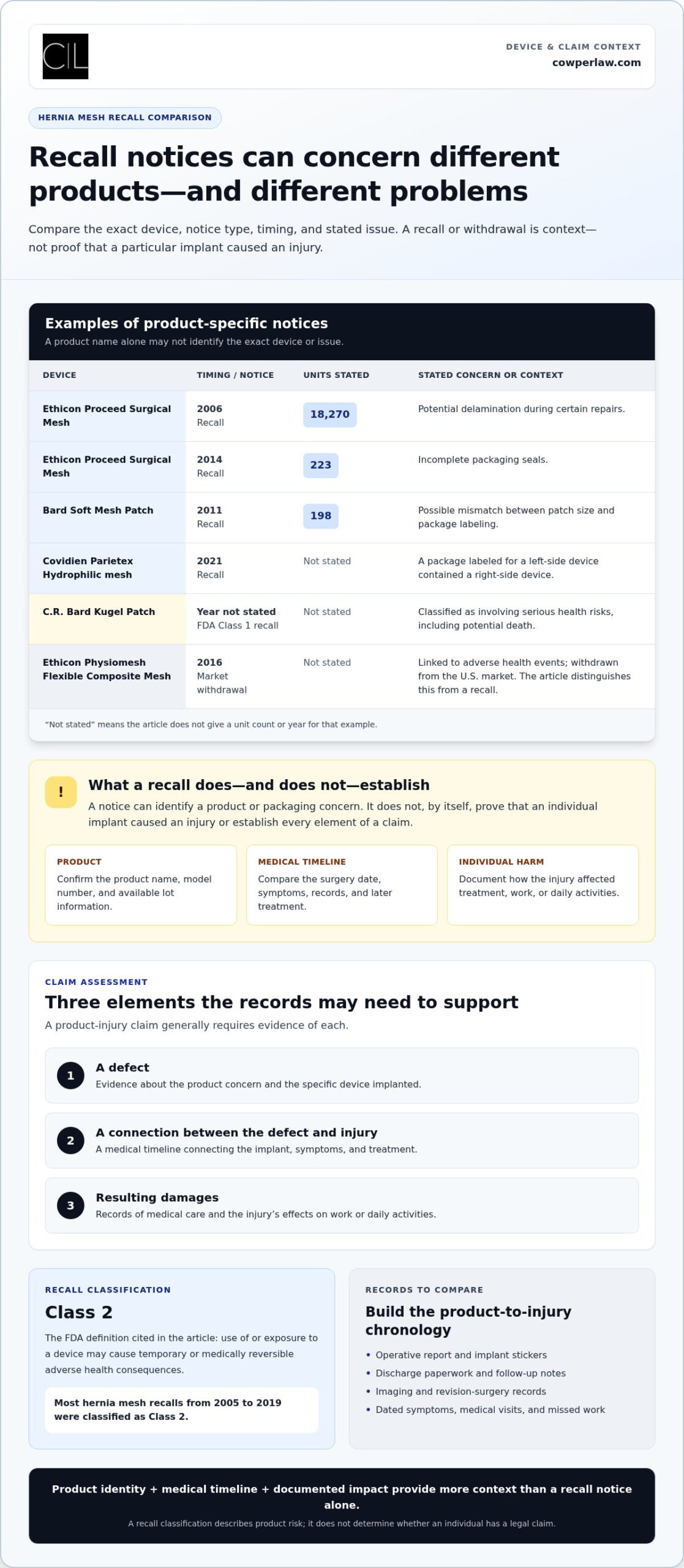
A recall identifies a concern with a device or its packaging; the reason varies by product. A mesh recall may reflect concerns about packaging or product performance, but does not by itself establish that an individual implant caused an injury. Ethicon’s Physiomesh Flexible Composite Mesh was linked to adverse health events and withdrawn from the U.S. market in 2016.
These examples do not prove that a particular implant caused an injury. A recall notice may describe a manufacturing, packaging, or performance concern, while medical records show what happened after implantation. Product names and model numbers in those records can help identify the mesh and compare it with recall information.
If you suspect a mesh complication, seek immediate medical attention. Tell the treating professional about your hernia repair, symptoms, and any implant details you know. Infection, obstruction, or worsening pain needs prompt attention as a health concern. Don’t make treatment decisions based only on a recall notice.
Gather records connecting the implant to your care, including operative reports, device labels, follow-up notes, imaging, and revision-surgery records. A surgeon or medical record may identify the mesh product and model number, helping you compare the implant with a recall notice. Keep a dated account of symptoms, missed work, and treatment.
These records also help distinguish a recall from a market withdrawal. Ethicon’s Physiomesh was withdrawn in 2016 rather than recalled, while the C.R. Bard Kugel Patch recall was classified by the FDA as Class 1 because it involved serious health risks, including potential death. In litigation, the distinction can shape the questions about the product, the alleged defect, and the injury.
Examples of hernia mesh products recalled in the United States include Ethicon Proceed Surgical Mesh, Covidien Parietex Hydrophilic mesh, and Bard Soft Mesh Patch. To identify an implant, look for its product name and model number in your medical records or ask the surgeon who performed the repair. Then compare those details with FDA recall notices.
Product identification matters because manufacturers issued recalls for different reasons. Ethicon recalled 18,270 Proceed Surgical Mesh devices in 2006 over potential delamination during certain repairs. In 2014, Ethicon recalled 223 Proceed units because of incomplete packaging seals. Those notices concern distinct product issues, so the exact model and lot information can guide the comparison.
Other examples include Covidien’s 2021 recall of Parietex Hydrophilic mesh, after a package labeled for a left-side device contained a right-side device. Bard recalled 198 Soft Mesh Patch units in 2011 over a possible mismatch between patch size and package labeling. A product name alone may not identify the specific device; preserve labels and implant records where available.
A product-injury claim generally requires evidence of a defect, a connection between that defect and the injury, and resulting damages. A recall can identify a product concern, but it does not establish every element of a claim for every patient. Records should show which device was implanted, what happened medically, and how the injury affected treatment, work, or daily activities.
Gather the operative report, implant stickers, discharge paperwork, follow-up notes, imaging, and records of revision surgery. If paperwork is incomplete, ask the surgeon’s office for the product name and model number. Compare those details with the relevant FDA notice, including its manufacturer, product description, and reason for recall.
FDA recall classifications also provide context. According to the FDA, a Class 2 recall means use of or exposure to a device may cause temporary or medically reversible adverse health consequences. The FDA classified most hernia mesh recalls from 2005 to 2019 as Class 2. Sofradim issued Class 2 recalls of Versatex products on April 26, 2018; Atrium’s C-QUR recall was also classified as Class 2 in 2013.
Recall classifications describe a product’s risk category, not whether a particular patient has a legal claim. A claim assessment considers the device, medical timeline, and documented harm together. For example, records showing an implant, a later revision, and continuing treatment create a clearer chronology than a recall notice alone.
Keep a dated record of symptoms, medical visits, missed work, and out-of-pocket losses. Preserve correspondence about the device and packaging, too. Those details can help connect the alleged defect with the injury and explain its practical effects. hernia mesh litigation can address claims involving injuries associated with these devices.
A hernia mesh injury can have medical, financial, and personal consequences. A product-liability claim may seek compensation for losses linked to the injury, not simply the fact that a device was recalled. Medical records, bills, and employment documents can help show how the harm affected your life.
Medical expenses may include care for complications, revision surgery, medication, rehabilitation, and follow-up visits. Keep itemized bills with records explaining why each treatment was needed. For example, a bill for mesh removal has more context when the surgeon’s notes connect the procedure to a documented complication.
Lost wages may include income missed during recovery or treatment. If an injury prevents you from returning to the same duties, employment records can help document reduced earning capacity. A timeline connecting appointments, surgery, recovery, and missed shifts makes the financial impact easier to understand.
Disability-related losses require more than a label. Medical assessments and work restrictions can describe activities you can no longer perform, while personal notes can document changes at home. For example, difficulty lifting after revision surgery may affect both job duties and everyday caregiving responsibilities.
Depending on the facts and applicable law, a claim may also address pain, emotional distress, and loss of normal activities. Evidence should describe practical effects, such as persistent discomfort interfering with sleep or routine movement. An attorney evaluating compensation considers the medical course, documented losses, and how clearly each loss connects to the alleged defective device.
Potential causes of mesh injuries include a design defect, a manufacturing problem, or inadequate warnings about risks. A design claim examines whether the device’s design created an unreasonable danger; a warning claim examines whether patients or clinicians received important risk information. These issues require evidence about the specific implant and injury, not assumptions based only on a recall.
Organize records by category and date. Keep bills separate from wage documents, and pair major expenses with the related treatment records. This file can show how the injury developed, what care it required, and how it changed your work and daily life.
Patients who suspect complications from recalled hernia mesh should seek immediate medical attention. A hernia mesh injury claim may be filed when surgery using hernia mesh took place on or after June 2008 and complications resulted. Hernia mesh lawsuit filing deadlines are 2-3 years in most states, generally running from discovery of the injury.
Past hernia mesh outcomes show that awards and settlements can vary widely. Each reported result reflects specific evidence, injuries, and litigation circumstances.
A settlement total is not the same as an individual patient’s payout. That total applied to a group of claims, not a guaranteed amount for each person.
The settlement figure describes the overall agreement, not a uniform payment to every plaintiff. Individual damages depend on factors such as medical treatment, revision surgery, chronic pain, lost income, and the strength of evidence connecting the implant to the injury.
For an individual claim, organize medical bills, wage records, and documentation of daily limitations. An abdominal injury requiring additional surgical repair may involve different losses from one treated without revision. Adhesion diagnoses, continuing symptoms, and documented treatment can also affect how damages are evaluated.
Jury verdicts offer another point of reference, but each is a decision in a specific case involving manufacturers like Bard. These outcomes depend heavily on the unique facts presented at trial.
These outcomes differ in product, evidence, injury, and procedural history, so they are not a payout schedule.
Settlements and verdicts also differ in how they are reached. A settlement is an agreement resolving claims; a verdict follows a trial and jury decision. A settlement may resolve claims through agreement, while a jury award reflects a decision in an individual case. Those distinctions matter when comparing results.
Use past outcomes as context, not as a forecast. Compare the injury, treatment, documented losses, and device in each example with your own records. A claim involving revision surgery and chronic abdominal pain presents different evidence from one without those effects. A claim’s value depends on its own proof and damages.
If you are assessing a mesh injury claim, discuss your hernia mesh case with Cowper Law and bring records showing treatment, work losses, and the implant involved.
Evaluation depends on the device, the alleged failure, the injury, and supporting records. Before accepting a settlement, review its release terms and filing deadlines, which vary by state.
Start with records identifying the implant, manufacturer, and lot, then build a timeline of symptoms and treatment. An operative report may identify the device, while follow-up notes and revision records can show what happened afterward. Bills, work records, and documented restrictions help explain the injury’s impact beyond the medical diagnosis.
Compare the exact product with its recall notice and stated reason. Atrium’s C-QUR recall involved packaging concerns, while Covidien recalled Parietex Hydrophilic mesh after a package contained a device different from its label. These examples show why matching product and recall details matters. A recall alone does not establish the cause of an individual injury.
Examine the alleged failure and the harm together. A claim may involve a design or manufacturing defect, inadequate warnings, or another product issue. Evidence should connect that concern to the patient’s condition, such as records documenting an organ injury, infection, or revision surgery after implantation. The medical timeline helps clarify whether the evidence supports that connection.
Filing deadlines can affect whether a claim proceeds. Hernia mesh lawsuit deadlines are two to three years in most states, generally running from discovery of the injury. Claims must be filed within the specific statutory window dictated by local jurisdictions. The applicable date and rule depend on the state and the facts, so identify the relevant timeline early.
Before signing a settlement, read the release carefully. It may resolve claims covered by its terms, so understand which injuries, parties, and future claims the agreement addresses. Consider whether ongoing treatment, future surgery, or lasting limitations are documented before agreeing to a final resolution.
Potential eligibility criteria can also differ across claims. One described criterion is hernia mesh surgery on or after January 1, 2013, followed by complications requiring revision surgery. That criterion does not replace state deadlines or prove liability. Product identification, medical evidence, and the settlement’s exact language all matter.
Preserve a complete file before making a decision: implant records, recall details, treatment notes, bills, and wage documentation. For example, records showing when symptoms began and when a revision occurred can help establish the sequence of events. Reviewing these details can clarify the claim’s strengths, risks, and unresolved losses.
More than 8,000 hernia mesh injury claims had been filed in state and federal courts as of 2020. More than 26,000 hernia mesh claims had been consolidated in mass tort lawsuits as of December 2025. Cowper Law can assist individuals in navigating these complex requirements to seek proper legal recourse.
You do not have to rush your next decision. Take time to consider what you want to protect, which questions remain, and what outcome matters to you. Recalled hernia mesh lawsuit assistance can help you understand your options in light of your circumstances.
Cowper Law represents patients in hernia mesh litigation who say they were harmed by a medical device. A conversation about your claim can clarify how legal representation may fit your circumstances and what information could help move the discussion forward.
Contact Cowper Law about your claim to take a considered step toward understanding your legal options. You deserve to have your concerns heard and your path forward treated with care.
Possible signs include a recurring bulge, persistent or worsening abdominal pain, swelling, fever, or changes in digestion. A bulge near the repair site may indicate recurrence, while fever and redness can signal infection. These symptoms need medical assessment, especially if they worsen or interfere with normal activities. Tell your clinician when they began and whether they followed a particular movement, treatment, or change in your condition.
Several products have been subject to recalls or market withdrawals, including C.R. Bard’s Kugel Patch, Atrium’s C-QUR, and Ethicon’s Proceed Surgical Mesh. Ethicon recalled 87 Proceed products in 2010 over potential delamination, and recalled 15 units from one lot in 2020 after hair was found inside packaging. Check the exact product and model, since a manufacturer may make multiple mesh devices with different recall histories.
Legal action may give an injured patient a way to seek compensation and present evidence about an allegedly defective device. A claim can also examine whether the manufacturer provided adequate warnings and whether the product caused documented harm. Recalled hernia mesh lawsuit assistance can help organize product records, the medical timeline, and losses for legal review. Preserve relevant paperwork and note how the injury affects work and daily responsibilities.
A Bard settlement was announced in October 2024 to address claims involving its hernia mesh products, but that announcement wasn’t a promise of a universal payment to every claimant in 2025. A group settlement and an individual payout are not the same thing. The agreement’s terms determine which claims it covers, what steps claimants must take, and what rights may be released by accepting payment.
Reported injuries include infection, intestinal obstruction, adhesions, hernia recurrence, and nerve damage that causes lasting pain. Some patients need revision surgery to treat complications or remove or revise the implant. An obstruction may affect digestion, while adhesions involve tissue sticking together. Record new symptoms, diagnoses, and treatments, and seek prompt medical care if you suspect a complication.
Useful records include the operative report, implant card or device label, discharge papers, imaging, follow-up notes, and records of later procedures. Bills and employment records can document medical expenses and missed work. An implant label may help identify the model, while a dated symptom log can clarify when problems began. Keep copies together, including communications about the device and related treatment.