
A strong trial lawyer may be within reach even when an injury has disrupted your income. In the United States, personal injury attorneys commonly work on contingency, meaning the attorney’s fee is generally owed only if the lawyer obtains a recovery. Understanding how to afford a top trial lawyer for my injury starts with learning how the fee is calculated and how case expenses may affect your final recovery.
It’s reasonable to worry that a case headed toward trial could become costly. If you’re wondering how to afford a top trial lawyer for my injury, the contingency percentage and responsibility for expenses are central to the answer. Those terms affect what you may ultimately receive, so the fee agreement matters as much as the headline percentage.
This article explains how contingency fees work, how trial preparation may affect costs and settlement proceeds, and what to look for in a lawyer whose experience fits your injury. You’ll have a clearer way to assess both the financial terms and the experience your case may require.
Contingency fees let injured people pursue compensation without paying an attorney’s fee upfront. The agreement explains how the fee and case expenses affect any recovery.
A contingency-fee arrangement ties an attorney’s fee to a recovery, usually as a percentage of a settlement or award. Personal injury lawyers in the United States commonly use this structure, and clients generally owe no attorney fee if the lawyer obtains no recovery. This can make legal representation accessible when injuries have disrupted income. Before signing, understand when the fee is earned and what the agreement says about settlements and trial outcomes.
The percentage may depend on the agreement’s terms and whether the case settles or proceeds through litigation. The U.S. District Court for the District of Vermont cited a usual contingent-fee range of 33 to 50 percent in personal-injury suits. The Internal Revenue Service notes that attorneys typically receive one-third of the recovery, while the amount may vary depending on whether the case settles or is resolved through litigation. Ask how the percentage changes as the case advances, and whether it applies to the gross recovery before deductions.
Hourly fees charge for each hour or part of an hour worked; flat fees set an amount in advance, regardless of time spent. Contingency fees depend on a recovery, so under the usual arrangement, clients avoid an advance attorney fee. State laws and local court rules can affect fee agreements and case costs. Courts can review fees, and fee-dispute procedures exist in essentially all jurisdictions. Legal aid offices, bar referral services, and pro bono programs may help injury victims find counsel, though eligibility and availability vary.
Case expenses are separate from the attorney’s contingency percentage and may include filing fees, expert witnesses, records, or investigation. Firms handle these costs differently, so review whether expenses are advanced, when reimbursement is due, and whether they are deducted before or after the fee is calculated. If you’re considering changing lawyers, read your existing agreement for termination terms and any fees or expenses claimed for work already completed. These details clarify how much of a settlement or award may remain after deductions.
Yes. Trial preparation can add case expenses, reducing the net amount left from a settlement or jury award. The fee basis and expense terms determine how those costs are handled.
Trial-related costs are expenses for preparing evidence, filing a lawsuit, and presenting witnesses.
Ask personal injury lawyers who advances each expense and when repayment is due. Clarify whether the fee agreement covers expert witnesses, investigation, medical records, and trial preparation. Also ask what happens if the case does not recover compensation. A low percentage alone doesn’t explain the financial terms if case expenses are handled differently.
Case costs can affect how much of a settlement or jury award remains after expenses and other deductions. Many personal injury claims settle out of court, but preparing for trial may require additional records, witness preparation, and expert analysis. A larger award doesn’t automatically mean a larger net recovery if litigation costs also increase.
Be cautious if a lawyer promises a specific settlement amount or says a jury will award more than a pretrial offer. No lawyer can guarantee that result. Before agreeing to a fee basis, ask which costs may arise, whether expenses are deducted before or after the attorney’s fee, and how the firm reports spending during the case. These answers help you compare the potential financial effect of settlement and trial without relying on a headline percentage.
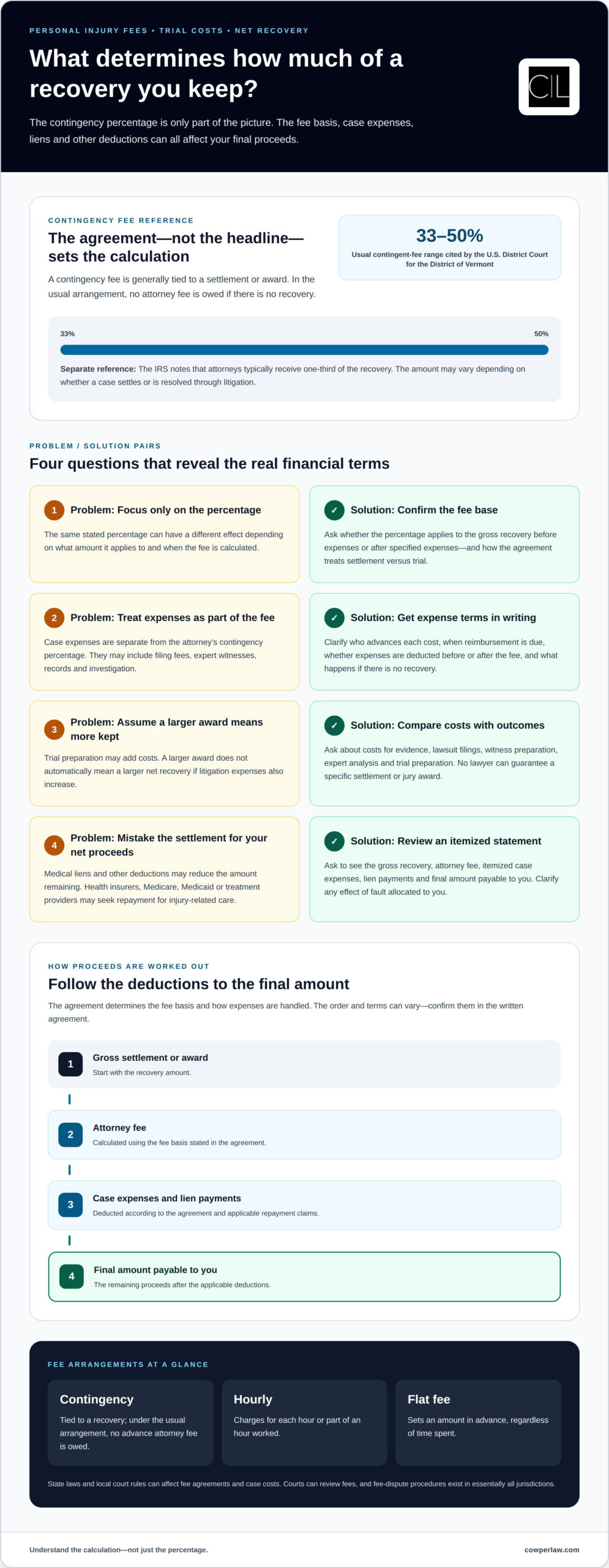
Your fee agreement determines how the law firm calculates its share of a settlement or award. Some agreements apply the contingency percentage to the gross recovery before deductions. Others calculate it after specified case expenses. That difference affects the amount left for you, so focus on the calculation method, not just the percentage. The agreement should explain the fee basis and when expenses are deducted.
Think of a settlement amount as a sequence of deductions. First, the agreement determines the attorney’s fee base. Then case expenses may be deducted according to its terms. Medical liens can also reduce the proceeds because health insurers, Medicare, Medicaid, or treatment providers may seek repayment for injury-related care. Any fault allocated to you may further affect your net recovery.
Ask the law firm to show how each deduction would appear on a written settlement statement. Look for the gross recovery, attorney fee, itemized case expenses, lien payments, and final amount payable to you. Clarify whether the fee is calculated before or after expenses, and how the agreement treats a settlement reached before litigation versus an award after trial. These terms help you understand what a settlement means in practical terms.
Liability and the evidence surrounding the accident can shape negotiations and the recovery available, while deductions determine what remains afterward. A settlement offer is not the same as your net proceeds. Before accepting one, understand the fee calculation and any outstanding liens, then weigh the resulting amount against the case’s documented losses. For guidance on injury litigation and the financial terms of representation, discuss your injury case.
Match the lawyer’s experience to the injury, evidence, and legal issues your case presents. A traumatic brain injury, for example, may require a different investigation from an injury involving a medical device. Relevant experience helps counsel identify which records, experts, and arguments may matter when seeking compensation.
Use a consultation to understand how the attorney approaches cases like yours. Ask about prior work involving comparable injuries, what evidence typically shapes liability, and how the lawyer would prepare if negotiations fail. An experienced trial lawyer should explain the strategy clearly, without promising an outcome or relying on a broad claim of success.
These questions reveal whether the lawyer’s experience fits the demands of your case. A local attorney may also understand state personal-injury laws and the practices of nearby courts. That knowledge can inform decisions about evidence, negotiations, and whether pursuing a trial serves your interests.
You can consult multiple attorneys before choosing representation. Compare how each explains your case’s strengths, challenges, likely expenses, and possible routes to compensation. Notice whether the discussion addresses your specific injury instead of treating every accident as the same. A lawyer who connects the medical details to the legal strategy gives you a clearer basis for evaluating the proposed approach and the attention your case may receive.
Experience is more than a résumé entry. It should show in the questions the lawyer asks, the evidence they identify, and how they explain your options. Choose counsel whose relevant case experience and trial approach align with the outcome you need to pursue.
Your next step is to connect the facts of your injury with the legal experience your case demands. Knowing how to afford a top trial lawyer for my injury also means looking beyond the fee: consider whether the lawyer can explain the case’s key issues, prepare for resistance, and keep your priorities central.
Cowper Law represents people in medical device injury litigation, including spinal cord stimulator lawsuits, and handles wrongful death litigation. If one of these situations reflects what you or your family are facing, a conversation with the firm can help clarify how its work relates to your circumstances and what moving forward could involve. When considering how to afford a top trial lawyer for my injury, weigh relevant experience and fit alongside the fee terms.
You deserve a clear conversation about your case, your questions, and the path ahead. Discuss your injury case with Cowper Law, and take the next step with a determined advocate beside you.
Personal injury lawyers commonly charge 33 1/3% to 40% of a recovery, and some agreements may set a different percentage. The fee can vary based on the agreement’s terms and whether the case settles or proceeds through litigation. For example, compare the percentage that applies before a lawsuit is filed with any percentage stated for trial or appeal.
Yes. A lawyer can challenge a denial by reviewing the insurer’s reasons, gathering additional evidence, and negotiating on your behalf. If the denial disputes how an injury occurred, for example, supporting records or witness evidence may help address that issue. The lawyer can assess the stated basis for the denial and explain your options for pursuing compensation.
With Cowper Law’s contingency-based representation, the firm collects legal fees only upon a successful recovery of damages. You don’t pay the firm’s legal fee in advance under this arrangement. Case expenses are separate, so review the agreement to understand who advances them and how they are handled if the case ends without a recovery.
Look for relevant experience, clear explanations, and a strategy grounded in the facts of your injury. During a consultation, notice whether the attorney identifies specific evidence and explains how it could support your claim. Ask who will handle key decisions, how updates are communicated, and whether the lawyer can describe trial preparation in plain language without promising a particular result.
The final distribution may include the attorney’s fee, case expenses, medical liens, and repayment claims from organizations that paid for injury-related care. The exact deductions depend on your agreement and obligations connected to your treatment. Before approving a distribution, review the settlement statement and ask the law firm to explain each listed payment, who receives it, and how it affects your net proceeds.
A contingency fee is an attorney’s fee tied to obtaining a recovery for the client. The agreement explains how the fee is calculated and what events trigger payment. This arrangement can make legal representation accessible without an advance attorney fee, but it’s important to distinguish the fee from case expenses. Read the terms carefully so you understand the financial arrangement before representation begins.