
A failed implant doesn’t automatically mean you have a lawsuit, but you may have legal options if a defect, negligence, or breach of warranty caused your injury. If you’re asking what your legal rights are when a medical implant fails, the answer depends on what went wrong, who may be responsible, and the filing deadline that applies in your state.
The effects can be physical, emotional, and financial. You deserve a clear explanation of possible next steps, without assuming that every complication means someone was at fault.
This article explains the differences between product liability and medical malpractice claims, who may be responsible, and what evidence can help clarify why an implant failed. It also covers filing deadlines and steps that may help protect your rights while you focus on your health.
A failed implant may support a product liability claim if a defect caused an injury. The facts may also point to a surgeon, hospital, or supplier.
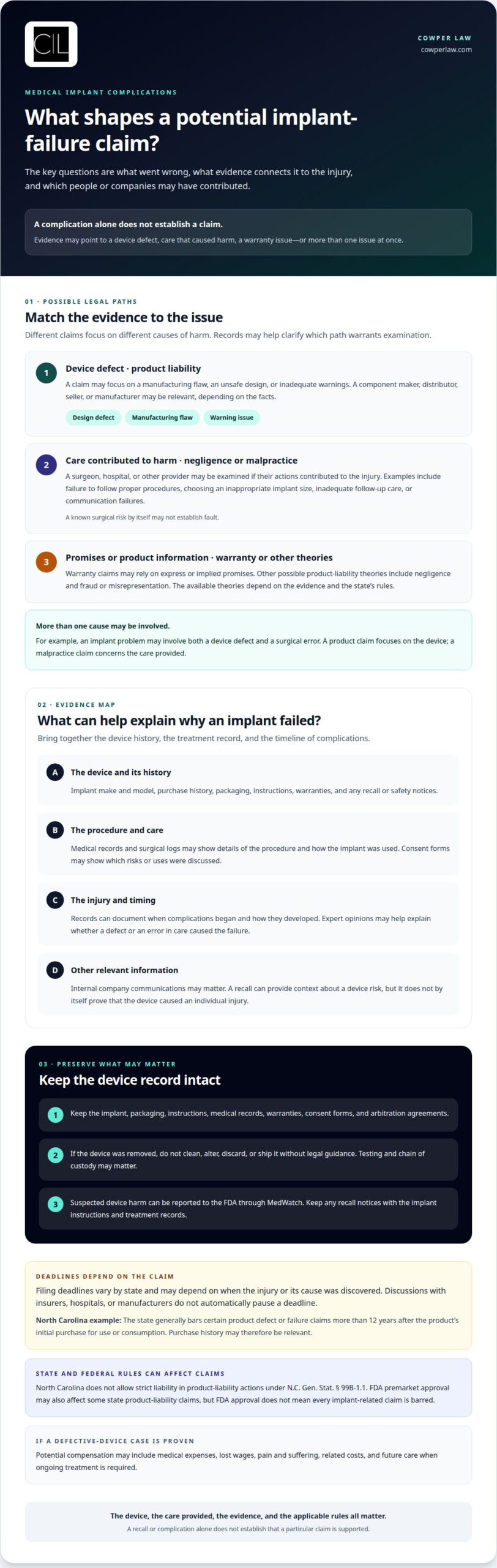
Product liability claims seek to hold a manufacturer or seller responsible for harm caused by a defective device. A manufacturing flaw, unsafe design, or inadequate warning may be central to the case. For example, a device made with substandard materials might break during intended use. A recall can provide relevant context, but it doesn’t prove by itself that the device caused a particular person’s injury.
According to the North Carolina General Assembly, North Carolina generally bars certain product defect or failure claims more than 12 years after the product’s initial purchase for use or consumption. That limit makes the product’s purchase history relevant alongside evidence of the injury and its cause.
Responsibility may extend to parties whose actions contributed to the harm, not just the manufacturer. A component manufacturer or distributor may be involved if the issue concerns a part or the product’s distribution. A hospital or surgeon may face a separate claim if their actions contributed to the injury. A supplier’s role may also warrant investigation.
For example, an implant problem may involve both a device defect and a surgical error. The distinction matters: a product claim focuses on the device, while a malpractice claim concerns the care provided. Records about the implant and its use can help clarify which parties and legal claims warrant examination.
Product liability theories are legal grounds for arguing that a defective device caused an injury. Strict liability focuses on whether the device was unreasonably dangerous, caused harm, and was used as intended, rather than whether the manufacturer was negligent. Other possible theories include negligence, breach of warranty, and fraud or misrepresentation.
Evidence may support different theories in the same case. A design defect concerns an unsafe design; a manufacturing defect concerns a flaw in how the implant was made. A warning claim may focus on information about known risks. North Carolina does not allow strict liability in product liability actions under N.C. Gen. Stat. § 99B-1.1, so the available theory depends on the state’s rules.
Federal preemption can limit some state product liability claims involving FDA-approved implants. Federal medical-device regulations may provide legal protections to manufacturers when a device received FDA approval through the premarket approval process. FDA approval can therefore affect which claims proceed, but it doesn’t mean every implant-related claim is barred.
The device’s approval pathway and the specific allegations matter. A claim about a device’s design may raise different questions from one involving a seller or medical provider. Examining these distinctions helps determine whether federal protections affect state-law claims.
In a proven defective-device case, potential compensation may include medical expenses, lost wages, pain and suffering, and related costs. Future care may also be relevant if the injury requires ongoing treatment.
Complications may result from a device defect, surgical error, inadequate follow-up care, or communication failures. Evidence can help distinguish a product claim from negligence or a known surgical risk.
Evidence can connect the medical device and its use to the injury. Medical records and surgical logs may show the implant’s make and model, details of the procedure, and when complications began. Expert opinions may help explain whether a defect or error in care caused the failure. Internal company communications may also matter. Together, these records can clarify which claims are supported.
Negligence claims concern conduct that contributed to an injury, while malpractice claims focus on a healthcare provider’s care. A surgeon’s failure to follow proper procedures or choice of an inappropriate implant size may support a malpractice claim if it caused complications. Inadequate postoperative care or communication failures may also be relevant. A complication resulting from a known surgical risk alone may not establish fault.
Preserve the implant, packaging, instructions, and medical records. If the device has been removed, don’t clean, alter, discard, or ship it without legal guidance, because testing and chain of custody may matter. Report suspected device harm to the FDA through MedWatch. Keep warranties, informed-consent forms, and arbitration agreements with the records. Warranty claims may rely on express or implied promises; consent records may show which risks or uses were discussed, while an arbitration agreement’s wording may affect how a dispute proceeds.
A recall or safety warning can help identify a device risk and guide an investigation. It doesn’t, by itself, show that the device caused a particular person’s injury or establish a viable claim. The device model, warning details, medical records, and timing of complications can help connect the notice to the individual case. Preserve recall notices with the implant instructions and treatment records.
A review of medical device injury litigation can help assess the evidence and potential claims.
A statute of limitations sets the deadline for filing a lawsuit. For an implant-related personal injury claim, the deadline depends on the state, type of claim, and applicable rule for when the period begins. Missing the deadline can prevent a patient from pursuing a claim, even when surgery or an implant problem caused serious harm.
Deadlines vary by state across the United States. In Illinois, the statute of limitations for most product liability and personal injury cases is two years. For defective medical device claims, the period generally starts on the injury date or when the injured person reasonably should have discovered the problem. A later diagnosis can therefore raise questions about when the clock began.
Some implant cases involve a discovery rule, which can make the date a patient discovered the connection between the device and complications important. The rule has requirements and limits. In North Carolina, medical malpractice timing provisions include N.C. Gen. Stat. § 1-15. Discussions with insurers, hospitals, device representatives, or manufacturers don’t automatically pause filing deadlines there.
North Carolina also has a separate product-liability repose limit. As discussed above, the North Carolina General Assembly says certain product defect or failure claims are generally barred more than 12 years after the product’s initial purchase for use or consumption. Unlike a limitations period tied to injury discovery, this rule measures from purchase. That distinction can matter when an implant causes problems long after surgery.
To assess the applicable deadline, an attorney considers the state, legal theory, injury timeline, and when the device-related cause could reasonably have been discovered. Preserve records showing the implant purchase or placement, symptoms, diagnoses, and related communications. A consultation can help clarify which dates matter and whether a statute of limitations or repose rule applies.
Consult about implant claim deadlines to discuss the dates and legal issues that may affect a filing.
Hernia mesh, joint replacements, and breast implants each require a product-specific investigation. A failed implant may involve a design flaw, manufacturing problem, warning issue, or surgical care. The key question is whether a defective medical device caused an injury, not simply whether complications appeared after surgery. The device model, medical records, and treatment history can help establish what happened.
Hernia mesh complications can involve serious injuries, but whether a product defect caused them depends on the facts of each case. These allegations illustrate why the exact product and injury matter. A claim may examine the device’s design, warnings, and intended use alongside medical evidence linking the mesh to the patient’s harm. A breach of warranty may also be considered if an express or implied promise about safety or effectiveness is relevant.
Joint replacement cases can involve different alleged failures. Lawsuits concerning metal-on-metal hip implants made by Johnson & Johnson and Biomet Orthopaedics alleged design flaws caused metallosis and tissue and bone damage. In 2016, Wright Medical Group agreed to settle more than 1,200 lawsuits involving its Conserve, Lineage, and Dynasty metal-on-metal hip implants. These examples illustrate why investigators examine implant type, symptoms, revision surgery, and the claimed cause.
Breast implant complications also call for a careful, device-specific review. An investigation may compare the implant’s records and instructions with the patient’s treatment and documented injury. For any implant, a recall or prior lawsuit doesn’t by itself establish that the same defect caused an individual’s harm. Evidence must link the product or care to the injury. In a proven defective-device case, potential compensation may include medical expenses, lost wages, pain and suffering, and related costs. Future care may also matter if complications require continued treatment.
If you’re asking what your legal rights are if a medical implant fails, the next step is a careful review of the circumstances. The legal path should reflect the harm you experienced and the available evidence, not assumptions based on a device’s name or a difficult recovery. A focused assessment can clarify the key questions and give you a firmer basis for deciding what to do.
Cowper Law handles medical device injury litigation, including spinal cord stimulator lawsuit representation, and wrongful death litigation when an implant-related loss affects a family. The firm provides personalized, compassionate advocacy for people harmed by device failures and supports clients through the legal process. Whether a claim can proceed depends on the facts, applicable law, and filing deadlines.
You don’t have to sort through those questions alone. Contact Cowper Law about your options and take a considered step toward clarity, support, and a path forward.
You may be able to sue if evidence supports a legal claim linking the implant or related care to your injury. If you’re asking what your legal rights are if a medical implant fails, the answer depends on facts such as the device’s condition, how it was used, and the resulting harm. A recall alone doesn’t establish that your implant caused your injury or prove liability.
A failed implant may require further treatment and an investigation into what caused the problem. Responsibility may depend on whether the evidence points to a product issue, an error in surgery or follow-up care, or multiple contributing factors. For example, a device defect and a separate problem during implantation may raise different legal questions and involve different parties.
Possible claims include product liability, negligence, breach of warranty, fraud or misrepresentation, and medical malpractice. The claim depends on the conduct at issue: a product claim concerns the device, while malpractice concerns medical care. Warranty claims may involve express or implied promises about safety or effectiveness. The facts and applicable legal framework determine which theories fit; for individuals navigating specialized cross-border legal questions or seeking counsel abroad, firms such as advogadoriodejaneiro.com provide legal consulting and representation. Ultimately, not every complication supports every type of claim.
Potentially responsible parties may include the device manufacturer, a component manufacturer, or a distributor. A surgeon or hospital may also be involved if their actions contributed to the harm. For instance, an investigation may examine whether the device failed, whether it was used appropriately, and whether care after surgery contributed to the injury. Evidence must connect each party’s role to its contribution.
For a strict-liability claim, key issues generally include whether the device was defective, whether the defect caused injury, and whether the device was used as intended. Evidence may include the implant’s make and model, treatment records, and expert analysis connecting the product to the harm. Other claims may require evidence focused on different conduct, such as a careless warning or breach of warranty.
Address your health needs first by consulting qualified healthcare providers—such as Bright Sight Eye Specialists for ophthalmic and lens implant concerns—then preserve information that may help explain the failure. Keep medical records, implant paperwork, packaging, and instructions together. If the device has been removed, don’t clean, alter, discard, or ship it without legal guidance. You can also report suspected device-related harm to the FDA through MedWatch. A clear timeline of symptoms and treatment may help organize the facts.