
The word “breast” can be misleading: BIA-ALCL is a lymphoma involving immune-system cells, not cancer of breast tissue. A BIA-ALCL cancer lawsuit may seek compensation for medical treatment, implant costs, lost wages, and pain, suffering, or emotional trauma. The evidence and losses in each case shape what damages may be pursued.
A BIA-ALCL cancer lawsuit may raise questions about treatment costs, lost income, and whether a breast implant contributed to the diagnosis. This article explains the condition, potential compensation, and how evidence and legal deadlines can affect a claim. It also outlines how breast implant litigation works and what to consider before taking a legal next step.
BIA-ALCL is a type of non-Hodgkin lymphoma involving immune-system cells, not cancer of breast tissue. Understanding possible symptoms, timing, and diagnostic steps can help patients recognize when to seek medical evaluation.
Look for new breast swelling, pain, a lump, or asymmetry after surgical sites have fully healed. These changes can prompt evaluation, but symptoms alone don’t establish a diagnosis. BIA-ALCL has been reported as early as two years after implantation, and symptoms may first appear many years after surgery. The median time from implant placement to diagnosis was 8 years.
BIA-ALCL has been associated with both silicone gel and saline implants. The condition has been linked more often to textured implants than to smooth-surface implants. Keep implant records and note when symptoms begin; these details can help clinicians assess the implant and surrounding tissue.
Symptoms alone cannot confirm BIA-ALCL; diagnosis requires medical evaluation. The FDA recommends that patients with symptoms see a doctor and recommended prompt testing of breast implant scar tissue to rule out or confirm the disease. A biopsy of one or more lesions may help confirm a diagnosis.
For diagnosed BIA-ALCL, FDA guidance is summarized as recommending removal of the textured implant and surrounding scar tissue. The course and outcome depend on the disease and care received, so symptoms alone cannot predict a specific result. Timely evaluation helps establish a diagnosis and inform treatment.
For patients with a recalled implant style but no BIA-ALCL symptoms, the FDA recommends against removing the implant solely because of the recall. Watch for changes such as swelling, pain, a lump, or asymmetry, and seek medical evaluation if symptoms develop. A recall alone does not mean a patient has cancer.
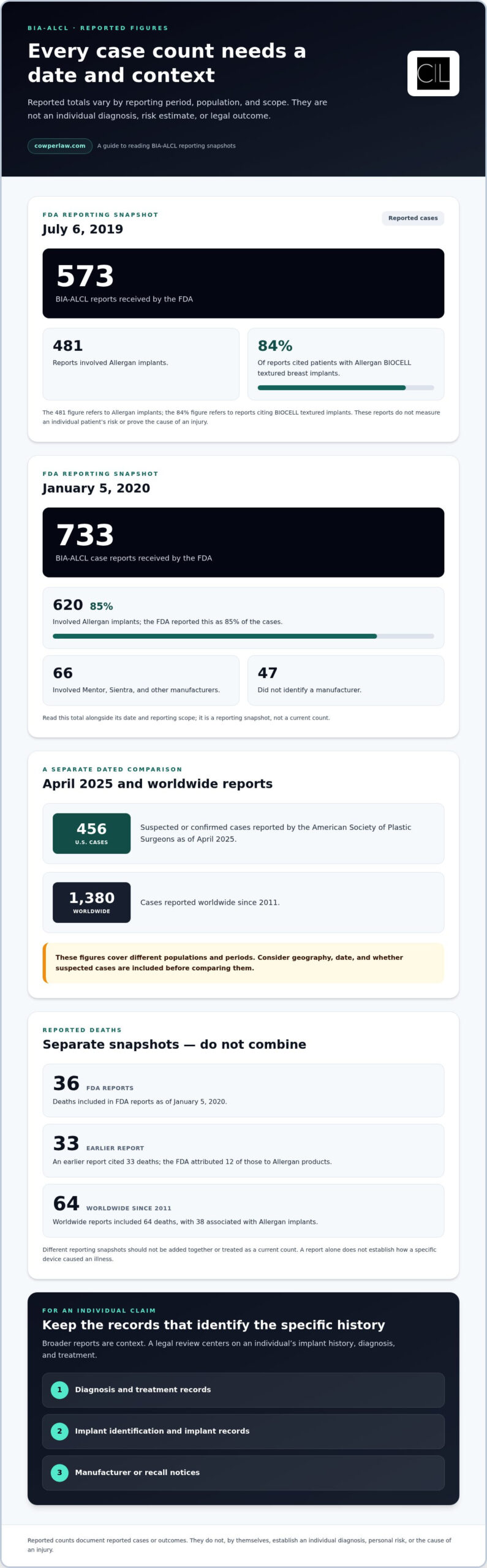
Reported totals vary depending on the date and reporting set, so each figure needs context. These numbers describe reports and cases, not an individual patient’s diagnosis or legal outcome.
On July 6, 2019, the FDA had received 573 BIA-ALCL reports; 481 involved Allergan implants. In its July 2019 safety communication, 84% of reports cited patients with Allergan BIOCELL textured breast implants. These figures show the reported association with BIOCELL devices, but don’t measure an individual patient’s risk or prove the cause of an injury.
By January 5, 2020, the FDA had received reports of 733 cases. Of these, 620, or 85%, involved Allergan implants; 66 involved Mentor, Sientra, and other manufacturers, while 47 didn’t identify a manufacturer. Read each total alongside its date and reporting scope.
The FDA’s reports as of January 5, 2020 included 36 deaths. An earlier report cited 33 deaths; the FDA attributed 12 of those to Allergan products. These totals come from different reporting snapshots, so they shouldn’t be combined or treated as a current count.
Worldwide, reports since 2011 included 64 deaths, with 38 associated with Allergan implants. A report records a case or outcome; it doesn’t, by itself, establish how a specific device caused an illness.
For another dated comparison, the American Society of Plastic Surgeons reported 456 suspected or confirmed U.S. cases as of April 2025. Worldwide, 1,380 cases had been reported since 2011. These figures cover distinct populations and periods, so comparing them requires attention to geography, date, and whether suspected cases are included.
For a patient assessing a possible claim, preserve diagnosis and treatment records, implant identification, and recall notices. Those materials help connect a specific device and injury to the reported history. Learn about legal options for device-related injuries as you consider what the records may show.
FDA findings and court records provide context, but an individual claim centers on the patient’s implant history and diagnosis.
The FDA has stated that it received 660 medical device reports about BIA-ALCL, including 467 confirmed unique reports. Nine reports involved patient fatalities. These reports document reported events; they are not a count of every affected patient or, by themselves, proof that a particular manufacturer caused an injury.
For a legal review, preserve implant identification, medical records, and manufacturer or recall notices. These details can help identify a specific device and put broader reporting totals in context.
BIA-ALCL has been associated with both saline and silicone gel breast implants, but reports have linked it more often to textured than smooth-surface implants. The FDA estimated the lifetime risk associated with textured implants at between 1 in 3,817 and 1 in 30,000 in March 2018. That range does not establish an individual patient’s likelihood of illness.
At the time of the recall, FDA data indicated that Allergan BIOCELL products had an estimated sixfold higher risk than other textured implants. Implant type, surface, and manufacturer are important details when assessing a possible device-related injury.
Legal claims may examine whether a device was defectively designed, inadequately tested, or sold without sufficient warnings. On March 19, 2021, the U.S. District Court for the District of New Jersey allowed manufacturing defect, failure-to-warn, express warranty, and negligence claims to proceed in Allergan MDL 2921, while dismissing certain theories on federal preemption grounds. The ruling reflects litigation claims, not a finding that every allegation is true.
Coverage for BIA-ALCL-related care through Medicaid varies by state. Patients can organize treatment records and insurance documents to understand medical expenses and preserve information relevant to a claim. A review of breast implant injury records can help clarify which device details and alleged warnings matter.
Compensation sought in a BIA-ALCL cancer lawsuit may include treatment expenses, lost income, and other personal harm associated with the diagnosis. There is no fixed settlement or judgment amount for every patient. Evidence should connect the breast implant, the lymphoma diagnosis, and the claimed losses. Records of textured breast implants, surgery, and treatment can help show that connection.
Claims can include several categories of harm:
Each type of loss needs supporting evidence. Treatment records and bills can document medical care, while pay records can help establish lost income. An account of pain or emotional distress can add context to clinical records. Reports about textured implants provide background, but they do not replace evidence of an individual diagnosis and its effects.
Breast Implant Cancer Advocates says a settlement or judgment may help a family with ongoing medical-care costs when evidence shows that the cancer diagnosis resulted from breast implants. The records should document the diagnosis, implant history, treatment, and resulting expenses. Organizing these materials can make claimed losses clearer and easier to evaluate.
Start by keeping implant records, diagnostic documents, treatment bills, and wage information together. Add records that show how care has affected daily life and continuing medical needs. These materials can help frame the compensation sought, rather than relying on general reports or assumptions. For guidance on pursuing a claim involving implant-related harm, discuss your breast implant injury case.
Cowper Law represents individuals harmed by medical devices, including patients pursuing breast implant litigation. If you have a BIA-ALCL diagnosis and believe a breast implant may be connected, legal guidance can help you understand how your diagnosis, implant records, treatment, and related losses may support a claim.
Medical device cases can involve complex questions about product design, warnings, and evidence linking a device to an injury. Cowper Law provides Medical Device Injury Litigation, representing individuals harmed by device failures as they pursue accountability and justice. Consider discussing a claim if you have concerns about an implant-related injury and want to understand potential legal next steps.
To discuss your situation, contact Cowper Law or visit cowperlaw.com.
A legal claim can feel like another burden alongside diagnosis and treatment. You deserve time to understand your options, ask direct questions, and decide what comes next without pressure. For a BIA-ALCL cancer lawsuit, a useful next step is to discuss your records and concerns with a lawyer and learn about potential legal options.
Cowper Law handles Medical Device Injury Litigation, including cases involving alleged harm from medical devices. Its work also includes Spinal Cord Stimulator Lawsuit Representation and Catastrophic Injury Legal Services. These offerings reflect the firm’s focus on helping people pursue accountability after serious harm, while each matter depends on its own evidence and circumstances.
You don’t have to have every answer before starting a conversation. If you’re ready to discuss your situation and possible next steps, contact Cowper Law. Taking one informed step can help bring greater clarity to the road ahead.
BIA-ALCL is short for breast implant-associated anaplastic large cell lymphoma, a lymphoma linked to breast implants. The World Health Organization characterized it as a type of T-cell lymphoma in 2016. This name describes a cancer of immune-system cells, rather than a cancer that begins in breast tissue. The distinction helps explain why a breast implant may be relevant even though the disease isn’t breast cancer.
Breast implant-associated anaplastic large cell lymphoma is a rare form of non-Hodgkin lymphoma associated with breast implants. “Associated” describes a reported connection; it does not mean every implant causes the disease. Diagnosis and implant history matter in an individual evaluation. Patients can gather implant cards, operative records, and pathology reports to give clinicians useful details about the device and tissue findings.
Warning signs can include new breast swelling, a lump, pain, or a change in breast shape after the surgical site has healed. Note which side is affected, when the change began, and whether it persists or worsens. These details can help you describe symptoms at an appointment. A symptom log cannot diagnose lymphoma, but it can help you report changes accurately.
Yes. On July 24, 2019, Allergan announced a worldwide recall of specific textured breast implants and tissue expanders, and the FDA designated the BIOCELL recall Class 1. The FDA recommendation for people with recalled styles who have no BIA-ALCL symptoms is not to remove their implants. Keep recall notices and device-identification records, and discuss any new symptoms with a medical professional.