
What if the device designed to keep you alive becomes the greatest threat to your safety? For thousands of patients, the Tandem t:slim X2 was supposed to offer freedom, precision, and peace of mind. However, the rise of the Tandem t:slim X2 insulin pump lawsuit highlights a darker reality where software failures and the dreaded "Malfunction 16" leave families facing life-threatening hyperglycemia. We know your trust has been shattered. You relied on this technology to manage your health, and when it failed, the consequences were personal, frightening, and costly.
This article provides a comprehensive 2026 update on the litigation landscape, exploring the legal hurdles of federal preemption and the impact of the Class I recall. You'll learn how to navigate the complexities of medical device litigation and what steps are necessary to protect your rights after a catastrophic failure. We examine the latest data on speaker malfunctions, analyze the recent court rulings shaping the legal landscape, and outline a clear path toward holding manufacturers accountable. We are your fierce, dedicated, and relentless advocates, standing by you as you seek the justice and stability you deserve.
The legal environment surrounding the Tandem t:slim X2 insulin pump lawsuit has reached a critical juncture as we move through 2026. Thousands of patients across the nation have reported device failures that transformed a management tool into a liability. These incidents aren't mere technical glitches. They represent a fundamental breach of the promise of safety. A review of the Tandem Diabetes Care company profile reveals a corporation that has expanded rapidly, yet this growth has been shadowed by allegations of negligent design and software instability. By August 2025, reports confirmed at least 700 adverse events and dozens of injuries specifically linked to hardware malfunctions. The scale of this crisis has forced a shift in how these cases are handled in the federal court system.
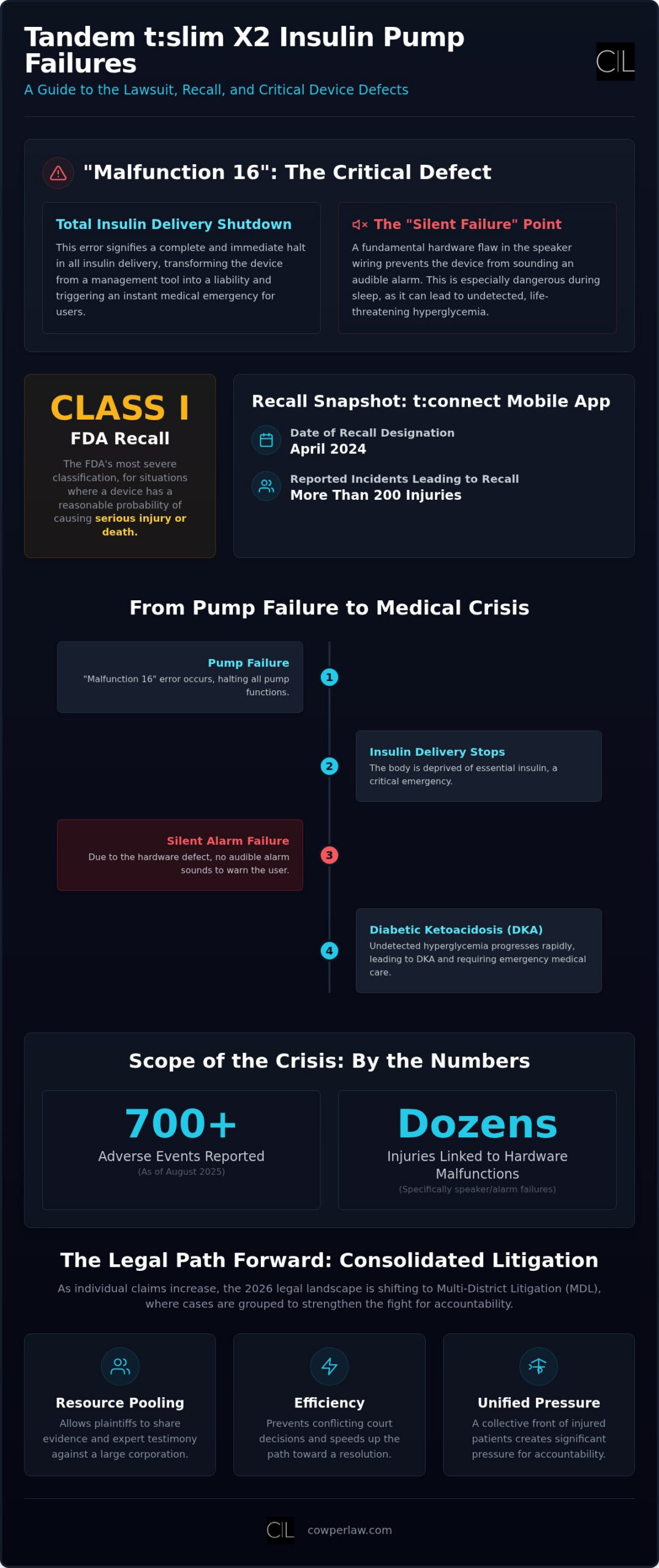
The FDA doesn't issue a Class I recall lightly. It's the agency's most severe classification, reserved for situations where there is a reasonable probability that using the device will cause serious adverse health consequences or death. In April 2024, the FDA designated the recall of the t:connect mobile app as Class I after more than 200 injuries were reported. This designation is a cornerstone of the Tandem t:slim X2 insulin pump lawsuit. It provides objective, federal validation that the device's failure was not an isolated incident but a systemic danger. While the company may frame these issues as voluntary corrections, a Class I status signals to the legal community that the risks were both real and catastrophic. It serves as foundational evidence that the manufacturer distributed a device that was inherently unsafe for its intended use. Patients harmed by other implanted devices subject to FDA Class I recalls, such as those pursuing a defective pacemaker lawsuit, face a similarly challenging legal landscape where this federal designation becomes critical evidence of manufacturer negligence.
As individual claims mount, the 2026 legal landscape is shifting toward consolidated litigation. This often takes the form of Multi-District Litigation (MDL), where cases from across the country are grouped together to streamline the discovery process. Understanding the class action vs individual lawsuit for medical device injuries is essential before deciding which path is right for your situation. This approach is vital for several reasons:
We are dedicated to ensuring your voice isn't lost in the shuffle of a large-scale proceeding. At Cowper Law, we treat every client as an individual with a unique story of survival. We combine the strategic power of national litigation with the personalized care of a boutique firm. We are your advocates, your defenders, and your partners in this fight for justice. Our trial-ready approach ensures that we are prepared to take on the most complex medical device failures, providing the stability and strength you need during a chaotic time.
Malfunction 16 isn't just a technical error code; it's a complete breakdown of the safety net patients rely on every hour of the day. At its core, this malfunction triggers a total halt in all insulin delivery. For a person with Type 1 diabetes, this is an immediate medical emergency. The defect is particularly insidious because it involves both physical hardware failures and software instabilities that leave users in the dark. While the company has attempted to address these issues through digital patches, many argue that a software fix cannot resolve a fundamental hardware flaw. This distinction is a primary driver of the current Tandem t:slim X2 insulin pump lawsuit.
The most dangerous aspect of Malfunction 16 is the failure of the pump's internal speaker. Physical defects in the wiring can prevent the device from sounding an audible alarm when a delivery error occurs. This creates a "silent" failure point. If a pump stops delivering insulin while a patient is asleep, and the alarm remains silent, the risk of diabetic ketoacidosis (DKA) becomes a near certainty. It's a terrifying scenario where the very device meant to provide security becomes a silent threat. Unlike the earlier t:slim X2 software defect recall, which focused on unintended boluses, this hardware failure removes the user's ability to respond to a crisis. As of August 12, 2025, data confirmed 700 adverse events and 59 injuries specifically linked to this speaker wiring defect.
The software component of this litigation centers on the t:connect mobile app. A critical bug in the iOS version of the app caused it to crash and relaunch repeatedly, leading to extreme battery depletion. As of April 15, 2024, more than 200 injuries were documented due to this software failure. When the pump's battery drains unexpectedly, the system shuts down, often without sufficient warning. This rapid depletion forces patients into a desperate scramble for alternative insulin delivery methods, often in the middle of the night. Documenting these crashes is essential for anyone considering legal action.
We understand the financial and emotional toll these malfunctions take on a family. If you've experienced a life-threatening shutdown, seeking legal advocacy that understands the intersection of medical technology and corporate negligence is a vital step toward recovery. We are here to ensure that your experience is not dismissed as a simple technical glitch. We stand ready to hold manufacturers accountable for the quality of the life-saving tools they provide.
When an automated system fails, the human body pays the ultimate price. For families navigating the Tandem t:slim X2 insulin pump lawsuit, the failure of a device is not a minor inconvenience; it is a catalyst for physical and financial devastation. Because pump therapy relies on a constant stream of short-acting insulin, any interruption leaves the patient without a safety net. Within hours, blood sugar levels skyrocket, and the body begins to starve for energy at a cellular level. This rapid onset of hyperglycemia is the first stage of a cascade that can lead to permanent injury or death.
Diabetic Ketoacidosis (DKA) is a life-threatening medical emergency that occurs when a lack of insulin forces the body to break down fat for fuel, creating a toxic buildup of acids called ketones in the blood. The progression is swift and unforgiving. Patients report a terrifying sequence of thirst, nausea, and confusion that can quickly escalate to respiratory distress and organ failure. Pump-induced DKA is uniquely dangerous because, unlike those on manual injections, pump users don't have long-acting insulin in their systems to buffer a delivery stoppage. When the "Malfunction 16" error silences the alarm, the patient may not even know they're in danger until they're already in a state of crisis.
The damage from a severe insulin delivery failure often extends far beyond the hospital discharge papers. Surviving an episode of DKA can result in neurological impact, chronic kidney issues, or cardiovascular strain. Beyond the physical toll, there's a profound psychological burden. We see clients struggling with alarm fatigue, a total loss of confidence, and a constant state of hyper-vigilance. This creates a life defined by chronic anxiety, fear, and exhaustion. At Cowper Law, we frame these human costs for a jury to ensure they understand that the injury isn't just a medical bill; it's a fundamental loss of peace of mind.
The financial impact is equally staggering. A single emergency room visit followed by an ICU stay can result in tens of thousands of dollars in medical debt. When you add lost wages, the cost of replacing a defective device, and the expense of ongoing specialized care, the burden becomes unbearable. We're committed to lifting this weight from your shoulders. We handle the complex legal strategy so you can focus on your recovery and your family. Our team is here to fight for the compensation that covers your past bills and secures your future health. We are your advocates, your shield, and your voice against the corporations that failed you.
Transitioning from a patient who received a recall notice to a claimant in a Tandem t:slim X2 insulin pump lawsuit requires a shift in perspective. You are no longer just a user of a medical device; you are a survivor of a corporate failure. Eligibility for a legal claim isn't determined by the recall alone but by the harm that the device caused to your life, health, and family. We are here to help you navigate this transition with a process that is methodical, thorough, and uncompromising.
The most important rule of medical device litigation is simple: do not return your pump to the manufacturer. Tandem may contact you offering a replacement or requesting the defective unit for "testing." While you need a working pump, you must keep the failed device in your possession. Returning it gives the company control over the primary evidence. Additionally, you should export your t:connect data immediately. Digital logs can be overwritten or lost during software updates, so capturing that data now is essential. Finally, gather every piece of paper from your medical treatment, including ER discharge summaries, lab results showing ketone levels, and records of lost wages.
We represent individuals who have suffered significant physical injuries due to pump failure. This includes patients who experienced DKA, respiratory failure, or long-term organ damage. We also stand as fierce advocates for families who have lost a loved one due to a device malfunction. Wrongful death claims are a vital part of holding corporations accountable for the most tragic outcomes. If you are unsure if your experience qualifies, you can learn more about how to join a medical device class action lawsuit through our detailed guide. We are ready to review your story, evaluate your evidence, and provide the clarity you need. If you've been hurt by a defective pump, contact our team today to begin your journey toward justice.
Suing a medical device giant like Tandem Diabetes Care is a classic "David vs. Goliath" confrontation. These corporations possess vast financial resources, elite legal teams, and sophisticated public relations machines designed to minimize their liability and protect their bottom line. When you are recovering from a life-threatening episode of DKA or mourning a lost family member, the thought of engaging in a Tandem t:slim X2 insulin pump lawsuit can feel impossible. This is where expert advocacy becomes the deciding factor. We are the shield that protects you from corporate intimidation, the sword that fights for your recovery, and the voice that demands accountability.
Our approach is built on a foundation of intellectual strategy, relentless persistence, and deep-seated empathy. We don't just understand the law; we understand the complex mechanics of insulin delivery systems and the devastating ways they can fail. We operate on a contingency fee model to ensure that every victim has access to top-tier representation. This means you don't pay any legal fees unless we successfully recover compensation for you. This model levels the playing field, ensuring that your path to justice is never blocked by a lack of financial resources during an already chaotic time.
We are not a high-volume practice that treats clients like file numbers. Cowper Law is a mission-driven firm that functions as a "Compassionate Warrior" for those harmed by corporate negligence. We provide the stability and strength you need to face powerful entities. Our history is defined by a refusal to yield and a constant state of support for our clients. By acting as a Medical Device Injury Lawyer: Relentless Advocacy, we handle the complex litigation while you focus on healing. We take the burden of the "Goliath" off your shoulders, using our expertise to build a trial-ready case that reflects the true human cost of your injury.
The journey toward justice begins with a single, confidential conversation. During your free initial consultation, we will listen to your story, evaluate your evidence, and provide a clear roadmap for your claim. We investigate the timeline of your pump failure, analyze your medical records, and preserve the digital data necessary to prove manufacturer negligence. While medical device litigation is a marathon rather than a sprint, we are your constant companions from the first filing to the final resolution. You aren't just hiring an attorney; you are gaining a partner who is personally invested in your peace of mind. Contact Cowper Law today for a confidential case evaluation.
The path to recovery after a catastrophic medical device failure is often paved with uncertainty and fear. Throughout this guide, we've explored the shifting landscape of the Tandem t:slim X2 insulin pump lawsuit, the critical dangers of Malfunction 16, and the essential steps for preserving evidence. You don't have to carry the weight of medical debt and emotional trauma alone. We are here to provide the specialized expertise in complex medical device litigation and national advocacy required to challenge corporate negligence with total certainty.
We are committed to a results-first approach, offering contingency-based representation where you pay nothing unless we win. This ensures that every individual can stand up to the industry giants that failed them. Your story matters. Your health is worth fighting for. We stand ready to act as your fierce defenders and loyal partners in this journey toward stability and peace of mind. You have the strength to move forward, and we have the skill to lead the way.
Begin Your Journey to Justice with a Free Case Evaluation
Litigation is active and evolving as of 2026. While individual claims are common, there is a distinct movement toward Multi-District Litigation (MDL) to consolidate cases. This allows victims to pool resources while maintaining their individual stories of harm. We are actively evaluating cases for those who suffered severe medical complications. A Tandem t:slim X2 insulin pump lawsuit focuses on holding the manufacturer accountable for systemic failures that put lives at risk.
Malfunction 16 is a critical hardware error rooted in faulty speaker wiring. When this error occurs, the pump ceases all insulin delivery immediately. Because the speaker is defective, the device often fails to sound the audible alarm that should alert the user to the shutdown. This creates a silent failure point that can lead to rapid hyperglycemia and life-threatening diabetic ketoacidosis, especially if the malfunction happens while the patient is sleeping.
Generally, a successful legal claim requires proof of physical or financial injury. If your device was recalled but you didn't experience a medical emergency like DKA or an ICU admission, you may not have a viable personal injury claim. However, we encourage anyone who experienced a frightening "near miss" to document the event. Our focus remains on those who suffered catastrophic health consequences or significant financial burdens due to device failure.
We operate on a contingency fee basis to ensure that justice is accessible to everyone. This means you pay nothing out of pocket to hire our firm. We only receive a fee if we successfully recover compensation for you through a settlement or trial verdict. This model removes the financial barrier between you and the elite legal representation you need to take on a massive medical device corporation.
Your immediate priority must be your health and safety. If you suspect a delivery failure, seek emergency medical care to prevent or treat DKA. Once you are stable, don't return the defective device to the manufacturer. Keep the physical pump, save any digital logs from the t:connect app, and contact a specialized attorney. Preserving the physical evidence is the most vital step in a Tandem t:slim X2 insulin pump lawsuit.
Compensation in these cases is designed to cover both economic and non-economic damages. This includes reimbursement for emergency room visits, ICU stays, and ongoing specialized care. You may also recover lost wages for time missed from work and compensation for pain, suffering, and emotional distress. We frame these human costs to ensure the jury understands the profound loss of peace of mind caused by a device you trusted.
The timeline for filing a claim is governed by the statute of limitations, which varies depending on your specific circumstances and location. However, medical device litigation is complex and requires significant time for investigation and evidence gathering. We recommend seeking legal counsel as soon as possible after an injury. Waiting too long can jeopardize your right to hold the manufacturer accountable for the harm you've endured.
Most medical device claims are resolved through settlements before reaching a courtroom. However, we prepare every case as if it's going to trial. This trial-ready approach gives us the leverage needed to negotiate from a position of strength. If the manufacturer refuses to offer a fair resolution, we are the fierce, dedicated advocates who will present your story to a jury to ensure your voice is heard. For a deeper understanding of how to navigate the choice between a class action vs individual lawsuit for medical device claims, our step-by-step legal guide can help you make an informed decision.