
What if the name of your hernia mesh isn’t enough to show whether you have a claim? A hernia mesh lawsuit attorney may need to review the full picture: your symptoms, implant and surgery records, and how your condition changed over time. If pain or other complications are disrupting daily life, it’s understandable to want clear answers about what may have caused them and what to do next.
Those answers can take careful investigation. An attorney may compare medical records and treatment timelines to assess whether the evidence supports a connection between the mesh and your injury. The review may also consider deadlines and other legal questions. No two cases are identical, and a device name alone doesn’t determine the outcome.
This article explains the factors an attorney may review, which records and timeline details can help, and what to expect as a claim is evaluated. Cowper Law represents individuals in hernia mesh litigation and provides personalized legal representation. The firm’s contingency-based fee model means legal fees are collected only upon successful recovery. Understanding what matters is a practical first step toward discussing your circumstances.
Persistent pain, infection, or another problem after hernia repair can raise difficult questions. A hernia mesh lawsuit attorney investigates whether the available facts may support a product liability claim. Symptoms and revision surgery can be important parts of that review, but neither alone proves that a mesh product was defective or that its manufacturer is legally responsible.
A medical complication is evidence of a problem, not proof of legal liability. Assessing a potential claim may require connecting the injury to the device while examining product evidence, the circumstances of surgery, and the law that applies.
Hernia mesh is used during some repairs to reinforce weakened tissue and provide support as the area heals. The overview of surgical mesh describes its medical uses, including hernia repair. After implantation, patients may report infection, ongoing pain, mesh migration or erosion, or a recurring hernia. These problems can have different causes. A clinician’s assessment is central to understanding what may be happening and what care is appropriate.
An attorney may examine how the injury developed, what mesh was implanted, and which records or other product evidence are available. The review may include the original repair and later treatment, such as imaging, specialist visits, or revision surgery. This helps identify whether the evidence raises questions about the product’s design, warnings, or other relevant issues, while also considering surgical and medical factors.
A possible claim is not a confirmed finding. A complication or a device name in medical records doesn’t by itself establish a defect, causation, or liability. Those questions depend on the complete medical history, evidence tied to the particular device, and applicable law. A useful review considers how the details fit together rather than treating one symptom or procedure as an automatic answer.
Cowper Law represents individuals in hernia mesh and other medical device injury litigation, with a personalized review of complex medical and legal questions. For a broader look at representation in device injury matters, the article Medical Device Injury Lawyer: Relentless Advocacy for the Harmed offers related context.
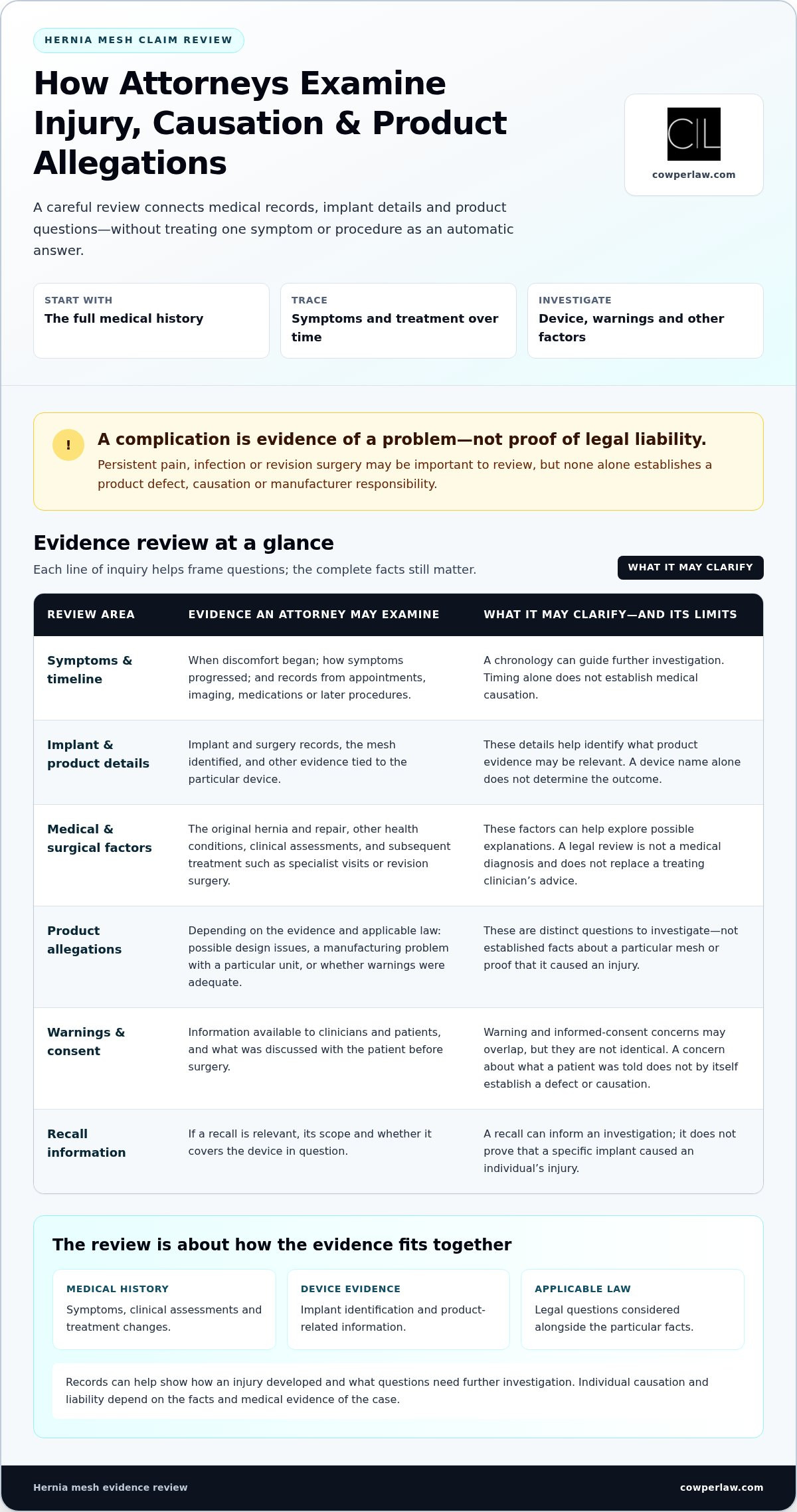
A careful review connects different kinds of evidence rather than relying on one symptom, procedure, or product name. A hernia mesh lawsuit attorney may compare when symptoms began, what the implant records identify, and how treatment changed over time. This helps explore possible explanations without assuming the mesh caused every problem that followed surgery.
Timing and medical documentation can help show how an injury developed, but neither tells the whole story on its own. Records from different visits may show when symptoms first appeared, how they progressed, and what clinicians considered when planning care.
An attorney may organize a timeline from the hernia repair through later appointments, imaging, medications, or additional procedures. For example, the records may help clarify whether discomfort began soon after surgery or appeared later, and whether symptoms changed after treatment. That chronology can guide further investigation, but it doesn’t establish medical causation by itself.
Other health conditions, the original hernia, and factors related to surgery may also matter. A legal review isn’t a medical diagnosis and shouldn’t replace advice from a treating clinician. Continue to follow your clinicians’ instructions while records are reviewed.
Product-related allegations raise distinct questions. Depending on the evidence and applicable law, an investigation may examine whether a mesh product was defectively designed, whether a particular unit may have had a manufacturing problem, or whether warnings about risks were adequate. These are questions to investigate, not established facts about any particular device.
Warning questions may involve what information was available to clinicians and patients. Informed consent concerns may focus on the discussion before surgery. These issues can overlap, but they aren’t identical: a concern about what a patient was told doesn’t by itself establish a product defect or prove that the device caused an injury.
If a product recall is relevant, an attorney may review its scope and whether it covers the device in question. A recall can inform an investigation, but it doesn’t prove that a specific implant caused an individual’s injury. The FDA analysis of hernia mesh complications provides background on reported risks and complications. Individual causation still depends on the facts and medical evidence of the case.
Cowper Law represents individuals in hernia mesh litigation and helps organize the medical and product questions involved in a potential claim. Learn more about Cowper Law’s hernia mesh litigation representation.
A case review helps clarify which legal questions may apply, but it can’t guarantee eligibility, a particular legal route, or recovery. An individual product liability claim is pursued on behalf of one person and relies on that person’s evidence and circumstances. Coordinated litigation, such as a multidistrict proceeding, groups similar cases before one court for certain pretrial steps. Individual claims generally retain their own facts and outcomes.
These options aren’t interchangeable. Shared proceedings may address common issues, but they don’t erase differences in medical history, injury, device records, or applicable law. The appropriate path depends on the claims and evidence, court procedures, and the status of relevant litigation. Procedural details can change. The FDA information on hernia mesh complications provides useful medical-device context, but it doesn’t decide whether an individual has a legal claim.
An initial review can help identify unanswered questions, organize available evidence, and discuss possible next steps. Use the questions below to understand what information may be relevant, not as a qualification checklist.
| Question | Records that may help | What an attorney may assess |
|---|---|---|
| What injury and treatment are documented? | Medical records, imaging, and procedure notes | The nature and timeline of the reported injury |
| Which mesh was implanted? | Implant stickers, operative reports, or device records | Whether the available records identify the product |
| What legal route may apply? | Treatment timeline and relevant case documents | Potential claims, court procedures, and current litigation status |
As you consider representation, look for a clear explanation of who will communicate with you, organize the investigation, and discuss significant litigation decisions. Cowper Law represents individuals in hernia mesh litigation and takes a personalized approach. Its contingency-based fee model means legal fees are collected only upon successful recovery. This fee arrangement doesn’t promise a particular recovery or case outcome.
If revision surgery is part of your history, Hernia Mesh Revision Lawsuit: 2026 Legal Guide offers related context. A careful review considers your circumstances rather than treating a procedure, product name, or participation in coordinated litigation as an automatic answer.
You don’t need a complete file before asking for a legal review. Start with records and details already available to you, and keep copies together. A hernia mesh lawsuit attorney can assess which materials may be relevant and whether additional records could clarify your history.
Medical documents can help show what was implanted, what symptoms followed, and how treatment developed. If you have them, preserve:
These records may help an attorney compare your recollection with the documented course of care. If something is missing, don’t assume that alone decides whether a claim can proceed. Counsel can assess what information is available and what else may be relevant.
Keep receipts, correspondence about the device, and records of related expenses, such as travel for care or time away from work, if applicable. Copies of bills, appointment confirmations, and work records may help document practical effects alongside medical treatment. Store originals safely, and don’t alter them or seek confidential material you aren’t authorized to access.
Organizing records should never delay care. Follow your clinicians’ instructions and continue necessary treatment. If you don’t have a particular document, note that it may exist. For broader context on legal help with medical device injuries, see Medical Device Injury Lawyer: Relentless Advocacy for the Harmed.
Share the records and timeline you already have with Cowper Law’s hernia mesh litigation team for a legal review of the available information.
Speaking with an attorney can feel like a major step, especially if you’re still dealing with symptoms or trying to understand what happened. The process should bring structure to your questions, not pressure you to have every answer ready. A hernia mesh lawsuit attorney can review the information you share, explain what remains unclear, and discuss possible next steps based on your circumstances.
An initial conversation may cover the mesh implant, your hernia repair, symptoms, and treatment since surgery. You can share what you remember, including approximate dates, and identify records you already have. Recounting an injury can be difficult. You don’t need to make the story sound polished; the purpose is to understand your experience.
Legal counsel may review available medical and implant records, look for gaps in the timeline, and identify questions that could require further investigation. The review may consider medical evidence, product information, and applicable law. It can clarify what is known and what needs further examination, but it can’t guarantee that a claim qualifies or predict an outcome.
There’s no single timeline for every matter. The time involved can depend on the facts, medical evidence, investigation, and legal procedures. Filing deadlines also differ by jurisdiction and may depend on the circumstances, so don’t rely on a general timeframe to decide when to seek legal guidance. An attorney can discuss how deadlines may apply to your situation.
Cowper Law represents individuals in hernia mesh and other medical device injury litigation. Its personalized approach focuses on organizing the medical facts and legal questions behind each potential claim. As a matter moves forward, counsel can explain the review, communicate about unresolved issues, and discuss available next steps without promising a particular result.
Cowper Law handles legal fees through a contingency-based model: fees are collected only upon successful recovery. This describes when legal fees are collected; it doesn’t guarantee that a claim will be accepted or result in recovery. You can raise questions about the arrangement as part of understanding representation.
You don’t have to resolve every question before beginning a conversation. If you’re ready to discuss your circumstances, discuss your hernia mesh claim with Cowper Law.
A potential hernia mesh claim calls for more than a symptom list or implant name. A hernia mesh lawsuit attorney may review how your symptoms and treatment developed, what the records show about the device, and which legal questions apply. Keeping available medical records and a clear timeline can make that review more focused. Missing documents don’t automatically answer whether a claim can proceed.
Legal options, filing deadlines, and case timelines depend on individual facts and applicable procedures. A review can help identify what’s known, what needs further investigation, and which steps may make sense next, without promising eligibility or a particular outcome.
Cowper Law represents individuals in hernia mesh and other medical device injury cases. The firm uses a contingency-based fee model, with legal fees collected only upon successful recovery. If you’re ready to discuss your circumstances, talk with Cowper Law about your hernia mesh claim.
Revision surgery may be relevant to a claim, but it doesn’t automatically establish eligibility or prove that a mesh product was defective. An attorney may review why the procedure was performed, what the medical records say about your injury, which device was implanted, and whether evidence connects the product to the harm. The legal assessment depends on your circumstances, available evidence, and applicable law.
Reported complications include persistent pain, infection, mesh migration or erosion, and hernia recurrence. These problems may be relevant to a legal review, but they can have different causes and don’t prove product liability on their own. Medical records and a clinician’s assessment can help explain the condition and treatment. An attorney may then consider whether the documented facts raise product-related legal questions.
You can’t determine the cause from symptoms alone. A clinician can assess your health and recommend appropriate care; an attorney may separately review the medical timeline, implant records, and treatment history for evidence relevant to a legal claim. Other health conditions or surgical factors may also be involved. If symptoms are troubling you, seek medical guidance rather than delaying care while investigating a possible claim.
Gather what you already have, but don’t wait for a complete file. Useful materials may include operative reports, implant or device information, follow-up notes, imaging, revision records, and bills related to care. A written timeline of symptom changes and treatment can also help. Keep copies of records and preserve originals without altering them. Missing documents don’t automatically determine whether a claim can proceed.
Yes, filing deadlines apply, but there isn’t one universal time limit for every hernia mesh claim. The deadline can depend on the jurisdiction and facts, including when an injury was discovered or reasonably connected to the implant. Because delay may affect legal options, don’t rely on a general estimate. An attorney can review which rules may apply to your situation and timeline.
Cowper Law uses a contingency-based fee model for its legal representation. Legal fees are collected only upon successful recovery. This explains when the firm collects legal fees; it doesn’t guarantee that a case will be accepted or result in recovery. You can discuss how the fee arrangement applies to your matter as part of considering representation.
An initial review generally begins with a conversation about your implant, surgery, symptoms, and treatment history. Legal counsel may review the records you have, identify missing information or unanswered questions, and discuss possible next steps. The review is specific to your circumstances and doesn’t guarantee eligibility or an outcome. You can share approximate dates and explain what you remember; you don’t need every record in hand. To discuss your circumstances, contact Cowper Law about your hernia mesh claim.