
What if the right lawyer isn’t the one making the biggest promises, but the one asking the most careful questions? A Defective breast implant attorney should look beyond a diagnosis or complication and examine how your medical history, implant details, and available evidence fit together.
If you’re unsure whether your symptoms have a legal dimension, or whether a firm has the right experience to assess a medical device claim, that uncertainty is understandable. The legal process can raise practical concerns, too, including privacy, fees, and how long a case may take. No symptom, diagnosis, or revision automatically establishes a valid claim, so an individualized evaluation matters.
This guide explains what an attorney may review, what to ask when comparing lawyers, and how to prepare for a conversation about your situation. You’ll also learn which records may help, what to clarify about contingency fees and case expenses, and what next steps may follow. The goal is to help you assess your options and choose counsel who takes your circumstances seriously.
Address health concerns with a qualified clinician first. If you notice a change or have questions about an implant, seek medical guidance and follow your clinician’s recommendations. A lawyer can’t diagnose a complication or replace your care team. A legal conversation has a different purpose: to consider whether the available facts may support a claim and what information would be needed to assess it.
It may be reasonable to ask a Defective breast implant attorney about an evaluation if you’ve experienced an implant-related complication, needed revision surgery, or received a diagnosis you believe may be connected to your device. These circumstances can raise legal questions, but none automatically proves a product defect or establishes a claim.
Rupture, leakage, capsular contracture, revision surgery, and diagnosed conditions are examples an attorney may consider in context. They don’t affect every patient in the same way, and symptoms or possible causes require an individualized medical assessment. For background on the risks and complications of breast implants, see the overview of complications such as rupture and capsular contracture.
Keep records you already have, such as implant identification cards, operative reports, imaging results, medical notes, and revision records. These can help establish what happened and when. Don’t delay recommended care to collect paperwork, and ask your clinician how to obtain missing records when appropriate.
No. An adverse outcome is a medical fact to investigate, not proof by itself of a design flaw, manufacturing problem, or inadequate warning. A legal review may examine which device was used, its records and warnings, the circumstances of the injury, and whether evidence connects the product to the harm. Responsibility and causation depend on the evidence and applicable law.
A complication alone does not establish that an implant was defective or that a manufacturer is legally responsible. A careful review separates what happened medically from what can be supported legally. During an initial conversation, an attorney may ask about your treatment and device history; that discussion isn’t a substitute for medical advice. Before sharing sensitive information, ask how the firm handles confidentiality at that stage.
A case evaluation is a structured review of your medical history, implant information, evidence of injury, and legal issues that may apply. A Defective breast implant attorney considers how these pieces fit together rather than relying on a diagnosis or complication alone. The goal is to identify what the available evidence supports, what remains uncertain, and whether further investigation may be appropriate.
That review may include examining product records and warnings, looking into potential design or manufacturing issues, and assessing whether evidence connects the device to the injury. Medical information provides context, but legal responsibility depends on the facts and the law that applies.
Records can help establish a timeline: when the implant was placed, when symptoms or concerns arose, what clinicians observed, and what treatment followed. Potentially useful materials include operative reports, implant cards, imaging, follow-up notes, and records of revision procedures. You don’t need to interpret them yourself or gather everything before speaking with a lawyer.
Continue following your clinician’s care recommendations. For a broader medical reference, the FDA provides an official FDA list of implant risks. Regulatory and medical information can change, so check authoritative sources for current information about risks or requirements.
Depending on the circumstances, counsel may examine questions such as:
These are lines of inquiry, not conclusions. The relevant legal theory depends on the evidence and governing law. Filing deadlines and claim requirements also vary by jurisdiction, so there isn’t one universal deadline for every person. A lawyer can identify which rules may matter to your situation.
For broader context on legal representation involving medical devices, explore medical device injury litigation. A careful review can bring structure to difficult questions without promising a particular claim or outcome.
Choose based on the quality of the questions and the clarity of the plan, not the boldness of a firm’s marketing. Experience evaluating medical device claims matters because an attorney may need to connect medical records, product information, and legal issues. Still, no complication automatically leads to a lawsuit or recovery. A careful lawyer should explain what’s known, what needs investigation, and what cannot yet be concluded.
| What to compare | What to look for |
|---|---|
| Device-litigation focus | Experience evaluating medical device claims, including breast implant matters, and a clear explanation of who will review your case. |
| Investigation approach | A practical plan for examining implant records, medical evidence, warnings, and potential product issues. |
| Communication | Clear expectations about who will answer questions, how updates are shared, and how uncertainties will be explained. |
| Fee clarity | A plain-language discussion of the contingency fee agreement, expenses, and when any amounts may be owed. |
Ask who will evaluate your matter and who will be your regular point of contact. Find out how the firm reviews implant records and medical evidence, investigates possible product issues, and explains strengths, uncertainties, and potential next steps. You can also review research on long-term implant safety to help prepare informed questions.
Ask how often the firm expects to provide updates, how you can raise questions, and who will respond. Cowper Law describes its representation as contingency-based, with legal fees collected upon successful recovery. Ask the firm to explain the written agreement, including how case expenses are handled, since terms may vary. Read the agreement carefully and request clarification before signing.
Pay attention to how the attorney handles difficult answers. A careful evaluation won’t promise that you qualify or predict a result from a short conversation. It should give you a grounded sense of what information matters and what may happen next. If you’re considering breast implant litigation, you can ask Cowper Law about a case conversation and how it approaches an individual evaluation.
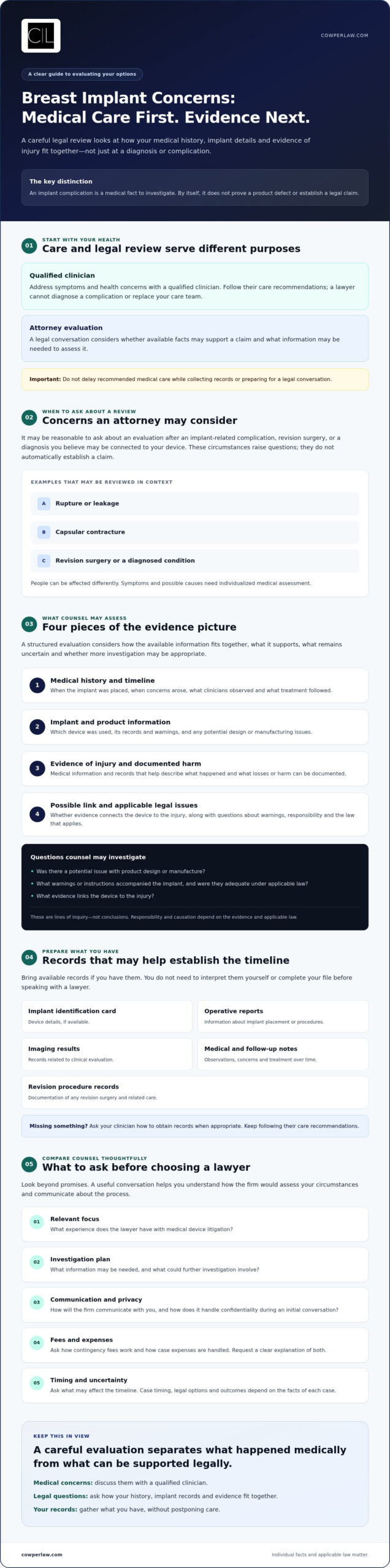
You don’t need a complete file to start a conversation. A little preparation can help a Defective breast implant attorney understand your history and identify what may need follow-up, but it can’t guarantee that a claim exists or predict an outcome. Keep seeking medical care as recommended. Don’t postpone an appointment or treatment while tracking down paperwork.
Gather what’s readily available, even if some details are missing. A short, factual timeline can help counsel understand how your experience unfolded. Consider noting:
Record dates and events as accurately as you can, and distinguish what you remember from what a medical record confirms. Keep original documents unchanged, and don’t post private medical records publicly. If you’re missing records, tell the attorney; counsel can discuss whether more information is needed and how it may be obtained. For broader recordkeeping ideas, look for a medical device injury documentation guide.
Use the consultation to understand both the possible evaluation and the working relationship. Ask:
Request plain-language answers and time to review any written agreement before signing. Don’t assume that a contingency arrangement handles every expense the same way; ask what the specific agreement provides. A consultation can help identify questions and possible next steps, but the case’s direction depends on the evidence and applicable law.
If you’re ready to discuss your breast implant history and records, contact Cowper Law about a case evaluation. You can begin with the information you have and ask what else, if anything, may be useful.
Hiring a lawyer begins a process of review and investigation, not a promise of a particular result. After you and the firm sign a representation agreement, the attorney may review your medical and implant records, identify information that may be missing, and investigate potential product and legal issues. The steps depend on the facts of your case.
As the review develops, counsel may discuss a legal strategy and explain significant developments. Make sure you understand who your main contact is and how the firm plans to keep you informed. Available claims, timelines, and outcomes can’t be predicted from a short consultation; they depend on the evidence, applicable law, and how the matter proceeds.
Cowper Law states that legal fees are collected only upon successful recovery. Before signing, ask the firm to explain in writing what “recovery” means under the agreement and how case expenses are handled. Fee and expense terms can vary, so read the agreement carefully and ask for clarification about anything you don’t understand. Don’t rely on assumptions about what may be owed or when.
Cowper Law represents people in medical device injury litigation, including breast implant matters, and describes its approach as personalized, compassionate advocacy. If you retain the firm, ask how it will apply that approach to your circumstances, who will handle your case, and what updates you can expect. A Defective breast implant attorney should be prepared to discuss both the investigation and its uncertainties, without guaranteeing eligibility, compensation, or a particular outcome.
The next steps should be explained clearly, from reviewing the agreement and records to considering further investigation and legal options. If you’re ready to discuss your situation, Discuss your situation with Cowper Law. A conversation can help clarify what information may matter and whether the firm may be able to represent you; it doesn’t guarantee representation or a specific result.
Choosing a Defective breast implant attorney starts with a careful, individualized evaluation, not a promise based on a symptom or diagnosis alone. Look for counsel who can explain how medical records, implant information, and potential legal issues will be reviewed, and who speaks openly about uncertainties.
As you compare firms, ask who will handle your matter, how the investigation may proceed, and what the written fee agreement says about legal fees and case expenses. Gather the records you have, but don’t delay medical care or wait for a complete file before asking what information may be useful.
Cowper Law handles medical device injury litigation, including breast implant litigation, and describes its approach as personalized advocacy. The firm states that legal fees are collected upon successful recovery; review the written agreement and confirm how its terms apply to your situation. A conversation can help you understand possible next steps without guaranteeing representation or an outcome.
Discuss your situation with Cowper Law and take the next step with greater clarity and support.
You may want to speak with a lawyer if you have an implant-related injury or diagnosis and questions about whether a product issue could be involved. A complication, symptom, or revision doesn’t automatically establish a legal claim. A Defective breast implant attorney can review your medical history, device information, and available evidence to help assess possible legal options. Keep following your clinician’s advice, since a legal evaluation is not medical care.
A rupture alone doesn’t determine whether you have a lawsuit. An attorney may review the implant’s history, medical records, evidence of injury, and whether the facts support a potential product-related claim under applicable law. The circumstances matter, including which device was used and what evidence connects it to harm. Seek medical care for concerns about a possible rupture, and preserve available records without delaying treatment to gather them.
Bring whatever you already have, such as implant identification details, operative reports, imaging, follow-up notes, diagnoses, and records of revision procedures. A brief timeline can note the procedure date, when concerns began, and treatment received. Don’t worry if records are incomplete; counsel can explain what else may be useful. Keep original documents unchanged, and don’t share private medical records publicly or postpone care while collecting them.
Cowper Law states that legal fees are collected only upon successful recovery. Before signing, ask the firm to explain in writing how the agreement defines recovery and how case expenses are handled. Those terms matter and shouldn’t be assumed. Review the agreement carefully, ask questions about unclear language, and make sure you understand what the arrangement means for your circumstances before deciding whether to proceed.
There isn’t one filing deadline that applies to every breast implant claim. Deadlines depend on the law governing the case and may vary by jurisdiction; some laws also consider when an injury was discovered or reasonably should have been discovered. The relevant start date can be fact-specific. If you’re considering a claim, ask an attorney to assess the applicable deadline promptly rather than relying on a general estimate.
No. Reports of systemic symptoms sometimes described as breast implant illness don’t, by themselves, prove that an implant caused those symptoms or establish a legal claim. Speak with a qualified clinician about symptoms and possible causes. If you’re also concerned about a legal issue, an attorney can review your medical history, device information, and other evidence. The legal assessment is separate from diagnosis and depends on the individual facts and applicable law.
Ask who will evaluate and handle your matter, how the firm investigates medical records and possible product issues, and how it will explain uncertainties and next steps. Clarify how the firm communicates updates and responds to questions. Before signing, request a plain-language explanation of representation terms, legal fees, and case expenses. A careful attorney should discuss what can and can’t be determined from the information currently available, without promising an outcome.