
Could a wrongful death attorney help your family find answers and pursue accountability while you’re grieving? Losing someone you love can leave you facing practical responsibilities and difficult decisions at the same time. A claim may involve more than determining how the death occurred. It may also require connecting someone’s conduct to the loss and establishing which parties could be legally responsible.
You deserve clear information, not added pressure. This guide explains the general purpose of a wrongful death claim, what families may need to establish, and why rules about eligible claimants, deadlines, and potential damages depend on state law. It also covers questions to ask when choosing an attorney, including how a firm investigates complex claims and explains legal fees and case expenses. Cowper Law represents families pursuing wrongful death claims, including cases involving complex product-related issues. The firm states that legal fees are collected only upon successful recovery. Ask how the written agreement addresses case expenses. A steady legal team can help you understand possible next steps while keeping your family’s needs in view.
A wrongful death claim is a civil action that may allow legally eligible people to seek remedies after a death caused by another party’s legally actionable conduct. An unexpected death alone doesn’t establish a claim. The applicable state law and available evidence matter. A wrongful death claim may raise questions about responsibility, eligible claimants, and recognized losses. The rules vary by jurisdiction.
A wrongful death attorney can investigate the circumstances, identify legal issues, and help a family understand its options. Depending on the facts, this may involve reviewing records, locating and assessing evidence, and examining whether an individual, company, or institution contributed to the death. If evidence raises questions about a drug or medical device, the investigation may also require careful review of technical information. An attorney can organize complex questions and guide decisions, but cannot promise a particular outcome.
A civil claim is separate from any criminal investigation or prosecution. Criminal authorities decide whether to investigate or bring charges under criminal law. A civil claim addresses legal responsibility and losses under civil law. One process doesn’t automatically determine the result of the other. A family can ask an attorney how the processes may relate to its circumstances.
An early conversation can help clarify which deadlines may apply and what information could be important to preserve. That doesn’t mean a family must decide immediately or arrive with complete evidence. Grief, arrangements, and financial responsibilities all take time and attention. An attorney can explain what is known, what remains uncertain, and what next steps may be worth considering under the relevant state law.
These claims may address different losses. A wrongful death claim generally concerns losses experienced by eligible surviving family members. A survival action may seek damages tied to losses the deceased person experienced before death. For example, the family’s losses and the deceased person’s injuries before death raise distinct legal questions. Whether either claim is available, who may bring it, and what damages may be considered depend on state law. Ask counsel whether both kinds of claims may apply and how they would be handled.
Eligibility isn’t the same in every state. State law determines which relatives may bring a claim, whether a personal representative must file on behalf of eligible beneficiaries, and who may recover damages. A spouse, child, or other close relative may be eligible in some jurisdictions. Other states set a priority order or limit who can participate. Cornell Law School’s legal definition of wrongful death offers useful background, but it doesn’t replace advice about the law that applies to a particular family.
Before assuming a family member can file, ask an attorney to identify the governing state law and explain who is authorized to act. An attorney can also clarify whose losses a claim may address and whether a personal representative has a role. Confirm these jurisdiction-specific rules for the circumstances of the case.
Immediate relatives and the estate’s personal representative are common examples of people who may have a role, but they aren’t universal rules. Some states restrict eligibility or specify which claimant has priority. If several relatives are affected, don’t assume each person can file separately or recover damages. Ask counsel to confirm who may bring the claim and who may be included under applicable law.
Depending on the legal theory and state law, a claim may require examining whether someone’s conduct violated an applicable duty, whether that conduct contributed to the death, and whether the law recognizes resulting losses. An allegation alone doesn’t establish fault. Neither does a product recall, diagnosis, or report of an adverse event.
Evidence helps test what happened. Records may establish a timeline, witness accounts may add context, and qualified medical, engineering, or other expert review may help address disputed questions. The relevant evidence depends on the case. Expert analysis doesn’t guarantee a particular conclusion.
For an initial discussion, families can ask:
You don’t need every document or answer before seeking guidance. If you’re considering a claim involving a complex injury or product-related issue, learn more about Cowper Law’s wrongful death representation and ask how the firm evaluates the facts and applicable rules.
Responsibility depends on the evidence, not simply on who was present or involved. A potentially responsible party might be an individual, company, or institution. For example, a claim could examine alleged careless conduct by a person, possible product defects or inadequate warnings, or questions about medical care. Each theory raises different legal and factual issues. An allegation alone doesn’t establish liability.
Claims involving government conduct may have distinct procedures. For certain claims involving alleged negligence by a federal employee, the Federal Tort Claims Act may be relevant. Ask counsel whether it applies and what procedures and deadlines need attention. The rules can depend on who was involved and the circumstances.
If the evidence points to a drug or device, an investigation may examine its design, manufacture, warnings, distribution, and use. Records and technical review can help assess whether a product-related issue contributed to the death and whether a company or another party may bear legal responsibility. A product’s presence, recall, or reported adverse event doesn’t by itself prove a defect or establish liability.
Medical-related allegations require separate care. A medical outcome or diagnosis alone doesn’t prove malpractice. The relevant care, applicable standards, and connection to the death must be evaluated under the governing law. In complex cases, a wrongful death attorney may coordinate review of medical records and other technical evidence to identify the questions that need answers.
Depending on state law and the evidence, potentially recognized losses may include the financial support a deceased person provided or the family’s loss of companionship. Some jurisdictions recognize additional categories, while others limit who may recover or what damages are available. Proof requirements, eligible beneficiaries, and any applicable caps also vary. No category or amount can be assumed without reviewing the governing law and facts.
Published settlements and verdicts describe individual cases, not a forecast for another family. Circumstances, evidence, legal rules, and losses differ. A careful evaluation focuses on the family’s situation rather than treating someone else’s result as a benchmark.
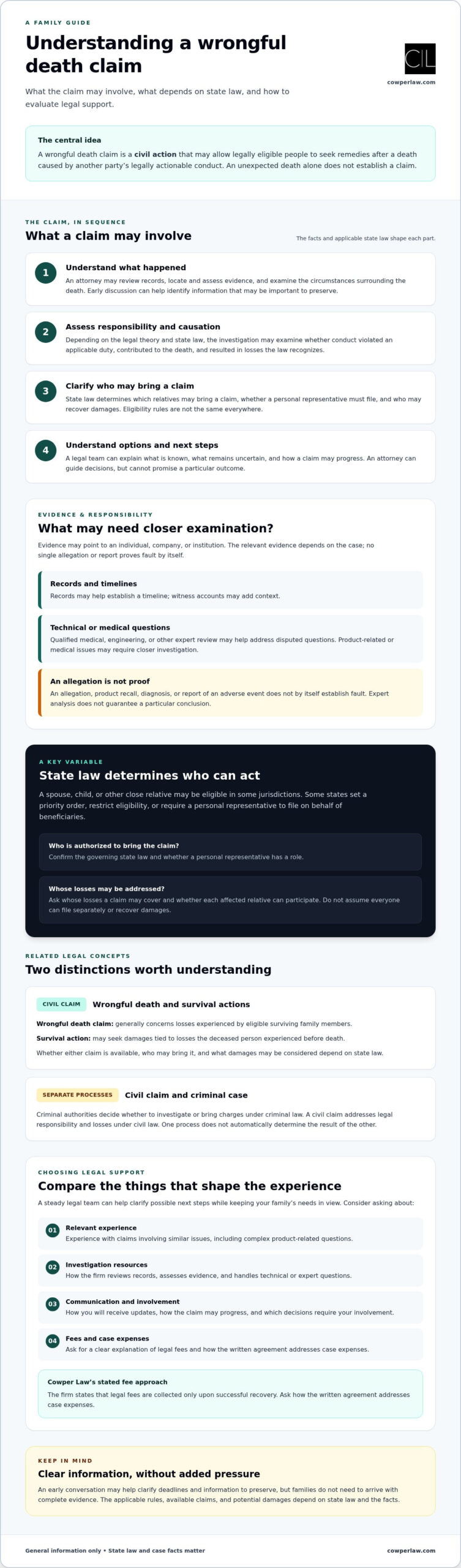
There’s no single path or predictable timetable. A claim may begin with a review of the family’s concerns and available information, followed by investigation into the facts, applicable law, and potentially responsible parties. Depending on what the evidence shows, the process may involve gathering records, consulting qualified experts, discussing resolution with opposing parties, or proceeding with litigation.
The duration of a wrongful death claim depends on the evidence, the parties involved, and procedural developments. Some steps may take longer if facts are disputed, several parties are involved, or more investigation is needed. Ask how the legal team will share updates, explain choices, and distinguish decisions it can manage from those that require your input.
An initial discussion may cover what happened, the family’s concerns, and information or records already available. You don’t need to arrive with every answer. The firm must assess the facts, applicable law, and whether it can handle the matter in the relevant jurisdiction before explaining possible options. If a drug or medical device may be relevant, ask how the team evaluates product-related evidence and whether technical review may be needed.
If the firm agrees to represent the family, ask what investigation may follow, who will handle day-to-day communication, and how significant decisions will be discussed. The precise steps depend on the case. Clear expectations can help families understand their role without carrying the entire process themselves.
Choose a conversation that leaves room for direct questions. Ask about the firm’s experience with claims involving similar issues, the resources it may use to investigate complex facts, and who will be responsible for the matter. Also ask how often updates are provided, how decisions are made, and what the written fee agreement says about attorney fees and case expenses.
Cowper Law describes its representation as contingency-based, with legal fees collected only upon successful recovery. That doesn’t establish how every case expense is handled. Review the written agreement and ask which expenses may arise, who initially pays them, and how they’re treated if there’s no recovery.
Understanding the process should bring clarity, not pressure. If your family is weighing legal options, discuss a wrongful death claim with Cowper Law and ask what facts and jurisdiction-specific rules would need review.
The right legal team should offer more than reassurance. Families need clear explanations, a thoughtful investigation, and a strategy shaped by the evidence and applicable law. In a complex corporate or product-related claim, records may be extensive, and technical questions may call for coordinated review by qualified experts. Ask how the firm would identify those issues and explain them in terms your family can understand.
Use an initial discussion to learn how the work would be handled, not just what the firm has handled before. Consider asking:
Past case results may show that a firm has handled certain matters, but they can’t predict the outcome of another family’s claim. Notice whether the answers are direct, questions are welcomed, and the proposed approach reflects your family’s circumstances. A respectful working relationship matters during a demanding process.
Cowper Law represents families pursuing wrongful death claims and describes its advocacy as personalized. Its complex injury litigation includes medical-device and drug-related cases, which may be relevant when evidence raises questions about a product or medication. Families can ask how the firm would investigate those facts, assess the applicable law, and determine whether technical or expert review may be appropriate. Representation and available options depend on the specific circumstances and jurisdiction.
The firm states that its legal fees are collected only upon successful recovery. That doesn’t necessarily mean all case expenses are covered. Before deciding, review the written agreement and ask how expenses are handled, including who may pay them and what happens if there’s no recovery.
Choosing counsel is a personal decision. If your family would like to discuss its circumstances and questions, discuss your family’s situation with Cowper Law. A conversation can help clarify what information and state-specific rules may need review, without guaranteeing case acceptance or an outcome.
A wrongful death claim depends on more than the circumstances of a loss. State law, the people eligible to bring a claim, the available evidence, and the parties who may be responsible all shape the options a family can consider. A wrongful death attorney can help make those questions easier to understand and guide the investigation and decisions ahead.
Cowper Law lists wrongful death claims among its practice areas and handles complex medical-device and drug-injury litigation when those issues are relevant. The firm describes its representation as personalized and contingency-based, with legal fees collected only upon successful recovery. Ask how the written agreement addresses case expenses, and confirm how the firm can assess the laws and facts that apply to your family.
You don’t need to have every answer before asking questions. Discuss your family’s situation with Cowper Law to explore what information and next steps may matter. Clear guidance can help your family move forward at a pace that respects both the legal questions and the loss you’re carrying.
State law determines who may bring a wrongful death lawsuit. Depending on the jurisdiction, eligible claimants may include specified relatives or a personal representative acting for beneficiaries. Some states set a priority order, define which beneficiaries may recover, or require the representative to file. A relative’s relationship alone may not settle eligibility. Ask an attorney to identify the governing law and explain who may act for your family.
There is no single filing deadline that applies to every wrongful death claim. The applicable time limit may depend on state law, the type of claim, the parties involved, and the circumstances. Certain facts can also affect how a deadline is calculated. Don’t rely on a general online estimate to determine how much time remains. Promptly ask an attorney to review the rules that apply to your situation.
A wrongful death case commonly requires evidence of legally actionable conduct, a connection between that conduct and the death, and losses recognized by applicable law. The exact elements depend on the legal theory and state. Records, witness accounts, and qualified expert analysis may help clarify disputed facts. An allegation, product issue, or adverse outcome alone doesn’t establish liability. A wrongful death attorney can assess what the evidence may show.
Potential damages depend on state law and the facts of the case. Where recognized, categories may include certain financial losses, such as lost support, or family-related losses, such as loss of companionship. Eligibility, proof requirements, and any limits vary by jurisdiction. An attorney must assess which categories may apply. Another family’s settlement or verdict reflects its own circumstances and doesn’t predict the value or result of your claim.
Possibly. A product-related claim may warrant investigation if evidence suggests a defect, inadequate warning, or another legally relevant issue contributed to the death. A device or drug’s involvement alone doesn’t establish a defect or liability. Medical records, product information, and qualified expert review may help evaluate the facts. State law and the circumstances determine which claims may be available and who is legally permitted to pursue them.
Fee arrangements vary by firm and agreement. Some firms handle these matters on a contingency-fee basis, meaning attorney fees are collected only if there’s a successful recovery under the agreement. The written terms should explain how fees are calculated and address case expenses, which may be treated separately. Cowper Law describes its representation as contingency-based. Review the agreement carefully and ask who is responsible for expenses and how they’re handled.
No reliable universal timeline applies. The duration may depend on the investigation, number of parties, need for expert review, negotiations, court procedures, and disputes. Some matters resolve without trial; others proceed through litigation. After reviewing the facts, an attorney can explain possible stages and factors that may affect the process, but shouldn’t promise a completion date. A faster resolution doesn’t necessarily mean a stronger or better-handled case.