
A femoral mesh complication can do more than disrupt recovery; it may also support a compensation claim. A femoral hernia mesh complications lawyer can assess whether a claim may apply when mesh used in a hernia repair after 2007 caused suffering or corrective surgery. Potential hernia mesh lawsuit payouts can reach $1 million or more. Pain, infection, recurrence, mesh migration, and bowel obstruction are among the reported complications.
If you’re facing ongoing symptoms, another procedure, or mounting bills, it’s reasonable to want clear answers about what happened and what options may be available. A mesh complication can affect more than your health: it may disrupt work, reduce income, and make everyday activities harder.
This article explains potential mesh rejection and injury symptoms, how claims are assessed, and what can influence compensation for medical expenses and lost income. It also covers the records and details that can help clarify a claim, and when legal support may help you pursue accountability while you focus on recovery.
A hernia mesh claim may apply when an operation after 2007 caused suffering or corrective surgery. Potential payouts can reach $1 million or more, and settlements differ from trial verdicts because one is negotiated and the other follows a trial decision.
A claim’s value can depend on the severity and duration of the injury, the treatment required, and the evidence linking the mesh to the harm. Revision surgery, organ injury, and recurring symptoms may affect documented losses. A careful assessment compares medical records with expense and income records to identify which losses are supported and which need more documentation.
Consider how the injury changed daily life as well as your medical care. Records describing activity limits, ongoing pain, or missed work can help explain its personal impact. For example, appointment notes documenting restrictions, alongside work records, can show how treatment affected recovery and earning capacity.
A product liability claim examines whether a mesh defect caused injury and whether the manufacturer disclosed potential product issues. Evidence may include implant records, product details, and medical findings connecting the device to complications. For femoral hernia repair, identify the implanted mesh and document resulting harm, such as recurrence or corrective surgery.
A claim may seek compensation for losses tied to an alleged defect, including treatment expenses and income lost during recovery. Product information and clinical history help establish its basis. Preserve implant identification details and keep a timeline of surgery, symptoms, and later treatment together for review.
How do femoral hernia mesh settlements compare with trial verdicts? A settlement is negotiated between the parties; a verdict follows evidence presented at trial. A settlement can resolve a claim without a trial decision, while a verdict reflects the trial’s outcome. Neither provides a reliable shortcut for valuing another person’s injuries.
Potential hernia mesh lawsuit payouts can reach $1 million or more, while outcomes vary by case. Evidence, injury, treatment, and documented losses shape the amount at issue. Compare a proposed resolution with the medical and financial record, including future care needs and income disruption. A headline figure alone cannot show whether a result reflects a particular person’s harm.
Organize key records before assessing a proposed resolution. Keep the operative report, implant details, treatment notes, expense documents, and income records in date order. This makes it easier to see how the injury developed, what care followed, and how losses connect. Reviewing these details helps frame a claim around your actual experience, rather than a general payout figure.
A mesh-related injury can involve pain, infection, recurrence, adhesions, or damage to nearby organs. After a suspected femoral hernia mesh complication, document symptoms, treatment, and records identifying the implanted device.
Symptoms may include persistent pain, swelling, infection, or a hernia returning near the repair site. Adhesions can form when tissue binds around mesh, and nearby organs may be affected by perforation or obstruction. After femoral repair, note whether discomfort is near the upper thigh or outer groin, where a femoral hernia occurs.
Track each change by date, location on your body, and effect on daily activities. For example, note when groin pain worsens, swelling appears, or symptoms interfere with walking or work. An ache in the muscle area alone does not establish that a device is defective, but consistent records help describe the injury and its progression.
Mesh may be designed to remain in the body permanently, so complications can lead to further evaluation or corrective treatment. Keep details from each appointment and procedure, including findings and discussions about removal or revision surgery. These records can connect symptoms to the repair and clarify what care followed.
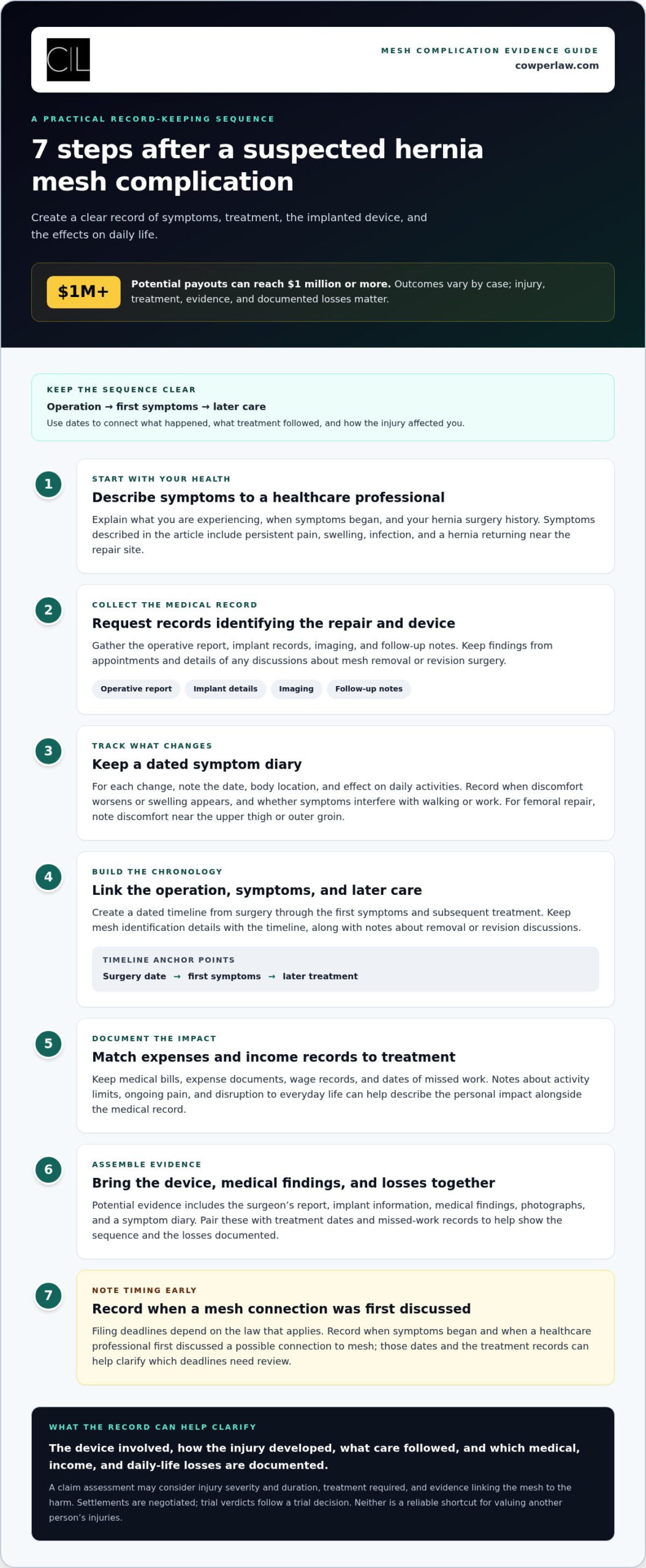
First, contact a healthcare professional and describe your symptoms, when they began, and your hernia surgery history. Then request copies of the operative report, implant records, imaging, and follow-up notes. Keep bills and work records too, as they can document how treatment affected income and daily life.
Next, create a dated timeline linking the operation, first symptoms, and later care. Keep mesh identification details with it, and record discussions about removal or revision surgery. These steps help attorneys assess the device, the alleged defect, and the connection between the mesh and injury.
Filing deadlines depend on the law that applies to a claim, so identify the relevant timeline early. Record when symptoms began and when a healthcare professional first discussed a possible connection to mesh. These dates, alongside treatment records, can help clarify when the injury was recognized and which deadlines need review.
Evidence may include the surgeon’s report, implant information, medical findings, photographs, and a symptom diary. Match these records with dates of missed work and treatment. For example, an operative note identifying the mesh, followed by records of a recurring hernia and corrective care, can help establish a clear sequence.
If records point to a device-related injury, legal guidance on mesh complications can help organize the timeline and evidence for a claim.
Symptoms after mesh implantation may point to pain, infection, recurrence, or another complication. About one-third of hernia mesh implant surgeries result in complications, including chronic pain and injury.
Reported symptoms include persistent abdominal or groin pain, swelling, infection, and a recurring hernia. Adhesions can form when tissue binds around mesh, and nearby organs may be affected by perforation or obstruction. After femoral repair, note whether discomfort is near the upper thigh or outer groin, where femoral hernias occur.
Some bloating after implantation can be normal for up to one week. Track whether swelling settles or continues, and record when pain starts, where it occurs, and what worsens it. A dated symptom log can distinguish a brief recovery change from recurring problems that need medical attention.
Mesh material matters when assessing what may happen inside the body. Non-absorbable mesh is considered a permanent implant that reinforces the repair. Absorbable mesh degrades over time while temporarily supporting the repair as new tissue grows. Request the operative record and implant details to identify which type was used.
A hernia that returns after repair may indicate recurrence, while ongoing pain or swelling may accompany other complications. Reported problems include mesh migration, bacterial infection, adhesions, and bowel obstruction. These symptoms can interfere with movement, meals, sleep, or work. Record concrete examples, such as pain limiting walking or swelling that persists beyond the first week.
Some mesh products have had documented performance concerns. Two independent studies associated Ethicon’s Physiomesh with higher recurrence and revision-surgery risks, leading to its voluntary recall in 2016. After-market studies reported an approximately 20% failure rate for Physiomesh Flexible Composite Mesh. Those figures concern that product, not every mesh implant.
Polypropylene fibers can shrink by 30% to 50% over time, potentially changing how the mesh sits against surrounding tissue. A change in pain, a new bulge, or infection after surgery deserves careful documentation. Record each symptom’s onset and progression, then compare those dates with follow-up notes and imaging.
For a possible hernia mesh lawsuit, preserve implant identification, the operative report, and records describing recurrence or organ injury. A clinician’s notes can clarify the observed problem and treatment, while your timeline can show how symptoms developed. Together, these records explain the course from implantation to complication.
A claim involving defective hernia mesh may seek compensation for losses connected to the injury. Medical expenses may include evaluation, medication, infection treatment, and corrective surgery. For example, keep the bill for abdominal imaging with the provider’s note explaining why it was ordered. Records should show how each expense relates to the implanted device and resulting harm.
Organize medical documents by date, starting with the mesh operation and continuing through later care. Include itemized bills, insurance statements, prescriptions, and records of procedures addressing recurrence or perforation. Separate any expense that appears unrelated to the mesh injury from the claim file. This makes the connection between treatment and alleged harm easier to understand.
Future treatment needs may also matter when medical records describe continuing care. A physician’s notes can explain whether infection, pain, or organ damage requires further monitoring or treatment. Keep appointment summaries and care instructions, not just invoices. For example, a note recommending follow-up after corrective surgery helps show why further medical attention remains part of recovery.
Lost income needs its own evidence. Gather pay statements, employer records, and dates missed for appointments, recovery, or activity restrictions. A missed shift for mesh removal surgery can be documented with the appointment record and payroll history. If symptoms reduced your work hours rather than stopping work entirely, compare schedules and earnings before and after the injury.
Self-employed workers can gather invoices, contracts, business schedules, and tax records showing interrupted work. A cancelled project during recovery, for example, may help explain the income impact when supported by dated correspondence. Keep these documents with medical records so the timeline connects treatment to time away from work.
Not every expense or missed workday automatically belongs in a mesh claim. Records need to explain the relationship between the implant, the complication, and the loss. A clear sequence, such as surgery followed by infection treatment and missed work, helps show how the injury affected both health and finances.
Before organizing the file, create a simple index with dates, document types, and the loss each item supports. Keep original records and add copies as they arrive. Discuss your hernia mesh injury claim to understand how medical expenses and lost income may be presented.
Ethicon withdrew Physiomesh from the U.S. market in May 2016. Sofradim recalled its Versatex Monofilament mesh in 2018, affecting the 50 by 50 cm device. These actions do not establish which product was used in a particular femoral hernia repair; the operative record and implant details identify the device.
Reported complications extend beyond recurrence. Patients have experienced pain, infections, adhesions, bleeding, bowel obstruction, mesh migration, and perforation of nearby organs. Some reports also describe pain during sex, known as dyspareunia. The specific injury depends on how the device and surrounding tissue respond after hernia repair.
Recurrence can reopen the repair and lead to corrective surgery. Migration may move mesh from its intended position, while adhesions can bind tissue or organs near the implant. Infection may become severe enough to require mesh removal. These are distinct complications, so medical records should describe the actual diagnosis, treatment, and effects on the patient.
Reported concerns have also involved individual products and manufacturers. Two independent studies linked Ethicon’s Physiomesh to higher recurrence and revision-surgery risks than comparable meshes. The FDA injury database detected a pattern of Physiomesh complications. After-market studies reported an approximately 20% failure rate for Ethicon’s Physiomesh Flexible Composite Mesh.
Atrium manufactured C-QUR, Vitamesh, Proloop, Prolite, and Prolite UltraQ. The FDA filed for a permanent injunction against Atrium Medical Corporation’s parent company in 2015. The FDA also cited Maquet for safety violations between 2009 and 2013. These regulatory events provide context, but they do not prove that a particular implant caused an individual patient’s injury.
The FDA received reports of hundreds of adverse events related to listed hernia mesh manufacturers and devices. Reports can identify patterns for investigation, but a patient’s records must still establish which product was used and what complication occurred. A useful first step is to match the implant sticker or operative report with follow-up notes, imaging, and any revision-surgery record.
When reviewing a possible claim, separate documented facts from assumptions. Record the mesh manufacturer and product, the date of hernia repair, diagnosed symptoms, and subsequent treatment. For example, a record naming Physiomesh and a later diagnosis of recurrence can clarify the sequence, though it does not by itself prove causation.
The key point is that a recall or safety concern makes product identification important, but does not automatically prove liability. Preserve records showing the implant, reported complication, and required care. This evidence helps connect a device to a patient’s experience.
The next decision is not about predicting an outcome. It is about understanding what your records show, which questions remain, and what legal options may fit your circumstances. A femoral hernia mesh complications lawyer can review the connection between the implant, your injury, and its effect on your life, then explain how a claim may proceed.
Cowper Law represents people in medical device injury litigation, including spinal cord stimulator lawsuits and catastrophic injury matters. For a hernia mesh concern, the first conversation should focus on your experience and the evidence behind it. You deserve a clear explanation, steady guidance, and an advocate who takes your concerns seriously.
Contact Cowper Law about your claim to discuss a potential hernia mesh case and the next steps available to you. You do not have to make sense of every legal issue alone. A focused conversation can help you move forward with greater confidence.
A lawyer can assess whether available evidence supports a claim and identify potentially responsible parties. A femoral hernia mesh complications lawyer can help organize implant records, medical findings, and documentation of losses. For example, comparing an operative report with later imaging may clarify the sequence of events. Legal guidance can also help preserve relevant evidence and identify applicable filing deadlines.
Complications can arise from how mesh interacts with healing tissue, its position, or the body’s response to the implant. A permanent device remains in place to reinforce the repair, and problems may include infection, adhesions, migration, or recurrence. Mesh materials and surgical techniques differ. For an individual patient, medical records and findings help explain the problem; symptoms alone do not establish its cause.
The filing deadline depends on the applicable law and how the claim’s timeline is calculated. Some deadlines may relate to when the injury occurred, while a discovery rule may focus on when a person knew or should have known of a connection between symptoms and mesh. Preserve records of symptom onset and diagnosis, then seek legal review promptly, as missing a deadline can affect a claim.
Gather records that identify the mesh, document the injury, and show the treatment that followed. Request the implant sticker or device record, operative report, and imaging reports. Keep a dated symptom account and match entries with appointment notes or prescriptions. For example, a follow-up note describing a recurring hernia can clarify what prompted additional care. Store work and expense documents separately to track financial effects.
Possible complications include a recurring hernia, chronic pain, infection, adhesions, mesh migration, bowel obstruction, bleeding, or perforation of nearby organs. A femoral repair involves the upper thigh or outer groin, so symptoms in that area may be relevant. For example, a new bulge near the repair differs from general postsurgical soreness. Record when it appears and how it changes, and discuss it with a healthcare professional.
A returning bulge, persistent or worsening pain, swelling, or infection can signal a complication, but symptoms alone cannot establish the cause. Note when changes began and whether they affect movement, sleep, or everyday activities. Imaging, examination findings, and operative records can help identify recurrence, migration, or another problem. Seek medical attention for new or worsening symptoms, and keep copies of the resulting clinical notes.
Evidence should identify the specific implant, document a diagnosed injury, and help connect the two. The operative report and implant record can identify the device, while clinical notes and imaging describe complications. A dated sequence can show when symptoms began and what care followed. For instance, records connecting a removal procedure with an infection diagnosis can explain the treatment and its relationship to the alleged injury.
Potential responsibility depends on the evidence and conduct involved. A manufacturer may face allegations concerning a defective device or inadequate warnings. A surgeon or hospital may be considered if evidence raises questions about device selection, placement, or follow-up care. These are distinct possibilities, not automatic conclusions. Product records, operative notes, and clinical documentation help clarify whether a claim concerns the device, medical care, or both.