
The filing deadline can matter as much as the injury itself. There is no single nationwide deadline for a hernia mesh erosion legal claim. The applicable statute of limitations depends on the state and the circumstances of the case. In many states, the filing period is tied to when mesh-related complications were discovered or reasonably should have been discovered.
Persistent pain, infection, bowel problems, or another surgery can leave you facing difficult medical and legal questions at once. A lawyer may review your medical history, mesh implant and treatment records, and the timeline of your complications to assess how those facts may support a claim and which deadlines may apply.
This article explains how legal representation may help, what complications have been reported, and how settlements, verdicts, and bellwether trials fit into hernia mesh litigation. You’ll also learn why a bellwether trial can influence related cases, even though its result does not decide every individual claim.
Mesh erosion claims allege that mesh wore into or damaged nearby tissue or organs. Other claims may involve migration, infection, obstruction, or recurrence without alleging erosion.
Reported complications can overlap, so the implant, symptoms, diagnosis, and subsequent treatment all matter when assessing a potential claim.
Reports involving hernia mesh surgery describe migration, shrinkage or contraction, infection, adhesions, bowel obstruction, and damage to internal tissue or organs. Hernias can also recur, and some patients undergo revision or mesh removal surgery. These problems may occur together; for example, bowel obstruction may accompany adhesions or damage to nearby tissue.
Reported complication estimates vary. One account says about one-third of implant surgeries result in complications, including chronic pain and injuries. A British Medical Journal complications article reported surgeons’ estimates of complication rates from 12% to 30%. These figures describe different reports, not an individual patient’s risk.
Symptoms associated with reported mesh injuries include persistent abdominal or groin pain, fever, nausea, and signs of infection. Erosion may cause chronic pain or hernia recurrence; bowel obstruction, perforation, and organ damage are also reported complications. Symptoms alone don’t establish what happened to the mesh, so the diagnosis and medical findings matter.
Consider a patient whose pain returns after hernia repair and whose imaging or surgery later identifies an obstruction. Keep records of symptoms, appointments, diagnostic findings, and treatment. An attorney reviewing a potential claim may compare those records with the implant details and the timing of each complication.
An erosion claim alleges that mesh wore into or injured tissue or an organ. Other hernia mesh lawsuits may instead allege migration, shrinkage, infection, defective design, or inadequate warnings. These allegations can overlap: erosion may contribute to organ damage, while migration may be alleged without erosion.
A reported Covidien Symbotex case illustrates why the timeline matters. According to the complaint, the patient received the mesh during a 2017 hernia repair and developed a bowel obstruction three years later. That allegation is a case-specific example, not proof that every obstruction involves erosion or the same cause.
Revision surgery or mesh removal can provide important details about the alleged injury, including the surgeon’s findings and treatment. Complications that require revision surgery or other medical care may support a claim. Those records can help an attorney assess whether the evidence connects the mesh to the injury. Keep operative reports and follow-up records together.
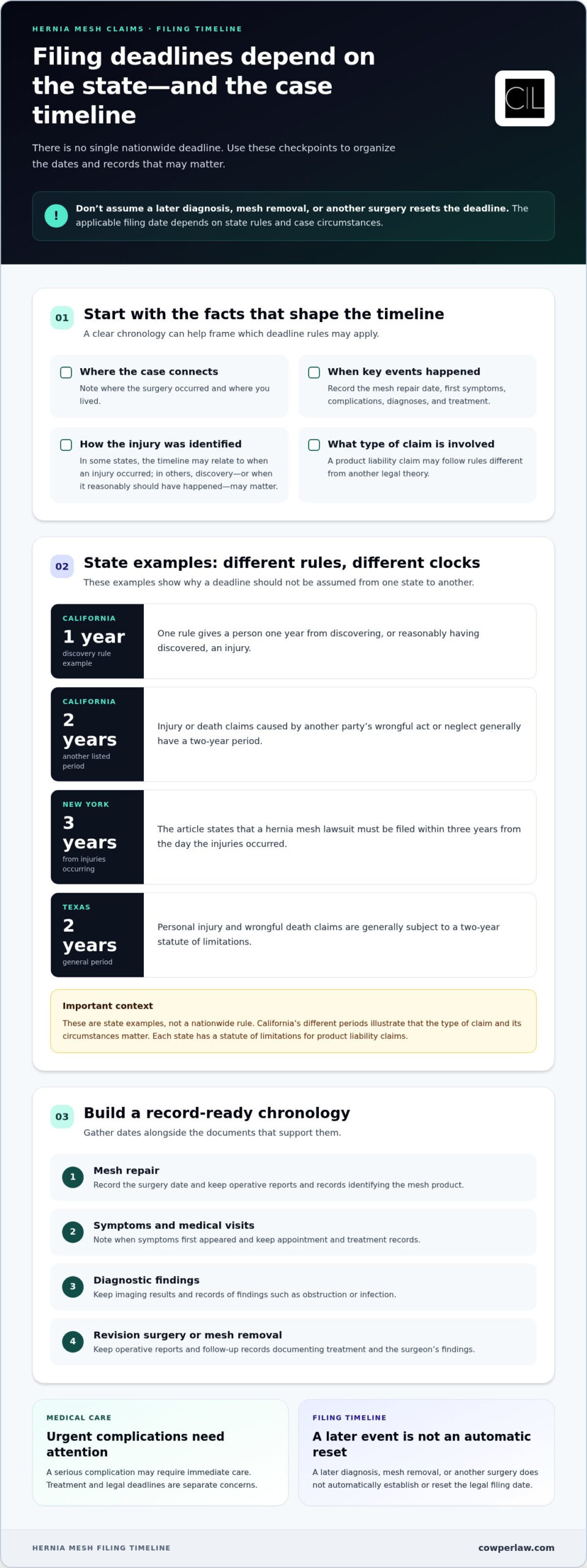
A statute of limitations sets the deadline for filing a lawsuit. Hernia mesh deadlines vary by state and case circumstances, so a deadline that applies in one state may not apply elsewhere. The mesh implantation date can also affect whether a claim falls within the applicable period. Start by identifying where the surgery occurred, where you lived, and when complications emerged.
In some states, the filing clock is tied to when an injury occurred. In others, the date a person discovered, or reasonably should have discovered, the injury may matter. A mesh erosion diagnosis, bowel obstruction, or hernia recurrence can develop after the original repair. That later event may matter to the timeline, but it does not automatically establish the legal filing date.
The listed state examples show why assumptions can be risky:
California’s different periods illustrate why the type of claim and its circumstances matter. A product liability claim may follow rules that differ from those for another legal theory. Each state has a statute of limitations for product liability claims. Don’t assume the date of mesh removal, a later diagnosis, or another surgery resets the deadline.
Build a clear chronology before speaking with a lawyer. Record the mesh repair date, first symptoms, medical visits, diagnostic findings, and any revision surgery. Keep discharge papers, operative reports, imaging results, and records identifying the mesh product. For example, note when pain first appeared and when a clinician documented an obstruction or infection. These dates help frame timing questions and preserve details that may fade during treatment.
A serious complication may require immediate care, but treatment and legal deadlines are separate concerns. Don’t wait for revision surgery or a final recovery assessment before asking how the filing period applies. A lawyer can compare the state’s rules with the treatment timeline and claim type. For a focused review of the dates and records involved in a hernia mesh claim, gather those documents and discuss the timeline promptly.
A lawyer can investigate the device, alleged defect, injury, and available evidence. Product recalls and withdrawals may provide context, but they don’t by themselves establish what caused an individual complication.
A recalled device doesn’t automatically prove liability or prevent a claim. A manufacturer’s bankruptcy can change how claims are handled, so the applicable process and deadlines matter.
Specific product records help connect an implant to a reported issue. Ethicon withdrew Physiomesh Flexible Composite Mesh from the market in 2016 after registry data showed higher hernia recurrence and reoperation rates. In May 2016, Ethicon voluntarily recalled the product. These events may help identify relevant evidence, but a patient’s implant and medical records remain central.
Bard Davol Inc. issued Composix Kugel Mesh Patch recalls in 2005, 2006, and 2007. A memory recoil ring defect could cause the mesh to break. In 2018, Covidien recalled certain lots of Parietex Composite Mesh because a packaging issue could compromise the mesh. Match the product name, lot information, and implant date to your operative records.
Hernia mesh lawsuits commonly allege defective design, manufacturing defects, or inadequate warnings. A design claim examines an alleged problem with the product’s design; a manufacturing claim focuses on a defect in a particular device or lot. A failure-to-warn claim concerns the information provided about risks. The evidence must connect the alleged defect or warning issue to the injury.
An attorney can organize medical records, implant details, and revision surgery findings, then assess which allegations fit the evidence. For example, records of mesh migration or breakage may point to product identification and manufacturing history. Expert testimony connecting the mesh to the injury may also support a claim.
The FDA has recalled hernia mesh implants since 2010. Recall history can help guide an investigation, but it doesn’t answer every question about a particular device, complication, or claim. A lawyer may compare the implant record with recall details and assess whether the alleged injury fits a product liability theory.
Bankruptcy adds a separate procedural concern. A lawyer can determine whether the manufacturer’s status affects where or how a claim proceeds, while preserving relevant records and tracking applicable deadlines. Key steps include identifying the manufacturer, obtaining implant and treatment records, and documenting the alleged injury. Those details help assess whether a claim may seek compensation and what evidence it requires.
Past outcomes show how hernia mesh cases have resolved, but they don’t set a standard payout. A settlement, jury verdict, and proposed estimate each mean something different for patients with injured tissue, perforation, or revision surgery.
In 2022, a Rhode Island man received a $4.8 million award against Davol Inc. and C.R. Bard. His case involved gastrointestinal injuries and corrective surgeries linked to Ventralex mesh. These outcomes concern specific evidence and injuries, not every implant or filing.
Earlier results also differ. In 2011, Bard paid $184 million to multiple plaintiffs in a settlement involving allegations that Kugel Patches migrated and caused serious complications. A jury award is decided at trial; a settlement reflects an agreement between parties. Neither alone determines what another patient’s case may be worth.
Large settlement totals describe group resolutions, not individual checks. In October 2024, Becton Dickinson agreed to settle roughly 38,000 hernia mesh lawsuits. The estimated total payout could exceed $1 billion, but that figure is not a per-person amount.
Other agreements involved different manufacturers and claims. In December 2023, Johnson & Johnson and Ethicon reached settlement agreements with 224 plaintiffs in the hernia mesh multidistrict litigation. In 2021, Ethicon settled more than 3,700 Physiomesh lawsuits. Each agreement reflects its own terms and claimant group.
Published estimates are not guaranteed awards. Those figures are estimates, not a promise or a reliable forecast for an individual claim.
Case value depends on documented medical expenses, corrective surgeries, physical and emotional suffering, injury severity, and lost wages. For example, records of bowel perforation, mesh removal, and time away from work may affect the damages analysis. A settlement review should distinguish proven losses from broad estimates and compare the evidence with the specific implant and injury.
Before assessing any past result, identify whether it was a jury verdict, a settlement, or an estimate. Then compare the injury, treatment, and financial losses involved. For a review of how those details relate to hernia mesh litigation, organize your medical and wage-loss records for discussion with a lawyer.
A bellwether trial tests a selected case in litigation involving many similar claims. Its evidence and verdict can give both sides information about arguments, witnesses, and potential trial risks. It is a signal, not a universal valuation formula for everyone who experienced complications from a surgical mesh device.
Federal hernia mesh cases are grouped into multidistrict litigation, or MDL, proceedings. As of October 2026, 25,904 hernia mesh lawsuits were pending across four federal MDLs in the United States. A bellwether case is selected from the broader litigation, then tried to help assess how similar claims may fare before a jury.
That process matters because claims can involve different products, injuries, and medical histories. One patient may allege infection after implantation; another may have a bowel obstruction or revision surgery. A bellwether trial lets the parties examine how evidence about a particular device and injury is presented, while recognizing the individual facts that distinguish other cases.
The verdict drew attention to evidence presented in that case, but it does not establish that every Covidien claim shares the same facts or outcome. The next Covidien bellwether trial was scheduled to begin in January 2027.
In September 2026, a Massachusetts federal judge said the judge was likely to reduce that verdict for an Alabama couple in a Covidien Symbotex case. A jury award may therefore face further court review, and the amount announced at trial may not be the final amount paid.
For someone considering a claim, the practical takeaway is to treat bellwether results as useful litigation signals, not promises. Compare the trial’s mesh product, alleged defect, medical records, and injuries with your own. A bowel obstruction, infection, or repeat surgery may require different evidence and damages analysis from the bellwether plaintiff’s experience.
To prepare, organize records that connect your implant to your treatment: the operative report, product identification, diagnostic findings, and revision surgery records. These details help show where your circumstances align with or differ from a bellwether case. The trial can inform the broader litigation, but evidence tied to your own device and injuries remains central.
The first Covidien hernia mesh bellwether trial was scheduled to begin on July 13, 2026.
Your next move can be practical: gather the records that tell your story, then prepare questions about the device, your injuries, and the legal path forward. A lawyer reviewing a hernia mesh erosion legal claim can help connect those details and explain how they may shape your options.
Cowper Law handles medical device injury litigation, including hernia mesh and spinal cord stimulator lawsuits, as well as catastrophic injury cases. The firm represents people harmed by medical devices and serious injuries, with attention to the individual circumstances behind each claim.
When you’re ready to discuss your situation, contact Cowper Law about your claim. A focused conversation can help you take the next step with greater purpose and confidence.
Yes. Bard Davol recalled Composix Kugel Mesh Patch in 2005, 2006, and 2007 because a memory recoil ring defect could cause breakage. Ethicon withdrew Physiomesh Flexible Composite Mesh in 2016 after higher recurrence and reoperation rates appeared in registry data. In 2018, Covidien recalled certain Parietex Composite Mesh lots over a packaging issue. A withdrawal and a recall are different actions, so identify your exact implant.
There is no single deadline for every state or claim. Texas generally sets a two-year period for personal injury and wrongful death claims; New York allows 3 years from the day injuries occurred. California has different rules, including one year from discovering, or reasonably having discovered, an injury, and generally two years for injury or death claims caused by wrongful acts or neglect. Identify the state and claim type promptly.
Reported problems include mesh migration or contraction, infection, adhesions, bowel obstruction, organ damage, perforation, chronic abdominal or groin pain, and hernia recurrence. Some patients need revision surgery or mesh removal. For example, a recurring hernia and persistent pain may occur together, while another patient’s complication may involve an obstruction. The type of problem, medical findings, and treatment history help distinguish a mesh-related injury from other post-surgical concerns.
Settlement assessments consider documented medical expenses, revision procedures, injury severity, physical and emotional suffering, and lost wages. Records can clarify those losses: itemized bills show treatment expenses, operative notes describe corrective surgery, and employment records document missed work. The implant, alleged defect, and evidence connecting the device to the injury also shape the case. A verdict or settlement involving another patient does not establish an individual claim’s value.
Hernia mesh erosion describes mesh wearing into or damaging nearby tissue or organs. It can be associated with chronic pain, infection, organ damage, or intestinal blockage. Symptoms alone don’t show whether erosion occurred; diagnostic findings and surgical records may clarify what happened. For a hernia mesh erosion legal claim, preserve records describing symptoms, imaging results, and any surgeon’s observations about the mesh or affected tissue.
Products discussed in hernia mesh litigation include Ethicon Physiomesh, Bard Davol Composix Kugel Mesh Patch, and Covidien Parietex Composite Mesh. Their withdrawal or recall histories concern particular product issues, including recurrence, a ring defect, or packaging. Those events do not establish that every product caused erosion or that every implanted device was affected. Check operative records for the manufacturer and product name, then compare those details with the alleged injury.
A claim may seek compensation for documented medical expenses, revision surgery, lost wages, and physical or emotional suffering. For example, a patient who underwent mesh removal may have treatment bills and time away from work to document. Available damages depend on the losses and supporting evidence in the claim. Keep invoices, employment records, and treatment notes together so the financial and personal effects are clearly represented.
First, keep copies of operative reports, implant identification, diagnostic results, and records from later procedures. Next, create a dated symptom and treatment timeline, including missed work and related expenses. Preserve letters or product information received about the implant. Then discuss the records and filing deadline with a lawyer without delay. An organized file helps connect the device, alleged injury, treatment, and financial impact.