
Could a catastrophic injury lawsuit help account for life-changing costs that continue long after the first hospital bill? When an injury affects mobility, independence, or the ability to work, immediate expenses may not show the full financial and personal impact.
A claim may need to consider more than what has already happened. Future treatment, rehabilitation, support at home, and reduced earning capacity can all matter, depending on the facts and applicable law. The practical challenge is documenting those effects while you or someone you love is focused on recovery.
This guide explains what may make an injury catastrophic in a legal claim, what evidence can help show its lasting effects, and what a lawsuit may involve. You’ll find steps for preserving records and protecting legal options without letting paperwork take priority over care. Deadlines and legal standards vary by jurisdiction, so ask about the rules that apply to your circumstances. We also cover questions to ask when assessing an attorney relationship, including how contingency fees and case-related expenses are handled. The goal is to help you make informed decisions without adding pressure.
A catastrophic injury lawsuit is a legal claim seeking accountability and compensation for severe harm that causes lasting impairment or substantial changes to a person’s life, when evidence supports another party’s legal responsibility. The term can describe serious physical consequences, but legal standards vary by jurisdiction. A diagnosis alone doesn’t establish that someone has a valid claim.
The effects may reach far beyond initial treatment. An injury can change someone’s ability to move, communicate, care for themselves, or return to work. The medical and legal perspectives on catastrophic injury help explain why lasting impact matters, but whether a particular case meets legal requirements depends on its facts and the applicable law.
Severe brain or spinal cord injuries and major burns are examples of injuries that may result in lasting impairment or extensive care needs. This list isn’t exhaustive, and no diagnosis automatically qualifies. An assessment considers the injury’s severity, its continuing effects, and the treatment or support the person may need. For individuals facing severe trauma following a motor vehicle collision, you can check out EMS Accident Cases to connect with legal counsel experienced in complex crash claims. An attorney must review the individual circumstances and applicable law to evaluate whether a legal claim may be available.
Responsibility may be explored through a negligence claim or, when a product is involved, a product-liability theory. The legal pathway depends on how the injury occurred, the evidence, and the relevant rules. A serious accident alone doesn’t prove that another person or company violated a legal duty or is responsible for the resulting harm.
An investigation may examine records, accounts of what happened, and the product or conditions involved. If a medical device may have contributed to the injury, learn more in Cowper Law’s medical device injury lawyer guide. Evidence of responsibility must be considered alongside evidence of the injury and legally recognized losses. The whole picture matters, not a label alone.
A strong claim needs to show more than the injury itself. Records and expert analysis can help explain how the harm occurred, what it has changed, and what care or support may be needed over time. In a catastrophic injury lawsuit, this evidence can connect documented losses to the person’s circumstances rather than relying on assumptions about a diagnosis.
Potential losses may include treatment and rehabilitation already received, anticipated future care, income lost during recovery, and reduced ability to earn in the future. Which damages may be recoverable, and what evidence is needed to support them, depend on the facts and applicable law. Cornell Law School’s overview of personal injury law explains the broad legal context; specific rules vary by jurisdiction.
Evidence about future care can help explain the treatment, assistance, and support a person may need over time. Whether projected losses can be recovered depends on the evidence and governing law.
In appropriate cases, a qualified professional may assess likely future care and support needs and organize them into a life care plan. Depending on the person’s condition, the plan might address ongoing treatment, rehabilitation, equipment, or assistance with daily activities. It is an evidence-based estimate, not a guaranteed treatment plan or promise of an award. Not every claim needs a formal plan; whether one is useful depends on the issues and evidence in the case.
Useful records may include medical files, rehabilitation notes, employment documents, and documentation of care or assistance. Keep copies when available, and make a simple record of how needs change over time. Don’t alter original records or devices. When relevant, qualified experts may address medical prognosis, functional limitations, or projected costs, helping explain how the injury affects daily life and work.
If a medical device may be involved, the facts may call for a closer review of the product and its connection to the harm. Cowper Law’s medical device injury guide offers more information on that subject. For a case-specific assessment of how evidence and long-term needs may fit together, you can also learn about Cowper Law’s catastrophic injury legal services.
A claim may seek to address measurable financial losses as well as the personal effects of an injury. These are often grouped as economic and non-economic damages, but the categories, proof requirements, limits, and recoverability depend on the facts and applicable law. No particular injury guarantees compensation, and there’s no reliable way to assign every person’s losses the same value.
In a catastrophic injury lawsuit, an assessment should reflect the individual’s care needs, ability to work, and changes to everyday life. The examples below are possibilities to discuss with qualified counsel, not a promise that a particular loss can be recovered.
| Loss category | Illustrative examples | Evidence that may help document it |
|---|---|---|
| Past and future care | Medical treatment, rehabilitation, assistive equipment, or support needs | Medical and rehabilitation records, care documentation, and relevant expert opinions |
| Income and work capacity | Income lost during recovery or a possible reduction in future earning capacity | Employment and income records, work history, and relevant assessments of functional or vocational impact |
| Non-economic effects | Pain, emotional effects, reduced independence, or disruption to daily activities | Treatment notes, consistent personal accounts, and observations from people familiar with daily life |
Depending on the circumstances and local rules, a claim may include expenses already incurred and projected needs, such as ongoing treatment, rehabilitation, or assistive support. Documentation can help distinguish injury-related costs from general or unsupported estimates. Lost income and reduced earning capacity also need case-specific support. Employment records may show work history and income, while other evidence may be needed to explain how lasting limitations affect work options. Whether an expense or loss is legally recoverable must be assessed under the applicable law.
Not all harm appears on a bill or paycheck. Pain, emotional strain, loss of independence, and difficulty with familiar routines may alter daily life. A dated personal record can help capture changes as they happen, while treatment notes and observations from family or caregivers may add context. These accounts don’t turn lived experience into a uniform calculation; they help describe the individual impact clearly and consistently.
A careful claim connects documented losses to the injury and the person’s actual needs. The right framework depends on the evidence and the rules governing the case.
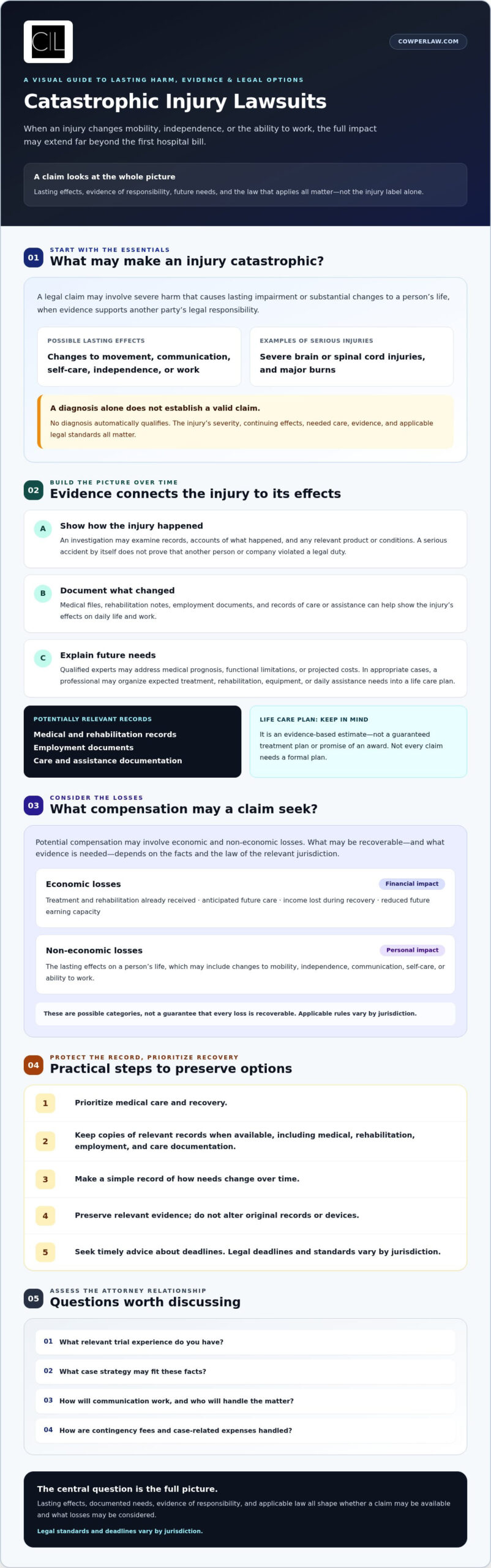
Recovery comes first. A catastrophic injury lawsuit shouldn’t require you or your family to put necessary care on hold. When possible, a few practical steps can help preserve information while you focus on health and support.
Organize useful information without making recordkeeping another burden. If the injured person agrees, a family member may be able to help gather documents or note changes in care needs and daily routines. Preserve relevant evidence lawfully. Don’t alter original records, discard potentially relevant items, or try to test, repair, or dismantle a product that may be involved.
If a medical device may have contributed to the injury, get preservation instructions from qualified counsel or investigators before handling or returning it. Details can matter. Cowper Law’s medical device manufacturer negligence explainer may provide relevant background when product involvement is part of the facts.
The time to file a lawsuit, or provide notice before filing, may depend on where the claim arises, the type of defendant, and other case-specific circumstances. Missing a deadline can affect legal options, so confirm the governing law with a qualified attorney as early as practical. The conversation can also clarify what evidence to preserve and which potential claims warrant investigation.
You don’t have to resolve every legal question alone while managing care and family needs. If you’d like to discuss possible next steps, contact Cowper Law about your catastrophic injury matter.
A lawyer can help bring order to a difficult process. Counsel may investigate how the injury occurred, identify potentially responsible parties, coordinate review of records and expert evidence, and assess which legal claims may fit the facts. An early evaluation can also clarify what information may be missing and which deadlines or preservation steps deserve attention.
Cowper Law represents people affected by catastrophic injuries and medical devices. A firm’s stated focus is one factor to consider, along with its approach to investigation, communication, and the needs of your case. No attorney can promise a particular result. An initial legal conversation can help you understand possible options and decide whether to proceed.
Ask how the attorney would investigate the incident, assess potentially responsible parties, and review the evidence. Find out who would handle the matter day to day, who would communicate with you or your family, and how updates are typically shared. You can also ask what records may be useful, what immediate actions to avoid, and what relevant trial experience the attorney brings to cases like yours.
Clear answers matter. Before deciding whether the relationship feels right, make sure you understand the proposed strategy, what remains uncertain, and what the next steps could involve.
Cowper Law describes its representation as contingency-based, with fees collected upon successful recovery. That doesn’t mean there are no potential case-related expenses or that recovery is guaranteed. Before signing, read the written agreement carefully and ask how fees are calculated, how expenses are handled, and what terms apply if there’s no recovery or circumstances change.
Make sure you have time to raise questions and understand the agreement in plain language. Fee terms and expense arrangements are case-specific, so confirm the details directly with the firm.
Choosing counsel is a personal decision, especially while medical and family needs remain at the forefront. If you’re considering a catastrophic injury lawsuit, discuss your circumstances and possible next steps with Cowper Law.
A catastrophic injury lawsuit should account for more than immediate bills. Lasting effects on care needs, work, and daily life may all matter, and thorough documentation can help tell that fuller story. Legal definitions, deadlines, and recoverable losses depend on the facts and applicable law.
Preserve relevant records when you can, keep medical care at the center, and ask a qualified attorney about your options and any time-sensitive requirements. Cowper Law handles catastrophic injury and medical device injury litigation, with personalized, contingency-based representation. Before entering an attorney relationship, review the written agreement and ask how fees, expenses, and case-specific terms work. No outcome is guaranteed.
If you’re weighing what to do next, talk with Cowper Law about your next steps. Ask about your circumstances and possible options, then focus on recovery one decision at a time.
It generally refers to a severe injury with lasting effects on a person’s function, independence, or ability to work, but legal definitions vary by jurisdiction. A severe brain or spinal cord injury or major burns may have profound consequences, yet no diagnosis automatically qualifies. The facts, medical evidence, long-term impact, and applicable law all matter. A lawyer can assess whether the injury and evidence may support a claim.
Possibly, but the answer depends on your family member’s circumstances and the applicable law. An adult with decision-making capacity generally makes choices about their own legal claim. If they can’t manage legal decisions, a court-appointed representative or another legally authorized person may need to act. A family member may also have different rights after a death. Ask an attorney who has authority to bring or manage a claim before taking action.
A catastrophic injury lawsuit may seek economic losses, such as injury-related medical care, rehabilitation, lost income, or reduced earning capacity, and non-economic losses, such as pain, emotional effects, and disruption to daily life. These are examples, not guaranteed recoveries. What’s legally available, what limits may apply, and what proof is needed depend on the facts and jurisdiction. Records and expert opinions may help substantiate individual losses.
There’s no single filing deadline that applies to every case. Limitation periods and any required advance notice can vary by jurisdiction, claim type, defendant, and other circumstances. Some claims may have shorter deadlines or special procedures, so don’t rely on a general rule or assume when time starts. Ask a qualified attorney to verify the deadline governing your situation as early as you can.
Future care needs may be supported by medical records, treatment history, a provider’s prognosis, and qualified expert opinions. In appropriate cases, a qualified professional may prepare a life-care plan projecting treatment, rehabilitation, equipment, or assistance needs. Such a plan is an evidence-based estimate, not a guaranteed course of care or an award. The evidence required and whether projected costs may be recoverable depend on the facts and applicable law.
Yes. If evidence suggests a medical device caused or contributed to serious harm, a claim may involve product-liability theories, depending on the facts and governing law. An investigation may examine the device, medical records, and the circumstances of its use. Preserve the device and related materials without altering, repairing, or discarding them, and seek qualified guidance about handling. A device injury alone doesn’t prove a manufacturer or another party is legally responsible.
With a contingency-fee arrangement, the lawyer’s fee is generally tied to a successful recovery rather than paid as an hourly fee. Cowper Law describes its representation as contingency-based, with fees collected upon successful recovery. That doesn’t mean there are no case-related expenses or guarantee that compensation will be recovered. Review the written agreement and ask how fees are calculated, how expenses are handled, and what terms apply to your case.