
If a product or drug may have contributed to your injury, you may be unsure whether your experience belongs in a larger lawsuit. A Mass tort litigation lawyer can review the connection between the product, your medical history, and the harm you report. Even when claims are coordinated, each person’s evidence and losses matter.
Before taking a step, you may have questions: Is this a mass tort or a class action? Does multidistrict litigation change your individual claim? Could a filing deadline apply, and what would representation involve? These cases can take time, so it helps to understand the investigation, costs, and process from the outset. Cowper Law represents people in drug and medical device injury matters through personalized trial advocacy. Legal fees are collected upon successful recovery under the firm’s contingency-based model.
This guide explains how mass tort cases work, how they differ from class actions and MDLs, and what to consider when choosing an advocate. It also covers records and details that can help an attorney evaluate a potential claim, why deadlines need attention, and practical ways to prepare for a conversation.
A serious injury can create medical, financial, and legal uncertainty at the same time. If you suspect a drug or medical device may be connected to what happened, you may wonder whether others have reported similar harm and what that means for your situation. A Mass tort litigation lawyer reviews your individual circumstances and assesses whether your potential claim may relate to broader litigation.
A mass tort is coordinated litigation involving multiple claimants who allege related harm from the same or similar conduct, product, or event, while each claimant’s circumstances remain distinct. The Mass tort overview describes the general concept, but the structure of a particular case depends on its facts and court decisions. Coordination can help address shared issues. It does not make every person’s evidence, injuries, or outcome the same.
In a mass tort, claims may be coordinated for parts of the litigation, while each person’s injuries and losses are generally assessed individually. A class action differs: one or more representatives may pursue claims on behalf of a defined class, subject to the court’s decisions about how the case proceeds. The applicable structure affects how claims are handled and what participation may involve. For more on the class action process, see this guide to joining a medical device class action lawsuit.
Related claims may also be handled together for certain proceedings without becoming one identical claim. The specific litigation and court orders determine how claims are grouped, what steps participants may need to take, and how individual circumstances are considered. No structure guarantees that a person qualifies or that all claimants will receive the same result.
An injury or diagnosis after using a drug or medical device does not, by itself, establish that the product caused the harm. An initial review may consider the product, when and how it was used, the diagnosis, treatment history, and timing of symptoms. Medical records and other documentation can help establish the sequence of events, though further investigation may be needed to understand the full picture.
A lawyer can assess the available facts, explain relevant legal options, and identify questions that need further review. Individual attention matters because two people may have used the same device or medication but have different medical histories, evidence, and legal circumstances. An evaluation can help organize those details without promising eligibility or a particular result.
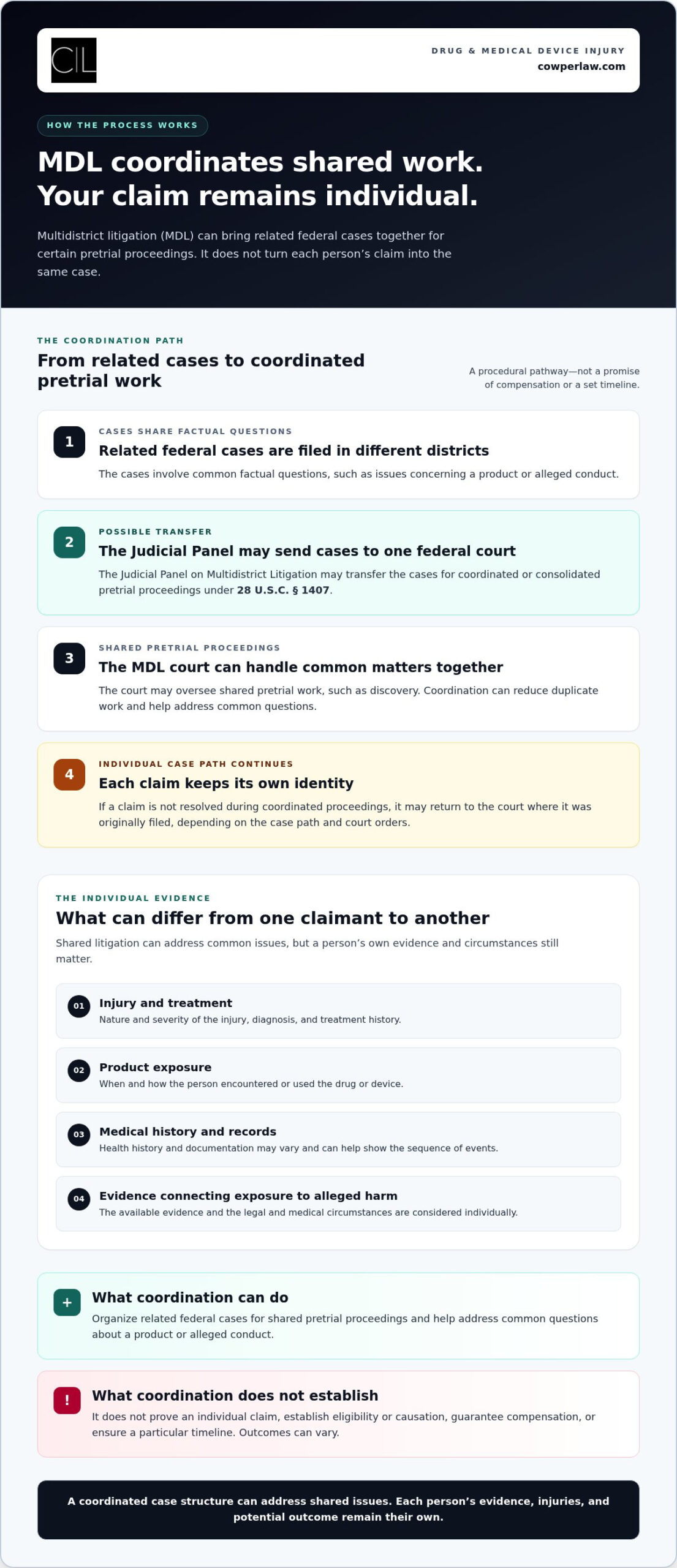
Coordinating related claims can help courts address shared questions more efficiently. It does not erase differences between people’s injuries or determine the outcome of any one claim. A mass tort may proceed through multidistrict litigation, often called an MDL. An MDL is a procedural tool, not a promise of compensation or a quick resolution.
When civil cases filed in different federal districts share factual questions, the Judicial Panel on Multidistrict Litigation may transfer them to one federal district court for coordinated or consolidated pretrial proceedings. This process is authorized by 28 U.S.C. § 1407. The court handling the MDL may oversee shared pretrial matters, such as discovery, while the claims retain their individual identities. The mass tort overview from Cornell Law School provides additional context on this type of litigation.
Coordination can reduce duplicate work and help resolve common questions about a product or alleged conduct. It does not mean the court has decided that every claim is valid. If a claim is not resolved during coordinated proceedings, it may return to the court where it was originally filed for further proceedings, depending on the case’s path and court orders.
Individual claims can turn on distinct evidence, including the nature and severity of an injury, medical records, when and how a person encountered a drug or device, and evidence connecting that exposure to the alleged harm. Treatment, health history, and the available documentation may also differ. Shared litigation can address common issues, but one claimant’s proof does not automatically establish another person’s case.
MDL coordination organizes related federal cases for shared pretrial proceedings; it does not establish an individual claimant’s eligibility, prove causation, guarantee compensation, or ensure a set timeline. A settlement may depend on the evidence and legal developments in a particular case, and trial outcomes can vary. Even when parties negotiate a broader resolution, the process for evaluating claims and potential payments may account for individual circumstances.
A Mass tort litigation lawyer can explain what coordination means for your claim, which issues may be handled together, and what remains individual. If you are weighing a drug or medical device injury claim, learn about Cowper Law’s injury representation and how personalized case review can help clarify your next steps.
Choosing counsel is not about finding the boldest promise or the most impressive marketing. A Mass tort litigation lawyer should explain how they will examine your circumstances, what they know about drug or medical device injury litigation, and how they will keep you informed. For background on the legal structure, Cornell Law School’s Legal Information Institute explains what is a mass tort. Rankings and promotional statements can offer context, but they cannot determine whether your individual claim is viable.
Legal fit depends on your case facts, the proposed strategy, and your communication needs. Use a conversation with counsel to understand how those factors will be assessed. Specific answers about the review process are more useful than broad claims about experience or outcomes.
Look for relevant work involving drug injuries, medical devices, or similarly complex injury claims. Ask how an attorney would review the records, product history, and injury evidence in your situation. A useful answer should describe an evaluation process rather than assume that similar allegations make every claim alike.
Cowper Law is a trial firm representing people alleging harm from drugs and medical devices. Its approach centers on personalized advocacy and careful review of each person’s injury, records, and legal circumstances, without assuming a particular result.
| What to compare | Questions that get beyond broad claims |
|---|---|
| Relevant experience | What drug, device, or complex injury matters have shaped your approach to evaluating a claim like mine? |
| Investigation | What records or product details would you review, and how would you assess evidence connecting exposure and injury? |
| Individual attention | How will my medical history, treatment, and specific losses be considered separately from shared allegations? |
| Communication | Who will explain case developments, and how can I raise questions or share new information? |
| Fees and expenses | How does the contingency arrangement work, when are legal fees collected, and how are case expenses addressed? |
Cowper Law uses a contingency-based fee model, with legal fees collected upon successful recovery. Before deciding on representation, review the written fee terms and understand how case expenses are treated. Ask how the firm communicates, who will discuss key decisions with you, and what uncertainties remain. Clear answers should explain the process without promising compensation, a specific timeline, or a successful outcome.
You do not need a complete file or perfect timeline before discussing a possible claim. A few details can help a Mass tort litigation lawyer understand what happened and identify what needs closer review. Gather what is readily available, but do not delay necessary medical care or put off treatment to collect documents.
Start with what you already have. Keep copies together and preserve original records and communications without editing them. If information is missing, note what you remember and what you may need help locating.
Use the conversation to understand how the firm would assess your specific facts, not just whether your situation sounds similar to other claims. Consider asking:
It is reasonable to ask for plain-language explanations. You should leave with a clearer understanding of what is known, what needs more investigation, and which deadlines may require attention. Preparing notes can make the discussion more focused, but you do not need to resolve every uncertainty on your own.
Discuss your drug or medical device injury concerns with Cowper Law to explore what information may help assess your circumstances.
When a drug or medical device may be connected to a serious injury, a careful review can help clarify what happened, what the records show, and what legal options may apply. Cowper Law is a trial firm representing people who allege harm from drugs and medical devices, with advocacy shaped around each person’s circumstances.
Cowper Law represents individuals in medical device injury, drug injury, catastrophic injury, and wrongful death matters. These cases can involve complex medical histories, product information, and legal questions. The firm’s approach is grounded in personalized support and close review of each person’s injury, records, and legal circumstances, rather than assuming that similar allegations make every claim the same.
For someone concerned about a spinal cord stimulator, the device’s history, the timing of treatment, and the reported injury may all be relevant to an initial evaluation. Read this spinal cord stimulator recall lawyer guidance for information specific to that device issue.
A Mass tort litigation lawyer can assess how an individual claim relates to broader proceedings while keeping the person’s own evidence and losses in view. Shared allegations may provide context, but they do not determine whether a specific person has a viable claim or what its outcome may be.
A potential case discussion can begin with details you already have, such as the drug or device involved, approximate dates of use, diagnosis, treatment, and records or communications related to the injury. You do not need every document in hand. A legal evaluation considers the available facts and evidence, along with deadlines that may apply to the particular claim and jurisdiction. It should not rest on assumptions or promises.
Cowper Law uses a contingency-based fee model, with legal fees collected upon successful recovery. This does not guarantee a recovery. The terms of representation should be clearly explained so you understand what they involve. A discussion can focus on your circumstances, questions, and the information that may be useful to review.
Discuss your potential mass tort claim with Cowper Law and learn what next steps may fit your situation.
Choosing a Mass tort litigation lawyer means looking beyond broad promises. Consider whether counsel will examine your injury, records, product history, and legal circumstances, and explain the process clearly. Related claims may be coordinated, but your evidence and potential outcome remain specific to your case.
Cowper Law is a trial firm representing individuals who allege harm from drugs and medical devices. The firm provides personalized legal advocacy and support through a contingency-based model in which legal fees are collected upon successful recovery. That arrangement does not guarantee eligibility or a particular result, so it is important to understand the terms and possible next steps.
You do not need every answer or document ready to begin a discussion. Sharing what you know can help bring relevant questions into focus, including deadlines that may apply to your circumstances. Discuss your potential mass tort claim with Cowper Law to explore possible next steps.
A mass tort litigation lawyer evaluates an individual’s potential claim and may represent them in litigation involving other people alleging related harm. The lawyer reviews information such as medical records, product exposure, injury history, and relevant deadlines, then explains possible legal options and the steps involved. If claims are coordinated, the lawyer can help the client understand which issues are shared and which parts of the case remain specific to them.
A mass tort generally involves multiple individual claims that may be coordinated because they raise related issues. In a class action, one or more representatives bring claims on behalf of a defined group, subject to court decisions about the class. The structures can affect how a person participates and how claims are assessed. Similar allegations do not mean every person has the same evidence, injuries, or potential outcome.
Using a product alone does not establish that you have a claim, and diagnosis or other medical information may be important to an evaluation. The relevant facts depend on the specific litigation and legal requirements. If you have concerns, keep available product information and seek appropriate medical care. A lawyer can review your circumstances and explain what evidence may be relevant without assuming you qualify or advising you to delay treatment.
Look for relevant experience with drug, medical device, or similarly complex injury litigation, and pay attention to how the lawyer discusses your individual facts. Ask how they would review medical records, product history, and evidence of injury, and how they will communicate updates. Request a clear explanation of representation terms, fees, expenses, and possible case stages. Rankings or broad marketing claims cannot determine whether your particular claim is viable.
Fee arrangements vary, so review the written terms before deciding on representation. Cowper Law uses a contingency-based model, with legal fees collected upon successful recovery. This does not guarantee a recovery. Ask how the agreement addresses legal fees and case expenses, when amounts may be collected, and how any recovery would be handled. Do not rely on a general estimate or assume every firm uses the same arrangement.
A mass tort case can take years, and timing varies with the litigation, evidence, court schedule, and whether claims resolve through settlement or proceed further. A traditional timeline from filing to distribution of settlement funds may be around two to five years, but that is not a prediction for an individual claim. Ask counsel what stages may apply and how the firm will share meaningful updates as the case develops.
If a settlement is reached, the agreement and any applicable court process shape how claims are reviewed and resolved. A settlement does not necessarily mean every claimant receives the same amount or that every claim qualifies. Your lawyer can explain any required documentation, how your individual injuries and evidence may be assessed, what terms you would be asked to accept, and how fees and expenses are addressed before you make decisions.