
In the first seven months of 2026 alone, the FDA recorded 1,836 medical device recalls, a staggering 28% increase from the previous year. If you're one of the thousands facing the physical pain, mounting medical bills, and emotional exhaustion caused by a failing implant, you aren't just a statistic; you're a person who deserves to be heard. You may be searching for how to join a medical device class action lawsuit to hold a powerful manufacturer accountable for the harm they've caused. The legal path often feels like a maze of complex filings and confusing terminology, but you don't have to walk it alone.
We understand that the weight of a revision surgery and the stress of financial recovery can feel overwhelming. You deserve a partner who is fierce, dedicated, and deeply committed to your cause. This guide provides the exact steps to seek justice, helping you move from a place of uncertainty to a position of strength. We'll explore the critical differences between class actions and multi-district litigation, explain how to preserve evidence, and show you how to secure the compensation you need for your medical bills and peace of mind.
A Class Action Lawsuit is a strategic necessity in the face of corporate negligence. It's a procedural tool that allows one or more individuals to stand as "class representatives," seeking justice on behalf of hundreds or thousands of others who've suffered similar harm. When a medical device fails, it rarely happens in isolation; these lawsuits consolidate those shared experiences into a single, formidable legal action. Understanding the mechanics of these cases is the first step in learning how to join a medical device class action lawsuit effectively.
To be certified by a court, a class must meet four strict legal requirements. These aren't mere suggestions; they're the foundation of a valid claim. The criteria include:
The ultimate goal is accountability. Large medical device manufacturers possess nearly limitless resources, and they can be dismissive of individual complaints. By joining forces, patients transform from isolated voices into a collective force that cannot be ignored. We are dedicated to ensuring that these giant corporations answer for their defects, providing the financial recovery needed for revision surgeries, medical bills, and long-term peace of mind. This collective strength is essential for patients who might otherwise be ignored by the legal departments of multibillion-dollar entities.
Being a class representative is a serious commitment. This individual is the "face" of the litigation. They must have suffered the same type of injury as the rest of the class and be willing to participate actively in the legal process. While they carry more responsibility, their success often dictates the outcome for the entire group. It's a role for someone who wants to lead the charge for justice, acting as a constant companion for others in the same struggle.
Many types of technology fall under this legal umbrella. Implants often top the list, including failing hip replacements, defective knee components, and complications arising from hernia mesh revision surgery lawsuits. Monitoring tools like faulty insulin pumps subject to the Tandem t:slim X2 insulin pump lawsuit and inaccurate glucose monitors can lead to life-threatening complications. Finally, life-sustaining equipment such as ventilators or cardiac devices like pacemakers often result in catastrophic outcomes when they fail to perform as promised.
Many people begin their journey for justice by asking how to join a medical device class action lawsuit, but the legal landscape for medical injuries is often more nuanced. A class action is a powerful tool designed for situations where everyone suffered the exact same harm, such as a financial overcharge. In these cases, a single verdict or settlement is reached and then split among all members of the class. However, medical device failures are deeply personal. They involve unique bodies, varying recovery times, and different levels of permanent disability. This is why most complex medical litigation moves toward Multidistrict Litigation (MDL) rather than a traditional class action.
An MDL consolidates hundreds or thousands of individual lawsuits before a single judge to streamline the discovery, evidence, and strategy phases. While the cases are grouped together for efficiency, they remain separate. This distinction is vital because it ensures that your specific medical history and the severity of your pain are not lost in a crowd. Once the discovery phase is complete, the court often schedules "Bellwether Trials." These initial trials serve as a litmus test for the entire group, providing the data, leverage, and momentum needed to negotiate settlements that reflect the true cost of the manufacturer's negligence.
We believe in a "Compassionate Warrior" approach that prioritizes your individual story. MDLs are often the preferred path because they preserve your right to prove your specific medical damages. You aren't just a number in a database; you're a person who has endured physical pain, financial stress, and emotional trauma. Our firm has extensive experience as a spinal cord stimulator recall lawyer, navigating the intricate web of MDLs to ensure our clients receive a recovery that actually covers their revision surgeries and long-term care needs. If you're caught in the confusion of a recall, scheduling a conversation with our team can help you decide which legal path best protects your future.
The settlement structures between these two formats vary significantly. In a class action, the recovery is typically distributed on a pro-rata basis, meaning everyone gets a similar slice of the pie regardless of their specific injury. In an MDL, settlements are usually tiered or individually assessed based on the severity of the harm. Legal fees also follow different rules; MDLs often utilize a "common benefit fund" to cover shared costs while allowing your individual attorney to focus on your specific case. While a class action results in one binding judgment for all members, an MDL consolidates cases only for pretrial proceedings while allowing each plaintiff to maintain their individual lawsuit.
Deciding how to join a medical device class action lawsuit requires a clear-eyed assessment of your specific injury. If your device failed but caused only minor inconvenience or minor economic loss, a class action provides an efficient, collective path to recovery. However, if the failure resulted in catastrophic bodily harm, an individual claim or a position within an MDL is almost always the superior choice. Understanding the key distinctions when weighing a class action vs individual lawsuit for medical device injuries can be the difference between a recovery that covers your needs and one that falls critically short. You must also consider "pre-emption" laws, which large manufacturers often use as a shield. These laws can sometimes bar lawsuits against devices that received specific types of FDA pre-market approval, making it vital to have an advocate who understands how to pierce that corporate defense.
Time is your greatest enemy in medical litigation. Statutes of limitations vary across the country, and missing a deadline means your right to seek justice is gone forever. For example, as of 2026, Florida has reduced its negligence statute to two years, while Utah recently extended its medical malpractice discovery period to four years. Because these laws are in constant flux, you shouldn't wait for your symptoms to worsen before seeking advice. Joining an established litigation often provides a strategic advantage because the heavy lifting of discovery and expert testimony has already begun, allowing you to step into a moving stream of justice rather than trying to divert the river yourself.
A class action is the ideal vehicle when the harm is uniform and purely financial. If a manufacturer overcharged thousands of patients or if a device has a widespread defect that doesn't cause physical injury but requires a low-cost replacement, the class action format is efficient. It allows the court to resolve thousands of identical claims through one single legal action, ensuring that even victims with smaller claims get their day in court against a massive corporation. This collective approach provides a sense of order and shared strength during a process that can otherwise feel isolating.
When the stakes involve your life, your mobility, or your future, a personalized approach is non-negotiable. Catastrophic failures, such as those discussed in relation to BioZorb lawsuit settlement amounts, require a deep dive into your specific medical records, revision surgeries, and long-term prognosis. In cases involving wrongful death or permanent disability, you aren't just another member of a class; you're a person who has lost everything. Families who have lost a loved one to a defective implant or life-sustaining device should consult a wrongful death medical device lawyer to understand the full scope of accountability available to them. We are trial lawyers who believe that high-stakes injuries demand a relentless, tailored strategy that high-volume settlement mills simply cannot provide.
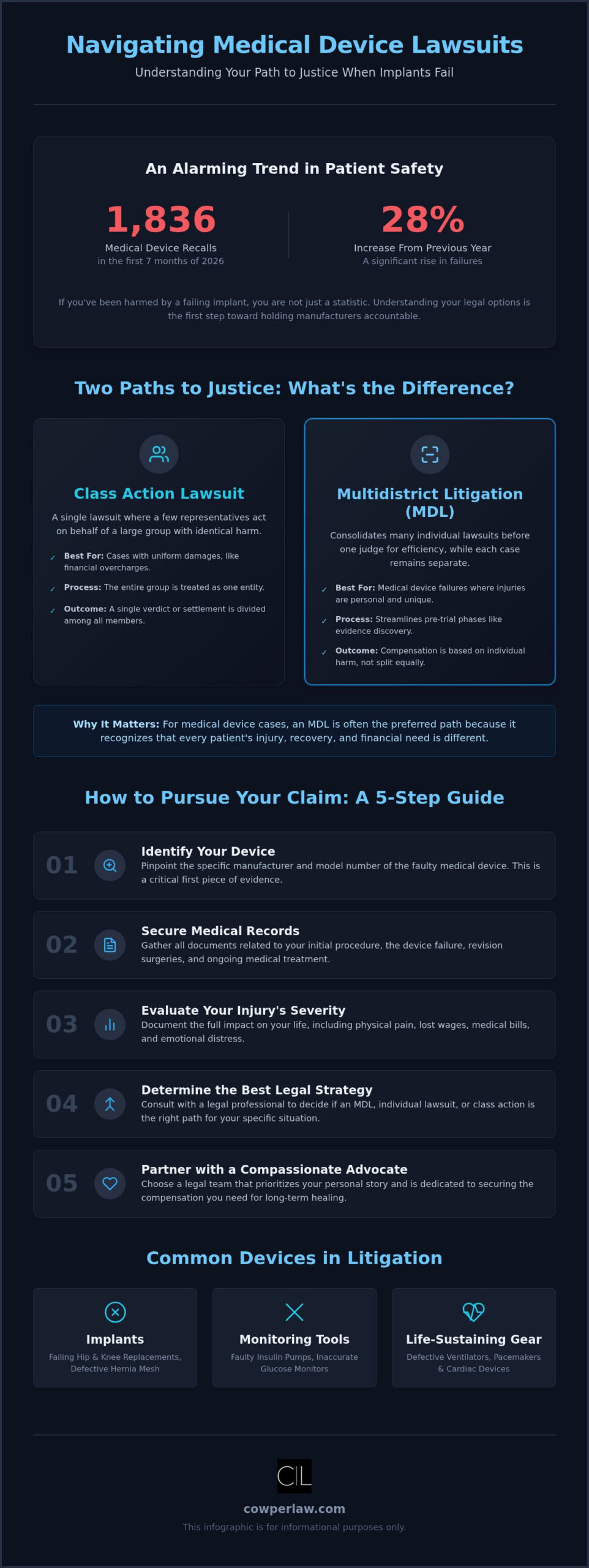
Moving from the realization of harm to the pursuit of justice requires a methodical, steady, and strategic approach. If you're wondering how to join a medical device class action lawsuit, you must understand that the process is built on evidence and timing. You aren't just filing paperwork; you're building a narrative of accountability against a corporation that failed in its duty to protect you. Following a clear roadmap helps replace confusion with clarity, providing a sense of order during what is often a chaotic time in your life.
The journey toward recovery typically follows these five essential steps:
Once your case is moving, the discovery phase begins. This is where we build your "David vs. Goliath" case by using your medical history to prove the manufacturer's negligence. It's vital to document every symptom, every doctor's visit, and every day you're unable to work or enjoy your life. Medical device lot numbers are the most critical piece of evidence because they definitively link your specific injury to a defective batch manufactured by the corporation. This level of detail transforms a pile of records into a powerful tool for justice.
Legal procedures vary depending on the court's certification of the class. In some class actions, you're automatically included unless you choose to "opt-out" to protect your right to sue individually. This is a critical decision because a class settlement might not fully cover catastrophic injuries. Missing a court-mandated deadline can strip away your right to seek further compensation, leaving you with a recovery that doesn't match your needs. If you're ready to take the first step toward holding these entities accountable, contact Cowper Law today to discuss your specific journey toward justice.
We are a national trial firm defined by a total certainty in our mission. We are not a high-volume settlement mill; we are trial lawyers dedicated to your unique story. While other firms might treat your injury as a case number in a database, we view it as a personal journey toward accountability. Taking on the largest medical device manufacturers in the world requires more than just legal knowledge; it demands a sophisticated blend of intellect, strategy, and heart to dismantle the defenses of multibillion-dollar corporations. We are the fierce, dedicated defenders you need when facing a corporate giant.
Our "Compassionate Warrior" approach provides the stability and reassurance you need during a time of physical and emotional crisis. We balance the toughness required for high-stakes litigation with the softness required for genuine client support. This philosophy ensures that you aren't just another name in a process about how to join a medical device class action lawsuit, but a partner in a strategic fight for justice. Understanding how to join a medical device class action lawsuit is often the first step on a long road, and we are here to ensure that journey leads to the recovery you deserve. Because we operate on a contingency-fee model, our interests are perfectly aligned with yours. We only win when you do, which reinforces our commitment to persistence, loyalty, and strength throughout the life of your claim.
We believe that every individual harmed by a defective device deserves an advocate who is personally and emotionally invested in the outcome. Our firm maintains a specialized focus on complex litigation, including spinal cord stimulators and breast implant litigation. We possess the national reach necessary to handle these intricate cases while maintaining the personalized, high-end service of a boutique practice. During the chaos of a medical failure, we provide the order, clarity, and peace of mind you need to focus on your recovery while we handle the legal battle.
The first step in your recovery is understanding the strength of your claim. During your initial free consultation, we take the time to listen to your experience and evaluate the evidence against the manufacturer. We don't offer generic advice; we provide a tailored assessment of your legal options and a clear path forward. If you're ready to hold a negligent corporation accountable for the harm they've caused, Contact our team for a case evaluation. We are ready to stand as your constant companion from the beginning of this process to the very end.
You've endured physical pain and the stress of a failing device; now it's time to shift the burden back to the manufacturer. By understanding the distinction between collective class actions and individual-focused MDLs, you've equipped yourself with the knowledge needed to make a strategic decision. Knowing how to join a medical device class action lawsuit is the first step toward reclaiming your peace of mind and holding powerful corporations accountable for their negligence. Accurate documentation and timely legal action are the pillars of your recovery.
We are trial lawyers who focus on catastrophic medical device failures, providing a national reach with a deeply personal, human-centered approach. Our firm operates on a contingency-fee basis, which means you pay nothing unless we successfully recover for you. We are dedicated to being your constant companion through this legal journey, offering the strength, strategy, and loyalty required to secure your future. Contact Cowper Law today for a free, confidential case evaluation. You don't have to face this giant alone; we are ready to stand with you and fight for the justice you deserve.
Yes, you can pursue legal action even without an official recall. Recalls are regulatory actions that often lag behind real-world injuries reported by patients. If you've experienced pain, infection, or device failure, your medical records serve as the primary evidence. When you're researching how to join a medical device class action lawsuit, remember that proving a defect requires rigorous investigation, not just an FDA notice. We focus on the human impact of these failures.
Joining a lawsuit with our firm involves no upfront costs or hourly fees. We operate on a contingency-fee basis, meaning our interests are perfectly aligned with yours from day one. We take on the financial risk of litigation against massive corporations so you don't have to. You'll only pay a percentage of the final recovery if we successfully secure compensation for your medical bills and suffering. This model ensures justice remains accessible to everyone.
Settlement amounts vary significantly based on the specific facts of each case. Factors that influence recovery include the severity of your physical harm, the cost of revision surgeries, and the long-term impact on your quality of life. While class actions result in a shared settlement, Multidistrict Litigation often allows for individual assessments of damages. We fight for a result that reflects the true human cost of the manufacturer's negligence rather than a generic average.
The time you have to act depends on your state's statute of limitations, which can range from one to six years. For instance, Florida recently reduced its negligence deadline to two years in 2023, while Louisiana extended its personal injury limit to two years in 2024. Because these deadlines are strict and vary, you should consult an attorney immediately. Waiting too long can permanently bar your right to hold the manufacturer accountable for your injuries.
A class action treats a large group as a single entity with one shared verdict. In contrast, a mass tort, often handled through Multidistrict Litigation, involves individual lawsuits that are consolidated only for pretrial proceedings. This distinction is critical when learning how to join a medical device class action lawsuit. Mass torts allow for personalized damages based on your unique medical history, ensuring your individual story isn't lost in a high-volume, impersonal legal process.
Yes, you can hold foreign manufacturers accountable, though the process involves complex international laws. Manufacturers who sell devices in the United States must comply with federal regulations and can be sued in American courts. We have the expertise to navigate these jurisdictional hurdles, including serving legal papers across borders and managing international discovery. Don't let a company's headquarters prevent you from seeking justice for the harm caused by their defective, dangerous products.
Most medical device lawsuits are resolved through settlements before reaching a courtroom. However, we are trial lawyers who prepare every case as if it's going to trial. While you may need to give a deposition or provide records, few plaintiffs actually testify in court. If your case is selected as a bellwether trial in an MDL, your participation becomes more direct. We stand by you throughout every step, providing stability and constant support.
If a company files for bankruptcy, the litigation is typically paused by an automatic stay. However, this doesn't necessarily mean your path to justice is closed. Bankruptcy courts often establish victim compensation trusts to handle existing and future claims. We navigate these proceedings to ensure your claim is filed correctly within the bankruptcy structure. It's another reason why having a fierce, dedicated advocate is essential when taking on powerful, yet failing, corporate entities.