
Can your family sue if negligence contributed to your loved one’s death? A preventable loss may point to a legal claim, but grief and suspicion alone aren’t enough. Suing for wrongful death negligence generally requires evidence connecting someone’s failure to act with reasonable care to the death and the losses your family now faces.
It’s understandable to be unsure where to begin, especially when records are incomplete or a company or institution controls important information. This guide explains the negligence elements families generally must prove, who may be eligible to bring a claim, and what compensation may be available. It also outlines how evidence can support a case and why filing deadlines deserve prompt attention.
Wrongful death rules vary by state. Who can file, how long they have, and which damages may be recovered depend on the circumstances and applicable law. The sections ahead will help you identify practical next steps, preserve potentially important information, and decide whether to speak with a wrongful death lawyer. You don’t have to sort through every unanswered question alone.
Losing someone unexpectedly can leave a family searching for answers. But a death alone doesn’t establish negligence or automatically create a legal claim. A family may be able to sue when evidence indicates another party’s legally actionable conduct caused the death, and the person bringing the case meets the state’s filing rules.
A wrongful death case is a civil claim, generally governed by the law of the state connected to the circumstances. It seeks a legal remedy for losses resulting from a death allegedly caused by someone else’s conduct. The Wrongful death claim overview describes how these claims function in the United States, but it can’t determine whether a particular family has a case. Eligibility, procedure, and available damages depend on applicable state law.
The claim concerns a death allegedly caused by conduct the law recognizes as wrongful, not simply a tragic outcome. Examples might include a driver’s careless actions, an unsafe condition someone failed to address, or harm allegedly linked to a defective product. Each situation calls for evidence connecting the conduct to the death.
Grief and unanswered questions deserve care, but suspicion alone may not prove a claim. Records, witness accounts, or other case-specific information may help clarify what happened and whether the conduct was legally actionable. Even a serious injury or death following medical care, for example, doesn’t by itself establish that a provider was negligent. The facts need careful review.
State law determines who has the right to file. Depending on the jurisdiction, eligible claimants may include specified family members, a personal representative filing on behalf of others, or another person identified by statute. These rules can also affect how a case must be brought and who may benefit from a recovery.
Don’t assume that being a close relative automatically gives you the right to file, or that one person can act for the entire family. The answer may depend on the decedent’s circumstances, family relationships, and the state’s procedure. A lawyer familiar with wrongful death claims can review who may qualify and explain the next steps under the applicable law.
For families considering suing for wrongful death negligence, the central question is whether evidence can connect actionable conduct to the death, while satisfying the state’s requirements for claimants and procedure. A prompt, state-specific review can help clarify those issues without treating every tragic loss as legally identical.
A family generally must do more than show that a death followed an accident, medical event, or product failure. The claim must connect the defendant’s alleged conduct to the death through evidence. Cornell Law School’s Legal Information Institute describes wrongful death as a civil action arising when someone wrongfully causes someone's death. The precise legal test and how it applies can vary by state.
A common negligence framework asks whether the defendant owed a duty of care, breached that duty, caused the death, and thereby contributed to legally recognized damages. These are related questions, but each must be supported. Evidence that someone acted carelessly, for instance, may not by itself establish that the conduct caused the death.
Duty means a legal responsibility to act with reasonable care in the circumstances. What duty applies depends on the relationship, the conduct, and governing law. Breach means the person or organization allegedly failed to meet the applicable standard. Relevant evidence may include incident reports, policies, communications, maintenance records, or expert analysis, depending on the situation.
Hypothetical: If a property manager knew of a dangerous stairway condition but failed to address it, inspection records and reports about the hazard might help show what the manager knew and what steps were taken. That evidence alone wouldn’t establish a claim; the facts would also need to support the other elements.
Causation is the link between an alleged breach and the death. Factual causation asks whether the death would have occurred without the conduct; legal causation considers whether the death is sufficiently connected to that conduct under the applicable law. States may frame these questions differently. Evidence such as medical records, event documentation, photographs, and expert analysis may help explain what happened and whether the alleged breach contributed to the fatal outcome.
Damages are losses the law allows eligible claimants to seek. Depending on state law and the facts, they may include financial losses, such as lost support or expenses, and non-financial losses recognized by that jurisdiction. A careful assessment identifies the losses and connects them to the death, rather than assuming every category is available in every case.
For families considering suing for wrongful death negligence, organizing records and questions can help a lawyer evaluate the evidence element by element. A discussion with a wrongful death claims lawyer may help clarify what evidence could matter and how state law applies. No framework guarantees a result, but a disciplined investigation can reveal where the proof is strong, incomplete, or disputed.
The facts surrounding a death may raise more than one legal theory. A healthcare decision, for example, could involve questions about professional care and a device used during treatment. The right label isn’t obvious from the outcome alone. Counsel examines what happened, who may be responsible, and how the applicable state’s laws define each claim. Cornell Law School’s Legal Information Institute offers an overview of proving negligence, but state law governs how a specific case is evaluated.
| Possible claim | Typical allegations | Possible evidence and issues counsel evaluates |
|---|---|---|
| Negligence | A person or organization allegedly failed to use reasonable care, such as by creating or failing to address an unsafe condition. | Incident reports, photographs, witness accounts, policies, and whether the conduct caused the death. |
| Medical malpractice | A healthcare professional allegedly failed to meet a duty arising from their professional role. | Medical records, treatment timelines, and expert review; whether professional standards and special procedural rules apply. |
| Product liability or corporate negligence | A product allegedly caused harm because of a design, manufacturing, or warning issue, or company conduct or safety systems may require investigation. | The product and its records, warnings, testing or safety information, and evidence about company decisions. Legal theories and requirements vary by state. |
When a death occurs during or after healthcare, review may focus on the professional responsibilities involved and what the medical records show. An adverse outcome alone doesn’t prove malpractice. Expert analysis may be needed to assess the care, and some states impose special notice or filing rules. Those requirements vary, so families should seek state-specific review rather than assume one process applies everywhere.
If a product may have contributed to a death, investigation may examine its design, manufacture, warnings, and the company’s related conduct. Product liability rules differ from negligence rules and vary by jurisdiction; a product’s involvement doesn’t establish liability by itself. If a medical device may be involved, this wrongful death medical device litigation guidance may help families understand what issues could merit review.
For those considering suing for wrongful death negligence, overlapping theories may affect what records to preserve and which parties or decisions to investigate. A lawyer can assess the facts and applicable law before determining which claims, if any, may fit. The distinctions matter, but they don’t predetermine an outcome.
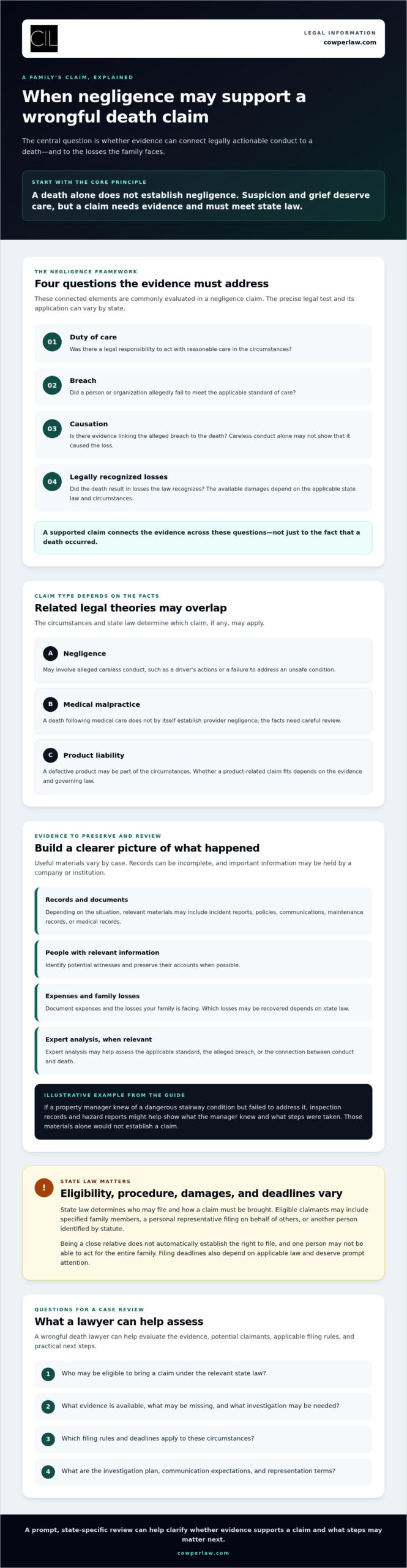
After a sudden loss, gathering records may feel like one more burden. Start with what’s available, and avoid trying to solve the entire case alone. Evidence can become harder to locate over time, while the deadline to file depends on the applicable law. These steps can help a lawyer assess what happened and identify what needs attention.
Useful materials may include medical records, employment and financial documents, incident reports, photographs, messages, and product labels or paperwork. Keep originals when possible and make a simple inventory rather than trying to interpret every record yourself. Note potential witnesses and key dates, including when an incident occurred and when important communications took place. Counsel can advise on lawful preservation and the process for requesting records you don’t have.
There’s no single nationwide filing deadline for wrongful death claims. Time limits and exceptions may depend on the state, defendant, claim type, and specific circumstances. A claim involving a government-related defendant may also have additional procedural requirements, such as a notice process, which must be checked under the relevant jurisdiction’s rules.
Don’t assume that negotiations, grief, or an ongoing investigation will pause or extend a deadline. A prompt review can help clarify which time limits may apply and whether additional steps are required. If your family is considering suing for wrongful death negligence, contact Cowper Law to discuss your circumstances and understand the representation terms. A lawyer can help organize the evidence and explain state-specific next steps, without promising a particular outcome.
After a preventable death, families may face unanswered questions, incomplete records, and uncertainty about what to do next. A wrongful death lawyer can help bring structure to that uncertainty. Counsel may assess whether evidence supports duty, breach, causation, and damages, then review who may be eligible to bring a claim and which deadlines or procedures could apply under state law.
An initial case discussion is also a chance to understand what remains unknown. A lawyer may identify records that need to be gathered, witnesses to locate, or further investigation to consider. If you’re thinking about suing for wrongful death negligence, you can ask for an explanation of the potential strengths and challenges without treating any result as guaranteed.
Bring a brief timeline and any records you already have, but don’t worry about having every answer. These questions can help you understand the proposed approach:
Cowper Law states that it handles cases on a contingency-fee basis, with legal fees collected upon successful recovery. Ask counsel to explain the written agreement, including how expenses are treated and what conditions apply, before deciding whether to proceed.
Cowper Law is a trial firm handling wrongful death and catastrophic injury matters. Its approach is described as personalized, compassionate, and results-focused. When the facts involve a company, medical device, or other alleged negligence, a careful investigation may help clarify which evidence and legal theories warrant review. No firm can promise a particular outcome, and each family’s circumstances require individual assessment.
If a medical device may have contributed to the death, learn more about medical device injury representation. If you’re ready to discuss your family’s circumstances and representation terms, you can choose to speak with Cowper Law. There’s no need to have every document or answer in hand to begin asking informed questions.
A wrongful death claim is not established by loss alone. The key question is whether evidence connects another party’s alleged conduct to the death, and whether the right person can bring a claim under the applicable state law. Evidence, filing rules, and available legal theories all deserve careful, case-specific review.
If you’re considering suing for wrongful death negligence, you don’t need to have every document or answer before asking for guidance. Cowper Law handles wrongful death and catastrophic injury litigation and can discuss how your family’s circumstances may be assessed. The firm states that legal fees are collected only upon successful recovery, but representation terms, including how expenses are handled, should be reviewed in the written agreement.
Discuss your family’s situation with Cowper Law if you’re ready to explore possible next steps. You can move forward at your own pace, with clearer information and support as your family considers what comes next.
Potentially, if the evidence and applicable state law support a wrongful death claim. Suing for wrongful death negligence generally requires showing that the defendant owed an applicable duty, breached it, and legally caused the death, resulting in recognized losses. A tragic outcome alone isn’t enough. State law also determines who may file and which procedures apply, so a lawyer should review the circumstances and potential deadlines promptly.
The person authorized to file depends on the state’s wrongful death statute. Some states allow specified family members to bring a claim, while others require a personal representative to file for eligible beneficiaries. Rules may also determine which relatives have priority and how any recovery is distributed. Don’t assume every relative has an independent right to sue; ask a lawyer to identify the rules that apply in the relevant jurisdiction.
A common negligence framework asks whether the defendant owed a duty, breached that duty, caused the death, and thereby caused legally recognized damages. The evidence and precise standards depend on state law and the circumstances. Medical or incident records, witness accounts, expert opinions, and other documentation may help establish parts of the claim. No single record or expert opinion guarantees that a case will succeed.
There’s no single nationwide deadline for filing a wrongful death lawsuit. Time limits may vary with the state, defendant, claim type, and circumstances, and some cases involve separate notice or procedural requirements. Waiting can affect both the filing window and access to useful evidence. Ask a lawyer to identify the applicable rules promptly; don’t assume discussions with the other party or an ongoing investigation pause a deadline.
Potential damages depend on state law, the facts, and who is eligible to recover. They may include certain financial losses and other losses recognized by the jurisdiction. A related survival claim may be separate from the wrongful death claim, with different damages or eligible parties. General online lists can’t estimate what a particular case may involve; a lawyer can explain which categories may apply and what evidence could support them.
Potentially, if evidence supports a company’s responsibility under the applicable law. An investigation may examine the company’s conduct, role in events, relevant records, and whether its actions legally contributed to the death. If a product or medical device was involved, product liability or other overlapping theories may warrant review. A company’s involvement alone doesn’t establish liability; available claims and proof requirements depend on the facts and jurisdiction.
Not necessarily. Some wrongful death cases may involve legal theories beyond negligence, such as product liability, and each theory can have different elements and proof requirements. The applicable law and evidence matter more than the label. An adverse outcome by itself doesn’t prove wrongdoing. A lawyer can review the circumstances, identify potentially relevant legal theories, and explain how state-specific rules may affect the family’s options.