
When a corporate giant releases a defective product, its defense relies on a cold calculation: that individual victims will feel too small, too exhausted, and too overwhelmed to fight back. You know the physical or financial harm is undeniable, but standing alone against deep-pocketed defense teams is a daunting task. Partnering with a dedicated class action lawsuit attorney levels the playing field, uniting individual voices into a formidable collective force for justice.
You shouldn't have to carry the cost of corporate misconduct while wondering if your claim is large enough to make an impact. This guide explains how trial counsel safeguards your rights, distinguishes collective class actions from individual mass torts, and pursues the full compensation you deserve. Below, we examine how to determine if you qualify, how the litigation process unfolds against corporate wrongdoers, and how contingency representation delivers relentless courtroom advocacy with zero out-of-pocket costs.
Corporate misconduct rarely strikes in isolation. When a manufacturer cuts corners, hides risks, or misleads the public, thousands of consumers suffer the exact same injustice. A class action lawsuit attorney acts as an equalizer in these David versus Goliath battles. Rather than forcing injured parties to fight costly individual skirmishes, counsel consolidates hundreds or thousands of identical claims into a single, unified legal action. We are trial lawyers committed to shifting the balance of power, conducting exhaustive investigations, drafting federal complaints, and demanding accountability from entities that prioritize quarterly profits over consumer safety.
Collective litigation relies on a partnership between brave individuals and experienced trial advocates. Lead plaintiffs step forward to represent the entire group, giving a human voice to the litigation while safeguarding the interests of absent class members. Under federal procedural rules, courts must formally vet class counsel to confirm they possess the trial skill, resources, and dedication required to protect the class. We carry the burden of the fight, deposing corporate executives, coordinating scientific testimony, and taking cases all the way to a jury verdict when corporate defendants refuse to take responsibility.
Modern class action lawsuits serve as private enforcement actions against institutional misconduct. By assuming the financial and logistical demands of complex litigation, your legal team shields you from the intimidation tactics routinely deployed by corporate defense firms.
A skilled class action lawsuit attorney pursues corporate wrongdoers across several distinct legal violations:
Holding large enterprises accountable demands relentless trial preparation. We build every claim on thorough evidence, clear legal strategy, and a commitment to restoring dignity and financial relief to everyday people harmed by corporate greed.
Corporate defense teams often hope injured consumers confuse their legal options. While both legal strategies hold negligent corporations accountable, their procedural mechanics and personal outcomes differ fundamentally. In a traditional class action, individual claims merge into a single collective lawsuit featuring one representative plaintiff and a shared resolution. In a mass tort, each plaintiff files a distinct individual lawsuit, coordinated through federal Multidistrict Litigation (MDL) for streamlined discovery. A knowledgeable class action lawsuit attorney evaluates the precise nature of your damages to select the legal path that maximizes your accountability and recovery.
To proceed collectively, a lawsuit must satisfy strict class certification requirements under Rule 23 in federal court. A presiding judge must confirm numerosity, commonality, typicality, and adequacy of legal representation. This procedural model suits cases where economic injury is uniform across every affected consumer, such as false advertising claims or deceptive software charges. Once a court certifies the class, the outcome binds every eligible member nationwide unless an individual formally opts out to pursue independent litigation.
Physical injury changes everything. When a defective product causes catastrophic harm, repeated surgeries, or permanent disability, uniform class treatment breaks down. Federal judges rarely certify personal injury classes because unique medical histories, preexisting conditions, and varied recovery timelines defeat Rule 23's commonality standards.
Instead, severe bodily claims proceed as mass torts. Centralized under federal statute 28 U.S.C. § 1407, these actions consolidate pretrial discovery while preserving your individual trial rights. If an unsafe health product or implant injured you, working with a dedicated medical device injury lawyer ensures your specific medical bills, pain, and lost income receive individualized trial representation. We are trial lawyers who recognize the personal trauma behind every claim, fighting relentlessly to ensure corporate negligence is met with full accountability. If you are uncertain which legal path fits your situation, connecting with our legal team provides immediate clarity and seasoned guidance.
Determining your eligibility for representative litigation begins with the court's precise "class definition." Judges do not grant blanket standing to anyone dissatisfied with a corporate brand. Instead, eligibility hinges on objective criteria, such as purchasing a specific item during a defined date range, experiencing a documented functional failure, or suffering an unaddressed economic loss. Understanding the institutional responsibilities of class action litigators helps clarify how attorneys establish these boundaries to withstand aggressive motions to dismiss by defense counsel.
Solid evidence anchors every successful legal claim. Corporate defendants routinely challenge consumer standing by demanding proof of purchase or verified use. To confirm your status within an active class, gather records that substantiate your interaction with the product or service:
For actionable steps on navigating complex product claims, consult our detailed guide on how to join a medical device class action lawsuit effectively. Maintaining organized proof protects your legal footing from day one.
When a court certifies a class or reaches preliminary settlement approval, official notices issue via certified mail, direct email, or nationwide digital publication. These documents outline your legal choices clearly:
You can remain in the class to receive your share of any court-approved monetary recovery, but this automatically waives your right to sue the defendant separately. Alternatively, you can file a formal opt-out notice within the strict court-ordered deadline. Doing so preserves your right to retain an independent class action lawsuit attorney to pursue individual claims. We are committed advocates who guide clients through these strategic crossroads, ensuring your legal actions match the true scope of your financial injuries.
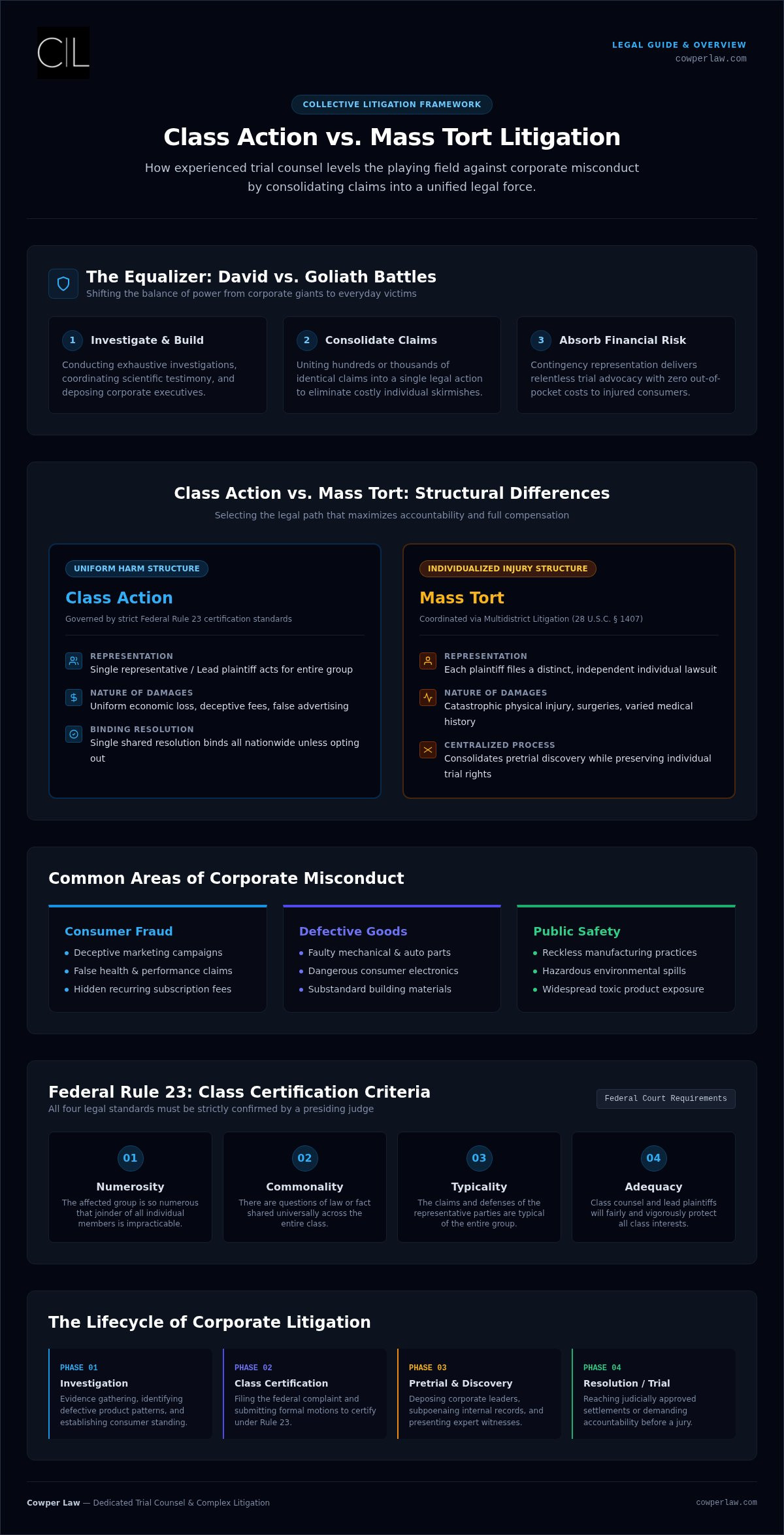
Holding a massive corporation accountable is never an overnight process. Major manufacturers commit millions of dollars to defensive legal strategies, aiming to drag out proceedings and exhaust plaintiffs before evidence reaches a courtroom. Navigating this multi-year marathon demands meticulous preparation, deep financial endurance, and unwavering courtroom resolve. A battle-tested class action lawsuit attorney anticipates procedural hurdles at every juncture, building an ironclad evidentiary foundation long before filing a formal complaint.
Real accountability begins when defense attorneys run out of procedural excuses to hide the truth. Once a complaint survives early motions to dismiss, the litigation enters the exhaustive discovery phase. Here, we force corporate defendants to open their private archives under court order:
We work closely with independent engineers, forensic accountants, and scientific experts to translate complex technical jargon into undeniable courtroom facts.
Corporate adversaries negotiate seriously only when they recognize opposing counsel is fully prepared to take the case to a jury. After class certification, parties often engage in court-ordered mediation. If a settlement agreement is reached, federal law requires a mandatory fairness hearing where the judge evaluates whether the terms provide genuine, adequate relief to affected members. The court closely scrutinizes claim distribution protocols, administrative expenses, and fee allocations to ensure consumers receive fair treatment.
We are trial lawyers who refuse to treat corporate malfeasance as routine paperwork. If a corporation refuses to offer full accountability, our team stands ready to bring the evidence directly before a jury. If corporate misconduct caused you financial harm, contact our trial team today to evaluate your legal options and join the fight for collective justice.
Selecting legal representation is the most consequential decision you will make in the fight against corporate overreach. Too many injured consumers fall into the trap of high-volume settlement mills, firms that collect thousands of digital intakes only to accept quick, discounted settlements that avoid the courtroom entirely. You deserve an advocate with real trial grit, someone who treats your struggle with genuine empathy and possesses the resources to go toe-to-toe with corporate titans. A proven class action lawsuit attorney brings the intellectual caliber required for federal multidistrict battles alongside an unwavering personal commitment to your recovery.
An initial conversation should give you absolute clarity about how a firm operates and who actually directs your legal fight. To separate authentic trial advocates from passive case processors, demand direct answers to key questions:
Direct answers indicate transparency. If a law firm dodges questions about courtroom experience, you should look elsewhere.
Financial barriers should never stand between an injured person and justice. We represent clients strictly on a contingency fee model, meaning you pay zero out-of-pocket costs to initiate or sustain your legal fight. Our firm advances all litigation expenses, including filing fees, extensive discovery production, and specialized expert witness retainers, fully insulating your family from personal debt.
Federal procedural rules provide vital consumer safeguards in representative suits. The presiding judge directly oversees, evaluates, and approves all attorney fee percentages to confirm they are fair and proportional to the benefit delivered to the group. Under this model, your class action lawsuit attorney recovers legal fees only when they secure a successful financial verdict or court-approved settlement. We are trial lawyers proud to shoulder the financial risk of litigation, aligning our dedication entirely with your pursuit of full, meaningful accountability.
Corporate misconduct relies on silence, fatigue, and isolation. When powerful manufacturers harm everyday consumers, collective litigation balances the scales of justice. Uniting your voice with hundreds of others transforms an individual struggle into an undeniable legal force, whether pursuing shared financial relief through collective claims or holding corporate boards accountable for widespread negligence.
Securing the justice you deserve requires more than routine paperwork; it demands relentless courtroom preparation. Partnering with a dedicated class action lawsuit attorney ensures your claim is guided by advocates who refuse to back down when corporate defense teams push back. We are trial lawyers committed to standing beside you nationwide, pairing uncompromising courtroom strength with attentive, compassionate care. Because we work strictly on contingency, you pay zero out-of-pocket legal fees while we shoulder the entire financial weight of the fight.
You don't have to carry this burden alone. Request a Free Case Evaluation with Cowper Law to take a decisive stand, reclaim your peace of mind, and demand the full accountability you are owed.
Hiring a class action lawsuit attorney costs nothing out of pocket. Reputable trial firms operate strictly on a contingency fee model, meaning legal fees are deducted exclusively from a successful verdict or settlement. The firm advances all litigation expenses, including court filings, expert witness retainers, and document discovery. A presiding federal judge must review and approve all proposed attorney fees to ensure the recovery remains fair for the entire class.
The main difference lies in how individual claims are grouped and resolved. A class action combines hundreds of identical claims into a single legal action with one shared settlement or verdict, which works well for uniform economic losses. A mass tort treats every injured person as an individual plaintiff. While cases coordinate in Multidistrict Litigation for pretrial discovery, each victim receives a distinct financial evaluation reflecting their unique physical injuries and medical expenses.
You can identify active litigation by checking federal court dockets, official consumer protection registries, and legal notice databases. When a court certifies a class or grants preliminary settlement approval, administrators issue formal notices via direct mail, email, or digital publication to identifiable consumers. Speaking directly with an experienced attorney is often the fastest way to confirm whether your product defect is part of an active proceeding.
Yes, you can file an independent lawsuit, provided you submit a formal opt-out notice before the court-ordered deadline. If you do not opt out, you remain bound by the class judgment or settlement, which permanently releases the defendant from further liability. Consumers who suffered severe physical harm or substantial economic damages often choose to opt out to pursue personalized claims rather than accept a standardized class distribution.
Settlement distribution follows a court-approved plan of allocation designed to compensate members equitably. In simple consumer disputes, participants often receive equal payments or automatic refunds. In more complex matters, funds are distributed through a tiered claims matrix based on documented losses, such as repair invoices or purchase volume. Lead plaintiffs may also receive an additional court-approved service award to acknowledge their active role in assisting counsel.
A federal class action lawsuit typically takes two to five years from the initial filing to final fund distribution. Corporate defendants routinely file early motions to dismiss, engage in extensive discovery battles over internal records, and aggressively contest class certification under Rule 23. If the parties negotiate a resolution, the court requires additional months to notify class members, host a final fairness hearing, and review administrative claims.
Most participants never set foot in a courtroom or give a deposition. Absent class members simply file a valid claim form online to collect their share once a settlement receives final approval. Only the court-appointed lead plaintiffs who represent the broader group participate directly in litigation by answering formal written questions, producing personal records, and sitting for depositions with a skilled class action lawsuit attorney protecting their interests.