
Does needing another operation mean your implant was defective? Not by itself. A revision surgery due to faulty implant lawsuit claim may involve important evidence, but the procedure alone doesn’t prove a defect or establish who caused the harm. The reason for revision, the device’s condition, and other possible causes all matter.
Facing another surgery or a difficult recovery can leave you worried about what went wrong and whether you have a legal claim. A careful review of the medical and device evidence can help distinguish a potential device-related injury from a complication with another explanation.
This article explains when revision surgery may support an implant injury claim, what evidence may matter, and how medical records can help establish the sequence of events. It also covers preserving information about an explanted implant, when possible, and why filing deadlines vary by state. Your health comes first: don’t delay recommended care to preserve evidence. Cowper Law represents people harmed by medical devices and evaluates each person’s records, circumstances, and applicable law.
Another operation can bring physical strain and questions about what went wrong. Follow your treating clinician’s guidance and seek urgent care for urgent symptoms. You can consider legal questions alongside medical care; revision surgery should not be delayed for the sake of a potential claim, and the operation does not automatically mean someone is at fault.
Revision surgery is a procedure to remove, replace, or repair an implant or the tissue around it. It is a medical response, not a legal finding that the implant was defective. A challenging recovery or known complication may be part of the medical picture. A potential claim requires more: evidence of an injury, a legally relevant defect or other basis for liability, and a connection between that issue and the harm.
Revision may be considered when an implant does not function as intended, shifts from its position, or is associated with infection, persistent pain, or another complication. A surgeon may also recommend repair or replacement to address surrounding tissue. The reasons vary by implant, a person’s medical history, and the course of treatment.
The broad topic of implant failure includes different ways an implant may stop functioning as intended, but a general definition cannot explain what happened in an individual case. Pain or a change in function deserves medical attention, but does not, by itself, establish that a device was defective. The treating team’s examination and records can help explain why revision was recommended.
No. Revision is one fact in a larger investigation, not a legal conclusion. An implant may need replacement for reasons unrelated to a product defect, and complications can occur even when a device performs as intended. The circumstances matter, including what the implant was designed to do and what clinicians observed before and during revision.
A careful assessment separates possible explanations rather than treating them as interchangeable. Questions may concern the device’s design or manufacturing, how it was placed, a patient-specific factor, or another medical cause. The evidence may also raise questions about diagnosis, surgery, or follow-up care. Which legal theory applies depends on the facts and governing law.
For someone considering a Revision surgery due to faulty implant lawsuit, the useful starting point is the full account of the implant, symptoms, clinical findings, treatment decisions, and resulting harm, not the second operation alone. Revision can prompt a closer investigation, but the evidence must support a connection between a potential device problem and the injury. That distinction keeps medical needs central while legal questions are assessed carefully.
Revision records can describe what clinicians observed and how those findings shaped treatment. They may document the implant’s position or condition, tissue changes, infection, or other complications. This information can help establish a timeline, but a medical finding and a legal conclusion are not the same thing.
No single record automatically establishes every element of a claim. Evidence generally must support that the person suffered an injury, that a legally relevant defect or other basis for liability existed, and that it caused the injury and resulting losses. Records of pain, additional treatment, or time away from usual activities may help show harm and its effects. They do not necessarily prove the implant was defective or explain what caused the problem.
A focused review may include operative reports from the original implant procedure and revision, imaging, pathology results, discharge summaries, and the clinician’s recommendation for further treatment. Implant identification details, device records, and available packaging or patient materials can help establish which device was used. If the implant was removed, information about its condition and handling may also be relevant.
Records are most useful when considered together. Comparing earlier imaging, later symptoms, and revision findings may help clarify when a change appeared and what clinicians concluded at each stage. Keeping copies organized by date makes it easier to trace that sequence during a legal review.
Depending on the evidence and applicable law, a case review may consider whether a concern relates to device design, manufacturing, warnings, or performance. Medical expertise may help interpret clinical findings, assess how an alleged device problem could have caused a specific injury, and consider other possible explanations, such as surgical technique or patient-specific factors.
Expert analysis does not guarantee a result. An opinion must be grounded in the available records and relevant facts, and experts may assess the same evidence differently. A Revision surgery due to faulty implant lawsuit therefore requires a careful connection between device evidence, medical findings, and documented losses, rather than an assumption based on revision alone.
A practical first step is to gather the records you already have and note which documents or device details may be missing. A legal review can compare the timeline, revision findings, and available device information with the requirements that apply to the claim. Cowper Law represents people harmed by medical devices and can assess the specific facts and records. Learn more about the firm’s medical device injury litigation team.
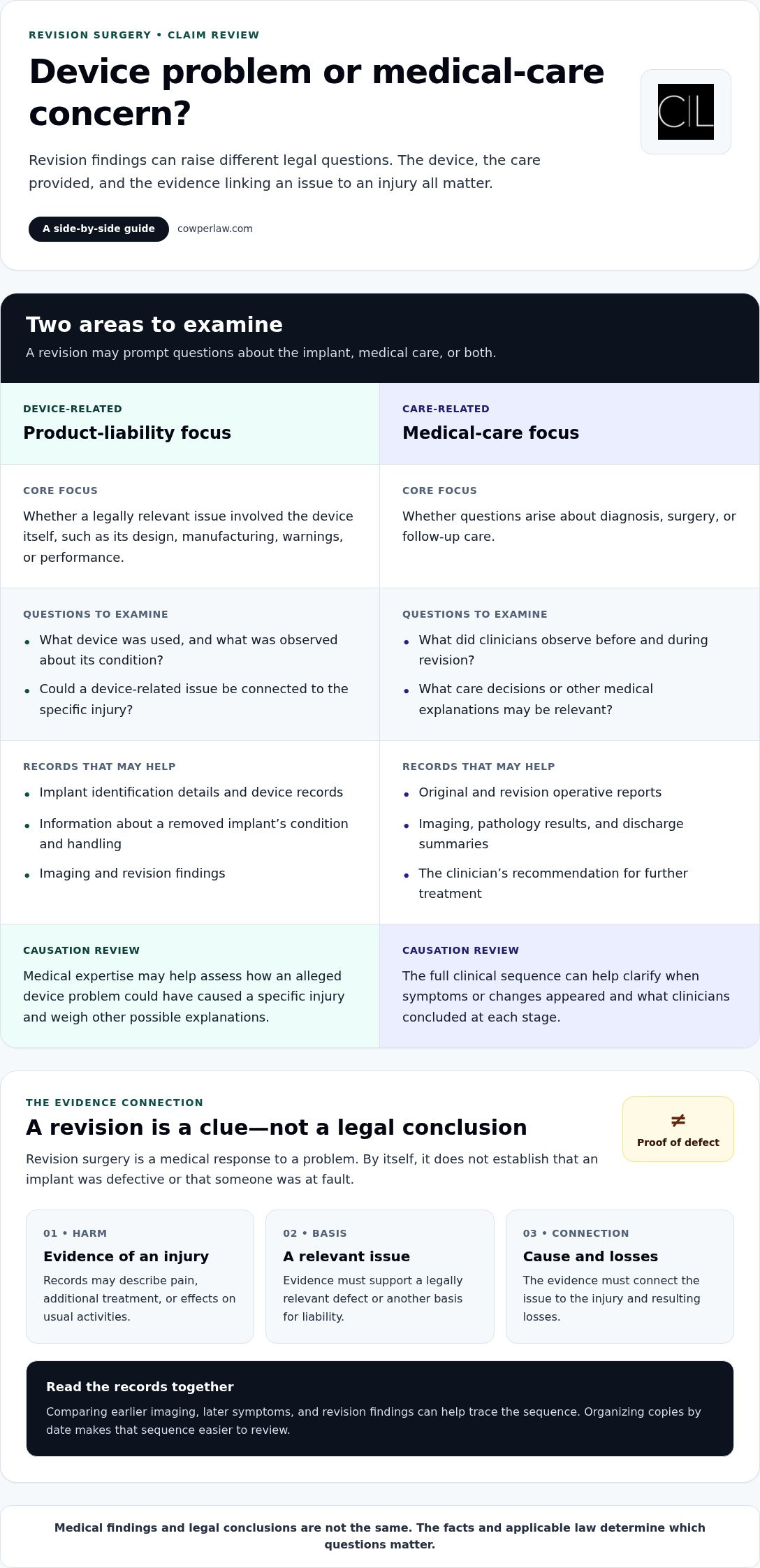
A complication after implantation can raise different legal questions. One concerns the device: whether its design, manufacture, warnings, or instructions were legally inadequate. Another concerns medical care: whether decisions about diagnosis, surgery, monitoring, or follow-up contributed to the harm. These questions can overlap, but they are not interchangeable. An adverse outcome alone does not establish fault by a manufacturer or clinician.
Product-liability inquiry
Medical-care inquiry
A device-focused claim may examine whether an implant’s design created an unreasonable risk, whether a manufacturing problem affected the specific device, or whether warnings or instructions adequately addressed relevant risks. These are general categories, not conclusions about a particular implant. The claim depends on the device, evidence, and governing law. A Revision surgery due to faulty implant lawsuit may involve product-liability questions, but revision alone does not answer them.
Separate questions may warrant review if records raise concerns about how symptoms were evaluated, how the procedure was performed, or how the patient was monitored afterward. A complication or disappointing result does not, by itself, establish negligent care. Claims involving medical treatment can have different legal standards from product-liability claims, and those standards vary by jurisdiction. The evidence should be assessed before assigning responsibility.
Sometimes both lines of inquiry deserve attention. For example, records might raise questions about the implant’s performance and separately about the timing of a response to worsening symptoms. That does not prove either theory. It means the events, decisions, and available evidence should be examined without assuming in advance that one party caused the harm.
Separating these questions can clarify a confusing experience. A focused review can identify whether the facts point toward a device issue, a medical-care concern, both, or neither under applicable law. Cowper Law represents people harmed by medical devices and evaluates individual circumstances without promising a particular result.
Start with your health. Follow your treating clinician’s instructions, attend recommended follow-up appointments, and seek urgent care if you have urgent or worsening symptoms. A legal investigation should never delay treatment or interfere with medical decisions. You can organize information and consider your options while care remains the priority.
A simple, dated record can make a complicated sequence easier to understand. Keep notes factual and store copies in one secure place. You do not need to decide what caused the problem before you begin.
These steps can help a legal review compare events over time and identify what information is available or missing. A Revision surgery due to faulty implant lawsuit may require looking beyond revision paperwork to the broader medical and device history.
Filing deadlines vary by state and by the facts of a claim. Some states may apply rules tied to when an injury is discovered, while others may have separate outer limits. The date of surgery or revision may not, by itself, tell you which deadline applies. A lawyer can assess the relevant law and circumstances, but do not rely on a general timeline to determine your filing date.
Prompt attention can also help preserve information while it remains accessible. Keep relevant records, device identification details, and correspondence together, and avoid discarding or changing potential evidence. If a physical device or other material is involved, follow medical guidance and applicable handling requirements rather than trying to collect or store it yourself.
You do not have to choose between getting care and asking legal questions. Cowper Law represents people harmed by medical devices and can review the specific facts, available records, and applicable law without assuming that revision alone establishes a claim. Learn about discussing implant injury concerns with Cowper Law while continuing to prioritize your medical care.
A second operation can leave you with more questions than answers. Cowper Law approaches each potential medical device injury claim individually, examining the implant, the circumstances surrounding revision, the reported harm, and the records documenting the course of care. Revision surgery is part of that history, but it does not decide the legal questions by itself.
The review begins with the sequence of events: implantation, changes in symptoms, treatment decisions, and revision surgery. Available medical records and device information can help clarify what clinicians observed and when. The review may also consider alternative explanations for the injury, since a complication can have more than one possible cause.
Cowper Law then assesses what the evidence may support under the applicable law. Potential legal theories and responsible parties depend on the device, records, and circumstances, not on a label or assumption. The goal is to understand the specific facts and identify questions that need investigation. No case review can promise that a claim will qualify or reach a particular outcome.
People dealing with another operation or lasting complications deserve clear, attentive advocacy. Cowper Law represents people harmed by medical devices across the United States, providing personalized representation throughout the legal process. The firm evaluates each person’s circumstances and evidence rather than treating every revision as the same case.
The firm’s representation is contingency-based. Legal fees are collected only upon a successful recovery, and the fee agreement governs the specific terms. This arrangement does not guarantee that a case will result in recovery. Readers can also explore device-specific issues, such as the questions raised in a hernia mesh revision lawsuit, while keeping in mind that facts and applicable law can differ from one implant claim to another.
A useful discussion can begin with what you know: the implant type, when it was placed, what led to revision, and which records or device details are available. You do not need to have every document or answer before raising your concerns. Cowper Law can review the facts and applicable law, explain the legal questions, and discuss potential next steps without promising eligibility or results.
To discuss your circumstances, contact Cowper Law about your implant injury. A conversation can focus on your experience, records, and what the evidence may show.
You do not need every answer before deciding what to do next. Start by writing down the questions you want addressed, such as what the revision findings may mean, which records could help clarify the cause, and whether timing could affect your options. If you are weighing a Revision surgery due to faulty implant lawsuit, seek guidance grounded in your circumstances rather than assumptions based on the fact that another operation was needed.
Cowper Law is a trial law firm focused on personalized advocacy for people harmed by medical devices. Representation is contingency-based, with legal fees collected only upon successful recovery under the fee agreement. No review can promise eligibility or a particular result, but a careful conversation can help clarify your concerns. Discuss your implant injury with Cowper Law to take a considered next step.
Possibly, if evidence supports a legally valid claim connecting an implant problem to your injury and losses. Revision surgery can be relevant, but it does not automatically establish that the device was faulty or that a particular party is responsible. A review may consider the type of implant, what happened before revision, and the applicable law. A Revision surgery due to faulty implant lawsuit requires an assessment of your specific circumstances.
No. Revision shows that further treatment was considered or performed, but it does not by itself establish a product defect. A surgeon may revise an implant because of a patient-specific concern or another medical cause. The operative report may describe what was found, while other records can help explain why it happened. Those details need to be evaluated together before drawing conclusions about defect or responsibility.
Keep copies of revision paperwork, imaging reports, discharge instructions, and records identifying the implant, such as an implant card or device label. Save relevant messages about treatment and note dates when symptoms changed or care was recommended. If the removed device or packaging is in your possession, do not alter or discard it; ask your medical team how it should be handled. Do not delay care to collect evidence.
Potentially, but claims against a manufacturer and claims involving medical care raise different legal questions. A manufacturer-related claim may concern the device or its warnings; a claim involving a surgeon may concern diagnosis, procedure decisions, or follow-up. The facts might raise one theory, more than one, or neither. A poor outcome alone does not establish negligence, and responsibility depends on the evidence and applicable law.
There is no single filing deadline for every implant claim. Time limits vary by state and can depend on the claim, when an injury was discovered, and other case-specific rules. Some jurisdictions also have an outside deadline measured from an event rather than discovery. Because the calculation can be fact-sensitive, seek a prompt legal assessment instead of assuming the clock starts on the revision date.
Possibly, but the time since revision can make deadline questions especially important. The applicable period may depend on the state, type of claim, and when you knew or reasonably could have known about the injury and its possible cause. Keep any records you still have, including older treatment notes or device information. A lawyer can assess how the dates and available evidence affect your options.
Not necessarily. A lawsuit may resolve through a negotiated settlement or another court process, or it may proceed to trial if the dispute remains unresolved. The path depends on the facts, legal issues, and decisions made during the case. No one can promise in advance that a claim will settle or reach a courtroom. Your attorney can explain the possible stages and how key decisions may affect you.