
What if the medical device you trusted may have contributed to your injury, but another condition or treatment could also be responsible? That uncertainty can be frightening when you’re focused on medical care and worried about lasting effects. A Defective medical product lawyer can investigate how the device was used, what went wrong, and whether a specific defect may have contributed to your harm.
A device failure alone doesn’t establish a legal claim. The key questions include whether a design flaw, manufacturing problem, or inadequate warning was connected to your injury. A recall may raise questions, but it doesn’t automatically prove that a product caused a particular person’s injuries. The evidence and circumstances matter.
This article explains common types of medical product defects, what may make a claim viable, and what a lawyer may examine, including medical records, device information, and the timeline of events. Cowper Law represents people harmed by medical devices and can investigate the connection between a device issue and an injury. Put your health first: seek needed medical care without delay. If you can do so safely, keep relevant records and product packaging to help preserve useful information.
A serious injury can leave you asking whether a device contributed or whether the harm stemmed from an underlying condition, a procedure, or another part of your care. A medical product may be considered defective in a legal claim when an alleged flaw supports a product liability theory. Whether that applies depends on the evidence and the law that governs the claim, not simply on the fact that an injury occurred.
An adverse outcome, even a severe one, isn’t proof that a product was defective. Medical devices may be used to address complex health conditions, and complications can have more than one possible cause. A lawyer may examine the device, how it functioned, what information accompanied it, and the circumstances surrounding its use. This general overview of product defects describes categories that may also arise in medical device claims, but it can’t determine whether a particular product or claim meets the applicable legal standard.
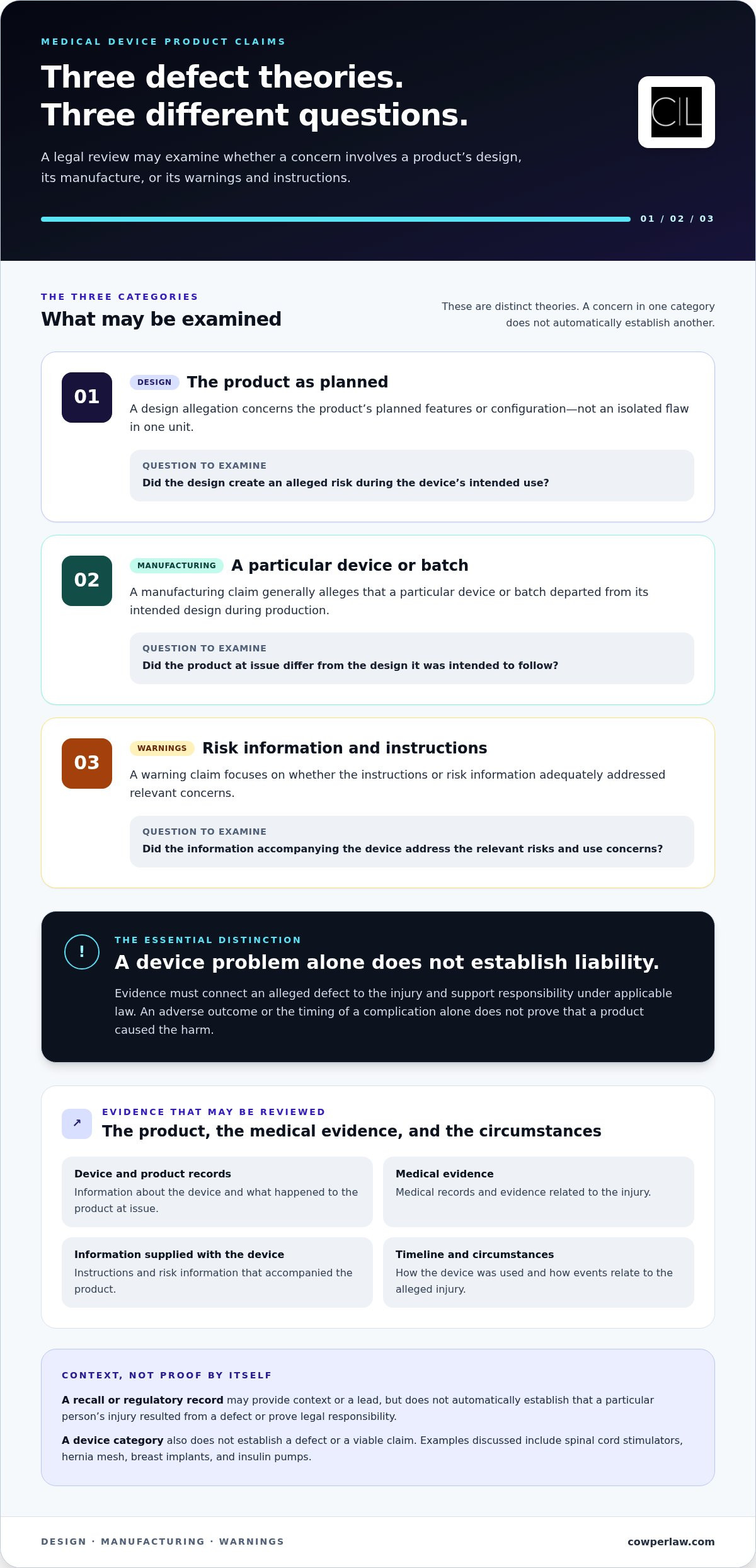
A device problem alone does not establish liability. Evidence must connect an alleged defect to the injury and support responsibility under applicable law. A Defective medical product lawyer can investigate that connection without assuming the device was at fault before reviewing the facts.
Claims can involve implants, stimulators, mesh, and insulin pumps. Cowper Law represents people in medical device litigation involving spinal cord stimulators, hernia mesh, and breast implants. These examples show the range of products that may be examined, not a conclusion about any individual device or case.
The product category alone doesn’t establish a defect or a viable claim. The product’s history, the reported problem, the injury, and the circumstances surrounding its use all matter. A lawyer reviews those details rather than assuming that complications involving the same type of device share a cause.
A product defect claim generally focuses on an alleged flaw in the device or its warnings. A medical negligence claim generally concerns allegations about a healthcare professional’s care. The issues can sometimes overlap, but one doesn’t automatically prove the other. The distinction is explored in this guide to medical malpractice versus product liability.
Understanding what happened calls for a careful review of the product, the medical care, and the individual facts. The timing of a complication can help guide questions, but timing alone doesn’t show that a device caused the harm or establish who may be legally responsible. An attorney can assess the evidence before reaching conclusions.
Not every device-related injury raises the same product concern. A legal review may consider whether an alleged flaw involves the product’s design, a problem during manufacturing, or information provided about its risks and use. These are distinct theories, and the evidence relevant to one may differ from what is needed to assess another.
Design claims focus on the product as planned, manufacturing claims on an alleged flaw in a particular product, and warning claims on risk information or instructions. This framework helps organize the questions; it doesn’t mean every case involves all three categories or that a particular device is defective. The facts must be assessed individually.
Legal standards and available claims can vary under applicable law. A lawyer may examine how the device was intended to work, what happened to the product at issue, and what information accompanied it, then consider how those facts relate to the relevant legal requirements. A recall or regulatory record may provide context, but neither automatically establishes whether a claim is viable.
A design allegation concerns a product’s planned features or configuration, rather than an isolated flaw in one unit. For example, a claim might question whether a device’s design created a risk during its intended use. That allegation needs careful evaluation; an injury or complaint alone doesn’t establish that a design was legally defective.
A Defective medical product lawyer may examine the device’s intended use, the alleged risk, and relevant product evidence to understand the basis for the concern. The analysis is fact-specific, and the legal test can depend on the law that applies.
A manufacturing claim generally alleges that a particular device or batch departed from its intended design during production. A warning claim instead focuses on whether instructions or risk information adequately addressed relevant concerns. These theories ask different questions, and evidence supporting one doesn’t necessarily support the other.
The FDA Medical Device Recalls resource explains recalls and why they may occur. A recall can be a meaningful lead, but it doesn’t by itself prove that a particular person’s injury resulted from a defect or establish legal responsibility. FDA oversight or a regulatory filing alone doesn’t decide liability either.
Product records, device-specific information, and the circumstances of the injury can help counsel identify which questions deserve closer attention. Cowper Law represents people in medical device injury litigation, including cases involving spinal cord stimulators, hernia mesh, and breast implants. Learn more about Cowper Law’s medical device injury representation.
A careful claim review separates three questions: What problem is alleged? What harm occurred? Is there evidence connecting the two? These questions are related, but they aren’t interchangeable. An injury doesn’t identify its cause on its own, and finding a product issue doesn’t automatically show that it caused the injury.
| Question | What may be examined |
|---|---|
| Alleged defect | The reported device issue, product records, design or manufacturing information, and warnings or instructions. |
| Injury | The person’s diagnosis, symptoms, treatment, and documented effects. |
| Causal link | Whether evidence supports a connection between the alleged defect and the specific harm, while considering other possible factors. |
This table is an organizing tool, not a legal test that applies identically everywhere. Applicable law and the evidence in an individual case shape what must be shown. A Defective medical product lawyer may gather and assess records, identify unanswered questions, and investigate whether the product issue and injury are connected. Medical causation may require appropriate evidence; an attorney shouldn’t substitute assumptions for that evidence.
Causation is the connection under examination between an alleged defect and a person’s harm. For example, a device may be reported to have stopped functioning, but the review must still explore whether that problem contributed to a particular injury. The timeline can help frame the inquiry: when the device was used, when symptoms appeared, and what followed. Timing matters, but it doesn’t prove causation by itself.
Other factors may also need consideration, including a person’s medical condition, treatment, or another issue involving the product. Reviewing relevant medical records alongside device and case-specific information can help clarify what is known and what remains uncertain. A lawyer can investigate the legal claim and assess the available evidence; medical conclusions require a sound evidentiary basis.
FDA materials may offer background about a device, including available safety information, recalls, or notices. A recall can prompt closer questions about the product and its history, but it doesn’t automatically prove that a specific device caused an individual injury or establish who is legally responsible. The absence of a recall doesn’t answer every question about a particular product or claim either.
Counsel may consider regulatory information alongside product records, medical evidence, and the circumstances of the injury. The review can also examine which parties had a role in the product’s design, manufacture, or warnings, without assuming responsibility before the facts are assessed. Cowper Law approaches medical device injury matters with individualized attention.
Suspecting a medical device may have contributed to an injury can bring uncertainty at an already difficult time. You don’t need to solve the medical or legal questions before taking practical steps. Focus on your health, preserve useful information when possible, and seek legal guidance when you’re ready to discuss what happened.
A measured approach can help protect your well-being while keeping information that may assist a later review:
A few basic details can help start a conversation: the product name, when treatment or device use began, when the concern or injury arose, and any communications you know about concerning the product or its use. An incomplete timeline can still provide useful context.
You don’t need to know whether the device malfunctioned, which legal theory might apply, or what caused a particular symptom. Those are questions for careful review, not prerequisites for seeking advice. A Defective medical product lawyer can assess the information available and identify what may need to be explored alongside the medical evidence.
Legal deadlines aren’t the same in every situation. They can depend on the applicable law and the circumstances of a claim, and some jurisdictions may have more than one deadline to consider. Missing a filing deadline can affect legal options, so seek guidance in a timely way rather than relying on a general estimate or assuming there’s plenty of time.
There’s no need to panic or set aside medical care. A legal review can help clarify which timing rules may apply and what information could matter. Cowper Law represents people in medical device injury litigation and can investigate the relationship between a device concern and an injury as part of an individualized review.
Organizing available records can help make a legal discussion more focused. You can also contact Cowper Law about your device injury to discuss a potential legal review. You don’t need to have every answer before explaining what happened.
When an injury raises questions about a medical device, clear answers matter. Cowper Law represents people harmed by medical devices, including spinal cord stimulators, hernia mesh, and breast implants. The firm provides personalized support and trial advocacy, considering each matter on its own facts rather than drawing conclusions from a product category or a single event.
A Defective medical product lawyer can help examine how the available evidence fits together. Counsel may review information about the product and the reported issue, consider the nature and impact of the injury, and investigate whether evidence supports a connection between them. The review may also consider which parties could bear responsibility under the facts and applicable law. No outcome is guaranteed; an assessment depends on the circumstances of the particular claim.
These cases can involve complex questions and powerful companies. Cowper Law investigates those questions, explains the process in understandable terms, and provides representation as the matter moves forward. The firm’s medical device injury litigation focuses on advocating for people harmed by devices.
You can describe the device, the injury, and the questions that concern you. Relevant information may help provide context, but you don’t need to arrive with a complete file or prove what caused the harm. The discussion is an opportunity to explain your circumstances, ask questions, and understand possible next steps.
An initial discussion isn’t a promise that a claim will be accepted or that compensation will result. It can help clarify what is known, what may need further review, and whether there may be a basis to investigate potential legal responsibility. You can discuss your situation without having every answer in advance.
Cowper Law handles these cases on a contingency-fee basis, meaning the firm collects legal fees only upon successful recovery of damages. This describes when legal fees are collected; it isn’t a guarantee of recovery or a promise about the result of a case. Any representation and its terms depend on the individual matter.
Seeking legal guidance can help you understand your options while you continue to focus on your health and recovery. If you have questions about a device-related injury, contact Cowper Law to discuss your circumstances.
You don’t have to know exactly what caused an injury before asking questions. A conversation with a Defective medical product lawyer can help you understand what information may matter and whether further investigation could clarify your options. Start by explaining what happened and what you’re still trying to understand.
Cowper Law handles medical device injury litigation, including matters involving spinal cord stimulators, hernia mesh, and breast implants. The firm provides personalized representation, and legal fees are collected only upon successful recovery of damages. No result is promised, but you can discuss your circumstances and possible next steps.
Contact Cowper Law to discuss your situation. A conversation can help you understand what the available information may show and what path forward could make sense.
No. A recall can signal that a device issue deserves attention, but it doesn’t automatically establish that the device was legally defective or caused a particular person’s injury. The reason and scope of the recall matter, as do the device involved, the person’s medical circumstances, and the available evidence. For example, a notice may apply only to certain units or situations. A lawyer can assess how the recall relates to an individual claim.
Possibly. A recall isn’t required for someone to raise concerns about a device or explore whether a legal claim may exist. A problem may be specific to a product, its use, or an injury and may not be reflected in a recall notice. A Defective medical product lawyer can review relevant product and medical information to assess whether evidence supports a claim. The absence of a recall alone doesn’t determine the outcome.
There’s no single filing deadline that applies to every defective medical product claim. Time limits can vary depending on applicable law, the type of claim, and facts such as when an injury occurred or was discovered. Some jurisdictions also have deadlines tied to when a product was sold. Because these rules can be complex, seek legal guidance promptly rather than relying on a general estimate or waiting for a recall.
Your doctor’s view may be important information, especially if it appears in your medical records or is supported by treatment findings. It doesn’t automatically resolve legal questions, such as whether a product defect contributed to the harm or who may be responsible. Share relevant medical information with counsel, who can consider it alongside product evidence and other case details. Continue following your healthcare professional’s guidance about treatment and care.
Family members may be able to pursue a wrongful death claim, but who may bring one and what must be established depend on applicable law and the circumstances. A review may consider the deceased person’s medical history, device information, and evidence about the alleged connection to the death. Families facing this loss deserve careful, compassionate guidance. An attorney can explain possible legal options without promising a particular result.
Cowper Law handles medical device injury cases on a contingency-fee basis, collecting legal fees only upon successful recovery of damages. This explains when the firm collects legal fees; it doesn’t guarantee a recovery or resolve any other case-related financial terms. Review the representation agreement so you understand the fee arrangement before deciding how to proceed.
Yes. Different patients may bring separate claims involving the same device, but each person’s injuries, medical history, and evidence still matter. In some situations, lawsuits involving a shared product issue may be coordinated for certain pretrial proceedings, while individual claims remain distinct. This doesn’t mean every patient has the same legal options or that joining a coordinated proceeding is automatic. A case-specific review can help explain which paths may apply.