
If you’re searching for “Infection from medical device legal action,” you may be trying to understand whether an infection after a medical device procedure points to a device failure or another source. The uncertainty can come alongside painful treatment, lasting health concerns, and disruption to daily life. An infection alone doesn’t prove a device caused the harm. Evidence must help connect the infection to a defect, inadequate warning, or another act that contributed to the injury.
It’s reasonable to want clear answers about what happened and who may be responsible. A careful investigation can examine medical records, device information, and the circumstances surrounding the infection. Depending on the facts, potential claims may involve a manufacturer, distributor, or healthcare provider. Legal deadlines can vary by state and claim type.
This article explains how device-related infections are investigated, which legal theories may apply, and what parties may require scrutiny. It also outlines practical steps to preserve information and protect your options. Cowper Law represents people harmed by medical devices, providing personalized advocacy in complex cases involving responsibility and next steps.
An infection after a procedure or during device use can leave a patient searching for an explanation. The timing may raise questions, but it doesn’t establish what caused the infection or whether anyone acted improperly. A suspected device-related infection is a medical question requiring clinical evaluation, as well as a legal question requiring evidence about how the device or care contributed to the harm.
An infection diagnosis is not proof of device-related causation. Evidence must connect the device or its use to the infection and resulting harm. A legal claim may warrant investigation if evidence points to a device problem or another responsible act, but infection alone doesn’t establish a defect or wrongdoing.
A medical device may be implanted, used during surgery, or used in ongoing treatment. The category is broad; the general Medical device overview describes different types and uses. For an infection investigation, the question isn’t simply whether a device was present. It’s whether something about how it was made, supplied, prepared, or used plausibly contributed to the infection.
Potential sources may include contamination during manufacturing or handling, problems with cleaning or sterilization, or circumstances related to the procedure. An infection may also have another source, including patient-specific factors. These possibilities need to be examined rather than assumed. The fact that a device was used, or that an infection followed surgery, doesn’t by itself show that the device was defective or that a provider made an error.
Serious, unexpected harm can be a reason to seek individualized information about what happened and what options may exist. Infection symptoms and the time they appear vary; there is no single timeline that proves or rules out a device connection. A careful review considers the device and treatment history alongside other plausible explanations.
These questions help distinguish a concern worth investigating from evidence that may support a legal claim. If you have symptoms or are concerned about an infection, put your health first: seek medical care promptly and follow your treating clinician’s advice. Legal questions should never delay evaluation or treatment. For someone considering Infection from medical device legal action, the next step is not to assume the cause, but to understand which records and facts may help clarify it.
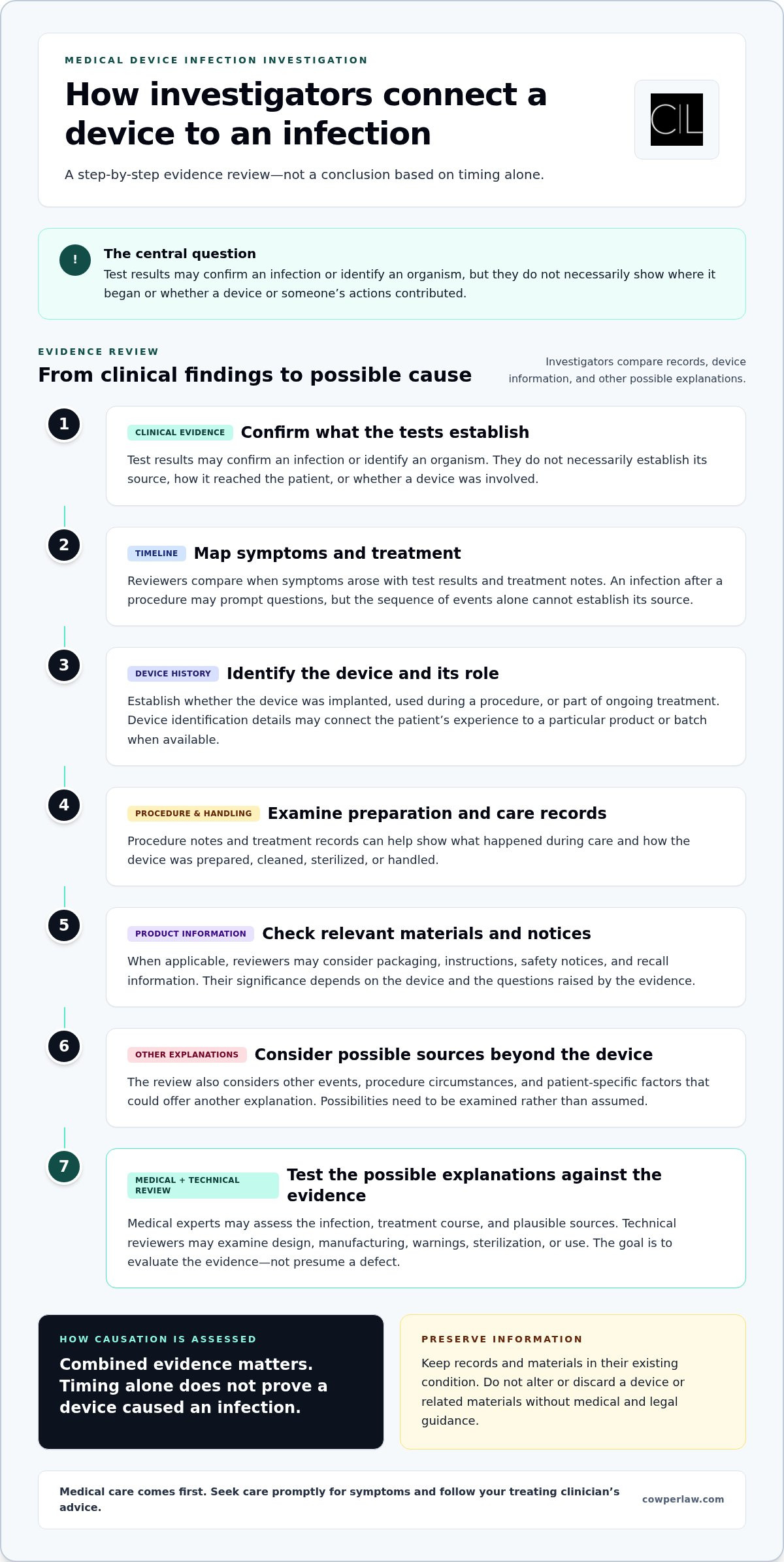
Finding an infection is only one part of an investigation. Test results may identify an organism or confirm an infection, but they don’t necessarily show where it began, how it reached the patient, or whether a device or someone’s actions contributed. Investigators build that picture by comparing medical evidence with the device’s history and the details of the procedure or treatment.
Causation is built from the combined evidence, not from timing alone. An infection that develops after a procedure may prompt questions, but the sequence of events alone can’t establish its source. Reviewers may compare when symptoms arose with test results, treatment notes, device information, and possible alternative explanations.
Relevant information can come from different sources and may need to be considered together. Treatment records and procedure notes can help establish which device was used, how it was prepared, and what occurred during care. Test results may help describe the infection, while device identification details can connect the patient’s experience to a particular product or batch when that information is available.
Packaging, instructions, safety notices, and recall information may also matter when applicable. Their significance depends on the device and the questions raised by the evidence. Preserve records and materials in their existing condition. Don’t alter or discard a device or related materials without medical and legal guidance. Medical care comes first.
Different kinds of expertise may help explain different parts of the chain. Medical experts may assess the infection, treatment course, and other plausible sources. Technical reviewers may examine whether the device’s design, manufacturing, warnings, sterilization, or use raises a concern. The goal is to test possible explanations against the evidence, not to assume a defect before the facts and applicable legal standards are assessed.
For example, if an infection is identified after a procedure involving a device, investigators may compare the clinical timeline with procedure notes, available device records, and information about preparation or handling. They may also examine whether other events or patient-specific factors offer a more likely explanation. A concerning notice or recall can provide context, but it doesn’t automatically establish that a particular device caused an individual’s injury.
The process involves three distinct questions: Is there evidence of infection? What source does the evidence support? Did that source cause the patient’s injury? Each requires its own analysis. A medical diagnosis alone can’t answer whether Infection from medical device legal action may be possible.
A focused review can help organize these questions without promising a particular conclusion. If you’re trying to understand what the available evidence may show, a medical device injury case review can assess potential causation, responsible parties, and next steps.
Responsibility depends on what the evidence shows, not simply on which device was involved. An infection may raise questions about a product, its distribution, the care provided, or more than one part of that chain. The legal theories and parties that can be pursued depend on the facts and applicable law.
Product-liability claims generally examine whether a device was unsafe because of its design, a manufacturing problem, or inadequate warnings or instructions. In some jurisdictions and circumstances, a claim may proceed under a strict-liability theory, but the requirements and available defenses vary. The injured person still typically needs evidence connecting the alleged product problem to the harm.
Negligence focuses on conduct. A claim might examine whether a provider or facility failed to use reasonable care in preparing, sterilizing, handling, or using a device. Medical-malpractice claims concern alleged errors in professional care and may be subject to specific rules. These theories aren’t interchangeable, although a case’s evidence may warrant examining more than one. Applicable standards must be assessed before drawing conclusions.
Depending on the infection pathway and supporting evidence, an investigation may consider:
These are investigative possibilities, not automatic findings of fault. A manufacturer’s involvement doesn’t rule out questions about care, and an allegation about care doesn’t establish that a product was safe. A medical device injury legal representation review can help assess potential claims and responsible parties in light of the evidence.
If a patient dies, eligible family members may have separate wrongful-death questions to consider. Who may bring a claim, what must be shown, and which deadlines apply depend on governing law and the circumstances. A wrongful-death claim involving a medical device requires a careful review of the facts and applicable requirements; no outcome should be assumed.
Evidence that multiple patients experienced similar problems may also raise questions about broader litigation. Related injuries don’t automatically qualify for a class action. A class case has distinct procedural and legal requirements, and individual claims may differ in their facts and harm. Learn more about the separate process of joining a medical device class action.
Deadlines and product-liability standards can differ by jurisdiction, claim type, and circumstances. If you’re considering Infection from medical device legal action, an individualized review can help identify which theories may fit, who may require investigation, and what timing issues need attention.
Start with your health. If you’re concerned about infection symptoms, seek medical care promptly and follow your treating clinician’s advice about evaluation and treatment. Legal questions can be addressed alongside that care, but they shouldn’t delay it or replace medical guidance.
Once immediate health needs are addressed, focus on preserving information rather than proving a theory. You don’t need to determine who was at fault before asking questions. A clear, factual account can help a medical device injury attorney understand what happened and identify what may need further review.
Gather what’s reasonably available. You don’t have to assemble a complete file before seeking legal guidance. Helpful information may include procedure and treatment records, device identification details, and infection-related test information. Keep relevant communications, packaging, instructions, safety notices, or other product materials if you have them.
Record what you know, and separate it from what you suspect. For example, note that a clinician diagnosed an infection, but don’t label a device defective unless evidence supports that conclusion. Avoid altering or discarding a device or product materials. An attorney can help identify additional records that may be appropriate to your circumstances.
Filing deadlines can differ by jurisdiction, claim type, and the details of a case. The date a deadline begins may also depend on applicable law and specific facts. Don’t assume that waiting for a final medical answer, a product notice, or a recall will preserve your options. Prompt legal review can help identify which timing rules need attention.
FDA reporting is a separate process. Under federal Medical Device Reporting requirements, manufacturers, importers, and device user facilities must report certain device-related adverse events and malfunctions. The FDA’s MedWatch program also receives adverse event reports from consumers. These reporting processes are not the same as filing a lawsuit, and an FDA report should not be treated as a universal patient deadline or a substitute for checking legal deadlines that apply to a potential claim.
If you’re weighing Infection from medical device legal action, an individualized review can help bring the timeline, records, and questions into focus. Cowper Law represents people harmed by medical devices with personalized advocacy. Discuss your circumstances with Cowper Law to understand what information may help assess your legal options.
A serious infection can leave you with urgent questions and no clear explanation. A legal assessment should start by listening to your account, understanding how the device was involved, and reviewing available facts without presuming that a claim exists or predicting an outcome. The purpose is to identify what the evidence may support and what still needs to be learned.
Cowper Law represents people harmed by medical devices through personalized advocacy. In a case review, counsel may consider the reported infection and resulting harm alongside the device and procedure details, relevant records, and sequence of events. You can explain what you know, what remains uncertain, and how the infection has affected your life.
An initial assessment may explore whether the available information supports a possible connection between the infection and a device-related failure or another act. Counsel can identify potential responsible parties and legal theories, consider deadlines that may apply, and determine whether further medical, technical, or legal investigation may be needed. Eligibility and potential outcomes depend on individual facts and applicable law.
A review can also help organize unanswered questions. For example, the information may not yet explain how the device was prepared or whether another source could account for the infection. Identifying those gaps is part of assessing a matter, not a reason to jump to conclusions. You don’t need to have every record or know the cause before discussing your situation.
That measured approach matters in Infection from medical device legal action. An infection, a device, and harm may all be part of the story, but the legal assessment must examine whether the evidence connects them in a way recognized by applicable law. Counsel can explain what is known, what remains uncertain, and which next steps may be appropriate based on your circumstances.
Cowper Law provides contingency-based representation, with legal fees collected only upon successful recovery. The terms of representation should be discussed during a case evaluation so you can understand how they apply to your circumstances. No assessment can guarantee that a claim will qualify, lead to a recovery, or result in a particular outcome.
You deserve to have your concerns heard and your questions handled with care. If you’re unsure whether a device, procedure, or another source contributed to an infection, share your situation with Cowper Law for an assessment of possible legal options and next steps. The review can help bring the facts into focus without asking you to assume the answer before the evidence is examined.
You don’t need to have every answer before asking what your experience may mean legally. Uncertainty about the cause is a reason to seek a careful assessment, not a reason to blame yourself or assume there’s no path forward. The question of Infection from medical device legal action depends on individual evidence and applicable law, so a measured review can help you decide what to do next.
Consider what would help you feel more informed: understanding which facts matter, learning what questions remain, or knowing whether further investigation may be appropriate. You can start by sharing what you know, even if parts of the timeline or device history are unclear. Cowper Law approaches medical device injury matters with individualized advocacy, without promising a particular result.
If you’re ready to explore your options, request an assessment of your situation. Taking that step can help turn difficult questions into a clearer plan. Cowper Law can help you assess possible legal options and next steps.
No. An infection after a procedure doesn’t, by itself, prove that the device was defective or caused the harm. The source could involve the procedure, device handling, or individual medical circumstances. For a possible Infection from medical device legal action claim, reviewers may compare clinical findings with device and treatment information to assess whether the evidence supports a connection. Your treating clinician can address medical questions; legal counsel can assess what the facts may mean legally.
Possibly. A recall isn’t a prerequisite for every legal claim, and the absence of one doesn’t decide whether a claim exists. A recall or safety notice may provide context, but an individual case still requires evidence about the device, the harm, and their connection. Even without a recall, relevant questions may include what the device was supposed to do, what happened, and whether applicable legal standards are met.
Infection timing varies, so a delay alone neither proves nor rules out a device connection. For example, a later diagnosis may lead investigators to examine when symptoms began, what testing showed, and whether there were other potential sources during the intervening period. If you have symptoms or medical concerns, speak with your treating clinician. A legal review can consider the timeline alongside records and device information without treating timing as a diagnosis.
Potentially responsible parties depend on the evidence and applicable law. An investigation might examine a manufacturer or distributor, as well as a healthcare facility or provider, if their role in the device’s design, supply, preparation, handling, or use is relevant. These parties aren’t automatically liable because an infection occurred. The facts may point to one source, several possible contributors, or no legally supportable claim.
There’s no single deadline that applies to every medical device infection claim nationwide. The filing period may depend on where the claim is brought, its legal basis, when the injury was or reasonably should have been discovered, and other circumstances. Some claims may also involve additional timing rules. Don’t rely on a general estimate or wait for a recall to assess timing; ask an attorney to review the specific facts promptly.
A death may raise wrongful-death or related legal questions for eligible family members, but the right person to bring a claim and the applicable deadlines depend on governing law and the circumstances. A review may need to consider medical records, the device’s possible role, and the harm that followed. Families don’t need to reach a conclusion about causation before seeking information about their legal options.
Cowper Law provides contingency-based representation, with legal fees collected only upon successful recovery. The specific terms for an individual matter should be discussed and documented before representation begins. Don’t assume a particular percentage, outcome, or treatment of other case expenses without reviewing the agreement. Asking how the arrangement applies to your circumstances can help you understand the financial terms before deciding how to proceed.