
A ruptured implant doesn’t automatically mean you have a legal case. A Silicone breast implant rupture claim may depend on whether the rupture caused an injury, whether that injury led to symptoms or additional treatment, and what the evidence shows about responsibility. Because a silicone rupture can be silent, a scan or diagnosis alone may not answer those questions.
It’s understandable to feel uncertain about what a rupture means for your health and your options, especially when medical care, records, and possible costs add to the stress. The details matter. The implant’s condition, your medical history, and the timing of symptoms and treatment can all help clarify whether a claim may be possible.
This article explains the difference between a rupture and a potentially actionable injury, and identifies records that may help a lawyer assess your situation. It also explains why responsibility depends on the specific facts and applicable law, including whether a manufacturer, provider, or another party may be involved. An individualized legal review can help you understand your options, but it cannot promise a particular outcome.
It may, but a rupture alone doesn’t establish that a manufacturer or another party is legally responsible. A Silicone breast implant rupture claim is a potential product liability or injury claim assessed on its particular facts. A lawyer may need to evaluate whether there was a legally relevant defect, whether it caused an injury, and whether that injury led to documented harm under the law that applies.
A medical finding of rupture is not, by itself, legal proof of a defective implant or a compensable injury. Symptoms, medical treatment, a revision procedure, and other documented effects may help show what happened and how it affected you. The implant’s age and condition, your medical history, and available product information may also matter. If you have health concerns, speak with your treating clinician. This section offers legal information, not a diagnosis or treatment advice.
Implants may contain silicone or saline, and the type can affect how a rupture is identified and discussed with your medical team. For general background on breast augmentation surgery and implant types, see this overview. Your clinician is the right person to explain your imaging, diagnosis, and care options.
With an intracapsular rupture, silicone gel has escaped the implant shell but remains within the scar tissue capsule that forms around the implant. With an extracapsular rupture, gel has moved beyond that capsule into surrounding tissue. These terms describe the location of leaked material. Neither one, on its own, proves symptoms, injury, or a product defect. Imaging and clinical interpretation belong to your treating medical team.
No. A device failure and a legally relevant defect are not the same finding. Assessing whether an issue may involve design, manufacturing, or warnings can require evidence about the particular device, its age and condition, and its use. Your medical history and the circumstances of the rupture may also be relevant. Whether a claim is viable depends on the individual facts and applicable law.
The practical question is not only whether the implant ruptured, but what followed and what evidence connects the device to a specific injury. A lawyer can assess those details without assuming that every rupture supports a claim. Your medical team should guide health decisions. Legal counsel can evaluate the evidence and related legal questions separately.
A useful evidence trail connects the diagnosis with changes in your health and the care that followed. It may include imaging reports, symptoms noted during appointments, treatment recommendations, and records of revision or removal procedures, if applicable. Notes about how symptoms affected daily activities may also help document their impact. No single record necessarily answers every legal question, but the records together can give counsel a clearer picture.
Medical and device records can help counsel assess timing, injury, and possible causation. They may show when a concern first appeared, when the rupture was identified, and what treatment a clinician recommended. You don’t need to interpret imaging or decide for yourself whether the rupture caused a symptom. Ask your treating medical team to explain the findings and care plan. The FDA’s information on breast implant risks offers general context, but it can’t determine what caused an individual patient’s condition.
Consider requesting copies of imaging reports, clinician notes, operative reports, and treatment recommendations. If you’ve had revision or removal surgery, records from those procedures may also be relevant, though no particular procedure is required to seek a legal review. Ask each provider how to obtain your records, and keep secure copies of what you receive.
A timeline can make those documents easier to review. Note approximate dates of symptoms, appointments, diagnosis, and treatment, along with changes you reported to your providers. Keep the timeline factual. Your attorney can compare your account with the records and assess what they support.
Product information can help identify which implant was placed and connect medical records to the device at issue. Look for an implant card, discharge paperwork, operative report, and any available purchase or procedure records. Details such as implant type, manufacturer, model, serial information, and implantation date may be recorded in different places. Don’t assume that one missing card means the information can’t be found.
Keep the paperwork together and tell your provider or lawyer if details are incomplete. A Silicone breast implant rupture claim may require review of both the injury evidence and the product history. Documentation can help counsel determine what further information may be needed. If you want an individualized legal assessment, Cowper Law’s breast implant litigation team can review the specific device, records, and circumstances without presuming an outcome.
A complication isn’t automatic proof that a manufacturer is liable. In a Silicone breast implant rupture claim, counsel may examine whether a legally relevant product issue existed, whether it caused a specific injury, and what losses followed. Legal standards and filing deadlines can vary by jurisdiction, so the facts must be assessed under the law that applies to your case.
Depending on the circumstances, an attorney may investigate a potential design issue, a manufacturing problem affecting a particular implant, or whether warnings adequately described relevant risks. These are questions to examine, not conclusions or guaranteed claims. Product records, labeling, testing information, and expert review may help clarify what happened. The FDA’s details on breast implant risks provide medical device context, but don’t determine whether a particular implant was legally defective.
| Potential theory | Evidence counsel may examine | Case-specific caveat |
|---|---|---|
| Design | Design records, testing, and expert analysis | A rupture alone doesn’t establish a design defect. |
| Manufacturing | Device records and available information about the implant’s condition | Evidence must connect a product-specific issue to the alleged harm. |
| Warnings | Labeling and information provided about risks and complications | The applicable legal standard and evidence matter. |
The central question is whether evidence supports a connection between an alleged device issue and documented physical harm. Counsel may review symptoms, clinical findings, and treatment history, then consider whether other factors could explain the condition. A rupture diagnosis can be important evidence, but it doesn’t by itself prove causation or establish that a legal claim is viable.
Records of medical expenses, additional treatment, revision or removal procedures, and other effects may help document losses being considered. Which losses may be recoverable, and what proof is required, depend on individual circumstances and governing law. The fact of rupture alone does not establish a particular outcome or recovery.
A careful review considers the whole picture: product information, medical evidence, the alleged causal link, and the rules in the relevant jurisdiction. An attorney can assess those factors and explain what further evidence may be needed, without promising eligibility or a particular result.
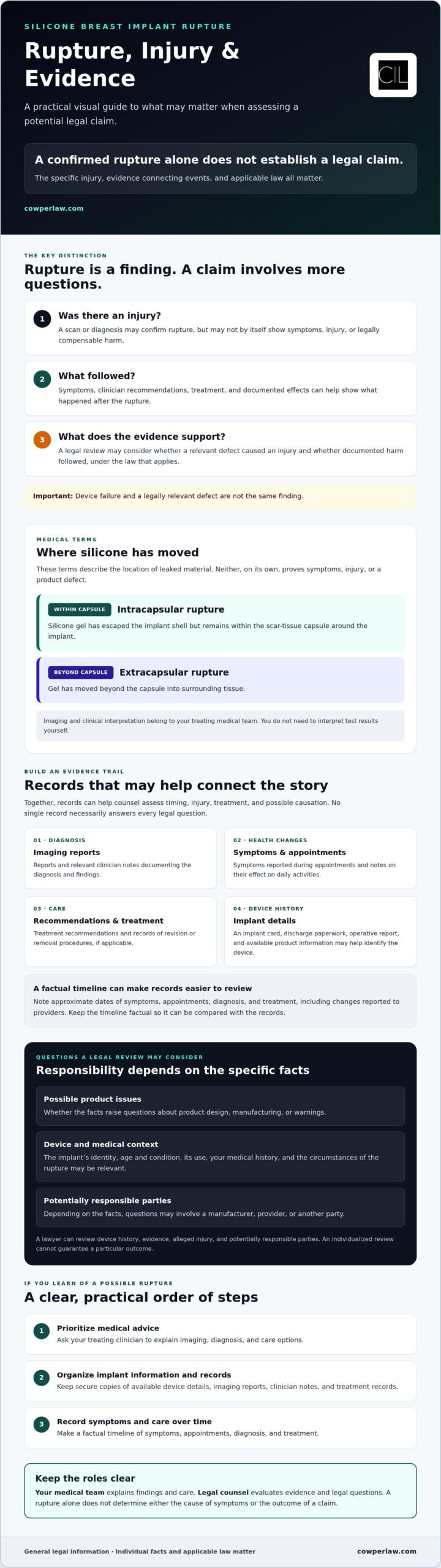
Take care of your health first. Follow your treating clinician’s advice, and don’t postpone recommended care while researching legal options. Once your immediate medical needs are addressed, a few organized steps can help preserve information for an individualized review of a Silicone breast implant rupture claim.
Put records in date order, keep secure copies, and preserve originals without writing on or altering them. Your timeline doesn’t need to be polished or medically conclusive. A clear note such as “pain reported at appointment” is more useful than trying to explain what caused it. Your providers interpret medical findings. Counsel can compare those records with your account.
Filing deadlines and related rules vary by state and claim type. Depending on applicable law and the facts, the date a legal clock begins may be disputed, and some rules may set an outside filing limit. Don’t rely on a general online deadline to decide how much time you have. Ask a qualified attorney to assess timing promptly, even if you’re still gathering records.
If you’re ready to discuss the device, timeline, and records you have, contact Cowper Law about a breast implant claim review. An attorney can consider your circumstances and applicable law, but a conversation does not guarantee that a case will be accepted or a particular result achieved.
A lawyer’s review looks beyond the fact of rupture. Counsel may assess your medical records, the injury you report, implant and manufacturer details, possible causation, and the laws that govern your circumstances. The review may also identify which facts are clear, which remain uncertain, and whether more investigation is needed.
That investigation could involve reviewing product history and available records, identifying potentially relevant manufacturers or providers, and consulting appropriate experts. Cowper Law represents people in medical device injury and breast implant litigation, but an initial discussion doesn’t guarantee that the firm will accept a matter or that a claim will succeed.
Use the conversation to understand the review process and what decisions may lie ahead. Ask which records would be useful, what facts remain uncertain, and what additional investigation might be needed. You can also ask how the attorney would evaluate applicable deadlines, potential defendants, and case costs in your specific circumstances.
Before deciding whether to proceed, request a clear explanation of the proposed fee agreement, including how fees and costs are addressed. Cowper Law describes its representation as contingency-based, but the written agreement controls. Confirm specific terms directly with the firm.
Some cases involve missing records, disagreement about what caused an injury, or differing medical opinions. Those uncertainties may call for further review. They don’t, by themselves, establish that you have no claim or that litigation will follow. A lawyer can explain what is known, what evidence may still be needed, and how the applicable law affects your options.
Before making decisions, consider asking:
A careful, individualized assessment can bring structure to an uncertain situation. If you’d like to discuss your Silicone breast implant rupture claim, contact Cowper Law to ask about a review of your circumstances. No online article can determine eligibility, and no attorney can promise a particular outcome before evaluating the facts and governing law.
A rupture finding is only one part of the story. A potential Silicone breast implant rupture claim may also turn on whether a specific injury followed, what medical and product records show, and whether the evidence meets the legal standards that apply. Preserve relevant documents, follow your clinician’s guidance, and seek prompt advice about deadlines, which can vary by jurisdiction and circumstances.
Individual review matters. Cowper Law handles medical device injury and breast implant litigation, and can assess the specific device, alleged injury, available evidence, and governing law without promising eligibility or a particular result. The firm describes its representation as contingency-based, but the written agreement controls. Confirm its terms directly before deciding whether to proceed.
Discuss your breast implant rupture concerns with Cowper Law and ask what information may help assess your options. You don’t need to have every answer before starting a conversation. A careful review can help you understand the questions ahead and choose your next step with greater confidence.
It may, but a rupture alone doesn’t establish that the product was defective or that a defect caused legally recognized harm. For a silicone breast implant rupture claim, an attorney may review medical records, implant details, treatment, and the applicable state law. The facts differ from person to person. A general article or another person’s outcome can’t determine your eligibility, so seek an individualized legal assessment.
A qualified clinician can evaluate a possible rupture using your symptoms, an examination, and appropriate imaging. Some ruptures may not cause obvious symptoms, so appearance or online descriptions can’t reliably diagnose one. Ask your healthcare provider what evaluation is appropriate and how to obtain copies of relevant reports. Address medical concerns with your care team first. Legal questions can be considered separately once you understand your diagnosis and care options.
Potentially useful evidence includes imaging reports, medical records, operative notes, implant cards, and records of recommended or completed treatment. A timeline of symptoms, appointments, and changes in daily activities may also help show what happened. This is a starting point for a legal discussion, not a fixed checklist or guarantee of eligibility. The evidence needed depends on the circumstances and the law that applies to your claim.
No. A rupture doesn’t automatically prove a legally actionable defect, causation, or manufacturer responsibility. An attorney may investigate the implant, product information, alleged injury, treatment, and other relevant circumstances to assess whether further inquiry is appropriate. Possible legal theories and required proof vary with the facts and governing law. A rupture may raise questions worth reviewing, but it doesn’t guarantee that a claim will succeed.
There isn’t one filing deadline that applies to every claim nationwide. The time limit and rules about when it begins may depend on state law, the type of claim, and the specific facts. Don’t assume that discovering a rupture starts or pauses a deadline in a particular way. Ask a qualified attorney to review the timing promptly, rather than relying on a general online deadline.
Keep available implant documents, medical records, imaging reports, and relevant communications, and ask your providers how to obtain complete copies. Don’t discard or alter potentially relevant items based on general online advice. If an implant has been removed, ask your medical team about its handling and consult a lawyer about preservation questions. Follow your clinician’s advice and don’t delay necessary medical care to address evidence concerns.
Cowper Law describes its representation as contingency-based, with legal fees collected upon successful recovery. The specific fee arrangement, case costs, and other terms depend on the written agreement, so confirm them directly with the firm before deciding whether to proceed. A contingency arrangement doesn’t guarantee that a claim will be accepted, that compensation will be recovered, or that all expenses are handled in the same way.