
You trust your insulin pump to be your lifeline, but sometimes the technology meant to protect you becomes your greatest silent threat. It's exhausting to battle unexplained high blood sugars while your screen insists everything is functioning perfectly. You've invested in a system that's supposed to offer freedom, yet you're left feeling anxious, unheard, and vulnerable. Identifying the signs your insulin pump is failing is not just a matter of convenience; it's a critical step in preventing life-threatening Diabetic Ketoacidosis (DKA). We see the David versus Goliath struggle you face when a multi-billion dollar manufacturer dismisses your concerns as simple user error.
You deserve a dedicated partner who stands firm against corporate negligence. This guide empowers you to regain control, providing the clarity you need to act before a mechanical glitch becomes a medical emergency. We'll provide a definitive hardware safety checklist, immediate steps to protect your physical health, and a clear path toward holding manufacturers accountable for defective technology. Your safety is our mission, and your peace of mind is the ultimate result we strive to achieve.
Insulin pump failure is not simply a device that stops working. It's any interruption in programmed insulin delivery that originates from the device itself, not from anything the user has done. This distinction matters enormously, because manufacturers and their support teams routinely attribute delivery failures to patient error, site problems, or improper handling. Understanding where the real fault lies is the first step toward protecting your health and your legal rights.
To understand what can go wrong, it helps to first understand what is an insulin pump and how its interconnected components, from its motor and reservoir to its software logic and battery, must all function in precise coordination to deliver life-sustaining medication. A breakdown in any one of those internal systems is a hardware malfunction, and it carries consequences that a kinked cannula simply cannot be compared to.
Rapid-acting insulin analogs, the type used in most modern pumps, are designed to work continuously in small doses. When delivery stops for as little as two hours, blood glucose can rise sharply. The body, starved of insulin, begins breaking down fat for energy, producing acidic byproducts called ketones. Left unchecked, this cascade becomes Diabetic Ketoacidosis, a life-threatening emergency requiring immediate hospitalization.
Children and individuals with Type 1 diabetes face the steepest risk. They have no residual pancreatic function to buffer even a brief delivery gap, making them entirely dependent on the pump's mechanical precision. A device that fails silently, with no alarm and no visible sign of malfunction, can push a child toward DKA while their readings still appear manageable on a continuous glucose monitor. This is the terrifying reality of silent failure.
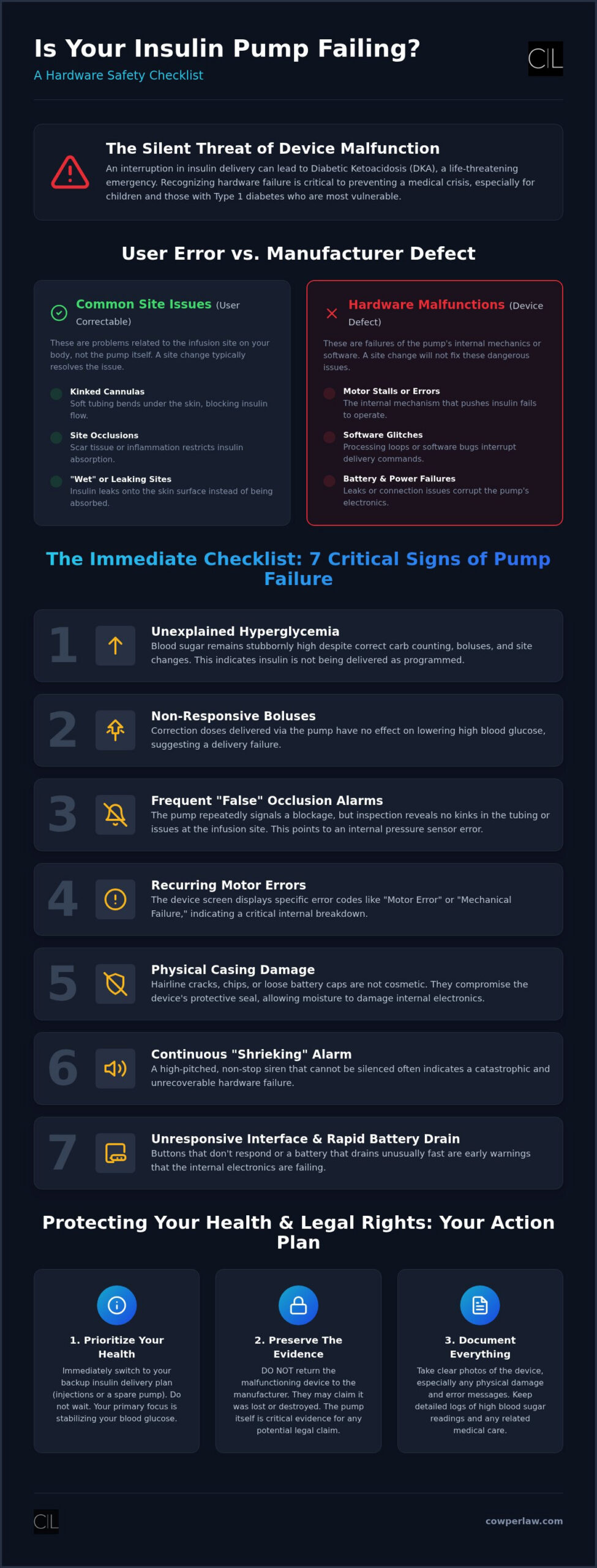
Not every delivery problem traces back to the device. Common site-level issues include:
These are real problems, but they're also correctable. A site change resolves them. Hardware malfunctions are a different category entirely. A hardware malfunction is a failure of the device's internal mechanics or logic, including motor stalls, software processing loops, and battery leaks that corrupt delivery commands. Recognizing the signs your insulin pump is failing at a hardware level, rather than dismissing symptoms as a bad site, is what separates a manageable inconvenience from a preventable medical crisis. Manufacturers have a clear duty to provide a device that performs as intended, every hour of every day. When they fall short of that obligation, accountability must follow.
When your life-sustaining technology falters, the symptoms are not always as loud as a siren. Sometimes, the signs your insulin pump is failing are subtle, creeping into your daily routine as unexplained high blood sugars or minor physical flaws. You might notice a hairline crack in the casing or a battery cap that no longer sits flush. These are not merely cosmetic issues. They are structural vulnerabilities that allow moisture, dust, and debris to compromise the delicate internal circuitry. We are here to help you recognize these red flags before they escalate into a medical emergency.
Use this checklist to evaluate your device's integrity immediately:
If your blood glucose remains high despite multiple corrections, you must verify the pump's functionality. Check your levels twice within a two-hour window. If the numbers climb or stay static, perform the "Correction Test." Give a correction bolus via an insulin pen or syringe. If your blood sugar drops, the pump is the failure point. For anyone managing this risk, the FDA guide to insulin pump safety offers essential protocols for home monitoring. If you suspect a failure, test for ketones immediately using blood or urine strips to catch the early stages of DKA.
Manufacturers often use E-codes or "Critical Failure" prompts to signal internal distress. When these appear, technical support frequently advises a "Clear and Restart" procedure. Be cautious. While this might temporarily silence the alarm, it often masks a permanent hardware defect. We are dedicated to ensuring patients understand that these glitches are often symptoms of systemic negligence. Always photograph every error code before it disappears from the screen. This visual evidence is vital if you need to pursue medical device injury litigation to hold the manufacturer accountable for their defective technology.
While a sudden alarm is impossible to ignore, many manufacturing defects manifest through a slow, agonizing erosion of reliability. These subtle signs your insulin pump is failing often appear as minor inconveniences before they escalate into catastrophic failures. You might find yourself replacing batteries at an alarming rate. A battery that typically lasts 30 days but suddenly dies in just 3 days is not merely a nuisance. It is a symptom of internal heat production or a short circuit within the device's motherboard. We believe you should never have to guess if your life-sustaining technology will last through the night.
Mechanical degradation also shows itself through the interface you rely on every hour. Buttons that become "sticky" or touchscreens that require multiple taps to register a bolus are warning you of an impending total system crash. For families managing these complex devices, the Pediatric Endocrine Society's guide to pump failure highlights how these mechanical inconsistencies often signal a deeper, systemic issue. When pixels begin to die or the screen flickers, the risk is no longer just technical; it's clinical. If you cannot clearly see your dosing information, the device is no longer safe for use.
Corrosion in the battery compartment is a silent killer of device integrity. Even a microscopic amount of battery acid leakage can lead to intermittent power loss, causing the pump to reset itself without warning. A pump that resets during the middle of the night is a major liability. It may default to factory settings or, worse, fail to resume your programmed basal delivery. In some manufacturing defects, power surges can even lead to the accidental over-delivery of insulin, creating a severe hypoglycemia risk that can lead to seizures or loss of consciousness. We stand as a fierce defender for those whose lives have been upended by these preventable mechanical surges.
Software lag is often the final precursor to a non-recoverable error. If your screen freezes while you are trying to confirm a bolus, you are left in a dangerous limbo. Did the insulin deliver? Is the pump stuck in a processing loop? This technical instability creates a heavy psychological toll. Device mistrust leads to constant anxiety, forcing you to check your pump every few minutes just to ensure it's still "alive." We are dedicated to holding corporations accountable when their faulty software turns a tool for freedom into a source of constant fear. When the technology fails to meet its intended purpose, the manufacturer has failed their most basic duty to the patient.
When delivery fails, manufacturers often resort to a predictable script of deflection. They suggest you didn't rotate your site, used expired insulin, or failed to prime the tubing correctly. This strategy is designed to shift the burden of proof onto you, the patient. We are committed to dismantling these corporate excuses by providing a clear framework to distinguish between user-controlled variables and genuine hardware failures. Recognizing the signs your insulin pump is failing starts with ruling out the basics so you can focus on the mechanical truth.
To isolate a hardware defect, we recommend following a strict "Rule of Two." First, replace your entire infusion set, the reservoir, and the insulin vial with brand-new supplies from a different lot if possible. If your blood sugar remains stubbornly high after two hours and a manual correction bolus, the problem is no longer your site. It's the device. A manufacturing defect is defined as any flaw in the design, assembly, or software logic that renders the device unreasonably dangerous for its intended use. When you follow this protocol, you strip away the manufacturer's ability to blame your technique for their technical failure.
You must be proactive in monitoring the safety status of your specific device. Check your pump's serial number against the FDA's national recall databases for major brands like Medtronic, Tandem, or Omnipod. However, understand that a device doesn't need to be part of an official Class I recall to be legally defective. Corporations often downplay systemic issues as "isolated incidents" to avoid the cost and scrutiny of a mass recall. We refuse to let these entities prioritize their bottom line over your survival. If your device is glitching, don't wait for a letter in the mail to confirm what you already know.
Software bugs are particularly insidious because they are invisible to the naked eye. These glitches can cause "pump errors" that suspend delivery without an audible alarm, leaving you vulnerable to DKA. If you've been dismissed, ignored, or gaslit by tech support, it's time to seek a higher level of advocacy. You can contact our team today to discuss your situation with a medical device injury lawyer who understands the "David vs. Goliath" nature of these claims. We are here to ensure you are no longer fighting this battle alone, providing the strength, strategy, and support you deserve.
Your physical safety is the absolute priority. Once you identify the signs your insulin pump is failing, you must disconnect from the device and transition to Multiple Daily Injections (MDI) immediately. Contact your endocrinologist to establish a stable basal and bolus routine using a backup insulin pen or syringe. This transition provides the stability, security, and peace of mind you need while your body recovers from the stress of a delivery interruption. We understand the fear this process creates, and we are here to ensure you don't face the aftermath of a medical emergency alone.
When a pump malfunctions, the manufacturer's customer service team will likely pressure you to return the device for "internal analysis." You should hesitate before doing so. In the world of product liability, your pump is the primary piece of evidence. Manufacturers have been known to "lose" or accidentally destroy devices once they're back in corporate hands, making it nearly impossible to prove a mechanical defect. We believe in the importance of independent testing to uncover the truth behind a failure. To protect your interests, store the failed pump in a clean, dry place; do not attempt to take it apart or "fix" it yourself. Keeping the hardware intact ensures its integrity, security, and availability for future forensic examination.
Holding a multi-billion dollar corporation accountable requires a methodical approach to evidence. You should document the "human cost" of the failure by keeping a detailed log of every ER visit, hospitalization, and out-of-pocket medical expense. Record any lost wages or physical pain you endured during the recovery process. This documentation serves as a powerful narrative of the harm caused by defective technology. We act as a compassionate advocate for those whose lives have been disrupted by corporate negligence, providing the intellect and strategy needed to win.
Our firm brings a "Compassionate Warrior" mentality to every case. We provide specialized BioZorb implant failure case management and apply that same level of rigorous, national expertise to insulin pump litigation. We operate on a contingency basis, meaning you don't pay a fee unless we are successful in your journey toward justice. We are serious, focused, and intensely loyal to our clients. When you're ready to move from victim to advocate, we are ready to stand as your constant companion from the beginning to the end of the legal process.
Vigilance is your strongest defense against corporate negligence. By mastering the "Rule of Two" and monitoring for subtle hardware degradation, you are now equipped to identify the signs your insulin pump is failing before a technical glitch becomes a medical crisis. Your journey toward recovery requires immediate medical action, meticulous documentation, and the preservation of your device as vital evidence. We are here to ensure that your voice is heard and your health is prioritized over a manufacturer's bottom line.
Harm caused by a defective insulin pump? We are the relentless advocates you need. Contact Cowper Law for a free case evaluation.
We are national leaders in medical device litigation, offering the compassionate, personalized support you deserve during this chaotic time. Our firm operates on a contingency-based model; you pay nothing unless we win your case. We provide the intellect, strategy, and heart required to challenge powerful entities and secure the justice you've earned. You've fought hard enough for your health. Let us stand as your constant companion in the fight for your future.
Yes, a cracked screen is a definitive sign of structural failure. Even hairline fractures compromise the pump's seal, allowing moisture, dust, and debris to damage delicate internal circuits. This vulnerability can lead to unpredictable insulin delivery or a total system shutdown without warning. If you notice physical damage, it's one of the physical signs your insulin pump is failing. We believe you shouldn't have to rely on a compromised device for your survival.
You can pursue legal action if a defective pump caused significant harm, such as DKA, seizures, or hospitalization. Manufacturers have a strict duty to provide devices that are safe and reliable for their intended use. When they fail this duty, we stand as fierce defenders of the individual against these powerful corporations. We are dedicated to holding them accountable for the physical, emotional, and financial toll their negligence creates for patients.
If your device alarms with a "Critical Error," you must disconnect and transition to backup insulin delivery immediately. Don't simply clear the code and restart the pump. These alerts often signal deep-seated software or hardware defects that can recur without warning. Document the error code by taking a photograph for your records. Your health is the primary priority, and a "Critical Error" is a clear sign your insulin pump is failing.
Use the "Rule of Two" protocol to isolate the issue. Change your entire infusion set and reservoir with new supplies from a different lot. If your blood sugar remains high after two hours and a manual correction injection works while the pump bolus does not, the hardware is likely defective. This systematic approach helps distinguish between a simple site issue and a life-threatening manufacturing flaw. We provide the clarity you need during these chaotic moments.
Refusal to replace a failing device is a common corporate tactic used to minimize costs and avoid liability. If you are facing manufacturer denials despite clear evidence of malfunction, legal advocacy can provide the leverage needed to protect your rights. We are relentless in our pursuit of justice for those gaslit by multi-billion dollar companies. You deserve a device that functions as intended without fighting a "David vs. Goliath" battle alone.
Yes, you should report any device failure to the FDA’s MedWatch program as soon as possible. This reporting helps the government track patterns of defects and can lead to national recalls that protect other patients from similar harm. Documenting your experience through official channels creates a public record of the manufacturer's failure. We encourage this step as part of a mission-driven effort to improve medical device safety for every individual.
The timeframe to file a lawsuit, known as the statute of limitations, varies depending on your specific circumstances and the laws governing your case. Because these deadlines are strict and uncompromising, it's vital to seek legal counsel immediately after an injury occurs. We are a national trial firm that can help you navigate these requirements. Acting quickly ensures your journey toward accountability is not blocked by a legal technicality or an expired deadline.
No, it does not cost any money upfront to hire our firm for your case. We operate on a contingency-based model, which means we only receive a fee if we successfully win your case or secure a settlement. This approach allows you to focus on your health and recovery without the burden of legal costs. We are personally and emotionally invested in your outcome, providing the toughness, strategy, and loyalty you deserve.