
What if an injury after surgery raises questions not only about how a doctor provided care, but also about the device used during the procedure? That uncertainty is common when weighing medical malpractice vs product liability. One claim may focus on a provider’s decisions, while another may examine whether a product was defective. Sometimes, the facts raise questions about both.
It’s understandable to want a clear answer about who may be responsible, especially when medical records, device information, and different legal standards all come into play. Start by asking what allegedly failed: the care, the product, or both. A malpractice claim generally requires evidence that a healthcare provider fell below the accepted standard of care. A product liability claim focuses on whether a defective product caused harm, though the specific requirements vary by state.
This article explains how the two theories differ, why one event can involve overlapping issues, and what records or professional review may help clarify next steps. Timing matters too: filing deadlines vary by state. Preserving relevant records and getting legal guidance promptly may help you understand which rules apply.
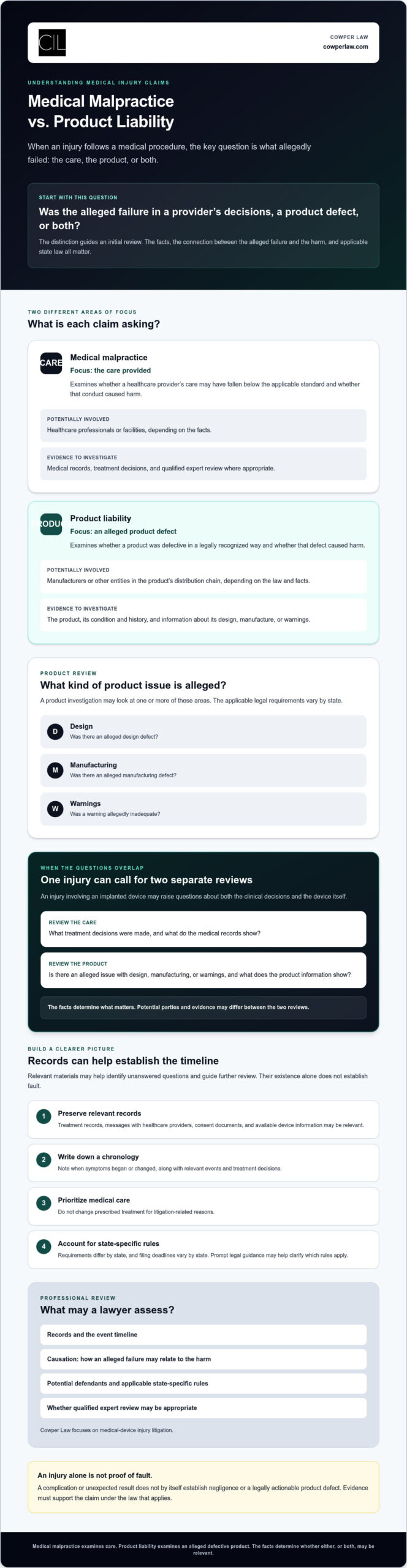
Medical malpractice concerns the care provided; product liability concerns whether an allegedly defective product caused harm. That distinction guides an initial review, but an injury by itself doesn’t prove negligence, a defect, or anyone’s legal responsibility. The facts, the link between the alleged failure and the harm, and the applicable law all matter.
In plain language, medical malpractice is a claim that a healthcare provider’s care may have fallen below the legally applicable standard and caused injury. Product liability is a claim that a product may have been defective in a legally recognized way and caused injury. The rules for bringing either claim vary by state, including what must be proved and what evidence may be required. The general product liability framework can involve different legal theories, but it doesn’t replace state-specific analysis.
| Comparison | Medical malpractice | Product liability |
|---|---|---|
| Focus | Whether care may have fallen below the applicable standard | Whether an alleged product defect may have caused harm |
| Potentially responsible parties | Healthcare professionals or facilities, depending on the facts | Manufacturers or other entities in the distribution chain, depending on the law and facts |
| Evidence to investigate | Medical records, treatment decisions, and qualified expert review where appropriate | The product, its condition and history, and information about its design, manufacture, or warnings |
The inquiry is whether a healthcare professional’s conduct may have fallen below the standard of care applicable to the situation and whether that conduct caused harm. Depending on the circumstances and state rules, qualified expert review may be needed to assess the care. A disappointing result, complication, or unexpected recovery doesn’t by itself establish that treatment was legally negligent.
A product claim may investigate an alleged design defect, manufacturing defect, or inadequate warning, subject to the law that applies. Depending on their roles and applicable law, the inquiry may extend beyond a manufacturer to other entities in the product’s distribution chain. A device that fails or causes a complication isn’t automatically legally defective. Evidence must connect an actionable defect to the injury.
The distinction is a starting point, not a verdict. In medical malpractice vs product liability, the central question is what allegedly failed, while state law and case-specific evidence shape what can be established.
The evidence review follows the alleged source of harm. A care-focused investigation may examine what providers knew and did; a product-focused investigation may look at the device, its history, and information supplied with it. The relevant materials depend on the facts and applicable law. Potentially responsible parties may include providers or facilities if the concern is care, or manufacturers and other entities in a product’s distribution chain if the concern is a defect.
Records can help establish a timeline, identify unanswered questions, and guide further review. They don’t automatically prove fault. For an overview of product-related parties and defect theories, see Cornell Law School’s legal definition of products liability.
Depending on the situation, potentially useful materials include treatment records, messages with healthcare providers, consent documents, and notes about when symptoms began or changed. A clear chronology can help connect events, decisions, and outcomes without relying on memory alone.
Qualified experts may assess whether care and causation meet the applicable legal standards, subject to jurisdiction-specific rules and the circumstances of the case. A medical record can provide important context, but its existence or contents alone don’t establish negligence or determine damages.
For a device-related concern, investigators may look for identifying information, packaging, instructions, maintenance history, and available product records. Technical review may examine the product’s design, manufacture, warnings, and reported failure, depending on the allegation. These materials can help clarify whether the concern relates to clinical decisions, the product, or both.
Preserve documents and product information you already have, and ask an appropriate professional how to handle any physical device. Don’t remove, alter, or attempt to repair an implanted device for litigation purposes. Follow medical advice, and contact a healthcare professional about symptoms or treatment questions.
A lawyer may compare provider and product evidence, identify potentially relevant parties, and assess what additional records or expert review may be appropriate. If an injury involves a medical device, medical device injury representation may include investigating both the product evidence and the care surrounding its use. Preserving what’s available can support a careful review of the claim.
Yes. One injury event can raise separate questions about the care a person received and the condition or safety of a product involved in that care. Investigate those questions distinctly: a concern about a clinical decision doesn’t establish a product defect, and an alleged product problem doesn’t by itself show that a provider delivered negligent care.
Overlapping allegations require distinct evidence and legal analysis, even when they arise from the same injury. Identifying more than one possible issue is not proof that multiple parties are liable. Any available claims depend on the evidence, causation, potential defenses, procedural rules, and state-specific law.
Consider an implanted device followed by an injury. One line of inquiry may examine the treatment timeline: what decisions were made, how the device was used, and whether the care may have met the applicable standard. Separately, a product investigation may consider whether evidence supports an alleged design, manufacturing, or warning problem. These are questions to investigate, not proof that care was negligent or the device was defective.
Different expert questions may help assess each line of inquiry. A qualified reviewer might evaluate the clinical decisions and their relationship to the injury, while technical review may examine the device and the alleged product issue. Keeping the timelines connected but distinct can clarify what happened without assuming a cause before the evidence is assessed.
Not necessarily, but there’s no universal answer. Whether claims can be brought together, and how they may proceed, depends on the jurisdiction, the facts, and applicable procedural rules. Evidence may support one theory, both, or neither. Defenses and legal strategy can also affect which allegations move forward.
A careful assessment may compare treatment and device-use records with available product information, then consider how each alleged failure relates to the injury. This isn’t a matter of naming every possible defendant or claim. It’s about grounding each legal theory in evidence and applicable law.
Cowper Law focuses on medical-device injury litigation, which may be relevant when an injury involves a device and questions arise about both its use and its condition. Learn more about medical-device injury legal representation as one resource for understanding that focus. Any case assessment remains specific to its facts and applicable law.
You don’t need to know whether the issue involves care, a product, or both before taking sensible next steps. Focus first on your health, then organize what you know. A clear record of events can help a qualified professional assess whether medical malpractice vs product liability, or another explanation, may warrant further review.
A concise timeline can start with the treatment or procedure, when symptoms appeared or changed, and any follow-up care. Include provider or facility names, relevant records you already have, and available product information, such as packaging or device identification. Write down questions and symptoms in your own words. Stick to what you observed rather than guessing who was at fault.
You don’t need to assemble a complete file or interpret the evidence yourself. An attorney can help determine what additional records to request and whether expert review may be appropriate. Keep original materials where possible, and note where and when you received them.
Filing deadlines and notice requirements aren’t universal. They can differ by state, claim type, defendant, and case circumstances, and special rules may apply when a public entity or another specific defendant is involved. Because missing a deadline can affect legal options, ask about the rules relevant to your situation as soon as you can.
This article can’t calculate an individual deadline or replace legal advice. Don’t assume that time spent investigating or discussing a potential claim pauses a filing period. The applicable rule must be confirmed for the specific facts and jurisdiction.
If your concern involves an injury and a medical device, Cowper Law represents people in medical-device injury matters. Discuss a medical-device injury claim to learn whether a case-specific review may help clarify possible next steps. Your health comes first, and any legal evaluation should account for the evidence and applicable law.
Sorting out medical malpractice vs product liability takes more than identifying what happened. A lawyer may review the timeline, medical and product records, potential defendants, and how the alleged conduct or product issue may relate to the injury. That analysis can help distinguish which questions warrant further investigation while accounting for applicable state law and potential defenses.
A focused case review can help clarify what evidence may support a care-related allegation, a product-related allegation, or both. Consider asking:
An attorney may also identify records to request and explain what remains uncertain. The purpose is a careful assessment, not a premature conclusion about fault or the outcome of a claim.
Ask about experience relevant to medical-device injury and complex injury litigation, how the lawyer approaches investigation, and what communication you can expect. Cowper Law represents people in medical-device injury matters, including cases involving devices and drugs. That focus may be relevant to a particular situation, but it doesn’t establish eligibility or guarantee a result.
The firm describes its representation as contingency-based, with legal fees collected upon successful recovery. Before deciding, review the written fee agreement and ask how case expenses or other provisions are addressed. Make sure you understand the proposed next steps, how updates will be handled, and which decisions may require your input.
If group litigation is being considered, ask how it may differ from an individual claim. A group proceeding can involve different procedures and considerations, and it won’t necessarily be appropriate for every person or injury. Medical device class action guidance may help explain some of those distinctions.
Every case turns on its own facts and applicable law. For an individualized discussion of a potential medical-device injury matter, contact Cowper Law.
The central distinction in medical malpractice vs product liability is what may have failed: the care, the product, or both. An injury alone doesn’t establish who is legally responsible. Records, timelines, expert review, causation, and state-specific rules can all shape what claims may apply.
If the cause is unclear, keep relevant records, note what happened, and seek case-specific guidance. Don’t delay needed medical care or change prescribed treatment while trying to preserve a potential claim. Deadlines can vary, so getting advice promptly may help you understand which rules apply to your circumstances.
Cowper Law focuses on medical-device injury litigation and can discuss questions about product evidence and medical care. The firm describes its fees as collected only upon successful recovery; review the written fee agreement and ask how case expenses or other terms are addressed.
Discuss your medical injury questions with Cowper Law. A careful conversation can help you understand possible next steps and move forward with greater clarity.
The difference in medical malpractice vs product liability is what allegedly caused the injury: substandard medical care or a defective product. A malpractice claim generally examines whether a provider’s conduct fell below the applicable standard of care and caused harm. A product liability claim examines whether a product had a legally actionable defect that caused injury. The specific elements, available theories, and evidence requirements depend on the claim and applicable state law.
Yes, a medical device injury may raise questions about both the care provided and the device itself. An investigation might examine a provider’s decisions separately from allegations about a device’s design, manufacture, or warnings. The inquiries may require different records or expert review. The fact that both questions arise doesn’t prove negligence, a product defect, or liability; each theory must be evaluated under applicable law and evidence.
Potentially responsible parties depend on how the injury occurred and what the evidence supports. If the concern involves treatment or device use, a healthcare provider or facility may warrant investigation. If the concern involves an alleged product defect, a manufacturer or another entity in the distribution chain may be relevant. Identifying a party for investigation isn’t proof of fault. Causation, defenses, the party’s role, and state-specific law all matter.
Generally, a claimant must establish that a healthcare provider failed to meet the applicable standard of care, that the failure caused injury, and that the injury resulted in legally recognized harm. The required proof and procedures vary by state and circumstances. Medical records and a treatment timeline may help explain what happened, while qualified expert review may be required to assess care or causation. An unfavorable result alone doesn’t establish malpractice.
Proof depends on the product theory and applicable law. A claim may involve an alleged design defect, manufacturing defect, or inadequate warning, along with evidence connecting the alleged defect to the injury. Investigators may consider device identification, product records, instructions, and technical review. Some product liability theories use different standards from negligence claims, so the required showing isn’t identical in every case. A device complication alone doesn’t establish a legally actionable defect.
It may be possible to pursue claims involving both a provider and a manufacturer if the facts and law support distinct allegations against each. One inquiry could address treatment decisions while another examines an alleged product defect. Whether claims can be filed together depends on jurisdiction, procedural rules, evidence, and case strategy. Naming multiple parties doesn’t establish that either is liable or guarantee a recovery from any party.
There’s no single filing deadline that applies to every medical malpractice or product liability claim. Time limits can differ by state, claim type, defendant, and circumstances, and rules may address when an injury was discovered or set an outside deadline. Notice requirements or other procedures may also apply in some cases. Don’t rely on a general estimate to calculate your deadline; seek prompt, case-specific legal guidance to confirm the rules that may govern.