
What if the effects of a brain injury are real but difficult to explain on paper? Symptoms and recovery can change over time, and a diagnosis alone may not establish who is legally responsible. A Traumatic brain injury legal claim generally depends on connecting the injury to another party’s legal responsibility and showing how it has affected the injured person’s life.
If you’re facing unfamiliar medical records, missed work, and questions about future care, it can be hard to know where to begin. This article explains the general elements of a TBI claim and the evidence that may help describe the full impact, including medical documentation, treatment history, and changes in daily life. It also outlines potential damages and practical ways to evaluate your next steps. Cowper Law provides personalized, trial-focused advocacy in serious injury matters. Because legal rules and filing deadlines vary by jurisdiction, an early review can help clarify which issues and deadlines may apply to your situation.
A brain injury can bring more than medical uncertainty. You may be adjusting to changes in everyday life while trying to understand how the injury happened and what comes next. A legal claim is separate from a diagnosis: A traumatic brain injury legal claim is a potential civil case seeking to connect an injury and its resulting harm to another party’s legal responsibility.
A medical diagnosis can describe an injury, but it doesn’t, by itself, establish who caused it or whether someone is legally liable. A claim generally requires evidence connecting the circumstances of the injury to a responsible party and showing legally recognized harm. Whether the evidence establishes that connection depends on the facts and applicable law.
Traumatic brain injury can have different effects, and no two people’s experiences are necessarily alike. Changes may affect thinking and memory, physical abilities, emotions, or behavior. Symptoms can appear soon after an incident or become noticeable later, and they may be temporary or persist. A healthcare professional can assess symptoms and guide care.
Some difficulties may be hard for others to see. Someone may hold a conversation or appear to have recovered while still struggling with concentration, fatigue, balance, or familiar tasks. These examples don’t establish a diagnosis or prove a legal claim. They illustrate why evidence of daily function may matter alongside outward appearance.
A claim may be considered when evidence supports a connection among three things: a harmful event, another party’s legal responsibility, and resulting injury or losses. A collision, fall, or other incident may lead to a brain injury, but the fact that an injury occurred doesn’t automatically mean another person or organization is at fault. The circumstances need to be examined.
Relevant questions may include what happened, what each person or organization did or failed to do, and how the injury affected the person. Evidence can help answer those questions, though its significance depends on the case. Fault standards and available claims vary by jurisdiction, and more than one party or factor may be involved. A careful evaluation looks beyond the diagnosis to the event, responsibility, and consequences.
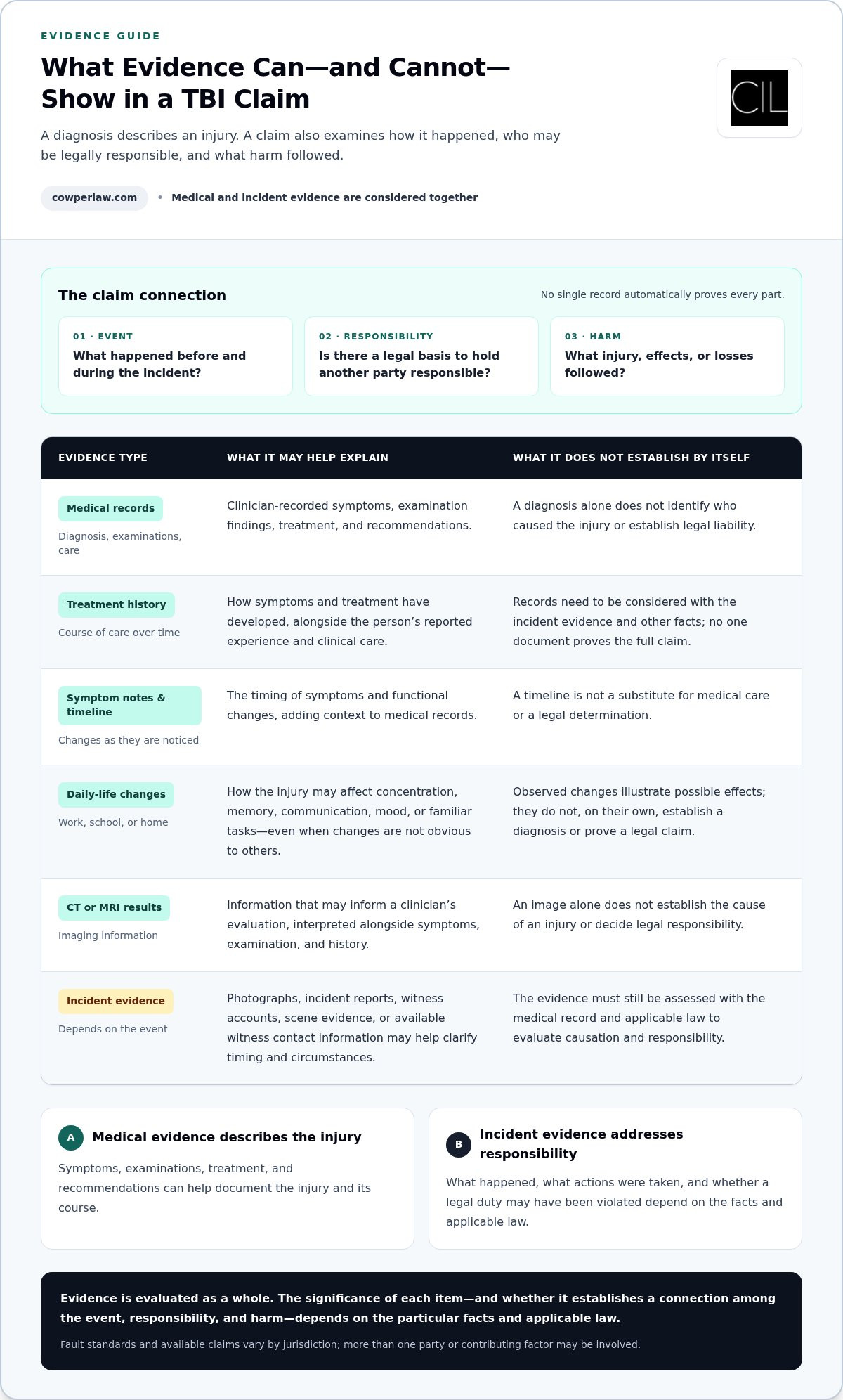
A diagnosis alone doesn’t establish a claim. The evidence needs to connect the injury to the event, show a basis for another party’s legal responsibility, and describe the harm that followed. Records are considered together; no single document automatically proves every part of a case.
Medical records and incident evidence work together to show what happened, how the injury affected the person, and whether another party may be legally responsible.
Potentially relevant evidence includes medical records, treatment history, notes about symptoms, witness accounts, and documentation of changes at work, school, or home. Clinicians may record reported symptoms, examination findings, treatment, and recommendations. A clear timeline of symptoms and functional changes can add context to medical records, but it isn’t a substitute for medical care or a legal determination.
CT scans or MRI results may inform a clinician’s evaluation, but an image alone doesn’t establish the cause of an injury or decide legal responsibility. Results need medical interpretation alongside symptoms, examination, and history. For background on the condition and its evaluation, see authoritative medical information on TBI.
Depending on the incident, photographs, incident reports, or available witness contact information may help establish timing and circumstances. If a device-related event is relevant, medical device injury legal guidance may offer useful context.
Medical evidence can describe the injury and its effects. It needs to be considered alongside evidence about the event: what happened before and during it, what actions were taken, and whether those actions may have violated a legal duty. For example, a timeline, scene evidence, and witness accounts after a fall or collision may help clarify the circumstances, while treatment records may document the injury and its course.
The legal question is not simply whether an incident happened before symptoms appeared. A claim may require evidence connecting the event to the injury and showing a legal basis for holding someone responsible. Causation and fault are assessed under applicable law and the particular facts, which may include competing accounts or other contributing factors.
In a Traumatic brain injury legal claim, an individualized review can help organize these separate lines of evidence without treating any one piece as conclusive. Cowper Law provides personalized, trial-focused support in serious injury matters. Explore legal support to learn how a case evaluation may help clarify the evidence and potential next steps.
An injury doesn’t have to be visible from the outside to deserve careful evaluation. Changes in concentration, memory, communication, mood, or the ability to manage ordinary tasks may be difficult for others to recognize, yet they can affect daily life. The medical question of what symptoms mean is separate from the legal question of whether the evidence establishes responsibility and harm.
The National Institute of Neurological Disorders and Stroke’s overview of Traumatic Brain Injury describes a range of possible effects. Symptoms, imaging findings, and expectations for recovery require individual medical interpretation. A scan alone may not explain every difficulty, and outward appearance cannot determine diagnosis or prognosis.
Someone may appear to be having a normal conversation but find it harder to follow instructions, remember details, express thoughts, or complete familiar routines. Others may notice changes in mood or behavior before understanding what is causing them. These are possible examples, not experiences that everyone with a TBI will have.
Experiences and recovery vary. If you notice symptoms or changes, share them with a qualified healthcare professional, who can assess them and guide appropriate care. A clear, ongoing record of how difficulties affect daily activities may also help explain their impact later.
Each type of information offers a different perspective. No single category automatically proves a diagnosis, legal responsibility, or the full extent of harm.
| Information | What it may help describe |
|---|---|
| Outward signs | Visible changes or assistance someone appears to need at a particular time. |
| Reported symptoms | The person’s account of changes such as memory, focus, communication, or mood. |
| Clinical documentation | Healthcare professionals’ assessments, treatment, and observations over time. |
| Daily-life impact | Changes in work, school, household responsibilities, or familiar routines. |
A disagreement may focus on whether the event caused the symptoms, how serious the effects are, whether a prior condition is relevant, or what losses followed. A dispute doesn’t, by itself, mean an injury is unreal or that a claim must go to trial.
Consistent records and a straightforward timeline can make the factual questions easier to understand. Note when changes began, how they affect everyday activities, and when you discussed them with healthcare professionals. In a Traumatic brain injury legal claim, those details may help clarify the evidence, while medical interpretation and legal proof remain separate questions.
Start with your health. Follow guidance from qualified healthcare professionals and discuss any new or changing symptoms with them. Decisions about diagnosis, treatment, and recovery belong with your medical team, not a legal checklist.
Once immediate needs are addressed, take the process one step at a time:
You don’t need a perfectly organized file before seeking guidance. A short timeline and a folder of available records can provide a useful starting point.
A simple timeline can bring the details together. Include the date and circumstances of the event, when symptoms or changes began, medical visits and treatment, and how daily activities have been affected. Keep the notes factual and add details as you remember them.
Gather what’s available, such as medical records, incident reports, photographs, and contact information for people who witnessed the event or its aftermath. Don’t delay medical care or strain yourself trying to collect every document. If a medical device may have been involved, records relating to the device and incident may also help clarify what happened.
There isn’t one filing deadline or procedure that applies to every TBI claim nationwide. Rules may depend on the jurisdiction, the type of claim, and who may be responsible. Different procedures can apply in some cases involving government entities or other specific circumstances, so a general online deadline may not fit your situation.
Prompt, jurisdiction-specific deadline review can help protect your options, but it can’t promise that a claim is eligible or establish its outcome. A legal professional can assess which rules may apply based on the facts. If you’re ready to discuss your circumstances, Discuss your situation with Cowper Law for a personalized review of potential next steps.
A brain injury claim can involve more than collecting medical bills. Legal counsel may help assess how the injury happened, what evidence connects it to another party’s responsibility, what losses may be relevant, and which deadlines or procedures could apply. That broader review can be useful when symptoms, recovery needs, or effects on work and daily life are difficult to measure.
Handling a claim yourself may feel manageable if the issues are straightforward and you’re comfortable organizing documents and communicating with the other parties. Representation may offer added support when responsibility is disputed, evidence is complex, or future effects are uncertain. Neither path is right for everyone. The choice depends on the facts, your capacity, and the guidance you want.
A legal assessment may consider medical care and treatment needs alongside income effects, daily limitations, and possible future needs. These details can create a fuller picture than immediate expenses alone. Potential damages depend on the available evidence, applicable law, and each person’s circumstances. No assessment can guarantee a recovery, amount, or timeline.
Cowper Law provides personalized, trial-focused advocacy in serious injury matters. For a Traumatic brain injury legal claim, an individualized review may help identify what is known, what needs further documentation, and what legal paths may be available. The goal is a clear-eyed evaluation, not a promise of a particular result.
Cowper Law collects legal fees only upon successful recovery of damages. Attorney fees and case expenses are not necessarily the same, and expenses or other terms can depend on the representation agreement. Before deciding how to proceed, read the agreement carefully and ask for a clear explanation of how fees, expenses, and case costs are handled.
Choosing representation is a personal decision. Weigh the time and effort involved in managing the claim yourself against the value of legal support with evidence, responsibility, damages, and procedure. If you’d like to discuss the facts and understand possible next steps, Talk with Cowper Law about your claim.
A Traumatic brain injury legal claim involves more than a medical diagnosis. Evaluating one means looking at how the injury happened, what evidence connects it to another party’s responsibility, and how it has affected the person’s life. Records of symptoms and changes in daily function may help tell that story, even when the effects aren’t obvious to others.
Organizing a timeline and available documents can make it easier to assess your options. Reviewing deadlines promptly can also matter, since legal rules and procedures vary by jurisdiction and claim type. You don’t have to resolve every question before asking for guidance.
Cowper Law focuses on catastrophic injury and serious personal injury litigation, with personalized, trial-focused advocacy. The firm collects legal fees only upon successful recovery of damages; case expenses and other terms may depend on the representation agreement. A conversation can help clarify how the facts and evidence might be evaluated, without promising a particular outcome.
Discuss your traumatic brain injury claim with Cowper Law. One manageable next step can bring greater clarity as you decide how to move forward.
Yes, symptoms don’t have to be outwardly visible for a potential claim to deserve careful evaluation. The key question is whether evidence can connect the event, another party’s legal responsibility, and the injury’s effects. Medical records, a symptom history, and notes about changes in daily activities may help explain what you’re experiencing. Legal standards and available evidence vary by jurisdiction and case, so an individual assessment matters.
Potentially useful evidence includes medical records, treatment history, incident reports, photographs, witness accounts, and documentation of changes at work, school, or home. No single item automatically proves a claim. What matters may depend on how the injury occurred, which facts are disputed, and the applicable law. Keep available records organized, and discuss symptoms and treatment questions with qualified healthcare professionals rather than relying on legal documents to guide medical decisions.
There’s no reliable universal amount for a TBI claim. Potential value may depend on the evidence, the nature and duration of the effects, medical and other losses, legal responsibility, and applicable law. Future needs may also require careful assessment. Outcomes in other cases can’t predict yours because circumstances differ. A lawyer may review the facts and explain relevant considerations, but no responsible evaluation can guarantee a particular recovery or amount.
Filing deadlines differ by jurisdiction and may depend on the type of claim, the parties involved, and other case-specific facts. Special procedural rules may apply in some circumstances, so a general online deadline may not fit your situation. Consider seeking jurisdiction-specific legal guidance promptly rather than waiting until every medical or factual question is resolved. This general overview is educational and doesn’t determine the deadline for an individual claim.
A prior head injury doesn’t, by itself, determine whether a new claim can be evaluated. Relevant questions may include what happened in the later event, what changed afterward, how healthcare professionals documented the condition, and which losses may be connected to that event. Medical and legal review may help distinguish the issues. Don’t assume that a prior condition automatically prevents an assessment of a potential claim.
A disagreement about causation may prompt closer review of the incident, medical history, symptom timeline, and available records. It doesn’t automatically determine the outcome or mean a claim is invalid. The useful evidence and legal standards depend on the facts and jurisdiction. An attorney may assess which questions need to be addressed and whether additional medical or factual information could help clarify the connection between the event and the reported effects.
Cowper Law’s stated fee model is contingency-based, with legal fees collected only upon successful recovery of damages. Attorney fees and case expenses are distinct, and the agreement explains how expenses and other terms are handled. Review the representation agreement carefully before signing and ask questions about any provisions you don’t understand. A contingency arrangement doesn’t guarantee recovery or make a case’s outcome predictable.