
A life-changing disability does not, by itself, establish who is legally responsible. A Permanent disability from injury lawsuit may be possible when evidence connects lasting harm to another party’s negligence or a defective medical device. The disability helps explain the harm, but the claim must also establish a legal basis for responsibility.
It’s understandable to worry about ongoing treatment, changes to your ability to work, and everyday needs that may continue for years. Depending on the facts and applicable law, a claim may address future medical care, lost income, reduced earning capacity, and the personal effects of an injury. No particular outcome is guaranteed.
This guide explains how lasting impairment differs from legal responsibility, what evidence can show an injury’s long-term impact, and which types of claims may apply. It also covers why filing deadlines depend on the jurisdiction and circumstances, and what to discuss with an attorney when weighing next steps. A focused review can help bring medical records, evidence of responsibility, and future losses into clearer view.
A lasting injury can change much more than a medical chart shows. It may affect whether you can return to work, live independently, manage daily routines, or handle ongoing care. These effects deserve careful attention, but a serious or permanent impairment does not, on its own, establish that another party is legally responsible.
In an injury lawsuit, permanent disability means a lasting physical or mental impairment that continues to affect a person’s functioning. The term describes the harm and its effects; it doesn’t determine who caused the injury or whether the law provides a remedy. “Permanent” also doesn’t mean doctors can predict every future limitation with certainty. Medical understanding may develop as treatment continues and a person’s condition changes.
The phrase can have a different meaning in an insurance policy. For example, Total Permanent Disability (TPD) is discussed in an insurance context, where the policy’s terms matter. An injury lawsuit raises separate questions about responsibility, causation, and legally recognized losses.
No. The Permanent disability from injury lawsuit question involves more than the extent of the impairment. A claim generally needs evidence connecting another party’s conduct or product to the injury, as well as a legal basis such as negligence or product liability. Evidence of a lasting injury can help explain the harm, while separate evidence may be needed to show how a careless act or defective device caused it.
Severity and liability are separate issues. A life-altering outcome doesn’t automatically prove fault, and a diagnosis alone doesn’t guarantee compensation. Available claims and legal standards vary by jurisdiction and circumstances, so the connection between the injury and the alleged responsibility needs a case-specific review.
A temporary disability may improve as an injury heals, while a lasting impairment continues to affect function over time. The distinction may not be clear early in recovery. Symptoms can change, limitations may ease or persist, and a person’s prognosis may become clearer as treatment progresses. A permanent-disability assessment relies on medical evidence and individual circumstances, not only how the injury felt in its first weeks or months.
A diagnosis, benefits decision, or disability label may provide relevant context, but it doesn’t automatically establish lawsuit value or legal responsibility. The practical questions are how the condition affects this person’s abilities and future needs, and what evidence connects those effects to the incident or product at issue.
A lasting injury can bring costs and losses that extend beyond initial treatment. Depending on the applicable law, evidence, and case facts, a claim may address medical care and support, income-related losses, and the effects of living with an impairment. No category or amount is automatic.
Damages analysis connects documented losses to the injury and its reasonably supported expected effects. Estimates should be grounded in records and qualified opinions, not guesses about the future.
Treatment plans, rehabilitation notes, prescriptions, and opinions from treating specialists may help explain what care is ongoing and what may be recommended later. They can also show how the injury affects daily support needs. If supported by medical evidence, a claim may include assistive equipment, home support, or future procedures.
Future needs require careful assessment. Don’t assume a projected lifetime cost or definite prognosis without qualified evidence. The aim is to understand what care may be needed and the basis for that estimate.
Past lost income refers to earnings missed because of the injury. Future earning-capacity loss concerns how the impairment may affect a person’s ability to earn going forward. Pay records, work history, and medical evidence can help show time away from work, changed duties, reduced hours, or accommodations needed to keep working. Together, they may clarify whether the effect on earning ability is temporary or lasting.
Not every loss appears on a pay statement. Testimony and personal records may describe changes in independence, relationships, and ordinary activities, such as needing help with household tasks or giving up routines that once came easily. These effects may be considered under applicable law, but their evaluation depends on the individual circumstances and supporting evidence.
Social Security disability benefits follow a separate program with its own eligibility process; the Social Security Disability Benefits resource explains that program. A benefits decision doesn’t, by itself, determine which losses a lawsuit may address. A Permanent disability from injury lawsuit requires a case-specific assessment of responsibility, evidence, and legally recoverable harm.
For a tailored review of how medical evidence and future losses may fit together, explore Cowper Law’s catastrophic injury representation.
A lasting disability doesn’t identify who may be responsible or which legal process applies. The appropriate route depends on how the injury happened, who may have contributed, and what the evidence can establish. A Permanent disability from injury lawsuit may involve negligence or a product-related claim. If the injury is work-related, workplace benefits may also be relevant. Each possibility requires individual review; none guarantees eligibility or recovery.
| Possible route | Who or what may be involved | Purpose and evidence to discuss |
|---|---|---|
| Third-party negligence | A person or organization whose conduct may have contributed to the injury | Assess whether the conduct caused harm. Discuss incident records, witness accounts, and other evidence of what happened. |
| Product liability | A manufacturer or another party connected to a product | Examine whether a design, manufacturing, or warning issue may have caused the injury, using the product, medical, and incident evidence. |
| Workplace benefits process | An employer-related or statutory benefits system, depending on applicable law | Consider the purpose and requirements of the benefits process, along with any rules affecting a separate claim involving another party. |
Negligence generally involves whether a party had a legal duty, failed to act as required, and thereby caused harm. Product-liability claims may focus on a possible design defect, manufacturing problem, or inadequate warning. Standards and available claims vary by jurisdiction, and evidence must support the connection between the alleged issue and the injury. If a medical device may be involved, the firm’s article, “Medical Device Injury Lawyer: Relentless Advocacy for the Harmed,” addresses that subject.
Workplace benefit systems and injury lawsuits can serve different legal purposes, and going through one process doesn’t automatically resolve the other. Rules about eligibility, exclusivity, and claims against third parties vary by jurisdiction and circumstances. An attorney can review applicable requirements, deadlines, and how potential routes may interact. More than one route may warrant consideration, but that doesn’t mean a person automatically qualifies for each or can recover the same loss more than once.
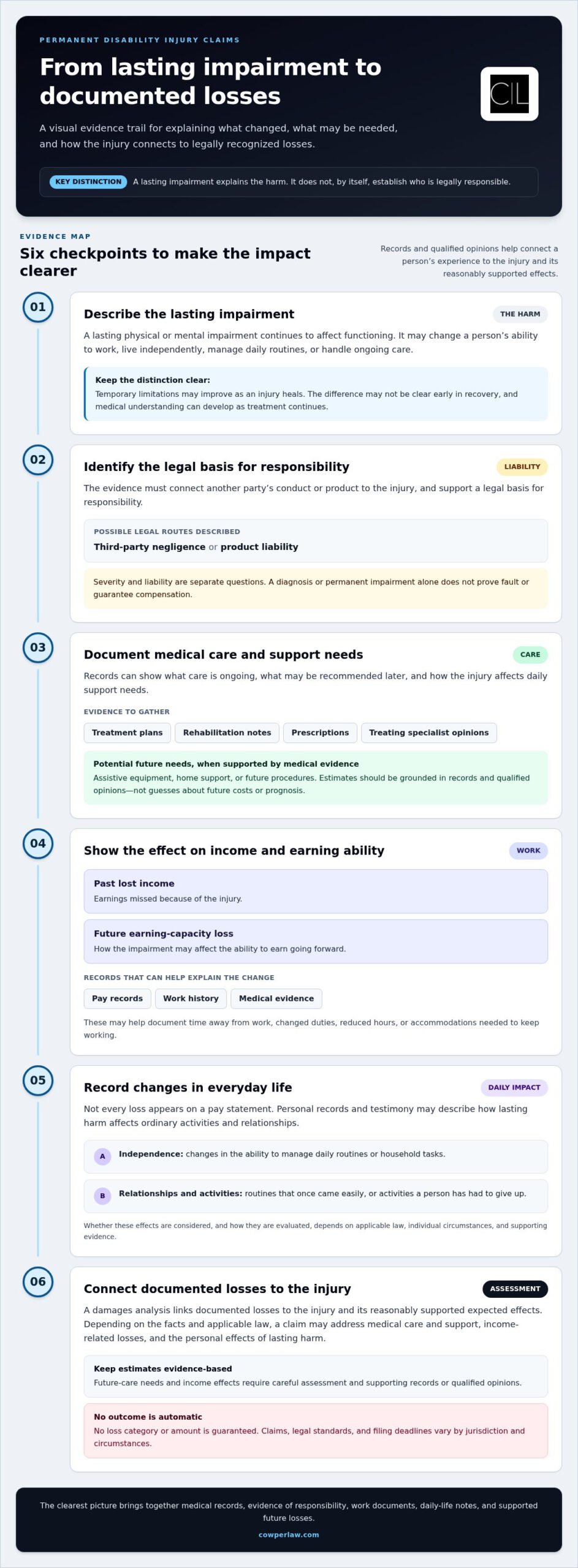
Building a clear record can feel like another burden while you’re focused on recovery. Keep the process manageable, and don’t delay necessary medical care to gather paperwork. Evidence can help connect what happened to the injury, lasting limitations, and the losses or needs that followed. In a Permanent disability from injury lawsuit, the central evidence chain is the incident, medical causation, lasting limitations, and documented losses.
Start with records that show treatment, recovery, work effects, and the incident itself. Gather what’s readily available; an attorney can help identify other potentially relevant materials.
Your records don’t have to be perfectly organized to be useful. A simple folder with documents grouped by date or type can make important details easier to find and review.
Medical files may not capture every change in daily function. Brief, dated notes can record tasks that have become difficult, assistance you need, changes in independence, and activities you can no longer manage as before. Keep entries factual and consistent. Don’t alter existing records or overstate symptoms.
People with firsthand knowledge, such as family members or coworkers, may also provide context about changes they directly observed. Their accounts can complement medical and work records, but shouldn’t replace them. Together, these materials can help explain how an injury affects ordinary routines as well as formal work duties.
Preserve the records you already have and continue following your care team’s guidance. For a case-specific review of evidence linking an injury to its lasting effects, discuss your injury claim with Cowper Law.
A careful legal review can bring medical, practical, and procedural questions into focus. Counsel may examine who could be responsible, whether the available evidence connects that conduct or a product to the injury, what losses need documentation, and which deadlines may apply. A Permanent disability from injury lawsuit calls for a case-specific assessment, not assumptions based on a diagnosis alone.
A focused review can help identify the questions that shape next steps:
Deadlines vary by jurisdiction, claim type, and circumstances, so there isn’t one universal filing period. For a review, bring records you already have and a concise timeline of the incident, treatment, and key changes since the injury. Don’t postpone urgent medical care to gather documents.
Consider whether the attorney gives your circumstances individual attention, has relevant experience with catastrophic injuries or medical-device litigation, communicates clearly, and explains the fee agreement in understandable terms. Cowper Law represents people harmed by negligence, defective medical devices, drugs, and other catastrophic injuries, with personalized advocacy focused on the facts and the person behind them. Careful investigation and trial readiness may matter when responsibility and long-term effects are disputed, but no review can promise a particular result.
Cowper Law’s representation is contingency-based: legal fees are collected only upon successful recovery of damages, subject to the specific engagement agreement. Read the written agreement closely and ask how it addresses the fee arrangement and any case expenses. Their treatment can differ, so don’t assume they are identical.
You can discuss the available evidence, possible legal routes, future losses, and applicable deadlines with counsel before deciding how to proceed. For a personalized evaluation, discuss your injury claim with Cowper Law. A clear review can help you understand your options without guaranteeing eligibility or an outcome.
A lasting disability can reshape work, independence, and everyday life, but impairment alone doesn’t establish legal responsibility or guarantee compensation. A Permanent disability from injury lawsuit depends on evidence connecting the injury to another party’s conduct or product, as well as the losses the law may recognize.
Medical records, work documents, and clear notes about daily limitations can help explain how the injury affects you now and what needs may lie ahead. The legal route and filing deadlines depend on the claim and circumstances, so a tailored review can help clarify responsibility, causation, and future losses.
Cowper Law provides personalized representation in catastrophic injury matters and handles medical device injury litigation. Its representation is contingency-based, with legal fees collected only upon successful recovery, subject to the engagement agreement. To discuss your situation and understand your legal options, discuss your injury and understand your legal options.
You deserve a careful assessment and clear information as you decide what comes next.
You may be able to sue if evidence supports a legal claim connecting another party’s conduct or product to your injury. A lasting disability can help explain the harm, but it doesn’t by itself prove negligence, product liability, or another party’s responsibility. The available legal route depends on how the injury occurred, the evidence, and applicable law. A case-specific review can help clarify whether a claim may be available.
Depending on the law and facts, a claim may address injury-related medical care, future treatment or support, past lost income, reduced future earning capacity, and the personal effects of lasting impairment. Treatment recommendations can help support future-care needs, while employment records may document income changes. Recoverable categories vary, and no particular compensation is guaranteed. A legal assessment can help distinguish documented losses from estimates that need further support.
Medical evidence and other records can help connect the incident to the injury and its lasting effects. Relevant materials may include treatment notes, test results, rehabilitation records, and clinician assessments, along with work restrictions and records of income changes. Dated notes about daily limitations can provide additional context. The claim must also be supported by evidence of legal responsibility, such as negligence or a product issue, where applicable.
No. A disability rating doesn’t automatically determine compensation in an injury lawsuit. A rating may serve a purpose in a particular benefits or insurance system, while a lawsuit considers legal responsibility, causation, evidence of harm, and losses recognized under applicable law. The rating may be relevant, but it isn’t necessarily decisive. Its significance depends on how it was reached and the rules that apply to the claim.
Possibly. A workplace injury may involve a benefits process, and a separate lawsuit may warrant review if another party could be legally responsible. These routes can have different purposes, and the rules governing eligibility, claims, and how processes interact vary by jurisdiction and circumstances. Don’t assume that a work-related injury automatically allows or prevents a lawsuit. A legal review can help identify potential claims and relevant state-specific rules.
There isn’t one filing deadline for every permanent disability injury lawsuit. Time limits may depend on jurisdiction, claim type, when the injury occurred or was discovered, and other circumstances. Separate procedures may have their own deadlines. Because missing an applicable deadline can affect your options, seek case-specific legal guidance promptly rather than relying on a general timeframe or waiting for a final prognosis.
No, you don’t need to wait for a final medical prognosis to discuss your options with a lawyer. Early guidance may help identify potentially relevant evidence, responsible parties, and deadlines while you continue receiving care. A case review can account for the possibility that symptoms and prognosis may change during recovery. Bring available records and a brief timeline if you can, but don’t delay necessary treatment to prepare for a legal discussion.