
Could a serious reaction to a medication be more than an unfortunate side effect? It may be, but an injury alone doesn’t establish a legal claim. A drug injury lawsuit attorney can assess whether the available evidence connects your injury to a potential legal failure, such as inadequate warnings, a design defect, or a manufacturing problem.
If you’re unsure whether your experience may support a claim or who could be responsible, the details matter. An attorney may need to understand which medication you took, how you used it, your diagnosis and treatment, and what the manufacturer or other parties communicated about its risks. This article explains how an adverse effect differs from a potentially actionable injury, which records can help with an initial review, and why filing deadlines depend on jurisdiction and circumstances.
Cowper Law represents individuals in drug injury litigation, providing personalized guidance through case evaluation and, when appropriate, litigation. The firm collects legal fees only upon a successful recovery of damages; no outcome is guaranteed. Understanding the issues can help you decide what to do next.
A serious health problem after taking medication can raise urgent questions: Was this a known risk? Could something have gone wrong? Is anyone legally responsible? A drug injury lawsuit is a civil claim alleging legally actionable harm connected to a drug. Showing that a health problem followed medication use is generally not enough. Evidence must help connect the injury to the medication and to a potential legal failure.
That distinction matters. A possible drug-related injury describes what may have happened; proof of a legal claim requires evidence connecting the harm to a legally relevant failure. The alleged failure might involve the drug’s design, a manufacturing problem, or a warning that did not adequately communicate a risk. The issues depend on the facts and applicable law. A broad overview of medical lawsuits offers context, but it can’t determine whether a particular medication injury supports a claim.
An attorney will generally need to assess three connected issues: whether there is an identifiable injury, whether the medication may have contributed to it, and whether evidence points to a potential legal failure. Timing can be relevant, but symptoms that begin after someone starts a medication don’t, by themselves, prove causation. Other possible explanations and the person’s full medical circumstances also need to be considered.
A useful starting point is a timeline of when you began taking the medication, when symptoms appeared, and when you sought care. The diagnosis, dose, other medications, and medical history provide important context. Treatment records and the prescriber’s notes may help an attorney understand what happened. A drug injury lawsuit attorney reviews legal questions and available evidence, not medical diagnoses. For symptoms and treatment decisions, follow the guidance of a qualified treating clinician.
Medications can carry risks, and an adverse effect does not automatically mean a product is defective or its maker is liable. A legal claim might allege that important risks were not adequately communicated, that the drug’s design was unreasonably unsafe under applicable law, or that a production error affected the medication. These are distinct allegations, and each requires evidence specific to the product and the person’s circumstances.
A warning on a label is relevant, but it doesn’t resolve every legal question. The wording, the risk described, and the circumstances of the person’s use may all matter. Likewise, a severe reaction alone doesn’t establish that a warning was inadequate or that the product was defectively designed or manufactured. A careful assessment considers medical evidence alongside product information and other records instead of assuming fault from the outcome.
Some questions may remain unanswered at the outset. A careful review can help distinguish a suspected medication connection from a claim supported by evidence, while keeping medical care and legal analysis in their proper roles.
After a medication-related injury, it’s natural to ask who may be responsible. The answer depends on the alleged failure and the evidence, not simply on which people or companies were involved. A manufacturer, prescriber, or pharmacy may be relevant to an investigation, but involvement alone doesn’t establish legal responsibility. Each potential claim raises different questions about conduct, causation, and records that may support or contradict an allegation.
Identifying a potential defendant means tracing the alleged failure to the party whose conduct or product may have caused the injury. A drug injury lawsuit attorney can help distinguish product-related allegations from concerns about prescribing or dispensing, then assess how the available evidence relates to the applicable legal theory.
Claims involving a drug manufacturer can center on different allegations. A design-defect claim challenges the product’s design. A manufacturing claim concerns an error or contamination in production. A failure-to-warn claim questions whether relevant risks were adequately communicated. These are not interchangeable labels, and none should be treated as proven without support specific to the case.
Drug packaging, warnings, prescribing information, and product or manufacturing records may help clarify what was communicated and how the medication was made. Expert analysis may also be needed to assess technical or medical questions, including whether a claimed defect could have contributed to a particular injury. The U.S. Food and Drug Administration (FDA) provides information about drug regulation and safety for general background. FDA materials alone don’t determine whether a party is legally liable.
Questions about a clinician’s prescription or a pharmacy’s dispensing differ from allegations that a drug itself was defectively designed, manufactured, or labeled. The relevant inquiry may include what instructions were given, what information was available, and whether the conduct at issue contributed to the injury. A physician or pharmacist isn’t automatically a proper defendant because they participated in a person’s care. The facts and governing law matter.
For example, an allegation about a prescribing decision requires examining the circumstances around that decision. A concern about dispensing raises different questions and may involve different records. In either situation, the injury must be connected to the specific conduct alleged. A bad outcome by itself doesn’t establish that a professional made a legally actionable error.
Drug claims also differ from cases involving an implanted or other medical device, which raise product-specific questions of their own. Cowper Law’s medical device injury litigation addresses a separate category of product-related harm.
Responsibility can involve complex facts, and more than one legal theory may need consideration. Cowper Law represents individuals in drug injury litigation with personalized guidance as the evidence is evaluated. Learn about Cowper Law’s drug injury representation.
People harmed after taking the same medication may still have different legal claims. They may have different diagnoses, treatment histories, or evidence about how their injuries occurred. Other people may share questions about the product or its warnings. Those similarities can affect how cases are handled, but they don’t automatically make the claims identical or eligible to proceed together.
Three common structures are individual claims, coordinated litigation, and class actions. Each handles shared and personal issues differently:
| Claim path | How it works | What remains case-specific |
|---|---|---|
| Individual claim | One person pursues a claim based on their circumstances. | Injury, medical history, causation, and supporting evidence. |
| Coordinated litigation | Related cases may have certain proceedings managed together, while remaining individual cases. | Each person’s injury, evidence, and potential outcome. |
| Class action | A representative case seeks to address claims for a defined group, subject to court approval. | Whether the person and claim fit the class and how shared issues apply. |
The appropriate path depends on the common facts, differences between individual injuries, applicable law, and court decisions. A drug injury lawsuit attorney can assess those factors without assuming that a particular structure will be available or suitable.
An individual claim keeps one person’s experience at the center. Even when others took the same medication, differences in diagnosis, dosage, treatment, and medical history may shape the evidence and legal issues. In coordinated proceedings, courts may manage some related cases together for efficiency, while the cases remain individual. Coordination doesn’t ensure a shared outcome or identical recovery.
For example, cases may share questions about a product but differ in the nature and extent of each person’s injury. Both the shared questions and the individual evidence matter. Coordination is a way to manage related litigation, not a finding that every claim is the same or that a particular result will follow.
A class action seeks to resolve claims for a court-defined group, and the court must approve the class. Shared questions may support considering that structure, but individual issues, including injury and medical causation, can affect whether one proceeding fits the group. Similar medication use alone doesn’t establish eligibility. Background on group litigation is available in this medical device class action guide, though drug and device cases are not necessarily alike.
These distinctions explain why a case structure must be evaluated rather than assumed. A careful review considers both what claimants share and what is unique to each person.
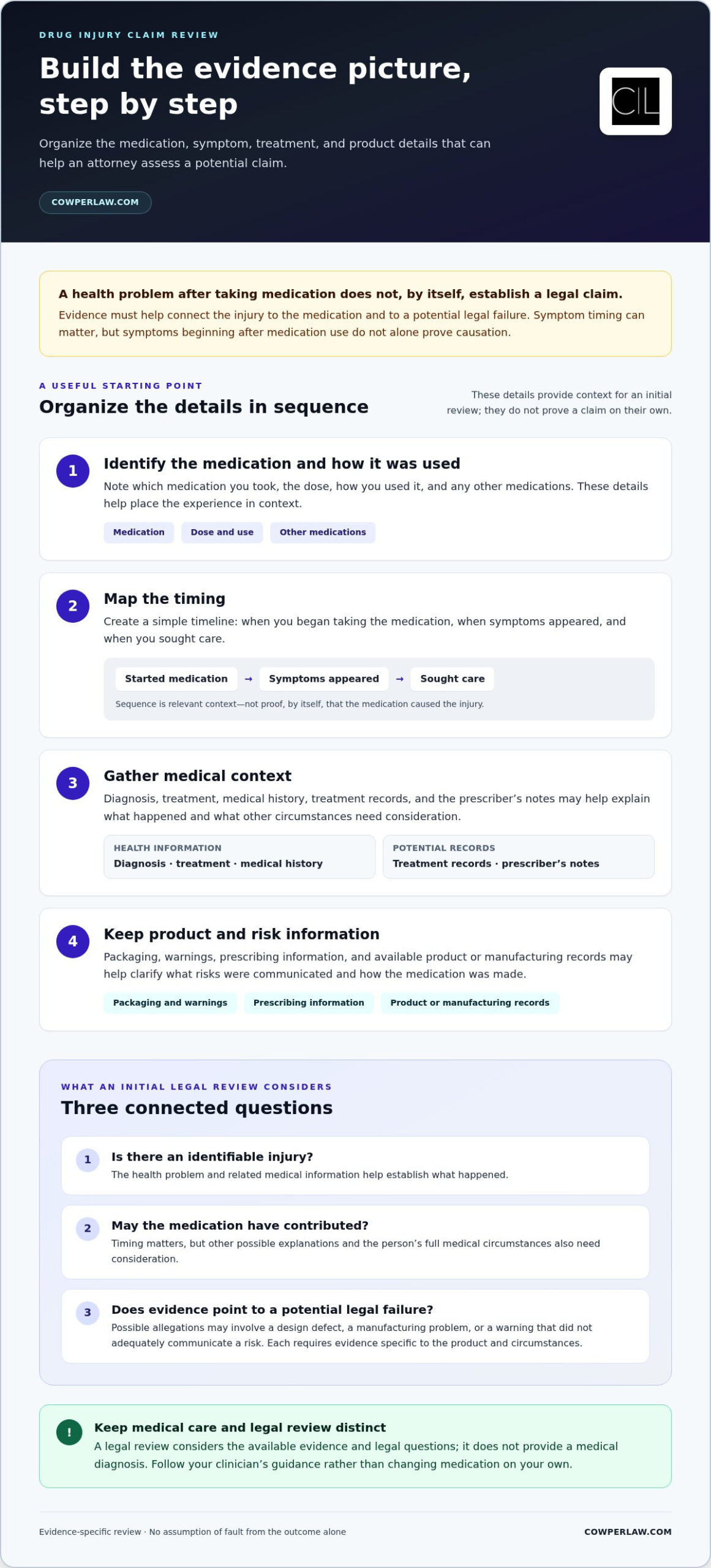
Gathering information can make an initial legal review more focused, even if you don’t have every record or date. Start with what you can access, and don’t delay necessary medical care while organizing paperwork. Never stop or change medication on your own. Follow your treating clinician’s guidance about your care and medication.
Use this checklist to create a clear starting point:
You don’t need a complete file before seeking legal guidance. A short timeline and a few available records can help identify missing information and questions that need attention.
Medication lists, dosage information, prescription details, and dates can help an attorney understand the sequence of events. Medical records may document symptoms, diagnosis, and treatment, while pharmacy records can help clarify when a prescription was filled. Bills and relevant communications may add context. Keep originals safe and avoid deleting messages or changing documents, even if you’re unsure whether they matter.
If you can’t find a particular record, note what’s missing. An incomplete collection shouldn’t prevent you from seeking an initial review.
Filing deadlines, often called statutes of limitations, differ by state and claim type. The date a deadline begins may also depend on case-specific facts, so a general deadline found online may not apply to your situation. Prompt legal review can help identify potentially relevant deadlines, but it can’t guarantee that a claim is available or will succeed.
During an initial review, a drug injury lawsuit attorney may consider your timeline, injury documentation, medication and treatment records, and possible legal theories. That legal assessment is separate from medical care. Keep following your clinician’s advice and prioritize treatment while the legal questions are evaluated.
For a personalized review of your drug injury concerns, contact Cowper Law about drug injury litigation. The firm provides individualized legal representation and collects fees only upon successful recovery of damages; no recovery is guaranteed.
When a medication-related injury disrupts your health and daily life, the legal questions can be difficult to sort through alone. Cowper Law represents individuals in drug injury litigation, with attention to the person behind the records and allegations. A drug injury lawsuit attorney can review available information, identify issues that may need further investigation, and explain possible next steps without promising that a claim will be accepted or succeed.
An initial evaluation is a review of the circumstances, not a guarantee of a particular result. It may consider the injury and its documented effects, medication history, treatment records, and timeline. It may also examine potential legal issues, such as whether the facts point to a product-related concern or another kind of alleged failure.
Some information may be missing or unclear. A review can help identify what is known, what remains uncertain, and what additional records or analysis might be relevant. Medical treatment remains separate from legal evaluation, so continue following your treating clinician’s guidance as the legal questions are considered.
Clear communication matters throughout the process. Cowper Law emphasizes personalized advocacy and compassionate guidance, helping individuals understand the issues under review and make informed decisions about how to proceed. Complex litigation calls for careful preparation and persistence, but the course and timing of any matter depend on its specific circumstances.
Cost concerns can make it harder to explore legal options. Cowper Law’s representation is contingency-based: legal fees are collected upon successful recovery of damages. This arrangement doesn’t mean a recovery is assured, and an evaluation can’t guarantee case acceptance or a particular outcome. A discussion of the facts can help clarify the legal questions they may raise.
You can describe what happened in your own words, share the records you have, and ask questions about the review process. You don’t need to arrive with every document or a fully formed legal theory. The conversation can help clarify what information may matter and whether further evaluation is appropriate.
If you’re concerned that a medication may have caused serious harm, contact Cowper Law to discuss your situation and possible next steps. The firm provides personalized legal representation and compassionate guidance.
You don’t need every answer before asking what options may be available. A conversation with a drug injury lawsuit attorney can help identify questions that deserve attention and help you decide how to move forward, without committing you to a particular outcome.
Cowper Law handles drug injury litigation and serious injury matters with personalized advocacy and compassionate legal support. The firm collects legal fees only upon successful recovery of damages, though no recovery or result is guaranteed. Your circumstances are your own and deserve careful consideration.
If you’re ready to discuss what happened and explore possible next steps, discuss your drug injury concerns with Cowper Law. Begin with the information you have and take the process one step at a time.
Yes. Taking medication as directed doesn’t automatically rule out a claim. A person may still have questions about whether the product’s warnings, design, or manufacturing were legally inadequate, though the facts and applicable law determine whether a claim may proceed. Keep prescription instructions, packaging, and records showing how you took the medication. A drug injury lawsuit attorney can consider those details alongside your medical history and injury evidence.
No. FDA approval doesn’t automatically prevent every drug injury lawsuit. Approval may be relevant, but it doesn’t settle every question about warnings, manufacturing, or other alleged failures. The legal issues can differ depending on the product and manufacturer. Some claims may face complex arguments about whether state-law claims conflict with federal requirements. An attorney can assess how approval relates to specific allegations rather than treating it as an automatic bar or proof of liability.
Potentially. The fact that a medication is sold over the counter rather than by prescription doesn’t, by itself, determine whether a legal claim may exist. Relevant questions may include what the product label communicated, whether the product was made as intended, and whether evidence connects an alleged problem to the injury. Keep the package or label, if available, along with receipts and treatment records to help identify the product used.
No. A recall isn’t a prerequisite to exploring a claim, and the absence of a recall doesn’t establish that a product was safe for every user or correctly manufactured in every instance. A recall notice may offer useful product information, but it doesn’t prove that a particular person has a legal claim. Case-specific records, medical evidence, and the alleged failure still matter when evaluating a potential basis for legal action.
Possibly. Depending on the jurisdiction and circumstances, an eligible family member or the representative of the deceased person’s estate may be able to pursue a wrongful-death or related claim. Who may bring it, what losses may be considered, and the filing deadline depend on applicable law. Preserve available medication, medical, and death-related records, and seek legal review promptly because deadlines can vary and may affect the options available.
Not automatically. A court must approve a class action for a defined group, and similar medication use alone doesn’t establish that people’s claims qualify. Shared issues may be considered alongside individual differences, such as diagnoses and medical histories. Related lawsuits may instead be coordinated for certain proceedings while remaining separate individual cases. Coordinated cases aren’t necessarily a class action, and neither structure guarantees a shared result.
At Cowper Law, legal fees are collected only upon successful recovery of damages. This is a contingency-based fee model, not a promise that a case will be accepted or that damages will be recovered. No percentage or additional fee terms are stated here, so don’t assume a particular amount or arrangement. Before proceeding with representation, review the specific fee agreement to understand the terms that apply to your matter.