
If you’re wondering how to prove pain and suffering from a medical device, start by showing how the injury affected your life, not just what happened to the device. Pain, fear, disrupted sleep, and changing symptoms can be difficult to put into words. A clear account connects your medical records with specific changes in your daily routine.
Pain and suffering are personal, and an existing condition or fluctuating symptoms can make their effects harder to explain. The most useful account is accurate and detailed: it brings together treatment records, your own observations, and changes that people close to you may have noticed. No single record has to tell the whole story.
This article explains what pain and suffering may mean in a medical device claim and how different kinds of evidence can help show its effects. You’ll find practical ways to organize treatment information, keep a personal journal, and describe changes to your abilities, relationships, and everyday life. An attorney can assess these details alongside the device-related facts and applicable law.
Pain and suffering generally refers to non-economic harm connected to an injury. It can include effects on physical comfort, emotional well-being, relationships, and daily activities that aren’t captured by a bill or paycheck. It describes a broad category, not one uniform experience. As Pain and Suffering in Legal Terms explains, pain and suffering is commonly discussed as a component of non-economic damages in personal injury claims.
In a medical device claim, evidence of a product problem and evidence of a person’s suffering address different questions. Information showing that a device malfunctioned or caused a complication may help explain how an injury occurred. It doesn’t, by itself, show how severe the pain was, how long it continued, or what the person could no longer do. Those effects depend on the individual’s injury and circumstances.
That distinction matters when considering how to prove pain and suffering from a medical device. Your account should connect the injury to specific consequences while distinguishing physical pain, emotional distress, and changes to everyday life. You may have experienced one, several, or different effects over time. The facts and available evidence shape how those experiences can be considered.
Legal standards and available damages vary by state and by the circumstances of a claim. There is no single formula that guarantees a particular result. A case-specific review can consider which effects the evidence supports and how applicable law treats them.
Possible experiences include ongoing or recurring pain, discomfort, and physical limitations associated with an injury. These effects may make it difficult to complete a task, participate in an activity, or maintain a usual routine. Emotional effects, such as distress or disrupted sleep, may also be relevant when supported by the facts. These examples don’t establish a diagnosis, and not every person will experience the same harm.
Describe what changed rather than relying on a broad label. “I hurt” gives little context. Explaining when discomfort occurs, how often it affects you, or which ordinary activities have become difficult can make your experience clearer. Include only details that reflect what actually happened, not assumptions about what someone with a particular device injury must feel.
Medical bills record treatment expenses, which are economic losses. Pain and suffering concerns non-economic effects, such as physical discomfort, emotional strain, or reduced ability to enjoy ordinary activities. Records may support both categories, but they don’t measure them in the same way. A treatment note might document an appointment and a reported symptom without showing the full effect on home life or relationships.
For example, records could show follow-up care after a complication, while your account explains that discomfort interrupted sleep or made a familiar daily task harder. The treatment history and your description of its effects tell related parts of the story. Neither should be assumed to prove every other part.
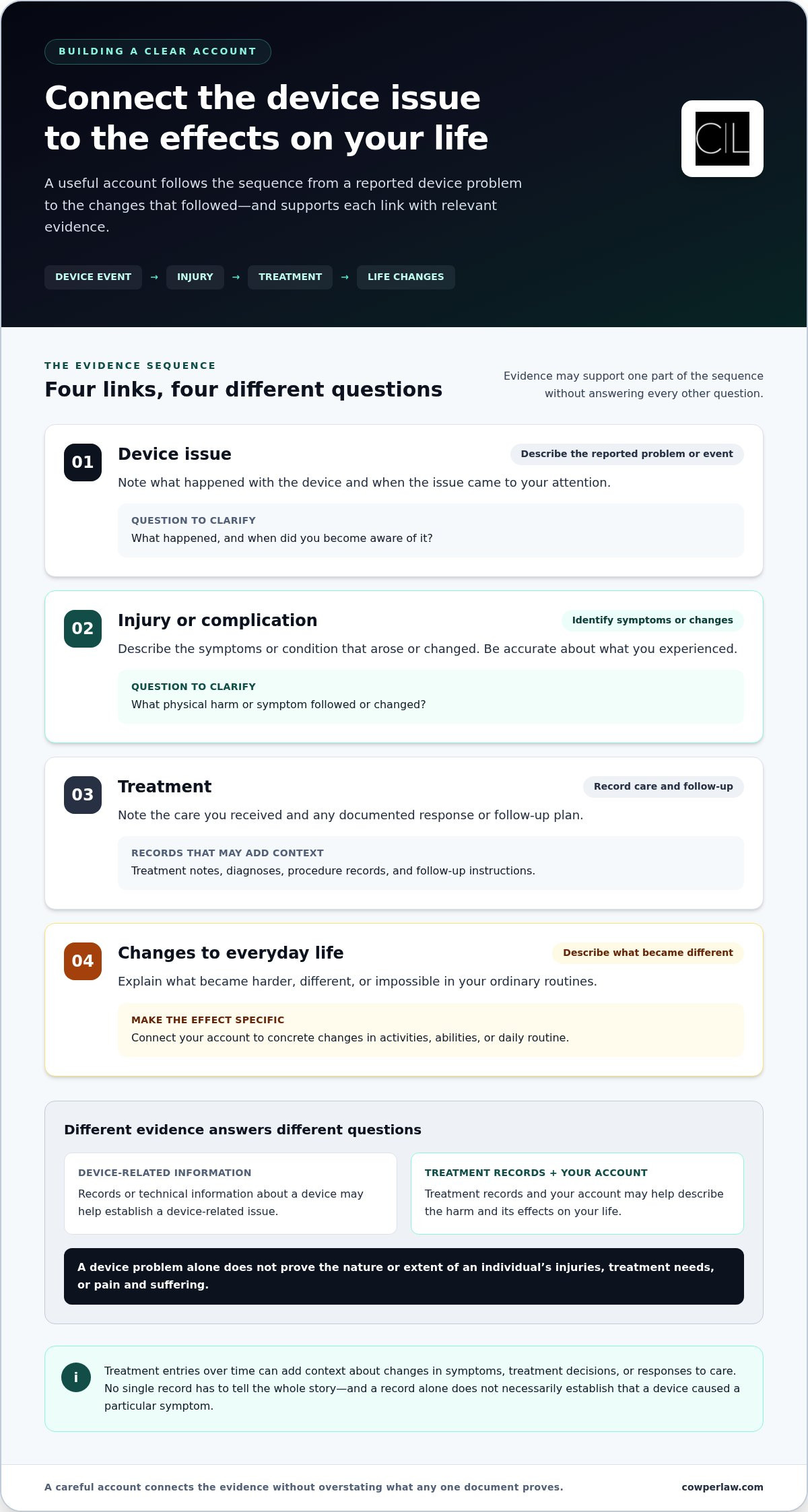
A clear account follows a sequence: a device issue, an injury or complication, treatment, and the changes that followed. Each link raises a different question. What happened with the device? What physical harm followed? What care did you receive, and how did the injury affect your daily life? Evidence may support one part of this sequence without answering every other question.
A device problem alone does not prove the nature or extent of an individual’s injuries, treatment needs, or pain and suffering. Records or technical information about a device may help establish a device-related issue, while treatment records and your account may help describe the harm. Evidence of a malfunction does not automatically establish what caused a particular symptom or how deeply an injury affected you.
Medical and legal questions are related, but they aren’t identical. A clinician evaluates health concerns and care; a legal assessment considers available evidence and applicable legal standards. Establishing responsibility or causation can involve facts beyond your experience alone. The goal is to present a careful account, not to diagnose the cause or assign blame based on timing alone.
If you’re considering how to prove pain and suffering from a medical device, use the sequence to organize your account without overstating what any one document proves:
Treatment notes, diagnoses, procedure records, and follow-up instructions may show what symptoms you reported, what clinicians observed, and what care was provided. Entries over time can add context by documenting changes in symptoms, treatment decisions, or responses to care. No single record is required in every case, and a record alone doesn’t necessarily establish that a device caused an injury.
Read records as a timeline rather than as isolated phrases. A brief note may capture only one visit; later entries may add detail or describe a different course. Reviewing the complete medical history can help an attorney assess how documented health events fit with the device-related facts.
The order of events can clarify your account: when the device was used, when symptoms began or changed, and when you sought care. A timeline may also reveal gaps or developments that need explanation. Timing can be relevant, but symptoms appearing after device use don’t, by themselves, prove the device caused them.
Prior conditions, other treatments, or unrelated events may also help explain symptoms. That doesn’t erase your experience; it means the full history deserves careful review rather than a conclusion drawn from one detail. A medical device injury attorney can assess the records, timeline, and reported life changes together as part of a case-specific evaluation. Medical device injury litigation representation can help bring those facts into focus.
No single type of evidence captures every effect of an injury. Medical records may document symptoms and care. Your account can explain what those symptoms feel like in daily life, and people close to you may describe changes they have observed. Relevant activity records can add context about routines or responsibilities that became harder to manage.
Different evidence sources can corroborate one another when they consistently describe the same changes from different perspectives. Consistency doesn’t mean every account must use identical words or cover the same details. The overall picture should make sense across records, recollections, and observations, with differences explained rather than concealed.
Evidence created close to an event can capture details that are easy to forget later. A later summary can also be useful: it may explain the broader pattern, provide context, or clarify why a record from the time is brief. Neither should be treated as automatically complete or dismissed solely because of when it was created. As you consider how to prove pain and suffering from a medical device, focus on truthful details and explain what each source helps illustrate.
Notes may record the symptoms you reported, the care discussed, and whether a clinician documented a limitation or change. Read entries across visits, since a pattern may be clearer than any single note. Describe symptoms accurately during appointments, including how they change over time. Gaps in treatment can have many explanations; relevant context may help clarify them without assuming what a gap means.
Your account can explain the practical effect of a symptom. For example, note whether discomfort interrupted sleep, limited movement, affected work tasks, or changed time with family. Be concrete about what happened and when rather than relying on broad labels. Family members or coworkers may independently describe changes they witnessed, such as you needing help with a routine task.
Keep accounts natural and truthful. Don’t script another person’s observations or exaggerate an effect to make it sound more serious. Specific examples of what changed and what the observer personally noticed are more useful than conclusions they can’t support. Together, these perspectives can help an attorney evaluate real-world effects alongside the medical history and the facts of the claim.
A clear account doesn’t need dramatic language. It needs a reliable structure that explains what changed, when it changed, and how those changes affected your life. If you’re learning how to prove pain and suffering from a medical device, organize evidence around your experience rather than trying to document every technical detail of the device incident.
Work through these steps:
Specific examples make suffering more understandable than broad claims because they show what changed in your actual life. “My mobility got worse” is less informative than a truthful description of which routine movement became difficult and how that affected a usual task. Don’t embellish or fill in details you can’t remember. An accurate account is more useful than one that sounds certain about everything.
Arrange information in sequence, connecting symptoms and treatment with changes in your routine. For each entry, note what you experienced, how often or how long it lasted if you can recall, and the practical consequence. For example, describe that a household task took longer or required help instead of simply writing that daily life was affected. If you can’t recall a date precisely, label it as approximate rather than guessing.
A timeline can include pauses, setbacks, and improvement as well as difficult periods. Preserve original notes and records. If you add an explanation later, make clear that it was added later rather than changing an earlier entry. This keeps the chronology transparent and tied to your actual experience.
Distinguish between an activity that was occasionally difficult and one you couldn’t manage regularly. Include good days as well as difficult ones if both reflect your experience; variation doesn’t make the account less credible. Keep personal notes factual: describe the effect you noticed, not a medical cause you haven’t been told or a legal value you can’t determine.
Once your timeline and examples are organized, a medical device injury attorney can evaluate how they fit with the records and other case facts. If you want help assessing that evidence, discuss your medical device injury claim with Cowper Law.
Showing pain and suffering involves more than collecting documents. A lawyer can assess how medical records, your personal timeline, witness observations, and facts about the device fit together. The aim is to present a clear, case-specific account of the harm, including what the evidence supports and where questions remain.
That review can help distinguish device-related facts from the injury’s effects. For example, records might document a complication and follow-up care, while a timeline and witness observations explain how resulting limitations affected work, sleep, or ordinary activities. Each source has a different role. Counsel can consider them together rather than treating one note or one account as the whole story.
There’s no universal measure for non-economic harm, and an attorney can’t promise how a claim will be evaluated or resolved. Legal options and deadlines depend on applicable law and the circumstances of the case. An individualized review can help identify relevant questions and assess the evidence without assuming a particular outcome.
An attorney may examine injury evidence, device history, treatment chronology, and reported changes in daily life. That review can help identify which records or observations support your account, whether important context is missing, and how the evidence relates to legal issues in the claim. A medical device injury lawyer guide can provide more context about the role of legal representation.
A careful review considers the full picture, including prior conditions, changes in symptoms, and differences between your recollection and contemporaneous records. These details don’t automatically settle the issue; they help shape an evaluation under the law that applies to your case.
You don’t need a perfectly assembled file to seek tailored legal advice. It can help to gather available treatment records, your timeline, and contact information for people who observed relevant changes. Keep notes factual and preserve original documents. An attorney can discuss what the information may show and what questions may need further review.
Cowper Law handles medical device injury litigation and represents clients on a contingency basis, with legal fees collected only upon a successful recovery. That fee arrangement doesn’t guarantee a recovery or determine the value of a claim. To discuss your circumstances, talk with Cowper Law about a medical device injury claim.
Putting pain into words can take time, especially when symptoms shift or an injury changes routines you once took for granted. You don’t need every detail perfectly organized before asking what your experience may mean under the law. A thoughtful review can help identify questions to address and clarify possible next steps.
If you’re still wondering how to prove pain and suffering from a medical device, Cowper Law provides personalized legal representation focused on medical device injury litigation. The firm collects legal fees only upon a successful recovery. Every situation is different, and an attorney can assess how the facts and applicable law relate to your circumstances without promising a particular outcome.
When you’re ready, talk with Cowper Law about your medical device injury. Cowper Law represents people harmed by medical devices and can review how the available evidence relates to your claim.
Not necessarily. Pain and suffering may involve experiences that aren’t visible to someone else, but a claim still needs evidence connected to your circumstances. For example, a clinician’s notes might record symptoms that don’t show on imaging, while your account explains how they affected a usual routine. The relevant legal standards differ by state, and no single type of evidence guarantees a particular result.
Yes. They may be able to describe changes they personally noticed, such as you withdrawing from a shared activity or needing help with a task you once handled independently. Firsthand examples are more useful than general opinions about how much you suffered. Their observations don’t replace medical evidence or establish what caused an injury, but an attorney can consider them alongside the broader record.
Emotional effects may be relevant when they relate to the injury and the case facts support them. You might describe fear around an activity or trouble sleeping, but don’t assume a particular reaction automatically qualifies for compensation. Legal treatment of emotional harm varies by jurisdiction and case. If you sought care or discussed these effects with a clinician, accurately describing when and how they arose may provide context.
A pre-existing condition doesn’t automatically determine whether a device-related claim is possible. The important question may be what changed and when, considered against your health history and other evidence. For example, note whether a symptom became more frequent, changed in character, or affected a new activity, without claiming a medical cause you can’t establish. An attorney can assess the full history under the law that applies.
A missed or incomplete symptom report doesn’t by itself decide whether a claim can be supported. Appointments may focus on immediate concerns, and a medical record may not capture every experience. Be candid about what you discussed and what you didn’t, including your reasons if you remember them. Understanding how to prove pain and suffering from a medical device means considering the whole account, not treating one chart entry as the only evidence.
There isn’t one deadline that applies to every medical device injury claim. The applicable limit can depend on the claim, relevant location, and when the injury was discovered or reasonably could have been discovered; other timing rules may also matter. Don’t rely on a general online estimate or wait until you have gathered every record. Prompt legal guidance can help identify which deadlines may apply to your circumstances.