
Atrazine is banned in 63 countries, including the European Union, which banned it in 2004. Water contamination and possible health effects are among the concerns raised about atrazine.
Those concerns deserve a clear, balanced explanation. Atrazine can move from treated land into waterways, and scientific and regulatory assessments of its health risks have differed. The International Agency for Research on Cancer classified atrazine as probably carcinogenic to humans in January 2026, while the U.S. Environmental Protection Agency’s reviews in 2003 and 2018 concluded that available evidence did not support a relationship between atrazine exposure and human cancers.
This article answers how many countries have banned atrazine and why. It also explains how atrazine can contaminate drinking water, what health concerns have been raised, and how regulatory decisions differ between the United States and other jurisdictions.
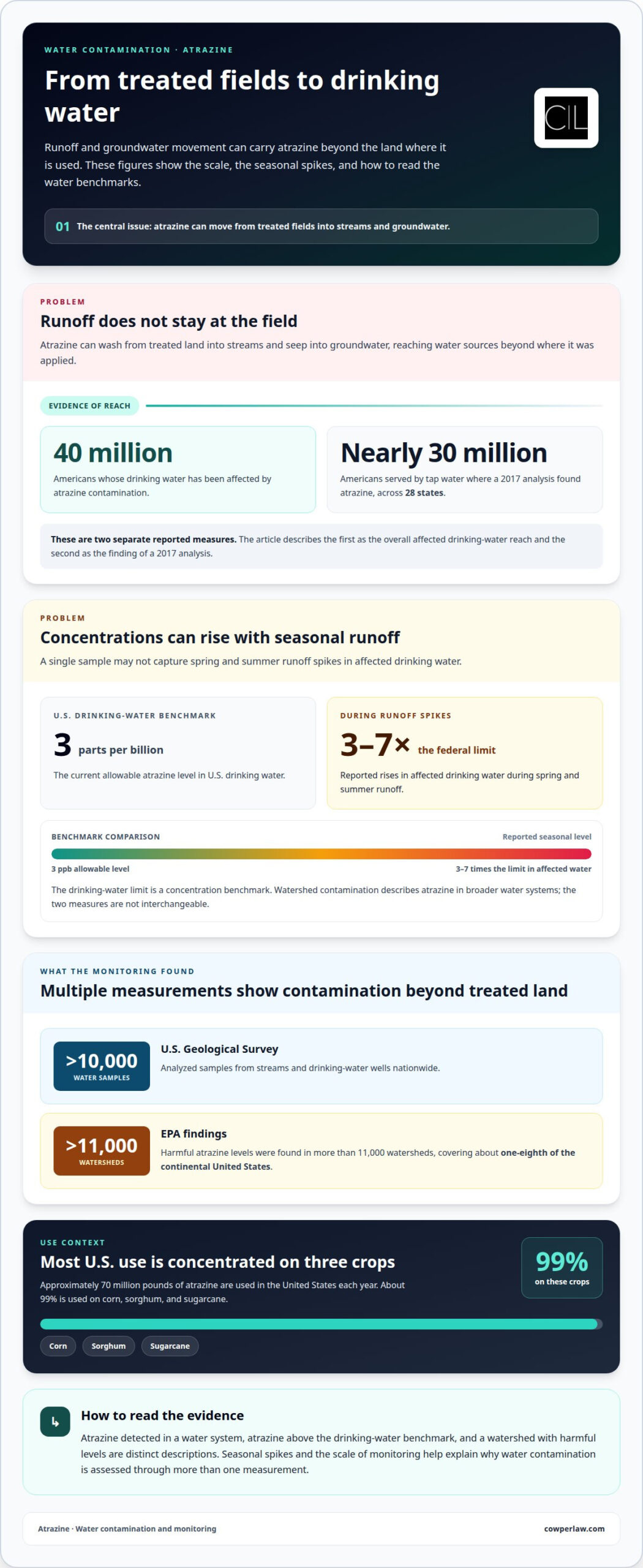
Atrazine can wash from treated fields into streams and seep into groundwater. The scale of concern is substantial: atrazine contamination has affected the drinking water of 40 million Americans. A 2017 analysis found atrazine in tap water serving nearly 30 million Americans across 28 states. The U.S. Geological Survey, a federal science institute, analyzed more than 10,000 water samples from streams and drinking-water wells nationwide. That evidence helps show how pesticide runoff can reach water sources beyond treated fields.
Concentration matters. The current allowable atrazine level in U.S. drinking water is 3 parts per billion. During spring and summer runoff spikes, atrazine levels in affected drinking water have risen to three to seven times the federal limit. Those seasonal increases can make contamination harder to assess through a single sample. The U.S. Environmental Protection Agency found harmful atrazine levels in more than 11,000 watersheds, covering about one-eighth of the continental United States.
What herbicides are used as alternatives to atrazine? Farmers may use other herbicides, but the right choice depends on the crop, target weeds, and growing conditions. Because atrazine is used mainly on corn, sorghum, and sugarcane, alternatives must fit both the crop and its weed-management needs.
Why is atrazine still approved for use in the United States? The EPA reapproved atrazine in 2020, and its use continues under the current U.S. drinking-water limit of 3 parts per billion. Approximately 70 million pounds of atrazine are used in the United States each year, with about 99% of use on corn, sorghum, and sugarcane.
What are the U.S. EPA rules for atrazine use and water monitoring? The key drinking-water benchmark is 3 parts per billion; measured concentrations above it exceed the stated allowable level. EPA findings across watersheds show why monitoring matters, particularly when spring and summer runoff can raise concentrations. The limit concerns drinking water, while watershed contamination describes atrazine in broader water systems. These measurements help distinguish a detected pesticide from levels that exceed the drinking-water benchmark.
Atrazine’s regulatory status differs sharply between the United States and Europe. The European Union’s ban is central to wider international debate about environmental safeguards and pesticide use.
The European Union banned atrazine in 2004, ending its approved use across member states. The restriction applies across the union rather than through separate national decisions. That matters because the EU approach differs from the United States, where atrazine remains in use. The EU also produces about 60 million tons of corn yearly without atrazine, showing that production can continue under a different weed-control system. Atrazine’s phaseout reflects a regulatory choice, not simply a change in how widely the pesticide is applied.
The United States permits atrazine use, while the European Union prohibits it. In the United States, the EPA’s current allowable drinking-water level is 3 parts per billion. The EU ban is a broader decision on approved use, not just a drinking-water concentration limit. At least 72 pesticides banned or undergoing complete phaseout in the EU are allowed for use in the United States, and atrazine is among them. This contrast helps explain why environmental policy and national risk assessments can produce different outcomes.
A ban generally means a country or regulatory jurisdiction has prohibited the pesticide’s use; a restriction limits use or phases it out under specified conditions. The distinction matters because counts may combine different policy actions. Atrazine has been banned in 63 countries, including the 27 EU countries. Separately, 44 nations across Europe, Asia, Africa, and South America have either banned or phased out atrazine. These figures describe different tallies and categories, so they should not be treated as interchangeable.
Atrazine has been banned or restricted in some jurisdictions, including the European Union and countries across several continents. Canada, Australia, Brazil, and China continue to use it, illustrating how policies vary internationally. A policy label alone does not establish the evidence behind an individual health claim. Debates about glyphosate, birth defects, or risks to children concern distinct assessments and should not be treated as proof about atrazine. The key comparison is whether a jurisdiction permits use, limits it, or has ended it.
Governments have acted over environmental contamination and concerns about atrazine’s possible health effects. The evidence includes animal findings, cancer assessments, and differing conclusions from international and U.S. agencies.
Endocrine disruption means interference with the hormone signals that help regulate growth and reproduction. Atrazine’s potential effects matter because reproductive development can be sensitive to chemical exposure. Research has reported harm to reproductive organ development in frogs at levels as low as 0.1 parts per billion. That animal finding raises environmental concerns, but it does not by itself establish the same effect in people. Human health questions require evidence specific to people and their exposure.
Scientific assessments of atrazine and human cancer have reached different conclusions. In January 2026, the International Agency for Research on Cancer classified atrazine as probably carcinogenic to humans. The U.S. Environmental Protection Agency reviewed atrazine in 2003 and 2018 and concluded that available evidence did not support a relationship between exposure and human cancers. These assessments reflect different evaluations of evidence, not proof that every exposure causes cancer.
What does scientific research say about atrazine’s safety? IARC’s classification identifies a potential cancer hazard, while EPA reviews did not find evidence supporting a relationship with human cancers. These conclusions should be considered together, rather than treating either as proof of an individual’s risk.
Why have countries banned atrazine? Concerns include water contamination, possible endocrine effects, and cancer evidence assessed differently by agencies. California’s Office of Environmental Health Hazard Assessment announced in early October that it plans to list atrazine as a known carcinogen. That planned listing is separate from IARC’s classification and EPA’s reviews.
For people assessing possible exposure and cancer concerns, learn about an Atrazine cancer lawsuit.
Country counts depend on what “banned” includes. One tally places atrazine bans in 63 countries, including the European Union; a separate count groups nations that have banned or phased it out. These totals describe policy categories, not a single coordinated international decision. That distinction matters when comparing environmental rules across borders.
The European Union offers the clearest dated example: atrazine was banned in 2004. The reported tally counts 27 EU countries among jurisdictions that banned it. This regional action helps explain why country totals can include member states separately, even though the EU ban provides a shared policy framework.
A different estimate says 44 nations across Europe, Asia, Africa, and South America have either banned or phased out atrazine. Another statement says more than 35 nations had ended its use. The totals differ because “ended use,” “banned,” and “phased out” don’t necessarily describe identical legal status. A phaseout can involve withdrawal over a transition, while a ban refers to prohibition.
When did each country ban atrazine? The European Union’s ban came in 2004. National dates aren’t uniform: jurisdictions adopted separate measures, and combined counts include both bans and phaseouts. A single date therefore can’t represent every country’s action.
For a country-by-country interpretation, separate three questions: Is atrazine prohibited, is it being phased out, or do national restrictions still permit certain uses? This distinction prevents treating the 63-country ban count, the 44-nation ban-or-phaseout estimate, and the “more than 35” ended-use statement as interchangeable. The takeaway is clear: international action is substantial, but its scope depends on which policy category is counted.
The question of how many countries have banned atrazine, and why, helps frame the debate. If you’re concerned about a possible connection between atrazine exposure and cancer, understanding how your circumstances relate to the available evidence is a useful next step. No two situations are identical, and a careful legal review can help clarify the issues that matter.
Cowper Law handles Atrazine Cancer Lawsuits, alongside medical device injury litigation, spinal cord stimulator lawsuit representation, and wrongful death claims. If you’re seeking guidance about an atrazine-related cancer concern, contact Cowper Law to discuss your situation. You deserve a clear path forward and an advocate who takes your concerns seriously.
Atrazine raises questions about cancer and hormone-related effects, but research findings differ. IARC classified atrazine as probably carcinogenic to humans, while EPA reviews concluded that available evidence did not support a relationship between exposure and human cancers. These assessments evaluate evidence; they are not an individual diagnosis. Understanding exposure means considering how contact occurred, how long it lasted, and what reliable records show.
Atrazine can harm wildlife through contaminated food and water. Research summarized in the available facts says contaminated plants can expose birds to 22 times the amount considered harmful, and mammals to 198 times that amount. The EPA also found atrazine likely harms more than 1,000 endangered plants and animals. These findings show why effects on wildlife extend beyond the water where contamination is first measured.
Atrazine is a herbicide used to control weeds, especially in corn, sorghum, and sugarcane production. In agricultural use, rain can carry residues beyond treated land into nearby water systems. This distinction matters: a chemical applied to crops may also become relevant to drinking-water sources and wildlife habitats.
Atrazine has been banned in 63 countries, including the European Union. Another reported tally counts 44 nations that have either banned or phased out its use. The totals differ because a full prohibition and a phaseout are not identical policy actions. So, the answer depends on whether the count includes only bans or also countries ending use through a phaseout.
Research and regulatory assessments focus on possible cancer and hormone-related concerns. IARC classified atrazine as probably carcinogenic to humans, while EPA reviews in 2003 and 2018 found available evidence did not support a relationship with human cancers. Animal findings about reproductive development also contribute to endocrine concerns, but they are not themselves proof of the same effect in people.
Atrazine contamination can affect watersheds, rivers, and species that depend on them. The EPA found likely harm to 56% of endangered plants and animals in the country. Wildlife may also encounter atrazine through contaminated plants, creating exposure beyond direct contact with water. These environmental findings help explain why policy discussions consider ecosystems as well as drinking-water standards.