AI does not erase corporate responsibility. The future of litigation against AI companies may involve claims over personal injury, wrongful death, privacy, discrimination, and copyrighted material used to train systems. Depending on their roles and the alleged harm, claims may involve developers, businesses that deploy AI, or employees.
That raises a difficult question for companies and people affected by their systems: who is accountable when AI contributes to serious harm? The technology may be new, but using it does not automatically shield a company from claims about its conduct or the impact of its decisions.
This article explains emerging AI-related claims, challenges involving training on existing content, and how responsibility may be shared among the people and organizations involved. It also examines personal injury and wrongful death disputes as AI becomes part of consequential decisions.
The future of litigation against AI companies will depend on how evidence links a system to a specific harm. Claims may allege a defective product, negligent design or use, discrimination, privacy violations, or breach of contract. For example, harmful instructions from a system could raise questions about foreseeable risks, warnings, and a business’s reliance on its output. Employers may also face discrimination claims over biased software decisions, even if another entity designed or administered the tool.
No single law governs every AI dispute in the United States. Claims may draw on existing areas of law, including copyright, contract, privacy, discrimination, product liability, and negligence. State laws are also developing. California Assembly Bill 316, effective Jan. 1, 2026, prohibits AI software developers from claiming that AI, rather than the developer, is legally responsible for AI-caused harms. California Senate Bill 243, effective Jan. 1, 2026, requires companion chatbot platforms to clearly notify users when they’re interacting with artificial entities.
Courts assess privacy claims under the laws and allegations in each case. In Taylor v. ConverseNow Technologies, a court allowed a California Invasion of Privacy Act claim against an AI chatbot provider to proceed on Aug. 11, 2025. In Rodriguez v. ByteDance, a court dismissed claims under that act and the federal Electronic Communications Privacy Act on Aug. 25, 2025. Children’s data also raises concerns under the Children’s Online Privacy Protection Act, codified at 15 U.S.C. §§ 6501-6506 (2018).
Section 230, First Amendment, and intellectual property defenses may affect particular claims. A dispute over generated speech differs from allegations of copied training material or mishandled data. The conduct alleged and evidence presented shape how those arguments apply.
Assessing a potential claim requires a clear account of the alleged harm and its connection to decisions or system outputs. A lawyer can review relevant contracts, including any mediation or arbitration provisions, and evaluate the evidence, possible remedies, damages, and settlement. AI tools may help analyze public filings for recurring allegations or potential claimants, but each lead still requires factual assessment. People with shared claims may have common evidence, while individual circumstances can require separate analysis.
Generative AI systems can collect existing content and create new material based on what they learn. This raises a central question: did training copy or use protected work in a way that violates copyright law? An artist may object when a model produces images resembling their work, particularly if the work was collected without their knowledge or consent and used for commercial purposes. The legal analysis depends on the specific content, its use, and the claim.
For a creator, a practical first step is to identify the work at issue and the AI output alleged to draw from it. A lawyer can then examine how the work may have entered a training dataset, how the system was used, and whether the output reproduces recognizable elements. These are related but distinct questions: including a work in training and generating a similar result may require separate evidence. Records of the work’s publication and ownership, along with the disputed output, can help define the claim.
Defenses may focus on how training operated, what material the model retained, or whether an output copied protected expression. Those arguments depend on evidence, not simply on calling a product artificial intelligence. The same scrutiny applies when a claim alleges that a system generated new material: similarity alone does not show which work was used or how. Counsel can compare the source material with the output and assess the legal theory and potential remedies.
A law firm evaluating these disputes may also examine contracts, platform terms, and records describing data acquisition. Creators seeking representation should preserve dated copies of their original work and disputed outputs, alongside communications about their use. These materials help counsel distinguish a concrete allegation from a general concern about training practices. Where AI deployment also caused physical harm, analysis may overlap with catastrophic personal injury litigation, though that involves a different type of claim.
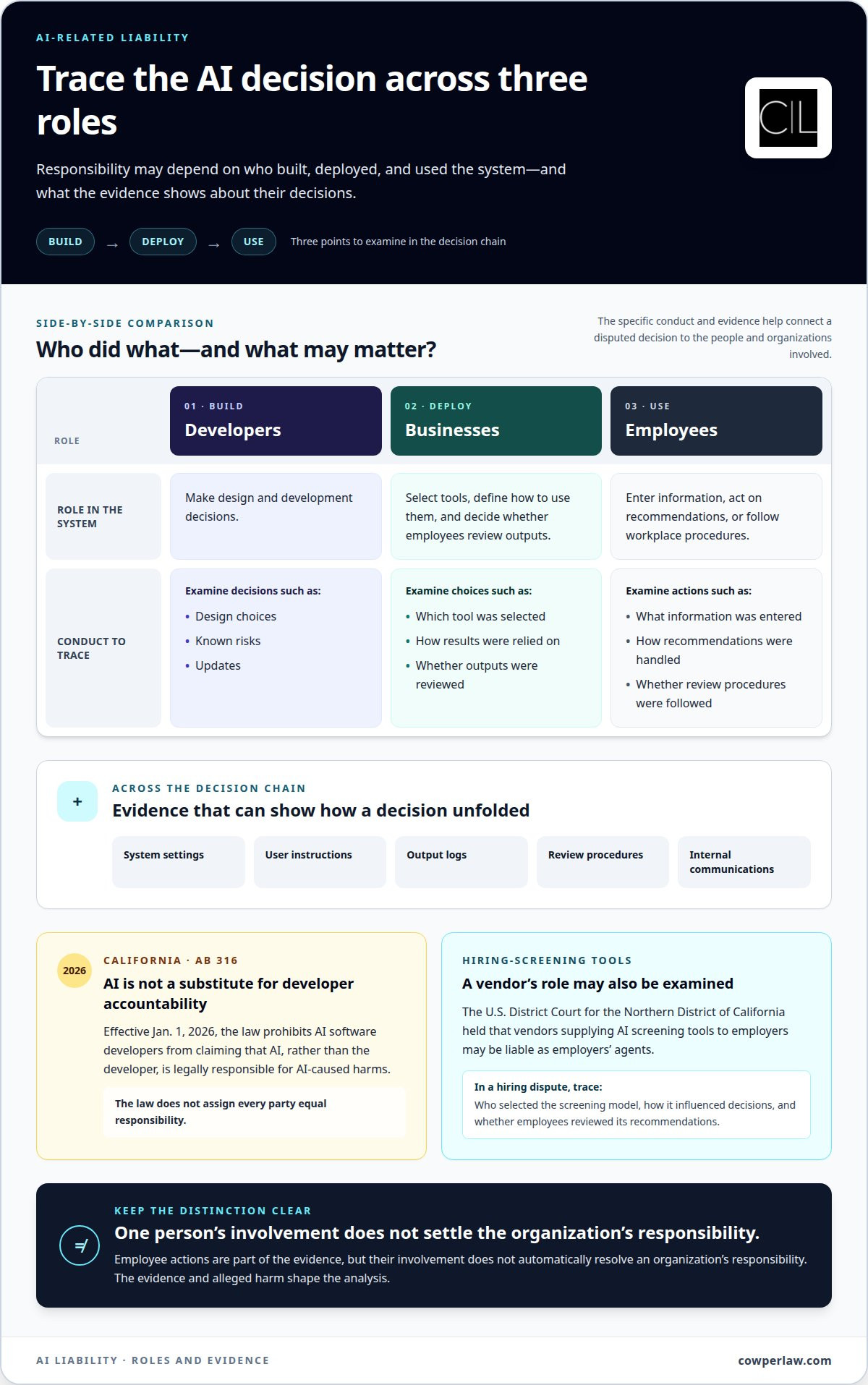
The future of litigation against AI companies will depend partly on evidence showing who built, deployed, and used a system. Developers make design and development decisions. Businesses select tools, define how to use them, and decide whether employees review outputs. Employees may enter information, act on recommendations, or follow workplace procedures. Tracing these steps can help connect a disputed decision to the people and organizations involved.
California Assembly Bill 316, effective Jan. 1, 2026, prohibits AI software developers from claiming that AI, rather than the developer, is legally responsible for AI-caused harms. The law does not assign every party equal responsibility. Evidence about design choices, known risks, and updates can help establish the developer’s role in a particular dispute.
Businesses may face scrutiny for choosing an AI tool and relying on its results. The U.S. District Court for the Northern District of California held that vendors supplying AI screening tools to employers may be liable as employers’ agents. In a hiring dispute, relevant questions include who selected the screening model, how it influenced decisions, and whether employees reviewed its recommendations.
Employees’ actions are part of the evidence, but their involvement does not automatically resolve an organization’s responsibility. System settings, user instructions, output logs, review procedures, and internal communications may show how a decision unfolded. A careful analysis maps each event to the relevant actor and alleged harm.
The future of litigation against AI companies will also be shaped by how clearly those records distinguish each party’s conduct. Leading developers and smaller businesses may play different roles, so the evidence must show what each did and how it affected the outcome. If an AI-linked event caused serious physical harm, discuss a serious injury claim and the roles each organization played.
The FTC distributed more than $15 million in connection with allegations that a developer using AI tools stored, used, and sold consumer information without consumers’ knowledge.
AI-related injury claims require a clear link between the system’s role and the harm. A model’s output, a company’s decision to rely on it, and the resulting injury are separate links to examine. A chatbot offering advice in a sensitive setting, for example, raises different questions from software used to screen job applicants. The practical starting point is to identify what the system did, who relied on it, and how that conduct contributed to the injury.
This analysis matters in wrongful death claims, where families may face complex questions about responsibility and loss. An attorney can examine the sequence of events, the system’s intended use, warnings or instructions, and decisions made by people or businesses. Records such as chatbot conversations, device logs, company communications, and incident reports may help establish what happened. They may also help distinguish a product failure from an independent human decision or another cause.
Not every AI-related legal story involves AI causing an injury. In May 2025, Christopher Pelkey’s sister played an AI-generated video depicting him speaking during the sentencing of Gabriel Paul Horcasitas, who had shot Pelkey in 2021. The Arizona judge sentenced Horcasitas to 10.5 years in prison for manslaughter. The video was used for a victim impact statement, not as formal evidence; such statements go to a judge, not a jury. That distinction helps keep claims about AI’s role precise.
Other concerns arise when AI tools are presented for emotionally sensitive uses. On Aug. 18, 2025, the Texas attorney general announced an investigation concerning alleged representations that chatbots could serve therapeutic purposes. An investigation is not a finding of liability. Still, alleged claims about a tool’s purpose may matter when assessing reliance and harm. The shaping question for any injury case is whether evidence links a specific system, human decision, and injury. That disciplined approach helps families and counsel focus on provable conduct rather than speculation.
The future of litigation against AI companies will be shaped not only by new technology but also by how clearly a claim connects conduct to harm. If an AI-related incident involved physical injury or death, the next step is to document the loss and identify the parties whose actions may have contributed. The legal path depends on the facts.
Cowper Law handles injury-related matters, including medical device injury litigation, spinal cord stimulator lawsuit representation, and wrongful death claims. These services address specific injury and loss claims, not general disputes about AI technology. If your concern involves an AI system and a serious injury, discuss the facts with Cowper Law to understand whether an injury-related claim may fit.
Clear questions deserve careful attention. You can take the next step by preparing a focused account of what happened, the harm involved, and the records that may help explain it.
Using AI does not automatically protect a corporation from claims or establish liability. A company may need to explain how it selected, configured, and used a tool in the decision at issue. For example, records showing that staff accepted an AI-generated recommendation without review may help clarify the company’s process. The relevant evidence depends on the alleged harm and the conduct being challenged.
Courts assess copyright disputes based on the specific works, training practices, and generated material involved, rather than treating every use of books, images, music, or news alike. A creator’s claim may focus on whether protected expression was copied or reproduced. Evidence about a work’s source, use in training, and later output can help define the dispute.
Potential responsibility depends on who created, deployed, or distributed the content and how each party contributed to the alleged harm. A developer, a business using a chatbot, or a person publishing its output may play different roles. For instance, a company circulating an unverified generated allegation raises different issues from a user who receives it privately.
Depending on the facts, claims may involve product defects, negligence, deceptive representations, or consumer data practices. In August 2025, the FTC sued Air AI over alleged deceptive claims about business growth, earnings potential, and refund guarantees. That action illustrates how claims about an AI-related product’s performance can draw scrutiny; it does not establish that every AI tool or marketing claim violates the law. For mid-sized B2B companies looking to drive sustainable growth without overpromising AI capabilities, partnering with senior marketing leadership such as Budget Boosters helps keep outreach strategies credible and effective.