
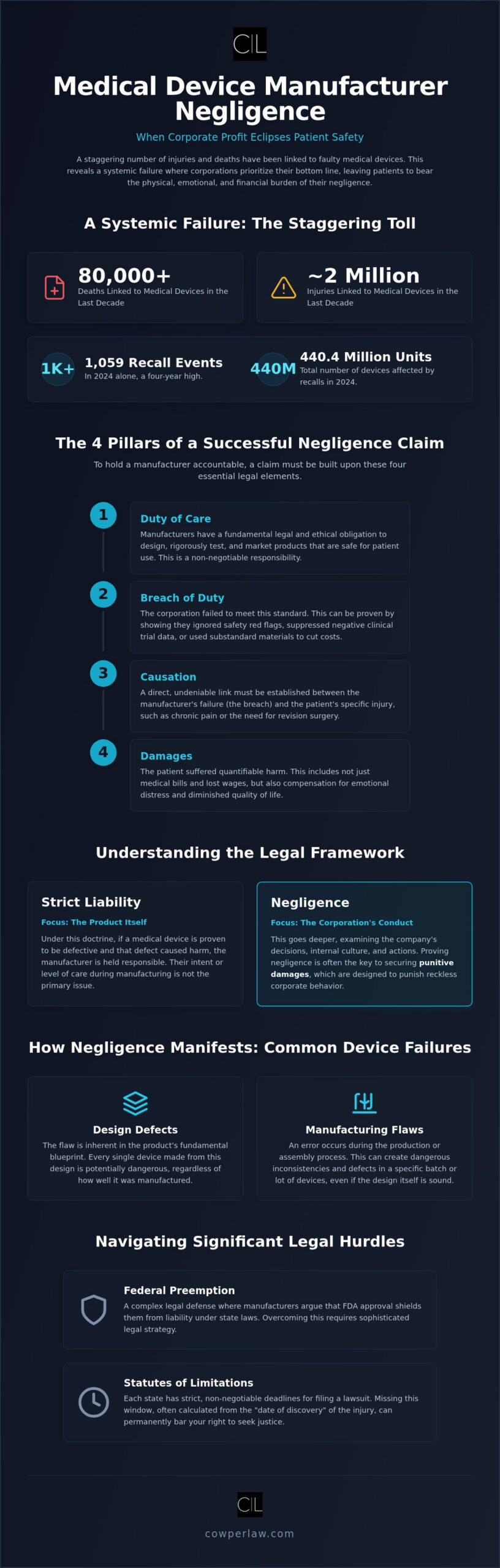
In the last decade, more than 80,000 deaths and nearly 2 million injuries have been linked to medical devices. This staggering data reveals a systemic failure where corporate profit often eclipses patient safety. If you're struggling with chronic pain or facing the financial burden of revision surgeries, you already know the heavy toll of medical device manufacturer negligence. You trusted a product to heal you, but instead, you're left feeling ignored, betrayed, and physically broken by a corporation that prioritizes its bottom line over your well-being.
It's natural to feel like a single voice against a massive entity, but you don't have to carry this weight alone. We're dedicated to validating your suffering and providing the clarity you need during this chaotic time. This guide will help you understand the legal foundations of manufacturer negligence and how patients can hold powerful corporations accountable for defective medical implants. We'll examine the 2026 FDA Quality Management System Regulations, the rise in Class I recalls, and the clear path toward your financial and emotional recovery.
Negligence is a choice. It is a calculated failure to act with the level of care that a reasonable, safety-conscious manufacturer must provide. In the high-stakes world of medical technology, medical device manufacturer negligence occurs when a corporation prioritizes market speed over patient safety, resulting in devastating physical and emotional trauma. While many companies point to FDA clearance as a shield, the reality is that regulatory approval is a floor, not a ceiling. Even with the FDA's Quality Management System Regulation (QMSR) taking full effect on February 2, 2026, manufacturers still find ways to bypass rigorous testing and ignore red flags. When these corporate shortcuts lead to patient tragedies, the law provides a path to hold them accountable.
Manufacturers carry an immense burden of responsibility. When they design, produce, and market life-altering implants, they enter into a silent contract with the patient. They promise durability, safety, and reliability. This legal duty of care requires companies to anticipate risks before they reach the operating room. A breach of this duty often looks like inadequate clinical trials, suppressed data, or a failure to monitor long-term outcomes. Even as advancements like trialport work to streamline connectivity and transparency in the clinical research ecosystem, some corporations still prioritize speed over safety. We believe every patient deserves a product that has been vetted with total transparency and unwavering integrity. When a company fails to meet this standard, they haven't just made a mistake; they've violated your trust and your bodily autonomy.
Understanding the legal landscape is vital for your recovery. Strict liability focuses on the product itself. If it's defective and causes harm, the company is responsible regardless of their intent. However, proving negligence goes deeper. It examines the corporate culture, the internal memos, and the decisions made in boardrooms. Proving negligence is often the key to securing punitive damages, which serve to punish the company for their reckless behavior. At Cowper Law, we are relentless investigators. We dig into the "why" behind the failure, exposing the shortcuts that led to your suffering. We are your advocates, your partners, and your shield against corporate indifference.
In 2024, the United States saw 1,059 medical device recall events, a four-year high that underscores a growing crisis in manufacturing standards. These aren't just numbers. They represent lives disrupted by failed spinal cord stimulators, broken hernia mesh, and leaking implants. We are dedicated to ensuring that these corporations don't just see you as a statistic, but as a person who deserves justice and comprehensive care.
Justice requires proof. To hold a massive corporation accountable, we must build a bridge between their boardroom decisions and your physical suffering. This process is methodical, steady, and rigorous. It requires proving four distinct legal elements that form the foundation of every claim for medical device manufacturer negligence. Identifying the specific failure points in medical device manufacturer negligence requires a deep dive into corporate archives. Without a clear demonstration of duty, breach, causation, and damages, even the most obvious injustice can be dismissed by a court's technicalities. We are here to ensure that your story is heard with total clarity and undeniable force.
Proving a breach requires us to look behind the curtain of corporate marketing. We analyze internal company memos, original clinical trial data, and manufacturing logs to identify exactly where the manufacturer ignored safety red flags. If a company knew about software-related glitches, which saw a 31% year-over-year growth in recalls recently, but failed to issue an alert, they breached their duty. We utilize expert witnesses to translate complex engineering failures into clear evidence. This stage of litigation requires persistence, precision, and forensic detail to expose how corporate inaction led to patient harm.
Causation is the critical link that connects a defective device to your specific health complications. It isn't enough to show that a device was part of the 440.4 million units affected by recalls in 2024. We must prove that the failure directly caused your chronic pain, infection, or the need for revision surgery. In cases like BioZorb migration, we carefully examine medical records and surgical notes to document the exact path of the device failure. If you are unsure of your next steps, our guide on what to do after medical device failure can help you begin gathering the critical documentation needed to protect your rights. We are constant companions in this process, helping you gather the documentation needed to prove your case and validate your experience.
Quantifying damages is about more than just tallying hospital bills. It's about capturing the totality of your loss, including past medical expenses, lost quality of life, and emotional distress. Understanding the critical factors that influence medical device lawsuit settlement amounts can help you recognize the true value of your claim and ensure you are not shortchanged by a corporate calculation designed to minimize your recovery. We are dedicated to securing a result that reflects the true depth of your journey. If you've been harmed by a defective implant, understanding your rights is the first step toward a personalized litigation strategy that demands accountability from those who caused your pain.
Corporate negligence is rarely a single isolated event. Instead, it typically manifests in specific, dangerous patterns that reveal a systemic disregard for human life. We categorize these failures into distinct legal theories to better target the source of the harm. Whether a device was fundamentally flawed from its first sketch or contaminated on a rushed assembly line, medical device manufacturer negligence remains the root cause. Understanding these categories is the first step toward reclaiming your agency and demanding the accountability you deserve. We are here to help you peel back the layers of corporate secrecy to find the truth.
Manufacturers have a continuous, non-negotiable obligation to update safety labels as new data emerges. When a company discovers a complication but chooses to bury the evidence to protect its stock price, they have failed to warn. This type of negligence often involves "off-label" promotion, where sales representatives encourage doctors to use devices like insulin pumps or spinal cord stimulators for purposes the FDA never approved. Overstating benefits while downplaying life-altering risks is a betrayal of the patient-provider relationship. We believe in transparency, truth, and the right to informed consent. When data is withheld, the consequences are measured in patient suffering rather than corporate spreadsheets.
There is a critical difference between a device that is poorly conceived and one that is poorly built. Design defects occur when a product is inherently unsafe for its intended use, regardless of how carefully it was manufactured. For example, using non-medical grade plastics in hernia mesh or unstable materials in breast implants constitutes a fundamental design failure. In contrast, manufacturing flaws occur when errors in the factory lead to dangerous inconsistencies. These often involve quality control failures, such as a lack of sterilization, the use of sub-standard components in a specific batch, or even logistics errors—though you can discover Comet Couriers for an example of how specialized medical transport should be handled.
In 2024, "device failure" surpassed "process control" as the leading cause of medical device recalls for the first time in over five years. This shift highlights a disturbing trend toward fundamental engineering flaws. During that same year, the number of units affected by recalls increased by 55.4%, reaching approximately 440.4 million units. These statistics represent a massive scale of potential harm. We are serious, focused, and intensely loyal to our clients when investigating these batch failures. We utilize a sophisticated blend of intellect, strategy, and heart to ensure that your case stands strong against the most formidable corporate legal teams.
Litigation against global manufacturers isn't just a legal dispute; it's a battle against a fortress. These companies possess nearly unlimited financial reserves, seasoned defense teams, and a complex web of legal protections. If you're suffering from a failed implant, the path to justice can feel blocked by technicalities, corporate stalling, and systemic delays. We are here to dismantle those barriers. Proving medical device manufacturer negligence requires more than just evidence of injury; it requires the grit to withstand a multi-year legal war. We are your advocates, your partners, and your shield against corporate indifference.
One of the most significant obstacles is the doctrine of federal preemption. For devices that receive Pre-market Approval (PMA), manufacturers often argue they are shielded from state-law liability because they met FDA standards. This creates a legal "safe harbor" that can leave injured patients without a voice. However, this shield isn't impenetrable. We look for specific gaps, such as failures to report adverse events or deviations from approved manufacturing processes, to bypass these protections. Our goal is to ensure the corporation's compliance with federal rules doesn't strip you of your right to accountability.
Time is rarely on the patient's side. Every state has a Statute of Limitations that dictates how long you have to file a claim. Even more dangerous is the Statute of Repose, which can cut off your right to sue based on when the device was sold, regardless of when it actually failed. The "discovery rule" is your most vital ally. It often pauses the clock until you reasonably should've known the device caused your harm. Waiting to investigate is the greatest risk to your case, as evidence can vanish, memories can fade, and legal windows can close permanently. Knowing what to do after medical device failure — including how to document your symptoms and preserve key records — can make the difference between a strong claim and a missed opportunity.
Facing a corporation with a bottomless legal budget requires a firm that is trial-ready and refuses to yield. We are active, relentless, and unwavering advocates who understand that a settlement is only possible when the opponent fears the courtroom. If you suspect your injury was caused by a defective product, you need a medical device manufacturer negligence expert who will stand by you from the first consultation to the final verdict. We provide the intellect, strategy, and heart required to turn a "David vs. Goliath" scenario into a victory for the individual.
We are not a high-volume legal factory. We are a dedicated team of advocates who view every case as a mission for justice. When you face the aftermath of medical device manufacturer negligence, you aren't just fighting for a settlement; you're fighting for your dignity, your health, and your future. Our "Compassionate Warrior" philosophy defines how we operate. We balance the sharp intellect and strategy required for high-stakes litigation with the deep heart and human connection required to support you through your recovery. We are fierce, dedicated, and relentless defenders of the individual.
Our approach is built on the reality of national advocacy. We take on the largest names in MedTech because we believe no corporation is too powerful to be held accountable. Whether your case involves BioZorb implant failure, hernia mesh complications, or spinal cord stimulator injuries, we build a personalized trial strategy designed to win. We don't just prepare for a settlement; we prepare for trial from day one. This readiness is the only way to force a change in corporate behavior and secure the results you deserve. Our firm is serious, focused, and intensely loyal to the clients we serve.
Your journey with us begins with a thorough understanding of your experience. During our initial consultation, we listen to your story, validate your pain, and provide a clear roadmap for the legal process. We handle the heavy lifting of litigation, from gathering medical records to interviewing expert witnesses, so you can focus on healing. Our results-driven focus is always on your long-term peace of mind. We operate on a contingency basis, which means there are no fees unless we win your case. This ensures our interests are perfectly aligned with your success, providing a sense of stability during a chaotic time.
Your story has the power to create change. By coming forward, you aren't just seeking personal recovery; you're contributing to a safer medical landscape for everyone. One successful lawsuit can force a manufacturer to update a warning label, improve a dangerous design, or issue a recall that prevents future injuries for thousands of other patients. We are your constant companions from the beginning of this process to the very end. If you are ready to hold a corporation accountable for their choices, Contact Cowper Law today for a confidential case evaluation. We are ready to stand by your side with the intellect, persistence, and loyalty your case requires.
You have endured enough pain, uncertainty, and corporate silence. Holding a corporation accountable for medical device manufacturer negligence is about more than just financial compensation; it's about reclaiming the peace of mind that was taken from you. This guide has identified the critical legal elements of a successful claim and the specific hurdles, such as federal preemption, that often stand in the way of justice. You deserve a partner who is intellectually formidable and emotionally accessible.
We are a national firm with a personalized, one-on-one approach to every client. Our experienced trial lawyers specialize in complex device failure, providing the stability you need during this chaotic time. We operate on a contingency-based model. This means you pay nothing unless we win. Your journey toward healing and justice is our primary focus, and we refuse to yield until your story is heard and your suffering is validated.
Secure your future with a Compassionate Warrior; Contact Cowper Law today. You don't have to face this battle alone. We are ready to stand with you.
Medical malpractice involves a healthcare provider's failure to meet the standard of care, while medical device manufacturer negligence focuses on the company that designed or produced a defective product. If a surgeon makes an error, it's malpractice. If the implant itself fails due to a design flaw or manufacturing defect, the liability rests with the corporation. We investigate these distinctions to ensure the correct party is held accountable for your suffering.
Yes, an FDA recall often serves as powerful evidence that a device is fundamentally unsafe. Recalls, especially Class I recalls which hit a 15-year high in 2024, indicate a reasonable probability that the product will cause serious health problems or death. While a recall doesn't automatically win a case, it provides a strong foundation for proving that medical device manufacturer negligence occurred and that the company breached its duty to you.
We operate on a contingency fee basis, meaning you pay nothing upfront and no out-of-pocket costs during the litigation process. We only receive a fee if we successfully secure a recovery for you through a settlement or jury verdict. This model ensures that every patient, regardless of their financial situation, has access to high-end, elite legal representation against powerful corporations that possess nearly unlimited legal budgets.
You don't need the original packaging to pursue a claim. Your medical records, specifically the operative report and implant log from your surgery, contain the specific serial number, lot number, and manufacturer details. We handle the heavy lifting of gathering these records directly from the hospital. Even if the facility has closed or records are decades old, our investigators are skilled at tracing the device's origin to build your case.
Every case is unique, but complex medical device litigation typically takes between one and three years to reach a resolution. The timeline depends on the complexity of the engineering failure, the volume of corporate documents we must review, and the court's schedule. We are your constant companions throughout this steady process, providing regular updates and maintaining a methodical pace to ensure no detail is overlooked in your pursuit of justice.
Most cases settle before reaching a jury, but we prepare every case as if it is headed for trial. This trial-ready advocacy is the only way to force a large corporation to offer a fair settlement. If the company refuses to take responsibility, we are ready to stand before a jury and fight for your rights. Our reputation for being an active, relentless advocate provides you with significant leverage during negotiations.
You can recover compensation for economic losses, such as medical bills and lost wages, as well as non-economic damages like pain, suffering, and emotional distress. In cases involving gross negligence, you may also be eligible for punitive damages designed to punish the manufacturer for reckless behavior. To better understand how these factors translate into real-world outcomes, our detailed breakdown of medical device lawsuit settlement amounts can help you gauge what a fair recovery looks like for your specific circumstances. We focus on the human aspect of these results, ensuring your recovery covers the long-term support and peace of mind you need.
Yes, you may still be able to sue thanks to the discovery rule. This rule often pauses the statute of limitations until the moment you knew, or should've known, that the device was the cause of your injury. Even if your implant was placed years ago, the clock might only start once a recall was issued or a doctor confirmed the failure. We provide a confidential evaluation to determine if your window for justice remains open.