
The most powerful weapon in a pharmaceutical company's arsenal isn't their bottomless legal budget or their scientific data; it's the silent, relentless ticking of a clock. While you're focused on mounting medical bills, declining health, and the daily struggle of recovery, corporate legal teams are often counting on you to miss the statute of limitations for drug injury lawsuit filings. It's a calculated strategy designed to use time as a barrier to justice, turning a legitimate claim into a dismissed technicality. You deserve a partner who is resilient, strategic, and deeply committed to ensuring your story is heard before the window closes.
We understand the confusion that comes with pinpointing exactly when an injury started, especially when side effects emerge slowly over months or years. This 2026 guide provides the clarity you need to understand these complex legal deadlines and protect your right to compensation. We'll break down state-specific rules, explain how the discovery rule can extend your timeline, and provide the knowledge you need to confront the entities that harmed you.
A legal deadline isn't just a date on a calendar; it's a boundary that defines whether your voice will ever be heard in a court of law. At its core, a Statute of Limitations is a mandatory legislative window that dictates exactly how long you have to file a claim. If this window slams shut before you act, your right to seek compensation vanishes forever. We are a firm that views these deadlines not as mere administrative rules, but as hurdles often placed in the path of the vulnerable by powerful entities. For victims of pharmaceutical negligence, the statute of limitations for drug injury lawsuit filings represents the first and most critical battle in a much larger war for justice.
The consequences of missing this deadline are absolute. No matter how severe your injuries or how clear the drug manufacturer's negligence, a judge will almost certainly dismiss a late case on a technicality. This permanent loss of rights is why timing is the most urgent factor in your legal journey.
Legislators design these time limits to ensure that the legal system remains efficient and fair. By requiring claims to be filed within a specific period, the law ensures that evidence remains fresh, documents aren't lost to time, and witnesses' memories don't fade. For defendants, these rules provide "repose," a legal term for the certainty that they won't be sued for actions that happened decades ago. However, in the context of high-stakes litigation, these laws often serve as a shield for large corporations, protecting them from indefinite liability even when their products continue to cause harm in the dark.
Pharmaceutical cases are fundamentally different from standard personal injury claims like car accidents. In a collision, the injury and its cause are immediate and obvious. You know the moment the clock starts. Drug injuries are rarely that simple. Pharmaceutical liability is a complex intersection of medicine and law. Injuries caused by defective medications are often latent, meaning symptoms might not appear until years after you first ingested the drug. You may experience a declining state of health without ever realizing a pill you took for a routine condition is the culprit.
We believe the law should account for these complexities. We stand as a shield for those whose lives have been upended by corporate negligence, ensuring that the clock doesn't run out while you're still searching for answers.
In pharmaceutical litigation, the moment of harm is often invisible. Unlike a sudden collision, you don't always know you've been injured the second you take a pill or receive an injection. This is where the discovery rule becomes a vital lifeline for victims. It dictates that the clock for the statute of limitations for drug injury lawsuit filings doesn't necessarily start on the day you ingested the drug; instead, it begins when you knew, or reasonably should have known, of the injury and its potential link to the medication. We are a firm that understands the science of delay, and we refuse to let corporate secrecy dictate your timeline for recovery.
Courts apply what's known as the "reasonably diligent" standard to determine this start date. This means the law asks when a person of average prudence would have suspected the drug caused their health decline. If you were diagnosed with a specific, life-altering condition like liver failure, kidney damage, or cancer, that diagnosis often acts as the primary trigger. You are expected to investigate the cause of such a significant medical event once it's identified. We are committed to helping you piece together this complex timeline, ensuring that a late diagnosis doesn't result in a lost opportunity for justice.
Subjective knowledge refers to your personal realization of the harm. Objective knowledge, however, is when the connection was so public that any person in your position should have suspected the link. Your medical records are the most critical evidence in this debate. They document when you first reported symptoms, what your doctors suspected, and exactly when you began investigating the pharmaceutical connection. If you're unsure where your case stands, our team can help you review your medical history to determine your current legal standing.
When the FDA issues a public warning or a manufacturer initiates a recall, the legal landscape shifts instantly. This often creates "constructive notice," a legal concept where the law assumes you are aware of the danger because it has become public knowledge. A recall doesn't always automatically start the clock for every individual, but it makes it much harder to argue you were unaware of the risks. You must act with urgency once a drug is pulled from the market. Corporate defense teams frequently use these public events to argue that your time has run out, making early intervention by a trial lawyer essential for your protection.
While the discovery rule offers a degree of flexibility, another legal mechanism exists that is far more rigid and unforgiving. This is the statute of repose. Think of it as an absolute "kill switch" for your case. Unlike a statute of limitations for drug injury lawsuit filings, which focuses on when you learned of your harm, a statute of repose focuses entirely on the product itself. It creates a hard deadline based on when the drug was first sold, manufactured, or delivered to its first purchaser. Once this period expires, your right to sue is extinguished, even if you only discover your injury the very next day.
Pharmaceutical giants heavily lobby for these absolute cutoffs. By shortening the window of repose, they effectively limit their long-term liability, creating a strategic wall that prevents victims of latent injuries from ever seeking justice. We are a firm that recognizes this "David vs. Goliath" dynamic, where the law is often tilted to favor corporate certainty over human recovery. Understanding the interaction between these Statutes of Limitations and Repose is essential for anyone harmed by a defective medication.
| Feature | Statute of Limitations | Statute of Repose |
|---|---|---|
| Trigger Event | Discovery of the injury or its cause. | Date of sale, manufacture, or delivery. |
| Primary Goal | Ensures fairness and diligence for victims. | Provides absolute finality for corporations. |
| Flexibility | Can often be extended or "tolled." | Fixed and non-negotiable in most states. |
Every state has its own unique approach to these deadlines, making the legal landscape incredibly difficult to navigate. For example, Texas has a 15-year statute of repose, while Florida sets its limit at 12 years. New York is a notable exception, as it doesn't have a statute of repose for product liability claims at all. These differences mean that a case could be "timely" in one state but "barred" in another, even if the injuries are identical.
Because drug manufacturers operate nationwide, "Choice of Law" rules often dictate which state's deadline applies to your claim. You shouldn't have to guess which jurisdiction offers you the best path to justice. We are a national firm with the reach and resources to investigate these complex variations. If you've been harmed, you need a medical device injury lawyer who understands how to navigate these absolute deadlines and protect your right to compensation before the clock runs out.
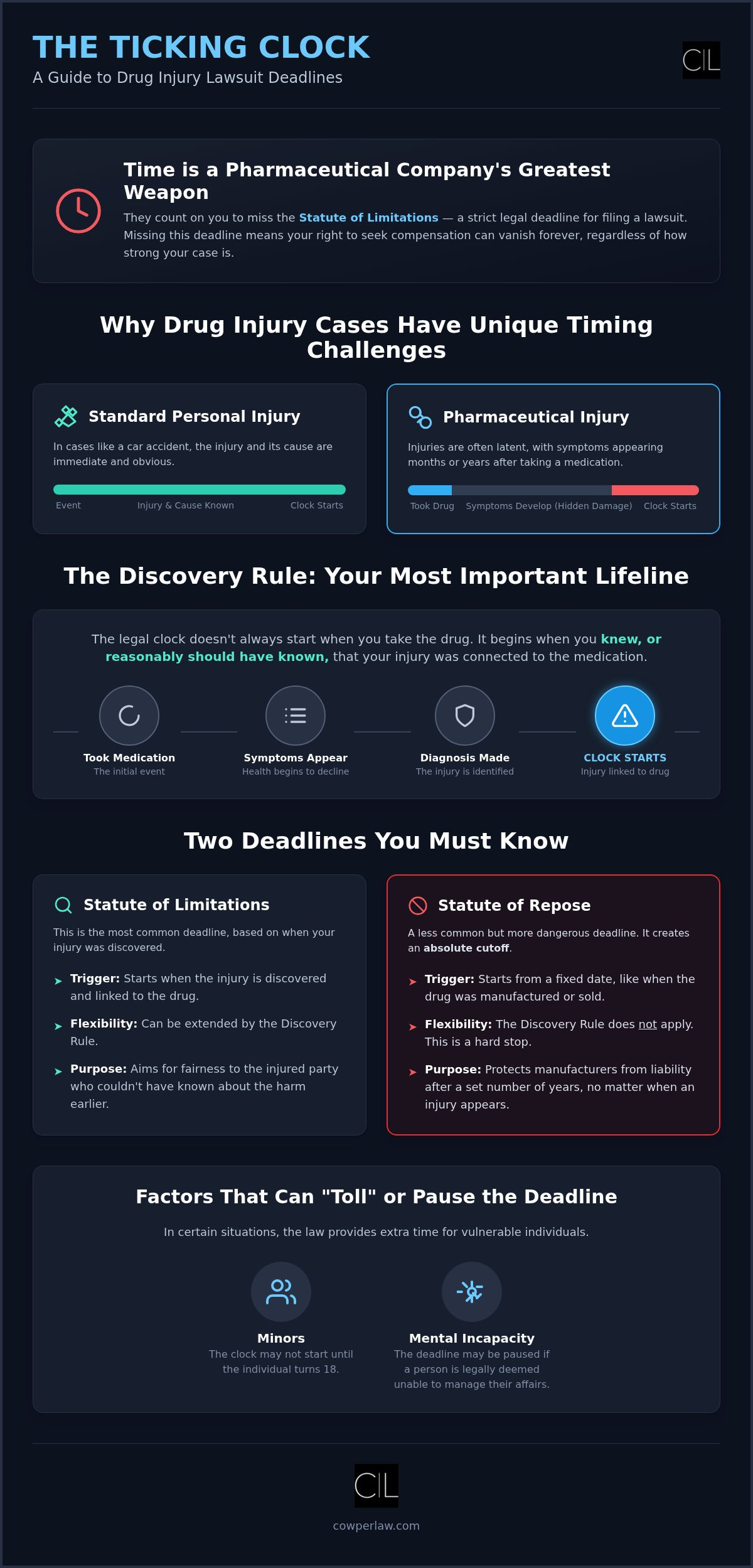
The law recognizes that justice shouldn't be a race you're forced to run while your hands are tied. "Tolling" is the legal term for pausing the clock on a deadline. It's a critical safeguard that prevents the statute of limitations for drug injury lawsuit filings from expiring when a victim is physically, mentally, or legally unable to act. We are a firm that relentlessly hunts for these tolling exceptions because we know that a single pause can be the difference between a dismissed case and a life-changing recovery. Our mission is to ensure that technicalities never stand in the way of truth, accountability, and restoration.
One of the most common reasons for tolling involves minors. If a child is injured by a defective drug, the clock typically stays still until they reach the age of majority, usually 18. This ensures that their right to seek compensation isn't lost before they even have the legal standing to hire an attorney. Similarly, if an individual suffers from a mental incapacity that prevents them from managing their own affairs, the law often pauses the deadline until their capacity is restored. We believe these protections are essential for a fair legal system that truly serves the individual.
The most contentious form of tolling occurs when a corporation actively hides the truth. If a drug company knows their product is dangerous but chooses to bury safety data, manipulate clinical trials, or mislead regulators, they cannot benefit from the time they bought through deception. This is known as fraudulent concealment. To prove this, we must show the company knowingly misled the public and that you couldn't have discovered the harm despite being diligent. This mirrors the patterns we often see in medical device manufacturer negligence, where corporate profit is prioritized over patient safety. We are experts at unearthing this hidden evidence to keep your claim alive.
Your individual deadline might also be paused by the actions of others. When a class action lawsuit is filed, it can stay the clock for all potential members of that class while a judge decides on certification. This prevents thousands of people from having to file identical individual suits just to protect their dates. Understanding how to join a medical device class action lawsuit is vital because the existence of a larger case might actually be protecting your individual right to sue. These rules are complex, but they provide the necessary stability for victims in a chaotic legal landscape.
If you fear you've missed your window, don't assume the door is closed. There are many strategic ways to fight back against a ticking clock and reclaim your future. Speak with an advocate at Cowper Law today to see if tolling applies to your journey.
Don't let a calendar date discourage you from seeking the justice you deserve. Many individuals mistakenly believe they've missed the statute of limitations for drug injury lawsuit filings, only to discover that a tolling exception or a specific discovery rule applies to their unique situation. We are not a high-volume factory; we are a dedicated national trial firm. We are trial lawyers who thrive in the courtroom. We are advocates who listen with empathy. We are warriors who fight with intellect, strategy, and heart. Our role is to transform you from a victim of circumstance into a partner in a mission-driven legal journey focused on accountability and restoration.
We don't just review files; we launch a comprehensive, trial-ready investigation from the moment we begin our partnership. This involves a deep dive into corporate records to uncover evidence of fraudulent concealment that might have paused your legal clock. We utilize high-level medical experts to establish precise discovery dates, providing a scientific foundation that stands up to intense scrutiny. We act as a protective shield against the aggressive, often heartless tactics used by pharmaceutical defense teams. Our goal is to provide stability and order during what is often the most chaotic time of your life, ensuring you have the durability, persistence, and loyalty of a firm that refuses to yield.
Starting this journey shouldn't be a financial burden for your family. We operate on a contingency-based partnership, which means there are no fees unless we win your case. This "no win, no fee" model ensures that our interests are perfectly aligned with yours. If you want to understand exactly how a contingency fee for medical device lawsuit works and how it removes the financial barriers to pursuing justice against powerful corporations, we encourage you to explore this topic in depth. When you prepare for your initial consultation with a drug injury lawsuit attorney, it's helpful to have certain items ready:
We are committed to human-centric results that offer more than just financial recovery. We seek the peace of mind and closure you need to move forward with your life. While the legal system can feel like an impenetrable fortress built to protect the powerful, we provide the strategic intellect and emotional support necessary to break through. You aren't alone in this fight; we are with you from the first consultation to the final resolution.
The legal landscape of pharmaceutical litigation is a battlefield where time is often the most aggressive opponent. You've seen how the discovery rule can offer a lifeline and how a statute of repose can act as an absolute cutoff. Every state has its own unique deadlines. Identifying the exact moment your clock started requires a deep dive into medical records and corporate history. Don't let the fear of a technicality stop you from pursuing the compensation you need for mounting medical bills and a declining state of health.
We are a national firm specializing in catastrophic pharmaceutical injuries. We provide the sophisticated strategy required to take on global corporations. Our contingency-based representation ensures you pay nothing unless we recover for you, removing the financial barriers to high-stakes litigation. We are a team of Compassionate Warriors dedicated to your peace of mind and long-term stability. It's a journey we take together from the first call to the final verdict. Contact Cowper Law today for a relentless evaluation of your drug injury claim and your specific standing regarding the statute of limitations for drug injury lawsuit requirements. You've fought long enough for your health; let us fight for your future.
There is no single national deadline; instead, the statute of limitations for drug injury lawsuit filings is determined by the state where you live or where the injury occurred. In 2026, California and Texas generally require filing within two years, while New York provides three years and Florida allows four years. Because these windows are narrow and strict, identifying your specific deadline is the most urgent step in your legal journey.
You may still have a valid claim due to the discovery rule. This rule pauses the clock until you actually discover, or should have reasonably discovered, the connection between your health decline and the medication. However, you must also consider statutes of repose. Some states, like Florida, have a 12 year absolute cutoff from the date of sale that can bar a lawsuit even if your diagnosis is recent.
An FDA recall serves as a critical public warning that often triggers the discovery clock. Legally, a recall can be viewed as "constructive notice," meaning the court assumes you should have known about the potential harm once it became national news. If a drug you took is recalled, you must act with extreme urgency. Corporate defense teams will use the recall date to argue that your time has run out.
If the deadline expires, you typically lose your right to seek compensation forever. Judges rarely grant extensions for simple delays, as the law prioritizes finality for defendants. Your only hope in this situation is proving that a tolling exception applies, such as fraudulent concealment by the manufacturer. This is why having a relentless advocate to investigate your specific statute of limitations for drug injury lawsuit timeline is so vital.
Yes, these are distinct legal categories with different procedural rules. Medical malpractice involves negligence by a healthcare provider, while a drug injury falls under product liability against the pharmaceutical manufacturer. Malpractice deadlines are often shorter and require specific medical board reviews. Drug injury claims focus on design defects or failure to warn, which allows for different strategies regarding the discovery rule and corporate accountability.
A drug company can absolutely be held liable for hiding side effects. When a manufacturer knowingly conceals safety data, it may trigger a legal doctrine called fraudulent concealment. This "tolls" or pauses the statute because the company's own deception prevented you from knowing you were harmed. We specialize in unearthing this hidden internal data to ensure that corporate secrecy doesn't prevent you from achieving a just result.
Joining or being part of a putative class action can pause your individual filing deadline. Under established legal principles, the filing of a class action tolls the statute of limitations for all potential members until a judge decides whether to certify the class. This protection ensures you don't lose your rights while the larger legal battle unfolds. You should always consult a lawyer to confirm how these complex rules apply.
You must contact a trial lawyer immediately to protect your rights. Thirty days is an incredibly narrow window that requires instant action to file the necessary paperwork and preserve the statute. We operate on a contingency basis, meaning we can begin an urgent evaluation of your case without any upfront costs to you. If you are also navigating a related device claim and wondering how long does a medical device lawsuit take, understanding the full litigation timeline can help you plan your next steps. Swift action is the only way to prevent a pharmaceutical company from using a technicality to silence your story.