
The calendar on your wall is often a misleading guide for your right to seek justice. Many people believe they've lost their chance at a recovery because years have passed since an implant was placed, but the law often recognizes a more compassionate reality. Understanding the statute of limitations for medical device injury isn't just about looking at a surgery date; it's about identifying the moment you realized the device was the source of your suffering. Whether you're dealing with a spinal cord stimulator, a BioZorb implant, or a failed hernia mesh, the deadline to hold a corporation accountable is often more flexible than it first appears.
It's natural to feel overwhelmed, confused, and anxious when facing a multi-billion dollar manufacturer alone. You might worry that you missed a window you didn't even know was open, especially with Class I recalls reaching a 15-year high in 2024. We are here to provide the clarity, protection, and advocacy you deserve during this chaotic time. This guide will explain how the "Discovery Rule" works in your state, the critical difference between a statute of limitations and a statute of repose, and why a professional evaluation is the only way to know for certain if you still have time to act.
A statute of limitations acts as the legal expiration date for your right to seek justice. These laws exist to ensure that litigation remains fair, evidence stays preserved, and witness memories remain reliable. While these deadlines serve a structural purpose in our legal system, they can feel like a ticking clock for a family already struggling with physical pain and mounting medical bills. We are dedicated to ensuring that no one loses their voice simply because they didn't know the clock had started. Our approach is rigorous, strategic, and deeply personal, ensuring you aren't just another case number in a corporate database.
Filing a claim after this date has passed usually results in a permanent loss of your right to sue. The court will almost certainly dismiss the case, regardless of how clear the manufacturer's negligence may be or how severe your suffering has become. Because the statute of limitations for medical device injury is governed by state law rather than federal law, the window for action depends entirely on where you live. This creates a complex patchwork of deadlines that requires a sophisticated, mission-driven legal partner to navigate.
Medical device injuries rarely announce themselves with the immediate clarity of a car accident. In a collision, the harm is obvious, documented, and undeniable from the moment of impact. Medical devices, however, often cause latent injuries that simmer beneath the surface for months or even years before they are identified. A latent injury in the context of a failing spinal cord stimulator occurs when a defectively designed lead or battery slowly erodes your health, causing neurological damage that isn't diagnosed until long after the initial malfunction began. This delay between the surgery and the realization of harm is why these cases require a specialized legal perspective.
Most states provide a window of two or three years to file a product liability claim. For instance, California, Florida, and Nevada generally require you to act within two years. New York and North Carolina typically offer a three-year window. However, some jurisdictions are significantly more restrictive; Kentucky and Tennessee have some of the shortest deadlines in the nation, often requiring action within just one year. Understanding the Statute of Repose vs. Statute of Limitations is critical, as these two deadlines often work in tandem to define your legal options. We provide the intellect, strategy, and heart needed to navigate these varying state laws and protect your future from powerful corporate entities that hope you'll simply run out of time.
The Discovery Rule serves as a vital safeguard for patients who have been betrayed by the very technology designed to help them. We are mission-driven advocates who understand that a manufacturer's failure often remains hidden for years. Under this rule, the statute of limitations for medical device injury does not begin until the moment you discover, or reasonably should have discovered, both the injury and its connection to the defective product. This legal principle acknowledges that you cannot be expected to file a lawsuit for a harm you didn't know existed.
Imagine a patient who received a BioZorb implant during a lumpectomy. Years later, a follow-up scan reveals that the device failed to resorb, leading to painful complications, unexpected surgeries, and permanent scarring. Even if the state's standard deadline has passed since the surgery, the Discovery Rule may allow the clock to start only when that scan provided the first evidence of failure. This is a core tenet of product liability law, ensuring that the burden of a latent injury falls on the responsible corporation rather than the innocent individual. We are the compassionate warriors who fight to ensure this rule is applied fairly to your specific journey.
Courts utilize a "reasonable person" standard to decide when you should have been aware of your injury. This means the law asks if a person in your situation, exercising normal care, would have suspected a problem. Your medical records play a definitive role here; they are the objective history of your symptoms, diagnoses, and doctor visits. While documenting your daily pain in a journal provides emotional support and clinical clarity, it can also be scrutinized by corporate defense teams to argue you were aware of the injury earlier than you claim. We analyze every medical record, every doctor's note, and every patient complaint to establish a timeline that protects your right to a recovery.
A formal FDA recall notice is a serious warning, but its impact on your legal deadline is often misunderstood. A recall does not necessarily start the clock for everyone simultaneously. There is a clear distinction between a general news report and a personal realization of harm. However, because corporations use recalls to argue that the "discovery" happened the day the news broke, you should speak with a medical device injury lawyer immediately after learning of a recall. We provide the intellect, strategy, and loyalty required to navigate these high-stakes deadlines. If you suspect your device is failing, scheduling a professional evaluation is the only way to ensure your statute of limitations for medical device injury remains valid.
While the Discovery Rule offers a path for justice, the Statute of Repose often acts as a silent case killer. We are the protectors of your rights, standing firm against legal traps designed to shield corporations from accountability. Unlike the statute of limitations for medical device injury, which bends to the reality of when you found your harm, a statute of repose is an unyielding, absolute cutoff. It doesn't care when you got sick or when your doctor found the defect; it only cares about the date the device was first sold or implanted into your body.
Large medical corporations lobby intensely for these hard deadlines to limit their long-term liability. By creating a definitive end-date for lawsuits, they can predict their financial risks and eventually stop worrying about the defective products they've put into the world. If you discover an injury in year 16 but live in a state with a 15-year repose, like Texas, your claim may be barred before you even knew you were a victim. This is the "David vs. Goliath" struggle we navigate daily, providing the intellect, strategy, and heart required to fight back.
| Feature | Statute of Limitations | Statute of Repose |
|---|---|---|
| Trigger Event | Discovery of the injury and its cause. | The date of sale, delivery, or implantation. |
| Flexibility | High; can be paused by the Discovery Rule. | None; it is a fixed, immovable deadline. |
| Primary Purpose | Ensures evidence is fresh and reliable. | Protects manufacturers from indefinite liability. |
A small number of jurisdictions offer a ray of hope through the "useful safe life" standard. Instead of a rigid year count, these states ask if the device failed during the period it was reasonably expected to function safely. This is particularly relevant for long-term implants like hernia mesh or breast implants, which are often marketed to last for decades. Proving a device failed before its time requires intellect, experience, and expert testimony. We work with leading medical professionals to demonstrate that your device was defective long before its safe life should have ended.
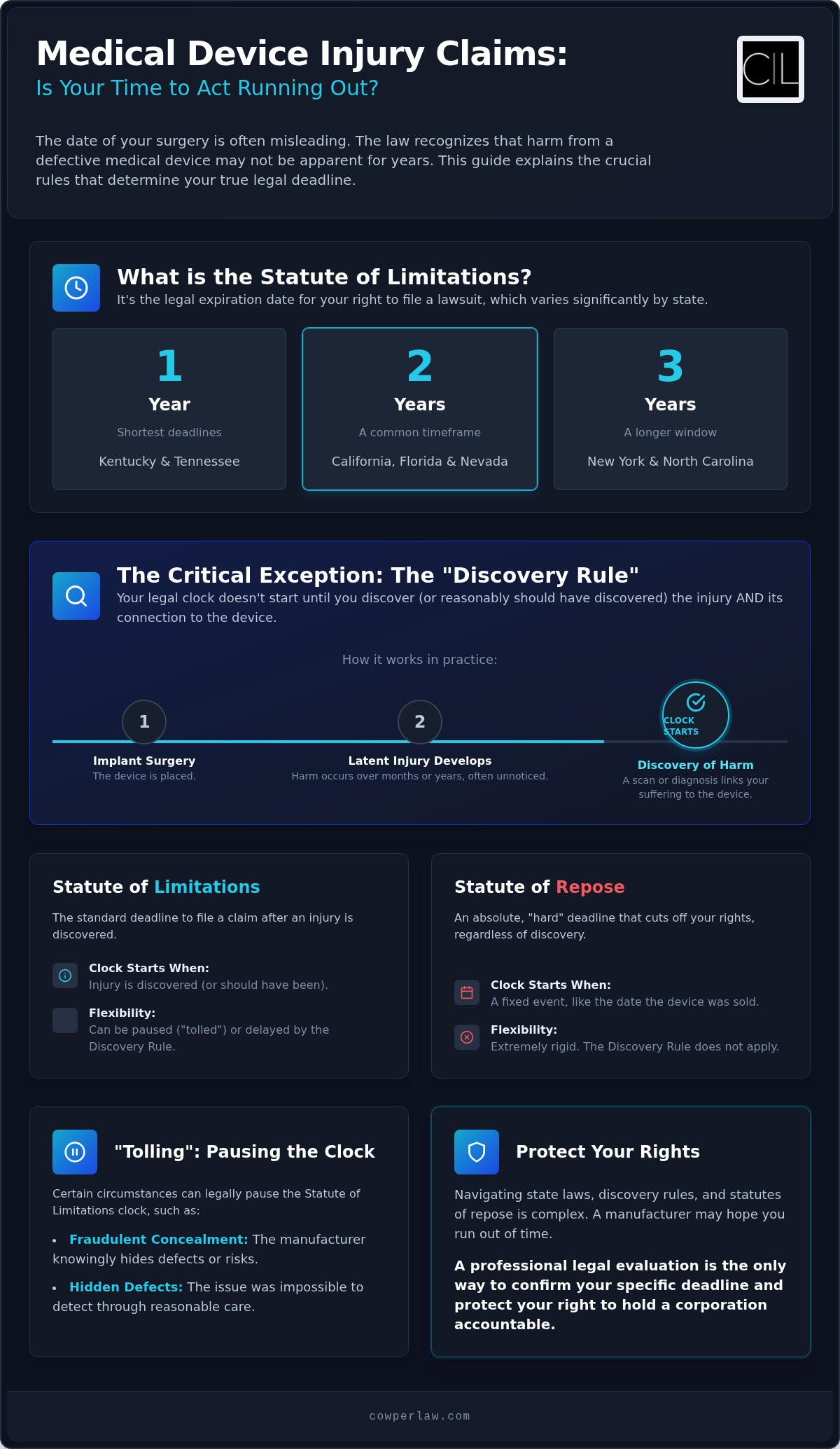
Tolling serves as a legal pause button for your right to seek justice. It provides a necessary reprieve when circumstances beyond your control prevent you from filing a claim within the standard window. While the statute of limitations for medical device injury is often rigid, tolling recognizes that fairness must sometimes override strict deadlines to protect the vulnerable. This is especially true for minors or individuals facing mental incapacity; the law typically pauses the clock until they reach adulthood or regain the capacity to advocate for themselves.
We are mission-driven defenders who understand that these legal pauses are often the only way to prevent a corporation from escaping liability through a technicality. Whether you were under the age of 18 at the time of your surgery or were medically unable to pursue a claim due to the severity of your injuries, we provide the intellect, strategy, and heart required to argue for your right to be heard. If you're worried that your time has expired, requesting a personalized legal audit is the most effective way to uncover these hidden protections.
Corporations sometimes prioritize quarterly profits over human lives by hiding known defects from the public. If a manufacturer knows a device is failing but actively tells the public it is safe, the clock may be stayed until the truth is revealed. We are relentless in our pursuit of transparency, often investigating internal corporate documents, emails, and memos to prove that active deception occurred. While silence is not always concealment, active deception is a deliberate act that stops the legal clock and prevents the manufacturer from using a deadline as a shield. We are the warriors who pierce that corporate veil to expose the truth behind their marketing claims.
When thousands of individuals are harmed by the same device, cases are often consolidated into a single court through Multi-District Litigation. Being part of this larger group can significantly affect your individual deadline, as courts often implement "Tolling Agreements" to pause the clock while the parties exchange information. Navigating these waters requires a firm that understands class action lawsuits and MDLs on a national scale. We ensure that your individual statute of limitations for medical device injury is protected while we fight for a global resolution that provides the peace of mind and support you deserve.
Hesitation is often the greatest threat to a successful recovery. While you focus on healing and managing the physical fallout of a failing device, the clock continues its relentless march. The danger of a "wait and see" approach cannot be overstated; once the statute of limitations for medical device injury expires, your path to justice is permanently closed. We are here to provide the clarity, honesty, and strategic depth required to ensure that never happens. We perform a sophisticated "Statute Audit" for every client, analyzing the intersection of your medical history, state law, and corporate conduct to pinpoint your exact filing window.
A critical, often overlooked step in this journey is the preservation of the physical device itself. If your surgeon removes a defective hernia mesh, BioZorb implant, or spinal cord stimulator, that device becomes a primary piece of evidence. It is the smoking gun that can prove manufacturing flaws or design defects in a courtroom. We advise our clients to ensure the hardware is preserved and not discarded by the hospital, as it belongs to you and serves as the foundation of your claim. Our commitment is to offer a transparent assessment of your timeline, giving you the stability and order you need during a chaotic time.
Taking control of your legal journey starts with gathering the facts. We recommend following these four essential steps to protect your future:
We are not a high-volume settlement mill that seeks the quickest exit. We are trial lawyers who prepare every case with the expectation of facing a corporation in front of a jury. This "David vs. Goliath" mentality defines our work; we provide the intellectual strategy and emotional support necessary to take on billion-dollar entities. Our contingency fee model ensures that you have access to elite legal representation with zero upfront costs, as we only receive a fee if we win your case. We are your constant companions, from the first audit of your timeline to the final resolution of your claim. Don’t let the clock run out on your justice. Contact Cowper Law for a free case evaluation today.
The path to recovery is often obscured by complex legal deadlines and corporate tactics designed to silence your voice. We've explored how the Discovery Rule can provide a lifeline when injuries surface late, but we also recognize the unyielding threat of the Statute of Repose. Understanding the statute of limitations for medical device injury is the first step toward reclaiming your peace of mind and securing the support you deserve. You don't have to face a multi-billion dollar corporation alone; we are the compassionate warriors who stand by your side from the very first audit until the final resolution.
We are dedicated trial lawyers, not a settlement mill, and our national expertise in Spinal Cord Stimulator and BioZorb claims ensures your case is built on a foundation of intellect, strategy, and heart. Our contingency model means there is no fee unless we win, allowing you to focus on your health while we handle the legal burden. Don't let uncertainty or the ticking clock steal your chance at justice. Secure your right to justice with a free case evaluation from Cowper Law. We are ready to listen, ready to fight, and ready to win for you. Your story matters, and the right time to protect it is now.
Yes, you may still have a valid claim depending on your state's laws and when you first discovered the injury. While some states have a "statute of repose" that acts as a hard cutoff after 10 or 12 years, the "discovery rule" often protects patients when a device failure was hidden. We investigate the specific timeline of your surgery and the subsequent failure to determine if your window for justice remains open.
Lack of knowledge about a recall doesn't automatically bar your claim, but it can complicate the legal argument regarding your discovery date. Corporations often argue that a public notice should have alerted you to the danger immediately. We fight to prove that a general announcement is not the same as a personal discovery of harm, ensuring your right to a recovery isn't stripped away by corporate marketing tactics.
The clock typically starts on the day you discovered, or reasonably should have discovered, both the injury and its connection to the device. This distinction is vital for implants like spinal cord stimulators that may fail years after the initial surgery. We analyze your medical records to establish the most favorable discovery date possible under your specific state's statute of limitations for medical device injury.
Yes, the filing deadline can be extended through a legal process called "tolling." This often occurs if the manufacturer fraudulently concealed known risks or if the injured party was a minor at the time of the harm. We are relentless in uncovering evidence of corporate deception that can pause the legal clock, providing you with the necessary time and stability to seek a meaningful recovery for your suffering.
The Discovery Rule is a legal principle that prevents the filing deadline from starting until you are actually aware of the harm. It protects patients from hidden defects that simmer beneath the surface for years before causing noticeable physical symptoms. We use this rule as a powerful tool to shield individuals from the harsh, arbitrary deadlines that large medical device manufacturers often rely on to escape their moral and legal responsibilities.
Yes, wrongful death claims often have a different, and sometimes shorter, statute of limitations than standard personal injury claims. In many jurisdictions, the legal clock starts on the date of the individual's passing rather than the date the device first malfunctioned. We provide the compassionate advocacy needed to navigate these sensitive timelines, ensuring your family's right to hold the manufacturer responsible is fully protected during a tragic time.
In addition to protecting your rights in injury cases, those who need to explore family law or manage international business interests can turn to the Israel Cross Border Law Firm for specialized legal support.
You can find your state's deadline by consulting with a national trial firm that understands the specific product liability laws in your jurisdiction. Deadlines vary wildly, from one year in Kentucky to six years in Maine. Because these laws are subject to frequent changes and complex repose periods, a professional legal audit is the only reliable way to confirm the statute of limitations for medical device injury in your case.
A bankruptcy filing creates an "automatic stay" that pauses active litigation, but it does not necessarily mean your path to justice is closed. Special compensation trusts are often established during the bankruptcy process to provide support to victims of defective products. We are experienced in navigating these complex proceedings to ensure you still have a viable path toward the financial recovery and the peace of mind you deserve.