
Over the last decade, nearly two million injuries and approximately 80,000 deaths have been linked to faulty medical devices. When a device designed to heal you becomes the source of your suffering, the betrayal feels deeply personal. You are likely facing physical pain, the cold indifference of a manufacturer, and the crushing anxiety of future surgical costs. We understand that you feel ignored, but we are here to ensure your story is heard with total clarity. Learning how to document medical device injury is the most critical step you can take to move from victim to advocate.
You deserve to hold powerful corporations accountable for the harm they have caused. This article provides the exact steps to preserve physical evidence, track your daily symptoms, and build a powerful, undeniable foundation for your lawsuit. We are your partners in this journey, offering a clear checklist of what to save and professional guidance on how to talk to your doctor. By the end of this guide, you will have the confidence, the strategy, and the tools needed to pursue the justice you are owed.
Your health is the absolute priority. If you suspect your implant or device is failing, seek medical intervention immediately. Do not wait for the manufacturer to issue a notice or for the pain to become unbearable. While the instinct to protect your legal rights is strong, your physical well-being must always come first. Seeking care creates the initial medical record that serves as the cornerstone of your case. It establishes a clear, documented timeline between the device failure and your physical distress. This early medical intervention is the first step in a long journey toward accountability. Stop. Breathe. Act.
Learning the specific steps of how to document medical device injury ensures that your voice is never silenced by corporate lawyers. Note the exact date and time your symptoms started. Record what you were doing and the specific nature of the pain or malfunction. While hospitals are often required to follow protocols for Medical Device Reporting (MDR), these internal reports are designed for regulatory compliance, not for your personal advocacy. You must be the primary guardian of your own evidence. We are here to help you turn that evidence into a powerful narrative of truth. Precision matters now more than ever.
The physical implant is the single most vital piece of evidence. It is the "smoking gun" that reveals design flaws or material failures. If you require explant surgery, you must instruct your surgeon in writing to preserve the device. Hospitals often discard hardware or return it to the manufacturer. You cannot allow this. A strict chain of custody ensures the device remains a credible weapon for your justice. We ensure this evidence is protected from those who would see it destroyed.
Visual evidence provides an impact that words cannot reach. Take clear, well-lit photographs of swelling, bruising, or surgical sites. If the device is external, capture images of serial numbers and packaging. These details link your injury to specific manufacturing batches. Always use a smartphone that applies a digital time-stamp. In court, the timing of these images proves the progression of your injury and your daily reality. High-quality images are hard to ignore. They tell the story of your pain with total clarity.
Data is power. While the physical device provides evidence of a mechanical failure, the records you gather provide evidence of your life's disruption. Corporations rely on the hope that you will be too overwhelmed to maintain a meticulous trail. You must prove them wrong. Learning how to document medical device injury requires you to become a librarian of your own experience. You are not just a patient; you are a witness. Every receipt, every chart, and every insurance statement acts as a brick in the fortress of your claim. We are here to help you stack those bricks with precision.
Start by creating a dedicated physical or digital folder for every piece of paper generated by this ordeal. Save every insurance Explanation of Benefits (EOB) statement you receive. These documents show exactly what your insurance covered and, more importantly, what you were forced to pay out of pocket. Preserve all written communications from the manufacturer or your physician, including emails, letters, and portal messages. If a manufacturer reaches out to you directly, do not provide a statement until you have secured medical device litigation support. Your records are your protection.
Your medical device identification card is a vital piece of evidence. It contains the "DNA" of your implant: the exact model, the lot number, and the serial number. This card links your specific injury to potential manufacturing defects or batch-wide recalls. Beyond the card, you must request your complete operative reports and discharge summaries. These narratives, written by surgeons and nurses, describe the implantation, the complication, and the revision. They provide the clinical proof that your suffering was caused by the device rather than a pre-existing condition.
The cost of a medical device failure extends far beyond the hospital doors. You must track the financial hemorrhage with total clarity. Keep a detailed log of lost wages and any impact on your future ability to work. Document the costs of specialized care, home modifications, or physical therapy sessions. Even small expenses matter. Prescription co-pays, gas for travel to specialists, and hospital parking fees add up to significant sums over months of treatment. In a courtroom, these "minor" costs demonstrate the relentless, daily financial burden placed upon you by a corporation's negligence. Understanding the full scope of medical device manufacturer negligence can help you recognize every category of harm you are entitled to pursue. We ensure no detail is overlooked.
The doctor's office is often the front line of your legal battle. Every conversation you have with your healthcare provider is more than a medical consult; it is a deposition in progress. To succeed, you must be specific, consistent, and unyielding when describing your symptoms. If you downplay your pain to appear "tough," you inadvertently provide the manufacturer with ammunition to claim your injury was minor. Use a consistent 1-10 pain scale to provide a measurable, objective record of your daily struggle. We are here to help you find the words that ensure your truth is recorded with total clarity. Precision, persistence, and honesty are your greatest assets.
Ask your physician directly: "Is it possible this medical device is the cause of my complications?" This simple question forces a professional assessment that must be documented. If they agree or even suggest it is a possibility, request that this specific concern be noted in your permanent chart. Understanding how to document medical device injury means ensuring your medical team records the "why" behind your symptoms, not just the "what." Your chart should reflect a journey of seeking answers, not just a list of treatments. You are the advocate for your own body.
Review your medical records frequently to ensure they accurately reflect your reality. If you notice omissions or errors regarding the device name, model, or your specific symptoms, request an amendment immediately. Mention the device by name during every visit to ensure it remains the focal point of the narrative. Using the phrase "patient reported" in your records is vital because it ensures your specific observations and concerns are legally preserved as your direct testimony within the clinical history. This creates a bridge between your lived experience and the medical evidence that a manufacturer cannot easily dismantle.
Seeking a specialist outside your original surgical team is often a necessary step for discovering the objective truth. Your original surgeon may be hesitant to admit a device they implanted is failing, whether due to professional pride, hospital policy, or a desire to avoid conflict. A second opinion provides an independent medical evaluation that can strengthen your legal position by offering an unbiased perspective on the failure. These independent assessments act as a powerful counter-balance to the manufacturer's claims. An outside expert can provide the intellectual strategy, clinical weight, and moral clarity needed to hold a massive corporation accountable. Trust your instincts, but verify the facts.
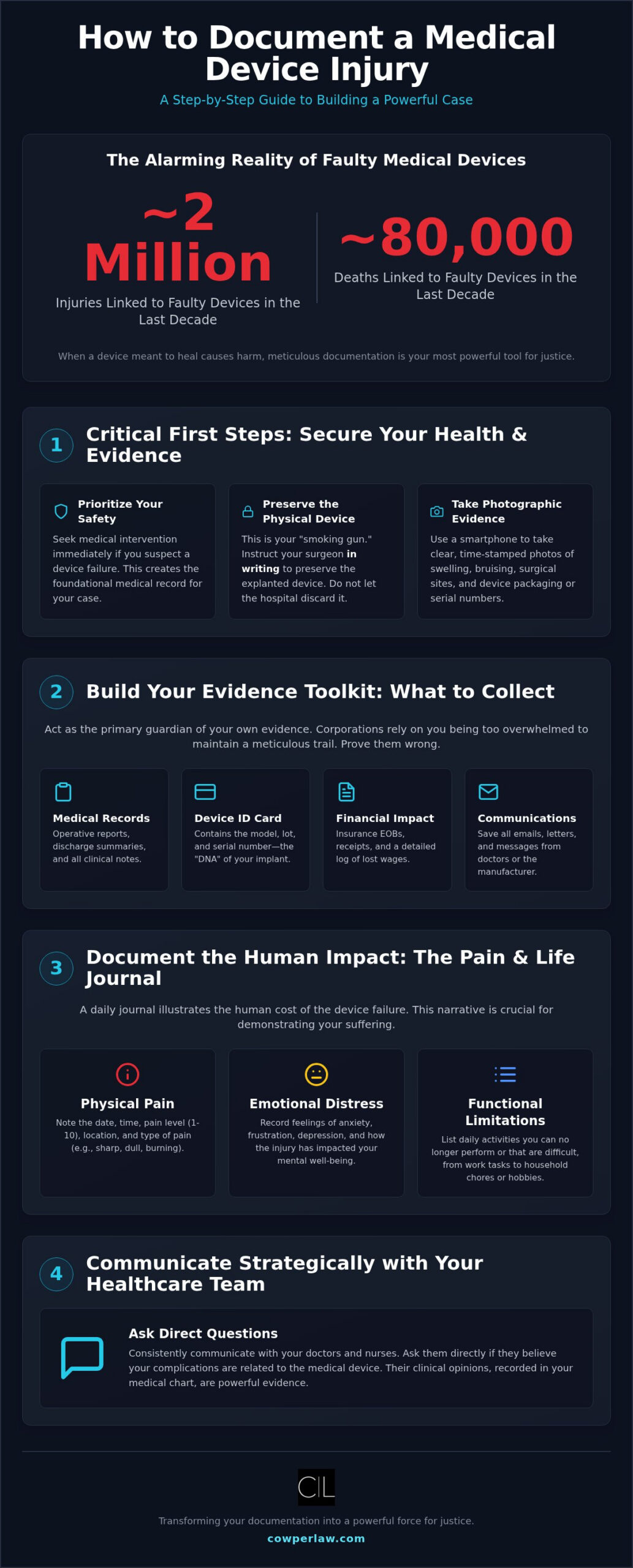
Medical records prove the mechanical failure, but your journal proves the human cost. While a surgeon notes the technical details of a revision surgery, they rarely record the missed bedtime stories, the canceled family vacations, or the quiet anxiety that follows a device failure. To a massive manufacturer, you are a data point. To us, you are a person whose life has been unfairly disrupted. Learning how to document medical device injury through a personal lens is what transforms a clinical case into a compelling narrative of justice. We are the guardians of your story, ensuring that no part of your struggle is erased by corporate indifference.
A daily journal acts as a bridge between your physical pain and the legal concept of non-economic damages. Start today by recording your pain levels on a consistent 1-10 scale. Note the specific nature of the sensation, whether it is sharp, burning, or throbbing. Beyond the physical, document how the injury affects your mental health and your relationships with your spouse, children, or friends. If you feel ignored by the medical system or fearful of the future, write it down. These entries provide a real-time, undeniable account of your reality that is far more persuasive than a memory recalled years later in a deposition. Your voice is your power.
Consistency is more important than length. You don't need to write pages of prose; you need to record facts with total clarity. We recommend the Three-Pillar approach to journaling: Physical pain, Psychological impact, and Practical limitations. For the physical, record the intensity and location of pain. For the psychological, note feelings of depression, isolation, or anxiety. For the practical, list the specific activities you could not perform that day, such as driving to work, lifting your grandchild, or preparing a meal. Include observations from caregivers or family members to provide a complete picture of your daily needs. If you are ready to hold the manufacturer accountable, reach out to our team for medical device injury litigation support.
Legal victories are built on more than just medical bills. You must document the "loss of enjoyment of life" through specific, concrete examples. Record every missed milestone, including birthdays, graduations, or career opportunities that were lost due to your injury. These are not just inconveniences; they are permanent losses that deserve recognition. Collect "Before and After" witness statements from friends who can describe the vibrant life you led before the device failure. These testimonies, combined with your journal, create a vivid portrait of the impact. We use this evidence to fight for the peace of mind and support you deserve. Your journey toward justice is a partnership, and we are with you at every step.
The documentation you have meticulously gathered is more than a paper trail. It is the foundation of your recovery. While the manufacturer relies on its massive legal teams and infinite resources, we rely on the truth of your experience. We are Cowper Law. We are the Compassionate Warrior in your corner. We understand that taking on a multibillion-dollar medical corporation feels like a David versus Goliath struggle. However, with the right strategy, the giant can be held accountable. We specialize in turning your evidence into a formidable narrative for justice. We are serious, focused, and intensely loyal to our clients.
We are not a high-volume settlement mill that avoids the courtroom. We are trial lawyers. This distinction is critical because manufacturers only respect firms that are willing to take a case to a jury. By mastering how to document medical device injury, you have provided us with the raw materials to build a case that is intellectually formidable and emotionally resonant. Our partnership is built on contingency, meaning we take the financial risk so you can focus on healing. You don't pay a fee unless we win. We bring clarity, conviction, and courage to every case we handle.
We are trial lawyers who focus on intellect, strategy, and heart. Your documentation provides the specific details needed to dismantle corporate defenses. We use your journals, medical records, and photographs to prove that your injury was not an isolated incident but a failure of corporate responsibility. Throughout this process, we are your constant companions. We provide the stability, reassurance, and strength required to face powerful entities. Whether your case involves BioZorb implants, Spinal Cord Stimulators, or Insulin Pumps, we have the experience to fight for you. We don't just advise; we advocate.
Waiting to seek legal counsel can be a costly mistake. Statutes of limitations are strict, and evidence can fade if not properly secured. The peace of mind that comes from professional legal advocacy allows you to stop worrying about the legal complexities and start focusing on your future. We are here to carry the burden for you. If you are ready to move forward, Contact Cowper Law for a free, confidential case evaluation. We are ready to fight for the results you deserve. Your journey toward justice starts with a single, decisive step.
You have the power to transform your pain into a catalyst for change. By preserving the physical device, gathering detailed financial records, and documenting the daily human impact in a journal, you build a foundation that no corporation can ignore. Understanding how to document medical device injury is the first step toward holding these entities accountable for their negligence. We are here to ensure you never walk this path alone. Our firm brings elite expertise in Spinal Cord Stimulator, BioZorb, and Hernia Mesh litigation to every case we handle, leveraging the growth infrastructure of Nexus Legal Group to remain focused, relentless, and ready.
We provide a national reach with a personalized, human-centric approach that prioritizes your peace of mind. We operate on a contingency basis; you pay nothing unless we recover for you. We are ready to act as your compassionate advocate, your strategic partner, and your fierce defender. Do not let your story be silenced by corporate indifference. Secure your future with a free consultation from Cowper Law. You deserve justice, and we are ready to fight for it together.
Liability typically falls on the manufacturer if the device itself was defective or lacked proper warnings. However, if the injury resulted from surgical error or improper implantation, the healthcare provider may be responsible. We investigate every angle to determine if your case involves product liability, medical malpractice, or a combination of both. Our focus is on holding the right entity accountable for your suffering with total certainty.
You can absolutely file a claim even if the FDA hasn't issued an official recall. Many catastrophic injuries occur long before a manufacturer acknowledges a defect or the government intervenes. Recalls are often reactive, but your right to justice is immediate. We use your medical records and expert testimony to prove the device was dangerous regardless of its current regulatory status or the manufacturer's public statements.
The time limit, known as the statute of limitations, varies significantly depending on your state's laws. Generally, this period ranges from two to four years from the date you discovered, or should have discovered, the injury. Missing this deadline can permanently bar you from seeking recovery. Because these timelines are strict and unforgiving, you should consult an advocate as soon as you suspect a device failure.
While preserving the device is ideal, you can still pursue a claim if it was discarded or returned to the manufacturer. We rely on your identification card, operative reports, and lot numbers to identify the specific unit used. Detailed photographs and a consistent journal on how to document medical device injury become even more vital when the physical hardware is unavailable. We work tirelessly to build a case.
You aren't required to report your injury to the FDA before seeking legal counsel. While reporting to the MedWatch system helps public safety, it doesn't initiate a legal claim for your personal damages. A lawyer can often help you navigate the reporting process while ensuring your statements are legally sound. We prioritize your recovery and your rights from the very first conversation, acting as your constant companion.
We operate on a contingency fee basis, which means you pay nothing upfront for our services. Our firm covers the significant costs of investigation, expert witnesses, and litigation. We only receive a percentage of the final recovery if we successfully win your case. This structure ensures that every individual has access to high-end legal representation without the burden of hourly fees or stressful out-of-pocket expenses during a crisis.
You may recover compensation for both economic and non-economic damages. This includes medical bills, lost wages, and the cost of future revision surgeries. Additionally, we fight for "pain and suffering" and the loss of enjoyment of life caused by your physical limitations. Our goal is to secure a result that provides long-term stability and restores your peace of mind after a life-altering device failure.
These complex cases typically take anywhere from several months to several years to resolve. The timeline depends on the manufacturer's willingness to settle and the complexity of the scientific evidence required. We aren't a high-volume firm; we take the time needed to build a meticulous, trial-ready case. We remain your dedicated partner throughout every stage of this steady and methodical process toward justice. If you are uncertain about what to do after medical device failure, our step-by-step patient checklist can help you take immediate, organized action to protect your health and your legal rights.