
In 2025, more than 1.2 million medical device adverse event reports were submitted late by manufacturers, leaving patients in the dark while safety issues mounted. When an implant malfunctions, it is more than a technical error. It is a moment of profound physical pain, deep uncertainty, and sudden fear. You are likely searching for exactly what to do after medical device failure to protect your health and your future. We believe you deserve a partner who is relentless, focused, and loyal during this crisis.
We understand that the prospect of revision surgery is terrifying and the reporting process feels like an impossible maze. This article provides the critical medical and legal steps you must take to stabilize your health and preserve your right to accountability. We are here to help you move from a state of confusion to a position of strength. You will learn how to secure your medical records, how to utilize the FDA's new Adverse Event Monitoring System, and how to protect the physical evidence that proves what went wrong. Your journey toward recovery and justice begins with these immediate, decisive actions.
The moment you suspect your medical implant is malfunctioning, your world feels unstable. You may experience sharp, sudden pain, localized heat at the incision site, or a total loss of device function. These are not just inconveniences; they are critical red flags that require immediate intervention. Knowing what to do after medical device failure starts with one non-negotiable rule: your physical safety must always come first. We are dedicated defenders of your health and your rights, and we believe that stabilization is the first step toward justice.
In the first 24 hours following a malfunction, focus entirely on stabilization. While the legal implications are heavy, your physical health is the foundation of everything that follows. We recommend keeping a timestamped personal log as soon as you feel something is wrong. Note the exact time, the intensity of the pain, and any external changes like swelling or redness. This log provides a clear, concise, and credible record for your doctors. When you arrive at the hospital, be direct with your medical team. Explicitly state that you suspect a product failure. This ensures they look beyond common post-surgical complications and focus on the mechanical integrity of the device itself. You must be your own advocate to ensure you remain stable, secure, and supported.
A general practitioner is an essential part of your care, but a medical device failure requires the eyes of a specialist. We often advise seeking a second opinion from a non-implanting surgeon. This provides an objective, clear, and uncompromised view of the situation, free from the potential defensiveness of the original provider. You must also secure your "Device Identification Card" and a full copy of your operative reports. These documents identify the specific model, lot number, and serial number of the implant. Without these, identifying the manufacturer's liability becomes significantly more difficult.
Diagnostic imaging is your most powerful tool for proving internal device failure. Demand a comprehensive workup to create an undeniable record of the malfunction. This typically includes:
We are here to help you navigate this difficult journey, ensuring you remain informed, protected, and empowered. Understanding what to do after medical device failure is the first step toward regaining control of your life. By documenting your symptoms and securing the right medical experts, you build a formidable foundation for your future recovery and legal accountability.
Understanding what to do after medical device failure means recognizing that the physical hardware is the most critical piece of evidence in your journey toward accountability. When a device is removed from your body, it transitions from a medical necessity to a legal smoking gun. Physical evidence preservation is the formal process of securing that hardware for independent testing. Without the device, proving a manufacturing defect or material failure becomes an uphill battle against a powerful corporation. We are dedicated to ensuring that your voice is heard and your evidence is protected.
Manufacturers often exert immense pressure on hospitals to return failed components under the guise of "safety analysis." You must resist this. Once the device leaves your control and enters the manufacturer's lab, the chain of custody is broken. This legal principle requires that evidence be handled only by authorized parties to ensure it remains untampered and authentic. You have a legal right to your prosthetic property, but you must assert it clearly and early.
We recommend drafting a formal "Preservation of Evidence" letter addressed to the hospital's risk management department and your surgical team. This letter should explicitly forbid the facility from releasing the explanted hardware to the manufacturer or any third party. As you navigate this complex process, partnering with a firm that specializes in medical device injury litigation can provide the steady, authoritative support you need to confront these entities. Whether you are dealing with a BioZorb implant or a failed Spinal Cord Stimulator, the physical hardware tells a story that words cannot.
Standard hospital biohazard protocols often lead to the destruction of explanted items. To prevent this, you must instruct your surgeon to place the device in a sealed, sterile container immediately following the procedure. It's vital that the device is not cleaned, scrubbed, or altered. Biological residue or tissue attachment can provide essential clues about how the device failed within your body. Altering the device in any way, even with good intentions, can lead to claims of evidence spoliation.
Once the device is secured, it should be transferred to a secure environment for forensic analysis by an independent laboratory. Unlike the manufacturer's internal teams, these labs provide an unbiased, strategic, and thorough assessment of the failure. We are here to act as your constant companion, ensuring that every piece of evidence is handled with the care and precision your case deserves.
Once you have stabilized your health and secured the physical evidence, you enter a complex landscape of regulatory reporting and corporate outreach. Understanding what to do after medical device failure requires a strategic approach to communication. Every statement you make to a government agency or a manufacturer becomes a permanent part of your record. We are here to act as your shield, ensuring that your words are used to build your case rather than diminish it. This process is about accountability, transparency, and the protection of future patients.
The FDA relies on the MedWatch program to identify trends in device malfunctions that manufacturers might be slow to report. In 2025, an analysis revealed that over 1.2 million adverse event reports were submitted late by manufacturers. This delay can leave patients at risk for months or even years. By filing a voluntary Form 3500, you provide the FDA with the raw data needed to trigger safety alerts or recalls. We recommend that your attorney reviews this report before you hit submit. A precise, factual, and timestamped report should include:
In March 2026, the FDA launched the Adverse Event Monitoring System (AEMS) to modernize how these reports are analyzed. This system makes your contribution even more vital in the "David vs. Goliath" battle against large medical corporations.
Shortly after a failure is reported, you may receive a call from a "Patient Safety" representative from the device company. These individuals often sound empathetic and helpful. However, their primary goal is to mitigate the company's liability. They may offer "financial assistance" or "patient support" programs. We strongly advise against signing any forms without legal counsel. These documents often contain hidden release clauses that can strip away your right to seek full justice.
It's also important to distinguish between a medical device recall and a product liability claim. A recall is a regulatory action that may or may not happen. A failure is a factual reality that has caused you physical and emotional harm. You don't need to wait for an official recall to seek accountability. We are serious, focused, and intensely loyal advocates who understand that a failed device is a failure of trust. Whether you are dealing with a BioZorb implant or a Spinal Cord Stimulator, we stand ready to navigate this maze with you.
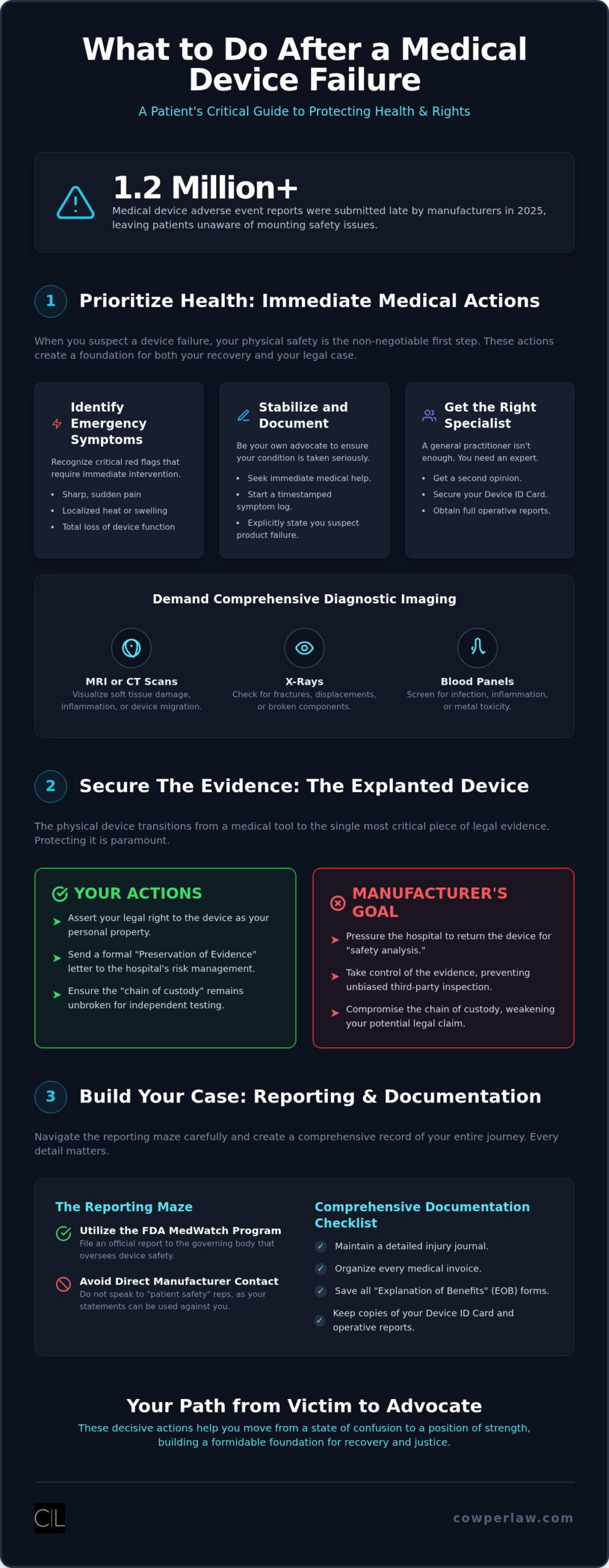
The physical evidence is secured, but the story of your suffering is written in the paper trail you leave behind. This documentation serves as your voice when you are not in the room. Knowing what to do after medical device failure involves more than just medical care; it requires a meticulous collection of every life disruption caused by the malfunction. We are here to help you organize this chaos into a formidable case. We are serious, focused, and intensely loyal advocates who believe that your documentation is the foundation of your future justice.
A daily journal is one of the most persuasive tools in litigation. We suggest you begin by writing a single, defining sentence: "Since my implant failed, I can no longer lift my child, return to my career, or sleep through the night without agonizing pain." This clarity helps a jury understand the human cost of corporate negligence. Beyond physical symptoms, you must track the emotional toll. Chronic pain often brings anxiety, depression, and a loss of consortium that strains your most intimate relationships. These entries provide a real-time account that is far more reliable than memory alone during a trial or settlement negotiation.
The financial burden of a failed implant is often staggering and multifaceted. You must collect and organize every "Explanation of Benefits" (EOB) and medical invoice to ensure no cost is overlooked. This includes receipts for travel to specialists, home care expenses, and a clear record of lost wages. Additionally, secure the original "Instructions for Use" (IFU) and any marketing materials you received. These documents often reveal discrepancies between what the company promised and what the device actually delivered. Understanding the critical factors that influence medical device lawsuit settlement amounts can help you recognize the full scope of compensation you may be entitled to recover.
Secure your medical device ID card immediately. Whether it's a "purple card" for a BioZorb implant or an identification card for a Spinal Cord Stimulator, this is your definitive proof of product. To ensure you aren't missing any critical details, you should learn how to document a medical device injury to meet the high standards required in court. What to do after medical device failure is a journey that requires persistence, loyalty, and precision. If you are overwhelmed by the paperwork, contact our team for a case evaluation so we can begin building your defense against the entities that failed you.
Transitioning from the chaos of a medical malfunction to the clarity of a legal claim is a powerful act of reclamation. You have already secured your health, preserved the evidence, and organized your documentation. Now, you must choose a partner who can translate your suffering into accountability. We are a national trial firm that sees you as an individual, not a case number. Understanding what to do after medical device failure means finding an advocate who is ready to stand between you and the corporation that failed you. Just as the Law Office of Kevin Bessant & Associates provides a robust defense for individuals in other high-stakes legal arenas, we are here to provide the toughness required for litigation and the softness required for your support.
Selecting the right legal partner depends heavily on the nature of your injury. If you are seeking assistance for a motor vehicle accident, you may want to check out Yakov Mushiyev & Associates, P.C.; however, when it comes to the technical complexities of a malfunctioning implant, you need a different type of expertise.
A general personal injury lawyer might handle a car accident or a slip-and-fall with ease, but medical device litigation is a specialized battlefield. This work requires a deep understanding of bioengineering, federal regulatory compliance, and complex product liability law. We are specialized experts in BioZorb, Spinal Cord Stimulators, and hernia mesh litigation. Our team knows how to investigate medical device manufacturer negligence by dissecting internal corporate communications and analyzing failed hardware with independent experts. We are not just advisors; we are warriors. We are prepared to go to trial against billion-dollar corporations that prioritize profit over patient safety, ensuring your story is told with intellect, strategy, and heart.
Your journey toward a settlement is a marathon, not a sprint. It begins with a comprehensive initial consultation where we listen to your story, review your evidence, and map out a strategic path for your recovery. We operate on a contingency basis, which is a "no-win, no-fee" model. This structure ensures that justice is accessible, equitable, and fair, regardless of your current financial situation. You don't pay anything unless we secure a victory for you. This approach aligns our success entirely with your outcome, fostering a partnership built on total certainty and trust. Before entering negotiations, it is worth understanding how medical device lawsuit settlement amounts are calculated and valued so you can make informed decisions about your case.
Time is a critical factor in these cases. Every state has a specific statute of limitations that dictates how long you have to file a claim. Waiting too long can permanently bar you from seeking the compensation you deserve for medical bills, lost wages, and emotional distress. We are here to provide the stability and strength you need to move forward during a chaotic time. If you are ready to hold the manufacturer accountable and regain your peace of mind, speak with a relentless medical device injury lawyer today. We are your constant companion from the beginning to the end of this process.
Navigating the aftermath of a malfunction is an exhausting journey, but you don't have to walk it alone. By prioritizing your health, securing the physical evidence, and maintaining a rigorous paper trail, you've already begun to shift the balance of power. You now understand exactly what to do after medical device failure to protect your rights and your physical well-being. We are here to ensure that your voice is not drowned out by corporate noise and that your suffering leads to meaningful change.
We are trial-tested lawyers who refuse to back down from billion-dollar corporations. Whether you are facing BioZorb or SCS failures, our nationwide advocacy is built on a foundation of total loyalty and strategic intellect. We operate on contingency-based fees, which means you pay nothing unless we win. Your peace of mind is our primary focus, and we're ready to act as your constant companion in this fight. Contact Cowper Law for a Free, Compassionate Case Evaluation today. You have the strength to move forward, and we have the heart to defend you.
The first step is seeking immediate stabilization from a medical specialist who understands your specific implant. Your safety is the priority. Once stable, you must secure your device identification card and request all operative reports. We are here to help you understand exactly what to do after medical device failure to ensure your health and your legal rights are protected from the very beginning.
You absolutely can. A formal FDA recall is not a prerequisite for a product liability claim. While a recall provides strong evidence, your lawsuit is based on the specific physical, emotional, and financial harm you've endured. We focus on the facts of your injury, the failure of the device, and the negligence of the manufacturer to build a formidable case for justice.
We believe that justice should be accessible to every individual, regardless of their financial situation. We operate on a contingency-fee basis, meaning you pay nothing unless we secure a successful outcome. There are no upfront costs, no hourly bills, and no hidden expenses. We are personally and emotionally invested in your victory, providing high-end, tailored service that prioritizes your recovery over our bottom line.
While preserving the physical device is ideal, its absence doesn't end your path to justice. We utilize medical records, diagnostic imaging, and expert testimony to reconstruct what went wrong. Our team is skilled, persistent, and methodical in gathering alternative evidence. We investigate surgeon notes and facility logs to prove that a malfunction occurred, ensuring your story is heard even without the hardware.
Every state has a specific statute of limitations that dictates your deadline for filing. These legal windows are often short and unforgiving. Missing a deadline can permanently bar you from seeking compensation for your pain, suffering, and medical bills. We recommend seeking legal counsel immediately to determine the specific timeline for your claim and to ensure your rights are fully protected from the start.
Most medical device claims are resolved through settlements, but we prepare every case for the courtroom. This trial-ready strategy provides you with the strongest possible leverage against powerful corporations. We are not passive advisors; we are active advocates. Whether your case settles or goes before a jury, we remain your constant, loyal companion, fighting for the peace of mind and support you deserve.
Yes, we specialize in what to do after medical device failure involving BioZorb and Spinal Cord Stimulators. These devices have unique failure profiles that require a sophisticated, intellect-driven legal strategy. We are intimately familiar with the technical nuances of these implants. Our firm is dedicated to holding these specific manufacturers accountable for the catastrophic injuries and life disruptions their failed products have caused.