
Imagine the device meant to silence your chronic pain suddenly delivers a sharp, erratic shock or simply stops communicating when you need it most. It's a terrifying reality for many patients facing the October 2025 Abbott Eterna recall or the June 2026 Boston Scientific MDL consolidation. You trusted this technology to restore your quality of life, but instead, you're left with worsening pain, lead migration, and the looming fear of another surgery. The confusion of FDA notices and mounting medical bills can feel like an impossible weight to carry alone. Finding a dedicated spinal cord stimulator recall lawyer is the first step toward reclaiming your peace of mind and your future. We understand that you need an advocate who is protective, persistent, and personally invested in your recovery. In this guide, we'll help you identify the signs of a failing device, clarify your legal rights, and explain how to select a trial-ready firm that manages the complex task of securing a settlement for your future medical care.
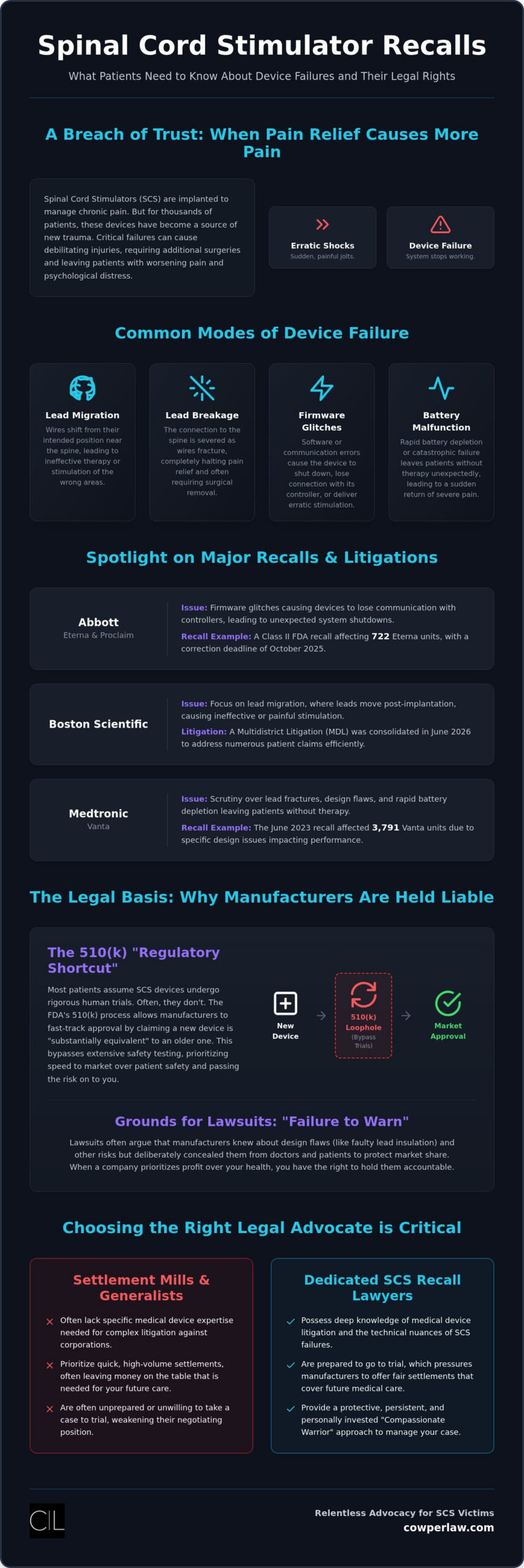
A recall notice for a medical device is rarely just a piece of mail; it is a profound breach of trust. For patients who rely on neuromodulation to manage chronic pain, understanding what a spinal cord stimulator is and how it can fail is the first step toward seeking justice. Major manufacturers like Abbott, Medtronic, and Boston Scientific have faced intense scrutiny as their devices exhibit critical failure modes that put patients at risk. These failures often manifest as lead migration, where wires shift from their intended position; lead breakage, which severs the connection to the spine; and catastrophic battery malfunctions. Patients frequently report terrifying "jolting" sensations or erratic electrical shocks that replace the intended relief with new, acute trauma. When these devices fail, the consequences are physical, emotional, and financial.
The FDA classifies these events based on the level of risk to the patient. A Class I recall indicates a situation where there's a reasonable probability that the use of the product will cause serious adverse health consequences or death. Class II recalls, such as the October 2025 Abbott Eterna recall affecting 722 units, involve temporary or reversible health problems. We monitor the FDA MAUDE database closely, as it serves as an early warning system for device failures. For instance, the June 2023 Medtronic Vanta recall affected 3,791 units due to specific design issues. Sometimes, even simple firmware updates meant to improve communication can trigger unexpected system shutdowns, leaving patients vulnerable and in pain. Choosing a spinal cord stimulator recall lawyer who understands these technical nuances is vital for a successful claim.
The physical toll of a defective device is often permanent and life-altering. Chronic nerve damage and a persistent "burning" sensation are common among plaintiffs who have suffered from lead migration or over-stimulation. These injuries often necessitate complex revision surgeries, which carry their own risks of infection, scarring, and further trauma. Beyond the physical, the psychological impact is devastating. Many patients experience "phantom shocks," a state of constant hyper-vigilance where they fear their own body's response to the device. We are a firm built on the belief that no one should live in fear of the technology meant to save them. Partnering with a dedicated spinal cord stimulator recall lawyer ensures that your journey toward healing is supported by a team that is protective, capable, and relentless in the pursuit of your peace of mind.
Most patients assume that a device implanted near their spine has undergone years of rigorous human clinical trials. Unfortunately, that's often not the case. Through the 510(k) premarket notification process, manufacturers can bypass extensive safety testing by claiming a new device is "substantially equivalent" to an older model already on the market. This regulatory shortcut allows corporations to bring complex electronics to market without proving their safety through new, long-term studies. By tethering a sophisticated modern system to a legacy model cleared decades ago, companies avoid the financial burden of new trials while passing the physical risk onto you. It's a system built on speed, not safety.
When these devices fail, the legal theory often centers on "failure to warn" and design defects. For instance, design flaws in lead insulation can cause electrical leakage, leading to the painful shocks discussed previously. A dedicated spinal cord stimulator recall lawyer investigates whether the manufacturer knew about these risks and chose to keep them hidden from doctors and patients. If you've suffered because a company prioritized market share over your health, you have the right to hold them accountable. Understanding your options starts with a detailed case evaluation to determine if corporate negligence played a role in your injury.
Current litigation targets the industry's biggest players for a variety of technical failures. Specific claims against Abbott involve the Proclaim and Eterna lines, particularly regarding firmware glitches that cause devices to lose communication with controllers. This was evidenced by a 2025 FDA recall notice that highlighted these communication risks. Meanwhile, Medtronic faces scrutiny over lead fractures and rapid battery depletion that leaves patients without therapy; patients who have experienced worsening neurological symptoms as a result may have grounds for a Medtronic spinal cord stimulator nerve damage lawsuit to hold the manufacturer accountable for these life-altering consequences. Boston Scientific is also a primary focus, with the June 2026 MDL consolidation addressing issues related to lead migration and inadequate anchoring systems. Patients who received the Nevro HFX system and experienced unpredictable electric jolts and revision surgeries may also have grounds for a nevro spinal cord stimulator lawsuit based on similar allegations of design defects and inadequate warnings. These aren't isolated incidents; they're systemic failures across the neuromodulation industry.
Fighting a multi-billion dollar corporation alone is an overwhelming prospect for an injured patient. These entities have unlimited resources to defend their products, which is why you need a spinal cord stimulator recall lawyer who acts as a "Compassionate Warrior." We specialize in uncovering internal corporate documents that reveal what these companies knew and when they knew it. Litigation does more than just secure compensation; it forces safety changes that the regulatory system often misses. We are here to balance the scales of justice, ensuring that your voice is heard and your future is protected against those who put profits before people.
Selecting a spinal cord stimulator recall lawyer is one of the most consequential decisions you'll make in the wake of a device failure. It's the difference between being a number in a high-volume settlement mill and having a dedicated advocate who understands the intricate engineering of neuromodulation. While many firms focus on quick resolutions, we are committed to a personalized, results-driven approach. You need a firm that possesses the national reach to challenge massive corporations yet maintains the softness required to support you through a chaotic time.
A local generalist might handle your neighborhood legal needs, but medical device litigation requires a specific blend of authoritative confidence and technical expertise. We position ourselves as your constant companion throughout this process. Our "Compassionate Warrior" persona is defined by three pillars: intellect, strategy, and heart. This ensures that every legal victory is framed in terms of the peace of mind and future security it provides to you. We don't just see a case; we see a person whose trust was broken by a multi-billion dollar entity.
The threat of a trial is the most powerful leverage a patient has against a negligent manufacturer. When a firm is trial-ready, companies like Abbott or Medtronic know they can't simply wait you out or offer a low-ball settlement. Ask potential attorneys about their specific history with jury trials in the medical device sector. A firm that is not afraid to stand before a jury sends a clear message: we will not yield until you receive the compensation you deserve. This readiness often forces manufacturers to settle more fairly and quickly.
Accessing high-level legal advocacy shouldn't depend on your bank account. Our contingency fee model means you face zero upfront costs and pay nothing unless we recover money for you. This structure perfectly aligns our goals with your success. We handle the heavy lifting of medical record collection and finance the significant costs of expert witnesses and engineering analysts. It's a partnership designed to provide stability and order during your recovery. Our commitment is to your future, ensuring that your settlement covers the long-term medical care you may require.
Your first priority must always be your health. If you learn that your device is subject to a recall, such as the October 2025 Abbott Eterna notice, consult your physician immediately before making any adjustments. Never attempt to reprogram or disable the system yourself. Once your medical safety is addressed, your next step is to verify your specific device serial number against official FDA recall lists. You can find this number on your patient identification card or within your initial surgical records. Documenting every instance of malfunction is equally vital. Keep a detailed log of every shock, jolt, or sudden spike in pain you experience. These records provide the concrete evidence your spinal cord stimulator recall lawyer needs to build a formidable case against the manufacturer.
Be extremely cautious of direct communication from the device manufacturer. They may offer to cover the cost of a replacement or provide a "release" form. Do not sign any documents or waivers without legal counsel. These agreements are often designed to strip you of your right to seek full compensation for future medical care and lost wages. We are here to handle these high-pressure interactions for you, acting as a shield between you and the corporation's legal team. Protecting your rights requires a partner who is serious, focused, and intensely loyal. If you are uncertain whether an individual lawsuit or a collective action is the right path forward, understanding how to join a medical device class action lawsuit can help you evaluate all of your legal options before making any decisions.
If your device requires removal, the explanted hardware is the single most important piece of evidence in your claim. It is the physical proof of a design or manufacturing defect. Many hospitals have a policy of returning failed devices to the manufacturer for "analysis," but you must insist that the device remains in your legal control. We help our clients establish a secure chain of custody to ensure the device is preserved for independent testing by our engineering experts. Losing this evidence can significantly weaken your position in court. We are your constant companion from the beginning to the end of this complex process.
Building a successful claim requires a comprehensive trail of documentation. We need everything from your initial implant surgery notes to the records of any revision procedures or emergency room visits. It is also essential to track the financial toll of your injury, including lost wages and out-of-pocket expenses for physical therapy or medication. For more detailed guidance, read our resource on Documenting a Medical Device Injury. If you are overwhelmed by the process of medical record collection, contact us for a consultation and let our team handle the heavy lifting while you focus on your recovery.
Cowper Law is more than a legal institution; we are a dedicated defender of the individual against powerful, multi-billion dollar entities. We are a firm built on a foundation of justice, compassion, and results. Our mission is driven by a deep-seated moral conviction that no corporation should be allowed to profit from the pain of others. Choosing the right spinal cord stimulator recall lawyer means finding a partner who is protective, capable, and mission-driven. We provide a sophisticated blend of authoritative confidence and empathy, ensuring you feel both shielded and heard throughout your legal journey. Our "Compassionate Warrior" approach balances the intellect required for complex litigation with the heart required to support a person in crisis.
We are a national trial firm, and our reach extends to every patient across the United States. This national presence is critical because these device failures aren't local issues; they are systemic corporate failures that require a high-level response. We position ourselves as your constant companion, standing firm in the "David vs. Goliath" struggle between an injured individual and a negligent manufacturer. Our results-first framing ensures that the ultimate outcome for you, including your peace of mind and future security, remains the primary focus of every strategy we employ. We refuse to yield until the scales of justice are balanced.
Investigating a medical device failure requires a methodical, steady, and reassuring process. We handle the heavy lifting of medical record collection, engineering analysis, and expert testimony. You aren't just a number in a high-volume system here. Every client receives tailored, high-end service that respects the personal nature of their injury. We have a long history of taking on the world's largest medical device manufacturers, uncovering the technical flaws and corporate shortcuts that lead to patient harm. By managing the complex logistics of your case, we provide the order and stability you need during a chaotic time.
The path to recovery starts with a single step toward accountability. We offer a zero-cost, no-obligation case review to help you understand your eligibility and your options. This process is designed to build trust and provide clarity without any financial pressure on you or your family. We are here to offer the calm strength and strategic intellect required to secure a settlement that covers your future medical care. Your journey doesn't have to be a lonely one. Contact Cowper Law for a Confidential Case Review and let us begin the work of restoring your peace of mind today.
You've endured physical trauma and the betrayal of a medical device that failed when you needed it most. We've explored how manufacturers bypass safety trials and why preserving your explanted device is the most critical step in your claim. Navigating the aftermath of a recall requires more than just legal advice; it demands a partner who understands the engineering of neuromodulation and the tactics of multi-billion dollar corporations. Partnering with an experienced spinal cord stimulator recall lawyer ensures that you are never just a number in a system. We are national trial lawyers with deep expertise in medical device failures, operating on a contingency-based model where you only pay if we win. Our "Compassionate Warrior" approach puts your recovery and peace of mind first, providing the stability you need during this chaotic time. You don't have to carry this burden alone. Begin your journey toward justice with a free case review from Cowper Law. Your voice deserves to be heard, and your future is worth fighting for.
Yes, several significant recalls and legal actions are active in 2026. The FDA classified the Abbott Eterna recall as a Class 2 event in late 2025, which affected over 700 units due to communication failures. Additionally, the June 2026 consolidation of Boston Scientific cases into a multidistrict litigation (MDL) highlights ongoing safety concerns across the industry. We monitor these regulatory updates daily to ensure our clients have the most current information regarding their legal eligibility.
Failing devices often manifest through sudden, erratic electrical shocks or a total loss of stimulation. You might notice the device no longer communicates with your patient controller, or you may feel a "jolting" sensation that indicates the leads have migrated from their original position. These physical symptoms are serious indicators that the hardware is compromised. If you experience these issues, consult your physician immediately and then speak with a spinal cord stimulator recall lawyer to protect your rights.
You can pursue a product liability claim if lead migration or erratic shocks resulted from a design or manufacturing defect. Lawsuits typically allege that the manufacturer failed to warn patients of these risks or used inadequate materials for insulation and anchoring. We investigate whether the company's negligence led to your injury. Legal action focuses on holding the manufacturer accountable for the physical trauma, chronic pain, and additional revision surgeries you've had to endure. If your device was made by Nevro and you experienced unpredictable jolts or a return of chronic pain after promised "paresthesia-free" therapy, learn more about your options by reviewing the current Nevro spinal cord stimulator lawsuit trends and patient rights.
Settlement amounts vary significantly based on the severity of your injuries and the long-term impact on your quality of life. There are no publicly reported average settlements as of August 2026, as many cases are still in the early stages of litigation or MDL consolidation. Factors that influence compensation include the cost of future revision surgeries, lost wages, and the necessity for specialized medical care; for instance, Living Well Dallas offers functional medicine consultations to help patients manage their health holistically during recovery. We focus on securing a result that reflects the true depth of your suffering. Just as patients harmed by other recalled implants must carefully evaluate the factors that shape their recovery, understanding the variables that determine BioZorb lawsuit settlement amounts offers a useful framework for how courts and manufacturers weigh the total human cost of a failed medical device.
If a manufacturer contacts you, they may offer a replacement device or ask you to sign a release form. It's vital that you don't sign any documents without a lawyer's review. These forms often contain language that waives your right to file a future lawsuit or seek additional damages. We act as your protective advocate, handling all communications with the manufacturer to ensure you don't inadvertently sign away your right to full compensation for your injuries.
No, you don't pay any upfront costs when you hire Cowper Law. We operate on a contingency-based model, which means our fees are tied directly to the success of your case. We cover the substantial expenses of expert witnesses, medical record collection, and engineering analysts. You only pay if we successfully recover a settlement or verdict on your behalf. This partnership ensures that high-level legal advocacy is accessible to everyone regardless of their current financial situation.
The timeframe to file a lawsuit, known as the statute of limitations, varies by state and the specific circumstances of your injury. It generally begins when you first discover, or should have discovered, that the device failed. Because these deadlines are strict and can be quite short, it's essential to consult a spinal cord stimulator recall lawyer as soon as possible. Waiting too long can permanently bar you from seeking justice and compensation for your injuries.
Your physical experience is valid even if a physician cannot immediately identify a technical fault. Some device failures, like intermittent firmware glitches or subtle lead fractures, don't always show up during a standard checkup. We recommend seeking a second opinion from a specialist familiar with neuromodulation failures. If your pain persists or worsens, we can help investigate whether a documented recall or known design defect is the underlying cause of your suffering and your device's failure. Patients in this situation often benefit from understanding all available legal pathways, including how to join a medical device class action lawsuit when multiple patients share the same device defect and manufacturer negligence.