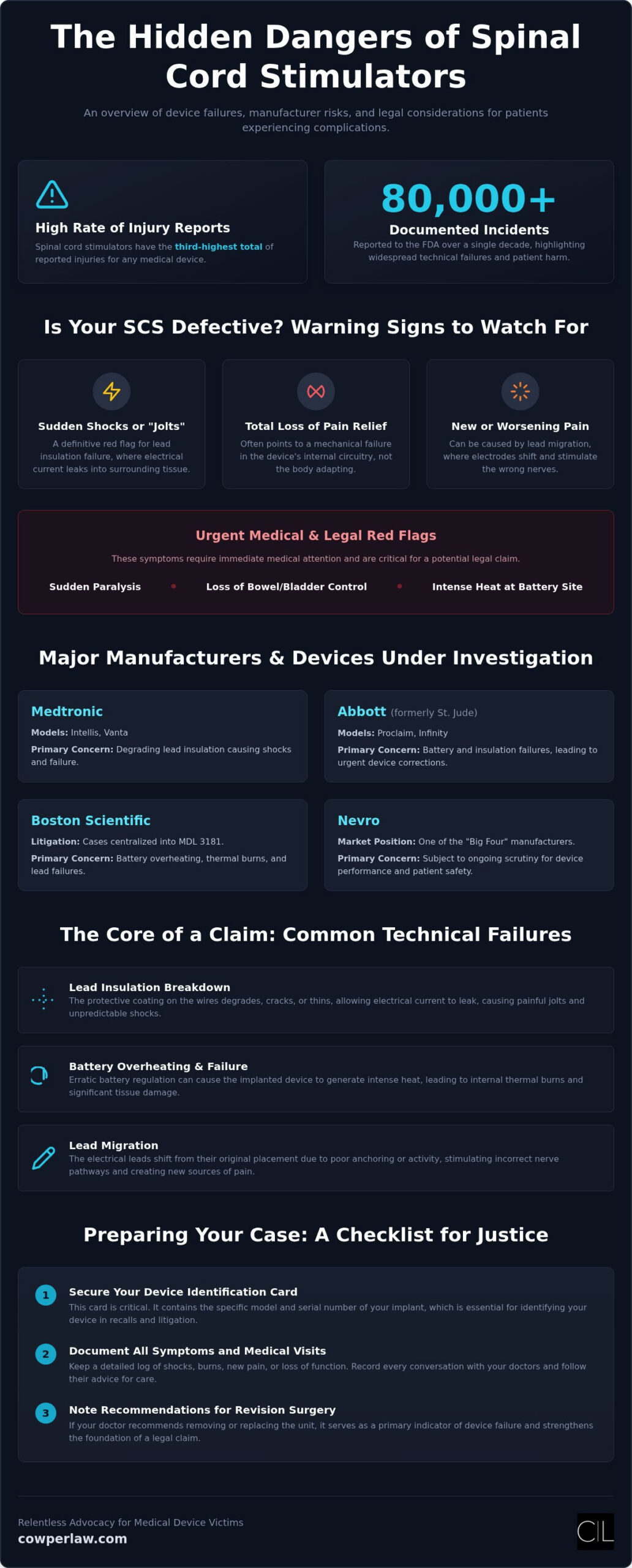
Did you know that spinal cord stimulators have the third-highest total of reported injuries for any medical device, with more than 80,000 incidents documented over a single decade? You were promised relief, restoration, and a return to normal life, yet you're now grappling with the fear of permanent nerve damage and the crushing anxiety of revision surgery. It's devastating to feel like a number in a manufacturer's profit margin while you're forced to consider a spinal cord stimulator burn injury lawsuit just to reclaim your health. We recognize that your symptoms aren't just in your head; they're the result of documented technical failures that have left thousands of patients in harm's way.
This 2026 resource guide provides the clarity you need to hold billion-dollar corporations accountable for their negligence. We are dedicated advocates who believe you deserve a partner who is intellectually formidable, emotionally accessible, and fiercely loyal. You'll find the latest updates on MDL 3181 against Boston Scientific, a breakdown of recent Abbott recalls, and a definitive checklist to help you secure the justice you deserve. We're here to manage the complex litigation so you can focus on your recovery, your family, and your future.
A Spinal Cord Stimulator (SCS) is engineered to interrupt pain signals before they reach the brain, but when the device itself is defective, it becomes a source of new, agonizing trauma. These complications typically stem from three primary failure points: degraded lead insulation, erratic battery regulation, or corrupted software. We understand the betrayal you feel when a technology promised to restore your life instead compromises it. Identifying these failures early is the first step toward reclaiming your health and building the foundation for a spinal cord stimulator burn injury lawsuit.
Unexpected shocks or "jolts" are not a normal part of the healing process. They are a definitive red flag for lead insulation failure. When the protective coating on the wires thins or cracks, electrical current leaks into the surrounding tissue. This is not the gentle tingling your clinician described. It is a violent, unpredictable surge that can cause you to fall, drop objects, or suffer muscle spasms. If your pain relief suddenly vanishes, it is rarely because your body has "adapted" to the stimulation. A total loss of therapeutic effect often points to a mechanical failure within the device's internal circuitry or a breakdown in communication between the remote and the implant.
It is vital to distinguish between normal post-surgical healing and device malfunction. Soreness at the incision site is a common recovery hurdle. However, internal burning sensations, electrical "lightning strikes," and sudden limb weakness are indicators of a failing medical device. We are here to help you translate these physical symptoms into the technical evidence required for a successful legal claim.
The cruelty of a failed SCS lies in its irony. A device meant to grant you freedom instead traps you in a cycle of secondary neurological trauma. Lead migration is a primary culprit in these cases. Lead migration is the shifting of electrodes from their original placement, often caused by poor anchoring or physical activity. When leads move, the device targets the wrong nerves, potentially causing excruciating pain in areas where you previously had none. This shift can be permanent, persistent, and profoundly debilitating.
Some symptoms represent both a medical emergency and a critical legal turning point. You must seek immediate care and document the following: sudden paralysis, loss of bowel or bladder control, or intense localized heat at the battery site. Waiting to document these events can weaken your position in a potential Medtronic spinal cord stimulator nerve damage lawsuit. If your doctor recommends revision surgery to remove or replace the unit, it serves as a primary indicator of a legal case. We are relentless advocates who will ensure your medical record reflects the technical reality of the device's failure.
The 2026 litigation landscape is dominated by the "Big Four" manufacturers: Medtronic, Abbott, Boston Scientific, and Nevro. While these companies control the vast majority of the market, they're currently facing intense scrutiny over device failures that have left thousands of patients in chronic pain. As of August 2026, the Judicial Panel on Multidistrict Litigation has already centralized cases against Boston Scientific into MDL 3181. For victims suffering from battery overheating or lead failure, filing a spinal cord stimulator burn injury lawsuit is often the only way to cover the high costs of revision surgery and long-term care. To protect your rights, you must first identify your specific model and serial number, which is typically found on the Device Identification Card you received after surgery.
Medtronic's Intellis and Vanta models have been at the center of significant safety concerns, particularly regarding lead insulation that can degrade over time. These failures are often the catalyst for a Medtronic spinal cord stimulator nerve damage lawsuit. Abbott, formerly St. Jude Medical, faces similar challenges with its Proclaim and Infinity systems. In April 2026, Abbott issued an urgent medical device correction for these devices to address risks associated with "Surgery Mode" features. Additionally, the October 2025 recall of Eterna and Liberta RC generators highlighted critical communication losses between controllers and implants. You can check the FDA's MAUDE database for specific adverse event reports tied to your device. If you're struggling to find this information, our team can help you secure your medical records to determine if your device is part of a known defect group.
The Boston Scientific spinal cord stimulator recall has fundamentally changed how patients view these implants. With MDL 3181 now active before U.S. District Judge Josephine L. Staton, the focus has shifted toward alleged design defects that make these devices inherently dangerous. Similarly, the Nevro spinal cord stimulator lawsuit landscape explores issues with high-frequency (HF10) therapy, which some patients claim causes unexpected shocks and localized heat. In a court of law, a design defect suggests the device's very blueprint is flawed, whereas a manufacturing defect implies a mistake occurred during the assembly of a specific batch. When these flaws result in skin or tissue damage, a spinal cord stimulator burn injury lawsuit becomes a necessary path toward accountability. We are here to ensure that no matter which manufacturer is responsible, your story is heard with total clarity and strength.
The physical damage caused by a failing medical device is often invisible to the naked eye, yet its impact is life-altering. When an implant malfunctions, the consequences are rarely limited to a simple loss of pain relief. Instead, many patients suffer from internal tissue destruction and permanent neurological deficits. We believe that no individual should have to endure the physical and emotional toll of a defective medical implant alone. A spinal cord stimulator burn injury lawsuit is built on the premise that manufacturers failed in their duty to protect you, specifically by neglecting to provide adequate warnings about thermal risks.
Manufacturers have a strict legal obligation to disclose every known hazard. When they prioritize market share over patient safety, they violate the trust of the medical community and the individuals they serve. Internal burns are not just side effects; they are severe injuries that can lead to irreversible nerve damage, chronic inflammation, and systemic health complications. We are here to stand as a shield between you and these billion-dollar entities, ensuring your voice is heard in the pursuit of accountability.
Rechargeable batteries in SCS units are susceptible to a phenomenon known as thermal runaway. This occurs when the battery's internal temperature rises uncontrollably, often during the charging process. This excessive heat radiates into the surrounding tissue, causing localized burns that are difficult to treat. You might notice redness, persistent heat at the implant site, or visible skin changes. However, the most dangerous damage happens internally. We work with medical experts to document these injuries through specialized imaging like MRIs or CT scans, which can reveal the extent of the tissue damage. If you've experienced these symptoms, it's vital to act quickly to preserve the physical evidence of your injury.
While battery issues cause thermal trauma, lead migration creates mechanical destruction. Shifting electrodes can physically compress the spinal cord, leading to a loss of motor function or sensory changes. This movement often results in fibrosis, which is a type of internal scarring that can permanently fuse the lead to the spinal column. This scarring makes removal surgery extremely dangerous and often leaves the patient with permanent nerve pain. At Cowper Law, we classify these incidents as catastrophic medical device injuries. We are a firm of compassionate warriors dedicated to securing the resources you need for long-term care, rehabilitation, and recovery. We handle the technical complexities of your case so you can focus on regaining your strength and your peace of mind.
Preparing for a spinal cord stimulator burn injury lawsuit is an act of reclamation. It is the moment you stop being a victim of corporate negligence and start becoming an active participant in your pursuit of justice. We understand that gathering records while managing chronic pain is exhausting, which is why we've designed this resource kit to streamline the process. Your legal journey begins with three essential pillars: identification, documentation, and preservation. We are here to stand as your shield, your guide, and your advocate throughout this complex process.
Building a case against a billion-dollar manufacturer requires more than just a memory of pain. It requires a meticulous collection of facts that prove the device failed you. We focus on the human impact of your injury, but we win cases through technical precision and relentless preparation. By organizing your evidence now, you ensure that your claim is intellectually formidable and ready for the rigors of litigation. If you feel overwhelmed, remember that we handle the heavy lifting of the legal process so you can focus on your health and your family.
Your first priority is to locate your Device Identification Card or the original implant manual. This card contains the model and serial numbers that serve as the unique fingerprints of your implant. You can cross-reference these numbers with our spinal cord stimulator recall lawyer database to see if your specific unit is part of an active safety alert or a previous recall. Additionally, document every remote session or software update pushed to your device by a manufacturer representative. These digital footprints are vital, as they often reveal the exact moment a company attempted to "patch" a known technical flaw.
You must request specific operative reports from your surgical center to validate your claim. We need the "op-note" from the initial implantation and the report from any revision or explantation surgery. These documents contain the Product Identification Tags, which are the sticky labels from the device packaging. These tags are the "smoking gun" of a case, as they provide indisputable proof of the hardware used. We also strongly advise you to instruct your surgeon to save the explanted device as evidence. It is your property, and it is a critical piece of physical proof in a spinal cord stimulator burn injury lawsuit. Finally, keep a contemporaneous pain journal to track every shock and burn. If you are ready to begin this journey, you can contact our trial team today for a professional evaluation of your records.
We are a national trial firm defined by unyielding stature, sophisticated strategy, and deep-seated empathy. When you choose to pursue a spinal cord stimulator burn injury lawsuit, you aren't just hiring a legal service; you're gaining a constant companion for a difficult journey. We understand the physical betrayal you've endured. Our mission is to provide a shield of calm strength against the chaotic aftermath of a medical device failure. We are the Compassionate Warrior, balancing the sharp intellect required for complex litigation with the soft touch needed for genuine client support.
Our approach is rooted in a results-first philosophy that prioritizes your peace of mind above all else. We don't view your suffering as a case number or a technicality. We see the human impact of every shock, every burn, and every lost moment of mobility. By focusing on the ultimate outcome for the individual, we ensure that our legal victories provide the stability and resources you need to heal. We are personally and emotionally invested in your success, operating on a contingency fee model that aligns our interests perfectly with your own. We don't get paid unless we win for you.
Taking on multi-billion dollar medical device manufacturers requires more than just legal knowledge; it requires a refusal to yield. We are trial lawyers who prepare every claim for the courtroom, not just the settlement table. This proactive stance forces powerful entities to recognize the gravity of the harm they've caused. Our firm is built on a foundation of Compassion, Expertise, Results. We utilize our intellectual formidable resources to dismantle the corporate defenses that often shield these companies from accountability. We handle the technical complexities of your spinal cord stimulator burn injury lawsuit with precision, persistence, and professional balance.
Your path to recovery should not be a solitary struggle against an impersonal system. At Cowper Law, we offer a tailored, high-end service that treats your story with the dignity it deserves. We are ready to begin a partnership that focuses on your long-term well-being and your right to justice. The next step is a methodical, steady, and reassuring review of your medical and device history. We provide the order and clarity you need during what is often a terrifying time. We invite you to take the first step toward reclaiming your future with a team that is steadfast, durable, and loyal. Contact Cowper Law today for your free SCS case evaluation.
You have endured the physical betrayal of a device meant to heal, but you don't have to carry this burden alone. We've explored how technical failures like lead migration, battery overheating, and insulation breakdown are not just side effects; they are the foundation of a spinal cord stimulator burn injury lawsuit. By identifying your specific device, preserving operative records, and understanding the 2026 litigation landscape, you take the first steps toward accountability. We are national leaders in medical device litigation with a specialized focus on the thermal burns and nerve damage caused by these implants.
We are your shield against billion-dollar manufacturers. Our trial team operates on a contingency basis, meaning there is no fee unless we win for you. We focus on the human impact of your journey, ensuring that legal victories translate into the reassurance, stability, and hope you deserve. Your story matters. Justice is possible. Contact Cowper Law for a Free SCS Case Evaluation and let us help you turn your pain into a pathway for justice. You are stronger than this setback, and we are ready to stand beside you.
You can absolutely file a spinal cord stimulator burn injury lawsuit if you've suffered tissue damage or nerve trauma due to battery overheating or insulation failure. These claims are based on the legal principle that manufacturers must provide safe devices and warn of all risks. We focus on proving that the device's technical failure led directly to your catastrophic injury. This legal action seeks to recover costs for revision surgery, lost wages, and your physical suffering.
Settlement amounts for these cases are highly individualized and depend on the severity of your injuries, the cost of medical care, and the impact on your quality of life. In 2026, litigation is still evolving, particularly with the formation of MDL 3181. Factors such as permanent nerve damage or the need for multiple revision surgeries typically increase the potential value of a claim. We focus on securing the maximum support needed for your long-term recovery.
While people often use the term "class action," most Boston Scientific cases are actually part of Multidistrict Litigation (MDL No. 3181), established in June 2026. You may qualify if you had a Boston Scientific stimulator implanted and suffered complications like shocks, burns, or lead migration. Unlike a class action, an MDL allows your specific injuries to be evaluated individually while benefiting from the collective strength of many plaintiffs against a major manufacturer.
If your device is recalled, your first step should be a medical evaluation to ensure your immediate safety. A recall is a formal admission of a defect, which can serve as powerful evidence in a legal claim. You should preserve your Device Identification Card and any communication from the manufacturer. We recommend contacting an advocate early to ensure your rights are protected before the manufacturer attempts to offer a low-value settlement or a software patch.
Hiring Cowper Law involves no upfront costs or hourly fees. We operate on a contingency fee basis, which means we only get paid if we successfully secure a recovery for you. This model ensures that we are personally and emotionally invested in your outcome. It allows you to focus on healing while we handle the complex litigation against billion-dollar manufacturers. You don't have to worry about legal bills while fighting for your health.
You can often still file a claim even if the implantation occurred years ago. In many states, the statute of limitations doesn't begin until you discover, or should have discovered, that the device was defective. If you recently experienced a sudden shock or burn, the clock for your spinal cord stimulator burn injury lawsuit may have just started. We can help you determine the specific deadlines that apply to your unique situation and medical history.
Common signs of failure in Medtronic devices, such as the Intellis or Vanta models, include "jolting" sensations, a total loss of pain relief, or localized heat at the battery site. These symptoms often indicate that the lead insulation has degraded or the battery is malfunctioning. If you experience sudden muscle weakness or a change in the intensity of the stimulation, it's vital to seek medical attention and document these events for your legal record.
Lead migration can be considered a defect if it's caused by flawed anchoring mechanisms or poor device design that makes the electrodes prone to shifting. While some manufacturers claim migration is a natural risk, litigation often reveals that the device wasn't engineered to withstand normal physical activity. When leads shift, they can compress the spinal cord or target the wrong nerves, leading to permanent scarring and the need for high-risk revision surgery.