
A medical device recall is never just a "glitch" or a minor technical update. For thousands of patients, the recent boston scientific spinal cord stimulator recall represents a profound failure of corporate responsibility that leaves the most vulnerable individuals caught in the crossfire. You chose an implant to regain your life, seeking relief from debilitating, persistent, and exhausting chronic pain. Instead, you may now face the trauma of unexpected electrical shocks, the sudden return of agony, or the looming anxiety of another invasive surgery.
We understand that this uncertainty is overwhelming. You deserve to know the truth about the WaveWriter Alpha software flaws and the moisture penetration issues affecting the Spectra WaveWriter models. This article provides the clarity you need to determine if your device is among the thousands recalled and outlines how to protect your health and your future. We'll examine the specific signs of device failure, the reality of the ongoing multidistrict litigation, and the definitive steps you can take to hold powerful entities accountable for their negligence. You aren't alone in this fight; we are here to provide the steady, fierce, and sophisticated advocacy you require to secure the justice you deserve.
The safety of a medical device is a sacred promise made to the patient. When that promise is broken, the consequences are devastating. Between 2024 and 2026, the medical community witnessed a massive boston scientific spinal cord stimulator recall involving more than 77,000 WaveWriter Alpha units worldwide. This wasn't a minor administrative update. It was a response to a fundamental software design flaw that could cause the device to reset unexpectedly, often resulting in high-intensity electrical shocks that leave patients reeling. We believe you shouldn't have to bear the burden of a manufacturer's oversight.
Many patients feel a sense of betrayal when they learn their device is recalled but not immediately scheduled for removal. This creates a unique brand of psychological and physical anxiety. While Boston Scientific may label these actions as "voluntary," this terminology is often a strategic choice to manage public perception. Regardless of the label, the risk to the individual remains the same. A device designed to heal is now a source of potential harm, leaving patients in a state of constant, exhausting, and unfair vigilance.
The primary focus of recent regulatory scrutiny remains the WaveWriter Alpha series. If you're unsure which device you have, you can typically find this information on your medical device identification card or within your surgical records. Beyond the software issues, the landscape of the boston scientific spinal cord stimulator recall expanded in 2026 to include reports of hardware failures in older Spectra models. These failures often involve moisture entering the pulse generator, which can lead to a complete loss of stimulation or an inability to recharge the battery. Identifying your specific model is the first step in reclaiming your peace of mind.
The "glitches" described in corporate press releases don't capture the reality of living with a defective spinal cord stimulator. Patients have reported "over-stimulation" events that feel like a sudden, violent surge of electricity through the spine. These shocks are intense, unpredictable, and agonizing. In some cases, these malfunctions manifest as physical burning sensations or permanent nerve damage. The Boston Scientific WaveWriter Alpha recall was officially initiated in July 2024 to address critical software design flaws that cause unexpected device resets. When a device fails this fundamentally, it's more than a technical error; it's a violation of the trust you placed in the manufacturer to protect your health.
Many patients believe that if a device is implanted in their body, it has undergone exhaustive, years-long human testing. It's a reasonable assumption. You trust the system to protect you. However, the boston scientific spinal cord stimulator recall exposes a darker reality: FDA approval is not a lifetime guarantee of safety. Instead, it's often a snapshot of a device at a specific moment in time, before manufacturers begin a cycle of constant, unproven modifications. We believe you deserve to know how these devices actually reach the market.
To understand how these devices reach your spine, we must look at the difference between the 510(k) clearance and the Premarket Approval (PMA) process. While a full PMA requires clinical data, the PMA Supplement pathway allows companies to make significant changes to software or hardware without conducting new human trials. They simply argue the change is "substantially equivalent" to what already exists. This is how the modifications cited in the FDA recall notice often slip through the cracks. These shortcuts prioritize speed over stability, leaving patients to act as the real-world testing ground for unproven software updates. If you've been harmed by these regulatory gaps, consulting a medical device injury lawyer can help you understand your path forward.
Manufacturers also use this approval as a "Preemption Shield" in the courtroom. They argue that because the FDA approved the device, they are immune from certain state-law claims. It's a calculated legal maneuver designed to block your access to justice. We believe this is a fundamental injustice. A regulatory stamp should not be a license to ignore patient harm or bypass accountability for defective design.
The numbers tell a story that corporate marketing teams would rather hide. Between 2016 and 2020, the FDA received 107,728 adverse event reports related to spinal cord stimulators. This includes reports of device failure, catastrophic injury, and even death. Post-market surveillance is supposed to catch these issues, but it often fails because it relies on manufacturers to self-report their own failures. This system is reactive, slow, and insufficient. It's a cycle of corporate silence that only breaks when a boston scientific spinal cord stimulator recall becomes too large to ignore.
We are here to bridge the gap between corporate negligence and individual recovery. Our team is focused on providing the clarity, strength, and persistence needed to navigate these complex legal waters. If you feel lost in the wake of a device failure, you can reach out to our team at cowperlaw.com to discuss your situation with an advocate who truly cares about your outcome.
The most insidious tactic a corporation can use is to blame the professional who trusted their product. For years, manufacturers have perpetuated the misconception that lead migration is exclusively the result of surgical error or patient non-compliance. We know the truth is far more complex. While surgical precision is vital, even the most skilled hand cannot overcome hardware that is fundamentally flawed. Defects in lead anchoring systems and poor structural integrity are significant contributors to device failure, yet patients are often told their returning pain is simply a "known complication" rather than a product defect.
Living with a defective implant creates a profound psychological burden. It's the feeling of carrying a ticking time bomb within your own body. You should be focused on your recovery, but instead, you're forced into a state of hyper-vigilance, waiting for the next malfunction. This constant anxiety is an injury in itself, born from a betrayal of the trust you placed in Boston Scientific to provide a safe, reliable medical solution.
Recognizing the early warning signs of device failure is critical for protecting your health. If you experience a sudden loss of pain relief or a "jolting" sensation when you change positions, your leads may have shifted. These physical sensations are often accompanied by a "burning" feeling at the site of the leads or the pulse generator. We've seen many cases where patients are sent for repeated reprogramming sessions; if your device requires constant adjustments just to maintain basic function, that is a major red flag. Furthermore, the 2026 boston scientific spinal cord stimulator recall of Infinion CX leads highlighted the risk of lead fractures at the anchor site, a structural failure that makes removal significantly more dangerous and complex.
The WaveWriter Alpha software flaws present a unique and terrifying danger. Unlike gradual lead migration, these software "resets" cause sudden, max-intensity shocks without warning. These aren't just uncomfortable; they are violent and incapacitating. Such events can lead to secondary catastrophic injuries, including falls down stairs or loss of vehicle control if a shock occurs while driving. If you are experiencing burning sensations or suspect nerve damage from your device, understanding your options through a spinal cord stimulator burn injury lawsuit resource can help clarify your legal rights. These patterns of over-stimulation aren't unique to one manufacturer; they echo the issues we see in the medtronic spinal cord stimulator nerve damage lawsuit. When a device designed to manage pain becomes a source of acute trauma, the boston scientific spinal cord stimulator recall is no longer just a regulatory notice; it's a call for accountability and justice for those whose lives have been upended by corporate negligence.
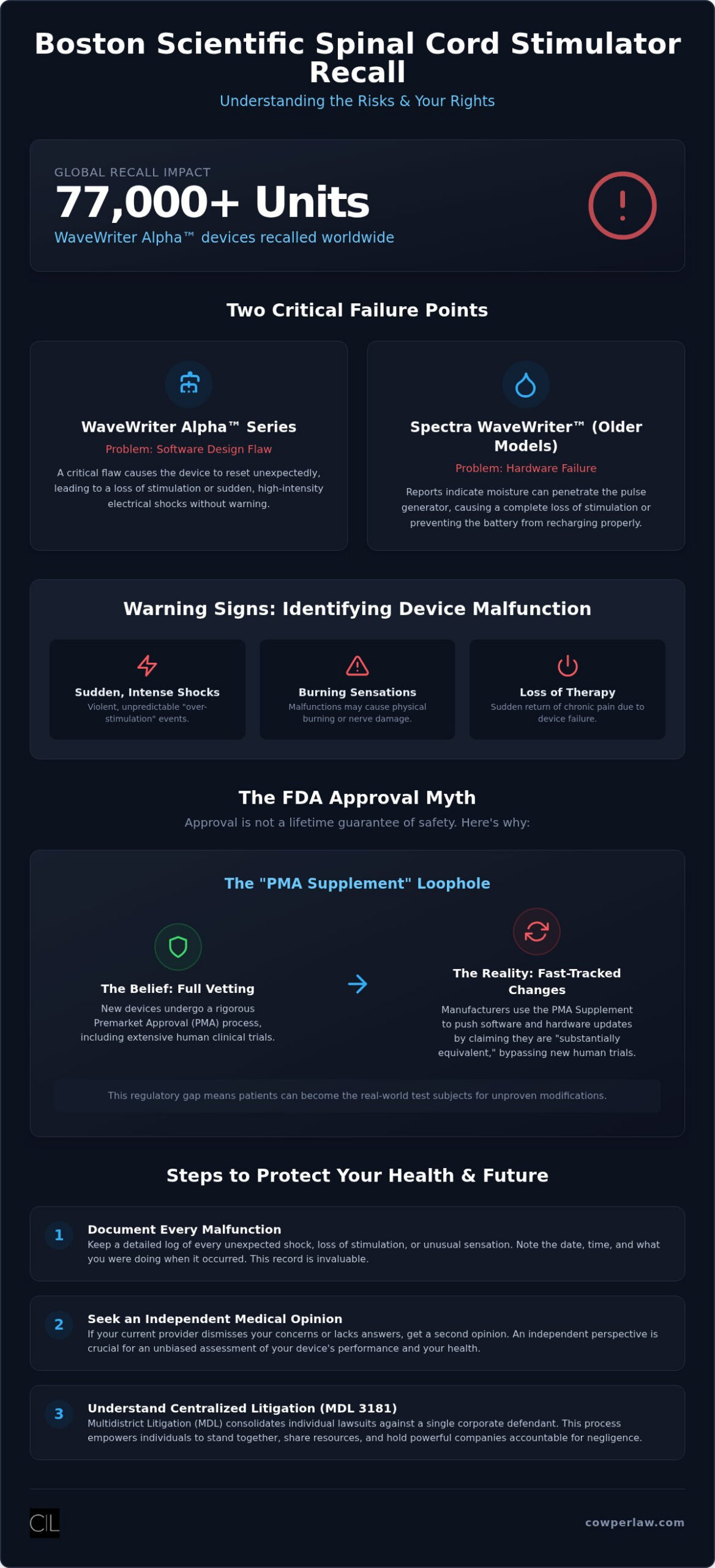
Discovering that your implant is part of the boston scientific spinal cord stimulator recall is a moment of profound vulnerability. You're likely feeling a mix of betrayal, fear, and frustration. When a device designed to provide relief becomes a source of new trauma, you must act with precision to protect both your health and your future. We are here to provide the clarity, protection, and advocacy you need during this chaotic time. Taking the right steps now can prevent further injury and ensure that the manufacturer is held accountable for their failure.
Your first priority is medical safety. If your current doctor seems dismissive of your concerns or attributes your shocks to "normal adjustments," it's time to seek a second opinion from a non-implanting surgeon. It's a common practice for device representatives to be present in the operating room or during reprogramming sessions. While they provide technical support, they work for the manufacturer, not for you. This creates an inherent conflict of interest that may cloud the clinical advice you receive. Always ask for a formal "device interrogation" report. This document provides a digital footprint of every error, reset, and malfunction your device has recorded. It's a vital piece of evidence that belongs to you, not the company.
If your medical team decides that explant surgery is necessary, you must be prepared to protect the physical evidence. The hardware itself is often the most critical component of a product liability case. It's the "smoking gun" that allows experts to identify the exact point of failure. You should never sign a release form from the manufacturer or their representatives without legal counsel. These documents often contain language designed to strip you of your right to seek compensation. When you're ready to take action, choosing a spinal cord stimulator recall lawyer who understands the nuances of complex litigation is essential.
We believe that no one should have to fight these corporate giants alone. Our team specializes in navigating the complexities of MDL 3181, and we're committed to being your constant companion throughout this journey. If you suspect your device is failing, don't wait for the manufacturer to tell you what to do. You can contact Cowper Law today to discuss your rights with a firm that prioritizes your recovery and peace of mind above all else.
We are not just legal advisors; we are fierce, relentless advocates for those whose lives have been upended by corporate negligence. When you face a global giant like Boston Scientific, you need more than just a lawyer. You need a protector who understands the weight of your pain, the depth of your anxiety, and the urgency of your recovery. The boston scientific spinal cord stimulator recall isn't just a case number on a docket to us. It represents a human being who was promised relief and delivered trauma. We are dedicated to ensuring that your voice isn't lost in the noise of corporate defense strategies.
Our approach to MDL 3181 is built on a foundation of centralized, sophisticated litigation. By focusing our efforts within this federal multidistrict litigation, we leverage a collective strength that individual claims simply cannot match. This strategy is designed for maximum impact, allowing us to pierce through the legal and regulatory shields discussed earlier. We are committed to a results-first framing, where the ultimate victory is measured by the peace of mind and financial security we secure for you.
Many firms operate as settlement mills, prioritizing high-volume turnover over individual justice. We are different. We are a trial-ready firm that isn't afraid of a courtroom, a confrontation, or a complex battle. We investigate every detail of how manufacturers utilize regulatory gaps to avoid rigorous safety testing. Our service is defined by a triad of core values: Expertise, Persistence, and Compassion. We don't just seek a settlement; we seek accountability. We believe that a manufacturer should never be allowed to profit from a defective design while the patient pays the price in physical suffering.
When you call our team, you'll find a steady, reassuring partner ready to guide you through the chaos. Your initial consultation is a space for you to be heard, understood, and supported. We'll listen to your story, review your device interrogation reports, and outline a clear path toward recovery. You aren't alone in this fight. We are your constant companion from the first conversation to the final resolution. Our contingency fee model means our interests are perfectly aligned with yours; we don't get paid unless we win. Secure your future by speaking with a dedicated advocate today who will fight for the justice you deserve.
The boston scientific spinal cord stimulator recall is a stark reminder that even the most advanced medical technology can fail when corporate responsibility is sidelined. You've learned that "FDA approved" doesn't guarantee a lifetime of safety and that your return of debilitating pain is often the result of hardware defects rather than surgical error. By documenting your experiences and seeking independent medical advice, you've already taken the first steps toward protecting your future. Now, it's time to ensure you have a relentless advocate by your side to hold the manufacturer accountable.
We are trial-tested advocates with extensive experience in MDL 3181, offering a national reach with a deeply personalized, human-centric approach to litigation. Our team is committed to being your constant companion throughout this journey, and we operate on a contingency basis, meaning there is no fee unless we recover compensation for you. You deserve a partner who fights with both intellect and heart. Contact Cowper Law for a Free, Compassionate Case Evaluation today to begin your journey toward justice. You don't have to carry this burden alone; we are ready to stand with you.
Yes, a federal multidistrict litigation (MDL) has been established to address the significant volume of claims against the manufacturer. These lawsuits allege that defects in the WaveWriter series have caused catastrophic injuries and permanent physical damage. This legal structure allows individual plaintiffs to pool resources while maintaining their own separate claims. It's a powerful mechanism for challenging corporate negligence on a national scale while seeking individual justice.
The boston scientific spinal cord stimulator recall primarily targets the WaveWriter Alpha series due to software flaws that cause sudden resets. Additionally, the FDA has issued Class I designations for certain Infinion CX leads and Spectra models. These recalls highlight a pattern of hardware and software failures that put patient safety at risk. If you're unsure about your specific model, your medical records or device ID card will provide the necessary details.
Patients often report sudden, violent electrical shocks that occur without warning. Other symptoms include a total loss of pain management, burning sensations at the lead site, or physical jolts during simple movements. These failures often lead to secondary injuries, such as falls or accidents. If your device requires frequent, unsuccessful reprogramming sessions, it's likely experiencing a fundamental hardware or software failure that needs immediate, expert attention to prevent further harm.
Yes, the legal right to seek justice remains even for FDA-approved devices. While manufacturers use regulatory approval as a shield, they can still be held liable for design defects and failure to warn of known risks. Litigation often uncovers how companies utilized shortcuts to modify devices after their initial approval. We focus on exposing these patterns of corporate negligence to ensure that patients aren't left to suffer the consequences of a defective product alone.
Compensation is determined by the specific physical, emotional, and financial impact the device failure has had on your life. This includes the cost of revision surgeries, lost wages, and the long-term management of new nerve damage or chronic pain. We prioritize a results-first approach, focusing on the human aspect of your recovery. Our goal is to secure a settlement that restores your peace of mind and provides for your future medical needs.
You must trust your own experience and seek an independent medical evaluation from a specialist not involved in the original surgery. Doctors often rely on technical data provided by device representatives who have a vested interest in the product's success. An independent specialist can perform a device interrogation to look for digital evidence of resets or malfunctions. If you're in pain, your device isn't working as intended, regardless of what a representative claims.
No, you don't pay any legal fees unless we successfully recover compensation for you. We operate on a contingency fee basis because we believe that everyone deserves high-end, sophisticated legal advocacy regardless of their financial status. We cover all the upfront costs of litigation, including expert testimony and evidence preservation. This model ensures that our interests are perfectly aligned with yours throughout the entire legal journey toward accountability.
MDL 3181 is a federal consolidation designed to handle many similar medical device claims more efficiently. It's not a class action; your lawsuit remains your own, but the pretrial process is streamlined to uncover evidence of corporate misconduct. This centralized strategy allows us to fight as a unified front against a powerful global manufacturer. It provides a structured, steady, and reassuring path toward justice for patients harmed by defective spinal cord stimulators.