
Could an implant be connected to new numbness, weakness, or persistent nerve pain, or might another condition explain the symptoms? That uncertainty can be frightening, especially when treatment and daily life are already affected. A Neurological damage from implant lawsuit cannot be established by timing alone. A legal review examines the medical evidence, the device, and whether a responsible party’s conduct caused the injury.
It’s reasonable to want clear answers before deciding what to do next. This article explains how implant-related neurological injuries may be evaluated, how a possible connection differs from proven causation, and what evidence can help inform a legal review. You’ll learn which medical and device records to preserve, how product-liability and medical-malpractice claims can differ, and why filing deadlines depend on the circumstances and applicable law. Each case turns on its own facts. A personalized review can help clarify your options without promising a particular outcome.
Neurological damage describes harm affecting the brain, spinal cord, or nerves. Its effects can involve sensation, movement, pain, or coordination, and may be temporary or lasting. The term alone doesn’t identify the cause or establish a connection to an implant. For background on brain injury and its different causes and forms, see this overview of Brain Injury.
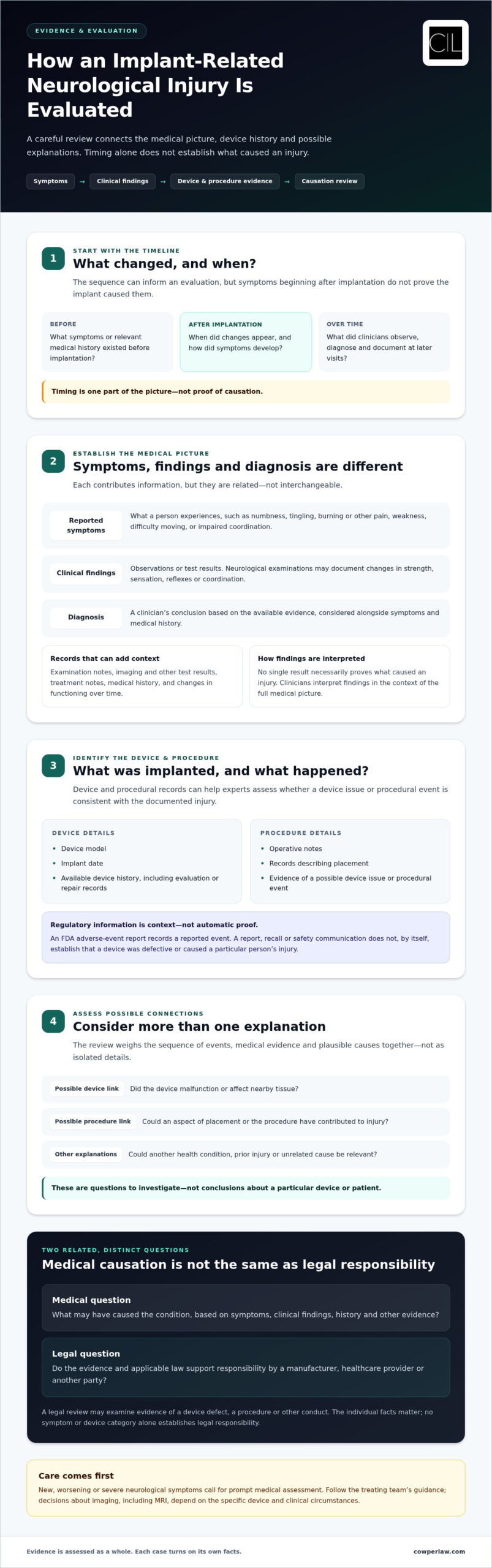
A symptom that appears after implantation can be alarming, but timing by itself doesn’t prove the device caused it. A person may notice a change after a procedure, while another health condition, a prior injury, or an unrelated cause may also be relevant. Medical assessment can help determine what is happening. A separate, evidence-based inquiry is needed to evaluate whether an implant or someone’s conduct contributed to the injury.
Reported symptoms describe what a person experiences; clinical findings are observations or test results; a diagnosis is a clinician’s conclusion based on the available evidence. These are related, but they aren’t interchangeable. For a potential Neurological damage from implant lawsuit, the distinction matters: a patient’s account is important, but it may need to be considered alongside examination notes, test results, and the broader medical history.
People may report numbness, tingling, burning or other pain, weakness, difficulty moving, or impaired coordination. These symptoms can affect ordinary tasks, such as holding an object, walking steadily, or feeling touch in an area. They aren’t a diagnostic checklist, and similar symptoms may have causes unrelated to an implant. New, worsening, or severe neurological symptoms call for prompt medical assessment. Don’t wait to see whether they resolve before seeking appropriate care.
Any possible connection depends on the device, the person, and the circumstances. Questions may include whether the device malfunctioned, whether its placement affected nearby tissue, or whether an aspect of the procedure contributed to injury. These are issues to investigate, not conclusions about a particular device or patient. An implant’s presence near nerves or the spine doesn’t, by itself, establish harm or explain symptoms.
Keeping these distinctions clear helps organize a difficult experience. A clinician evaluates symptoms and possible medical explanations. A legal review examines whether the evidence may connect an injury to a device defect, a procedure, or another party’s conduct. These inquiries overlap, but they serve different purposes. No symptom alone establishes legal responsibility, and no device category inherently causes neurological damage. The individual facts must guide any assessment.
Evaluation means connecting the evidence, not relying on one symptom or one test. Clinicians and legal professionals may consider when symptoms began, how they changed, what diagnosis was reached, which device was implanted, and whether other plausible explanations exist. Together, these details can help clarify whether an injury is medically supported and whether evidence points to a possible connection with the implant, its placement, or the procedure.
Timing can inform a causation analysis, but it can’t establish causation by itself. Symptoms starting soon after implantation may be relevant, but timing must be weighed against medical history, examination findings, and other evidence. Medical causation asks what may have caused the condition. The legal question is whether the evidence and applicable law support responsibility by a manufacturer, a healthcare provider, or another party.
Neurological examinations can document changes in strength, sensation, reflexes, or coordination. Imaging and other tests may help clinicians assess possible causes, while treatment notes can show reported symptoms, diagnoses, and changes in functioning over time. No single result necessarily proves what caused an injury. Clinicians interpret findings in light of symptoms and medical history. Decisions about imaging, including whether an MRI is appropriate, depend on the specific device and clinical circumstances, so follow the treating team’s guidance.
A useful record often establishes a timeline: what symptoms existed before implantation, when changes appeared, what clinicians observed, and how the condition developed. Gaps or differences between records don’t automatically resolve the question, but they may need context. A careful review considers the sequence as a whole rather than isolating one appointment or test result.
Device identification and procedural records can help clarify what was implanted and what occurred during placement. Relevant materials may include the device model, implant date, operative notes, and available device history, such as records of evaluation or repair. These details can help an expert assess whether a device issue or procedural event is consistent with the documented injury. Their significance depends on the individual facts.
Regulatory information can provide context, but it has limits. An FDA adverse-event report records a reported event; it doesn’t, by itself, establish that a device was defective or caused a particular person’s injury. A recall or safety communication also isn’t automatic proof of causation. Verify any device-specific notice or regulatory status against reliable, current information before relying on it.
In a Neurological damage from implant lawsuit, expert review may help interpret medical and device evidence, but no particular test or record guarantees a conclusion. A focused legal review can examine how the timeline, diagnosis, and device history fit together. Cowper Law’s medical device injury representation includes a personalized review of the evidence, without promising a specific outcome.
A potential claim depends on more than a diagnosis or the presence of an implant. The facts must be considered under applicable law, including evidence of injury and a supportable link between that injury and the product or conduct at issue. A Neurological damage from implant lawsuit may raise questions about a device, its placement, medical care, or more than one of these factors. Which questions matter depends on the individual case.
It’s also important to distinguish a concerning event from proof of legal responsibility. A recall, known complication, or FDA adverse-event report may provide context, but none automatically establishes that a device was defective or caused a particular person’s injury. A legal evaluation considers the specific medical and device evidence rather than treating a notice or report as a conclusion. For broader patient-rights context, Cowper Law’s medical device injury lawyer guide explains how these reviews can approach questions of responsibility.
Possible product-related theories may include a design flaw, a manufacturing problem affecting a particular device, or inadequate warnings about risks. Each requires evidence and legal analysis; an allegation alone doesn’t prove a defect. Separately, a procedure-related claim may raise questions about medical care or surgical placement. These theories focus on different conduct and may involve different responsible parties. The available records and applicable law help determine what, if anything, the evidence supports.
That distinction matters. A device may be functioning as intended while a claim raises questions about the procedure, or the concern may focus on the product itself. A careful review avoids assuming either explanation and examines the evidence for each relevant possibility.
An individual claim can focus on one person’s injury, medical history, treatment, and losses. Group litigation may bring together claims that share relevant issues, but it doesn’t erase differences between people’s experiences or establish that any individual qualifies to participate. The appropriate path depends on case facts, procedural requirements, and applicable law, not simply on whether others report similar concerns.
Understanding the difference can help frame useful questions without predicting eligibility or outcome. Cowper Law’s medical device class action guide offers a separate explanation of group litigation and the considerations that may arise.
Ultimately, potential liability turns on the connection among the injury, the device or medical care, and evidence of legally responsible conduct. A personalized review can help identify which issues deserve closer examination. No single report, complication, or diagnosis decides a claim on its own.
Take this one step at a time. Your health comes first, and you don’t need to prove what caused your symptoms before seeking care. If symptoms are severe or worsening, get prompt medical attention rather than pausing to collect paperwork. Once urgent needs are addressed, practical steps can help preserve information for your care team and any later legal review of a Neurological damage from implant lawsuit.
Be specific with your clinician about your symptoms, when they began, your implant history, and changes in daily functioning. You don’t need to interpret the cause yourself. If records are readily available, keep copies together so they’re easier to locate later. Don’t alter or discard records, and don’t attempt to handle, adjust, or remove an implanted device yourself. Medical decisions belong with your treating professionals.
As time passes, it may become harder to recall when symptoms changed or assemble older records and device details. Preserving what’s available can help create a clearer history, but it shouldn’t come before medical care. If you have a spinal cord stimulator, Cowper Law’s spinal cord stimulator recall lawyer guide may offer relevant context about device-related legal review.
Filing deadlines vary by jurisdiction and the facts of a claim. There isn’t one reliable time limit that applies to every implant injury case, and the rules may depend on the legal theory and circumstances. Don’t assume you have unlimited time or rely on a general online estimate. A case-specific legal review can help identify which deadlines may apply.
If you’re ready to discuss the records and circumstances of a possible implant injury claim, request a personalized legal review from Cowper Law. The firm represents people harmed by medical devices and provides individualized advocacy, without promising a particular result.
Uncertainty about an injury’s cause can leave patients facing medical decisions, practical challenges, and difficult questions about what comes next. Cowper Law represents people harmed by medical devices, including people with spinal cord stimulator cases. A legal review examines the individual evidence; it isn’t a promise that a claim will be accepted or produce a particular result.
For a potential Neurological damage from implant lawsuit, the review may bring together medical history, device information, and the changes the injury has made to a person’s life. The aim is to understand which facts may support a legal theory, what remains unclear, and what rules may apply to the claim.
Records can show the course of care and the reported injury. Device history may help identify the implant and any documented concerns. Information about pain, mobility, work, or daily activities can explain the injury’s personal impact. Considered together, these materials may help identify whether additional medical or device information could be relevant.
A legal review also considers possible responsibility. Depending on the facts, questions may involve a product-related issue, medical care, or more than one legal theory. The review can assess the evidence and jurisdiction-specific rules, including filing requirements that depend on the circumstances. It doesn’t determine medical care, guarantee that a lawsuit will be filed, or assure a settlement or verdict. Every case deserves an individual assessment.
Legal questions can feel especially heavy while a person is managing treatment or lasting symptoms. Personalized representation means looking beyond a device label to understand the patient’s records, concerns, and circumstances. It also means explaining the issues clearly and providing advocacy as the legal review develops. When an individual faces a manufacturer with substantial resources, careful preparation and sustained attention to the evidence matter.
Cowper Law collects legal fees only upon successful recovery. That arrangement isn’t a promise of recovery or a prediction that a claim will succeed. It describes when the firm collects legal fees; the merits and possible outcome remain specific to the facts and applicable law.
You don’t need every answer before taking a careful next step. If you want to discuss your circumstances and the available information, discuss your potential implant injury claim with Cowper Law. The conversation can begin with your questions and the evidence you have, without assuming that you qualify or predicting an outcome.
You don’t have to settle every question about your health or legal options before asking for guidance. A next step can be organizing what you know, identifying what remains uncertain, and deciding what support would help you move forward. A Neurological damage from implant lawsuit depends on individual evidence and applicable law, so a careful conversation should clarify possibilities, not promise an outcome.
If you’re considering legal review, think about what you want answered: what information may matter, which issues need closer examination, and what deadlines could apply to your circumstances. You deserve a process that takes your concerns seriously and treats your experience as more than a case file.
Ask Cowper Law to review your implant injury concerns and discuss a thoughtful next step. Keep your health at the center and move at a pace that gives you room to make an informed choice. You don’t have to face the uncertainty alone.
Possibly, if evidence supports an injury connected to a legally responsible party’s conduct or a defective device under applicable law. A Neurological damage from implant lawsuit may involve product-related or procedure-related issues, but symptoms alone don’t establish a claim. For example, records showing a new functional limitation may be relevant alongside medical assessments and device information. A lawyer can review the specific facts and applicable deadlines without promising a particular result.
No. A recall may raise questions about a device or provide context for a review, but it doesn’t prove that the device caused your specific injury or establish legal responsibility. The reason for the recall, the model involved, and your medical circumstances all matter. Keep any recall notice you receive and share it with your treating clinician and legal reviewer. Don’t change treatment based on a notice without medical guidance.
Removal doesn’t automatically prevent a legal review. Records created before, during, and after removal may help explain the device’s history, your symptoms, and the medical reasons for the procedure. If a medical facility is retaining the device or removed components, ask your care team how related records can be obtained. Don’t try to retrieve or handle a device yourself. Whether a claim is possible depends on the evidence and applicable law.
A delay between implantation and symptoms doesn’t automatically rule out a claim, but it can make the timeline and other possible explanations important. A review may consider when symptoms first appeared, whether they changed gradually, and what medical events occurred in between. For example, a later diagnosis or treatment note could help clarify when a problem was recognized. Filing deadlines vary, so don’t assume that delayed symptoms mean there’s unlimited time.
A family member can seek general information, but authority to make decisions or act for another adult depends on the person’s circumstances and applicable law. A valid power of attorney, court appointment, or other legal authority may be relevant, but the correct process isn’t the same in every situation. The patient’s wishes and decision-making ability matter. A lawyer can explain what information is needed to discuss the situation appropriately.
There’s no reliable amount to predict without reviewing the claim, and no recovery is guaranteed. If compensation is available, its assessment may depend on evidence of injury, treatment needs, effects on daily activities or work, and the legal issues involved. Two people with similar devices may have very different circumstances and claims. A legal review can discuss what losses may be relevant without promising a settlement or court award.
It depends on the exact device and its instructions. Don’t assume an MRI is safe or unsafe based only on the device category or another patient’s experience. Before scheduling a scan, tell the ordering clinician and imaging team that you have an implant, and provide the device identification information if available. They can assess the applicable device conditions and decide whether MRI or another imaging approach is medically appropriate.