
What if your loved one’s legal claim didn’t end with their death? A Survival action claim attorney can help the estate assess whether it may pursue claims the person could have brought if they had lived. The distinction matters: a survival action concerns the decedent’s losses, while a wrongful-death claim addresses losses suffered by surviving family members.
It’s understandable to be uncertain about which claim applies, who has authority to bring it, and whether evidence or time-sensitive rights could be lost. These questions can be especially difficult while your family is grieving. Rules depend on the circumstances and state law, so an early, careful review can help clarify the next steps.
This article explains how survival actions differ from wrongful-death claims, who may be able to act for the estate, and which records and questions may matter in an initial review. It also covers how an attorney can help preserve evidence, assess potential claims, and protect the estate’s interests. When a medical device, drug, or another form of negligence may have contributed to a death, experienced, compassionate counsel can provide guidance through a complex process.
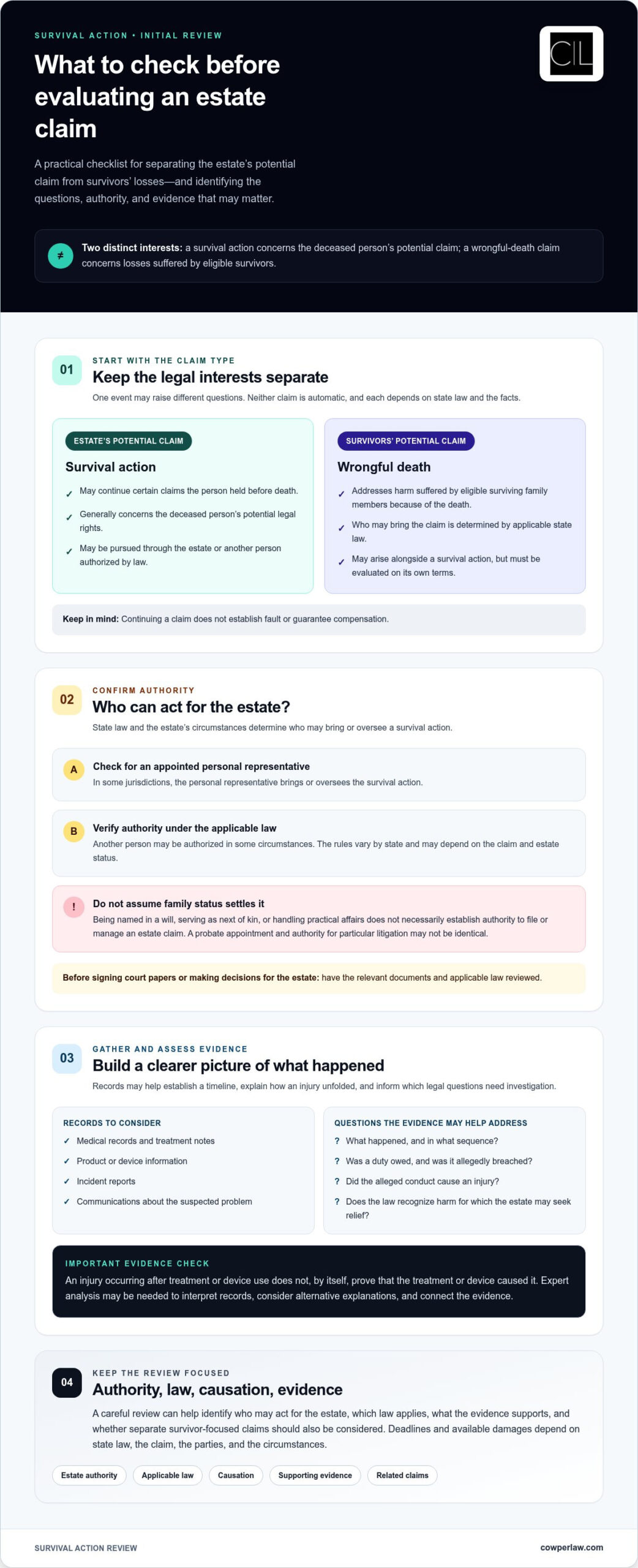
A survival action may allow certain legal claims a person held before death to continue through their estate. In plain language: A survival action concerns the deceased person’s own claim; a wrongful-death claim concerns eligible survivors’ losses. Neither claim is automatic. Whether either can proceed, who may bring it, and what it may cover depend on state law and the facts.
The distinction can be hard to see while a family is grieving, especially when one event may have caused both an injury and a death. But the claims address different interests. Understanding that difference helps families ask clearer questions and avoid treating one claim as a substitute for the other.
A survival action may preserve a claim the person could have pursued if they had lived. For example, someone might suffer an injury, receive medical care, and later die. Depending on the circumstances and governing law, the estate may be able to pursue a claim related to the injury. The fact that a claim continues does not establish fault or guarantee compensation; the legal and factual requirements still need to be assessed.
A survival action generally addresses the deceased person’s potential legal rights, pursued by an authorized representative for the estate. A wrongful-death claim addresses harm suffered by eligible surviving family members because of the death. State law determines who may bring each claim, how the cases proceed, and which damages may be available. Some circumstances may involve both claims, but each must be evaluated on its own terms.
For example, if a person’s injury allegedly resulted from a medical device problem and the person later died, an estate claim and a survivor-focused claim may raise distinct questions. Evidence about the injury and its cause may matter, while the family’s own losses are considered under the rules governing wrongful death. A wrongful death medical device claim guide explains the separate claim that may address eligible survivors’ losses.
These labels describe different legal interests, not guaranteed outcomes. A Survival action claim attorney can help identify which issues belong to the estate, which may concern surviving family members, and whether the facts support further investigation. That distinction matters when a family is trying to protect the deceased person’s potential rights while also understanding its own options.
Before anyone evaluates the merits of a potential survival action, there’s a threshold question: who is legally allowed to act for the estate? State law commonly controls that authority, and the answer may depend on the estate’s status, the type of claim, and procedural rules. A family relationship alone doesn’t necessarily give someone authority to file or manage a claim on the estate’s behalf.
In some jurisdictions, an appointed personal representative brings or oversees a survival action for the estate. Another person may be authorized under applicable law in other circumstances. A probate appointment and authority to pursue particular litigation aren’t always identical, so families shouldn’t assume that being named in a will, serving as next of kin, or handling practical affairs settles the question. A Survival Statute in US Law provides a general explanation of how these laws allow certain claims to continue after a person’s death, though the rules vary by state.
Before signing court papers or making decisions for the estate, have the relevant documents and applicable law reviewed. A Survival action claim attorney can help assess who may act, what steps may be needed to establish authority, and how a survival claim relates to separate claims brought by eligible survivors.
Authority is only one part of the review. The evidence must also support the particular legal theory. Depending on the claim, counsel may examine whether someone owed a duty, whether that duty was breached, whether the alleged conduct caused an injury, and whether the law recognizes harm for which the estate may seek relief. These are questions to investigate, not assumptions about fault or entitlement.
Records can help build a timeline and show how the injury unfolded. Relevant materials may include medical records, treatment notes, product or device information, incident reports, and communications about the suspected problem. In a device-related matter, investigators may need to understand the device’s use, reported symptoms, medical response, and the sequence leading to the death. Medical device injury litigation may involve reviewing these details alongside the applicable legal requirements.
Medical causation can be complex. The fact that an injury occurred after treatment or device use doesn’t, by itself, prove that the treatment or device caused it. Expert analysis may be needed to interpret records, evaluate alternative explanations, and connect the evidence to the legal elements. Proof requirements differ by legal theory and jurisdiction, so no single checklist applies to every case.
Careful review can help a family distinguish unanswered questions from established facts. For personalized legal advocacy involving a potential injury claim, Cowper Law’s legal team can assess the issues and explain possible next steps.
A survival action focuses on potential losses belonging to the deceased person’s claim, while a wrongful-death action addresses losses that eligible survivors may claim under state law. Keeping those interests separate helps an estate assess what evidence to gather and what questions to ask. Any possible recovery depends on the governing law, the facts, and proof supporting the claim.
No category of damages applies automatically in every state or case. Medical expenses or lost wages from before death may be relevant examples for review, but their recoverability depends on the claim and applicable law. Some jurisdictions treat non-economic losses differently, and legal rules can change. Damages claimed by surviving family members belong to the separate wrongful-death analysis, not automatically to the estate’s claim.
A lawyer may examine records of expenses and income related to the period before death, then determine whether the law permits those losses to be pursued through the estate. The amount billed, paid, or documented doesn’t by itself establish that a loss is recoverable. The claim’s legal basis, causation, and any jurisdiction-specific limits all matter. A list of expenses alone can’t establish a settlement value or predict an outcome.
| Question | Survival action | Wrongful-death claim |
|---|---|---|
| Whose interests? | The deceased person’s potential claim, pursued for the estate | Eligible survivors’ legally recognized losses |
| Who may bring it? | A personal representative or another party authorized by applicable law | Survivors identified by the governing law |
| Examples for review | Potential pre-death expenses or income loss, subject to legal review | Potential family losses, as allowed by law |
The examples in this table are starting points, not a checklist of guaranteed damages. The claims may have different rules for proof, procedure, and who can pursue them. A Survival action claim attorney can help sort records and identify which losses may belong to the estate’s claim versus a separate claim by eligible survivors.
Useful materials may include medical charts, bills, test results, incident reports, and information about a product or device involved. Notes or communications that help establish dates and events can also assist an initial review. If records are scattered, make a simple inventory of what exists and where it came from. This can help counsel identify gaps without drawing conclusions prematurely.
Preserve relevant materials and avoid altering or discarding potential evidence. How an item should be stored, whether it can be inspected, and whether it may be admitted in court depend on the evidence and applicable law. In a device-related case, technical or medical causation may be disputed. An attorney may coordinate expert review to assess records, product information, and the timeline together, distinguishing what the evidence shows from what still needs investigation.
Timing can shape what options remain, but there’s no single filing period that applies to every survival action. Deadlines may depend on the state, the type of claim, the parties involved, and the circumstances. A related wrongful-death claim may follow different timing rules or procedures, so don’t assume its deadline automatically governs the estate’s claim.
Survival and wrongful-death claims may arise from the same events yet be subject to separate limitation periods or procedural requirements. The estate’s appointment status, the identity of potential defendants, and facts affecting when a claim began may also matter. Because legal rules can change and depend on jurisdiction, timing should be checked against current, jurisdiction-specific authority rather than a general online estimate.
Prompt review matters. Waiting to identify the right deadline or authorized representative can complicate a case, and evidence may become harder to locate or preserve over time. This isn’t a reason to panic; it’s a reason to get case-specific guidance instead of relying on assumptions.
You don’t need a complete file to begin asking questions. A basic timeline, records already on hand, and information about who has been appointed to represent the estate can give an attorney a useful starting point. If documents are missing, note what’s unavailable and where they may be held. Don’t delay seeking guidance just because you haven’t gathered everything.
A practical early sequence may look like this:
These are practical preparation steps, not a substitute for legal advice or a guarantee that a claim can proceed. Filing requirements and the effect of particular dates depend on the facts and governing law. An early review can help organize the questions, even if the family has only partial records.
If your family needs help understanding possible deadlines or organizing the next steps, discuss your family’s legal questions with Cowper Law.
A focused legal review can help turn scattered questions into a clear plan. A Survival action claim attorney may assess who has authority to act for the estate, which law applies, what evidence needs investigation, and whether related claims should be considered separately. The goal is careful analysis, not an assumed outcome. Families deserve direct answers, steady communication, and an advocate who understands the stakes.
Relevant experience is one useful measure when evaluating counsel. Ask how the attorney approaches estate authority, identifies potentially responsible parties, analyzes causation, and preserves evidence. A thorough review should also explain what remains uncertain and what additional information could help clarify the claim.
Investigation strategy matters, especially if a drug, medical device, or technical product issue may have contributed to an injury or death. Medical records may need to be considered alongside product information, treatment history, and the sequence of events. Counsel may coordinate medical or technical review where causation is disputed, while assessing whether the facts support further investigation under applicable law.
Communication is part of case protection, too. Families should understand who their point of contact is, how updates will be shared, and how decisions will be discussed. Before representation begins, the attorney should explain the proposed scope of work and the written agreement’s terms in language the family can follow.
An initial review can identify potential claims, evidence needs, responsible parties, and timing questions. It isn’t a promise that the estate is eligible to proceed or that a particular result will follow. Cowper Law provides personalized legal advocacy and handles medical-device injury litigation, bringing relevant experience to cases where a device may be part of the facts without presuming it caused harm.
Cowper Law uses a contingency-based model in which legal fees are collected only upon successful recovery. The specific arrangement is governed by the written representation agreement. Read it carefully and ask for clarification about the terms that apply to the case, including how any case-related expenses are addressed. Don’t assume every matter has identical terms or arrangements.
Choosing counsel is a significant decision, particularly while your family is grieving. Clear advice and compassionate, determined representation can help bring structure to a difficult process. Talk with Cowper Law about your family’s situation.
Your family doesn’t need to have every answer before seeking guidance. A thoughtful first conversation can help identify what remains unclear, what information may be useful, and which decisions deserve timely attention. That gives the estate a more considered path forward, without assuming that any particular claim or outcome is guaranteed.
A Survival action claim attorney can provide personalized legal representation when a family is facing difficult questions. Cowper Law’s experience with medical-device injury and wrongful-death litigation can inform a careful review when those issues may be involved. The firm uses a contingency-based model, with legal fees collected only upon successful recovery; the written representation agreement sets out the specific terms.
There’s no need to navigate uncertainty alone. Talk with Cowper Law about your family’s situation and take a steady, informed step toward understanding the options ahead.
No. They are separate legal claims that address different interests, even when they stem from the same event. For example, after a fatal incident, the estate’s claim and a family member’s claim may involve different evidence, legal authority, or damage rules. Identifying the correct claim matters before documents are signed or a settlement is considered, since resolving one claim may not automatically resolve every other potential claim.
Often, a personal representative or another person authorized by state law brings the claim for the estate, but the rules aren’t uniform. A will naming an executor may not, by itself, answer whether that person can file a lawsuit. Families can gather available probate papers and ask counsel to assess who has litigation authority before submitting claim forms or making decisions on behalf of the estate.
Potential recovery depends on the governing law and facts; no category applies automatically. Pre-death medical expenses or lost earnings may be considered, while rules for pain and suffering differ. For example, California survival actions filed on or after January 1, 2026, generally can’t recover the decedent’s pre-death pain, suffering, or disfigurement. Earlier filing periods may be treated differently, so the filing date and current state law warrant close review.
There’s no single nationwide deadline. The applicable period and how it’s calculated can depend on the state, claim, parties, and circumstances. For example, California’s general rule is two years from injury or six months after death, whichever is later, and Maryland’s typical period is three years from the injury leading to death. These are not case-specific deadlines; prompt legal review can help identify the rule that applies.
Sometimes, both claims may be pursued in connection with the same death, if the law and facts support them. The estate’s claim and survivors’ claim still need separate analysis, including who has authority to bring each one and what losses each may address. A lawyer can also assess how filing or resolving one claim could affect the other, rather than assuming they can be treated as a single case.
Fee arrangements vary, so review the written agreement for the terms that apply to your case. Cowper Law uses a contingency-based model: legal fees are collected only upon successful recovery. The agreement governs the specific arrangement, including how case-related expenses are handled. Ask for clear explanations of any terms you don’t understand before signing, so the estate knows how the representation works and what responsibilities it may involve.