
Atrazine’s cancer-risk assessments now point in different directions. In January 2026, the International Agency for Research on Cancer classified atrazine as probably carcinogenic to humans, while an EPA-sponsored Cancer Assessment Review Committee classified it as not likely to be carcinogenic to humans. The chemical atrazine and its link to cancer remain subjects of scientific and regulatory debate.
It’s understandable to want a clear answer when a chemical used in agriculture may also reach water supplies. This article explains what atrazine is, what IARC’s classification means, how it differs from the EPA committee’s assessment, and what the evidence can and cannot establish about cancer risk. It also explains how groundwater and drinking-water contamination fit into the picture, including why finding atrazine in water is not the same as proving that exposure caused an illness.
In January 2026, IARC classified atrazine as probably carcinogenic to humans. That classification describes a hazard, not the likelihood that a particular person will develop cancer.
The International Agency for Research on Cancer (IARC) places chemicals into categories based on evidence about their potential to cause cancer. Its January 2026 classification of atrazine as probably carcinogenic to humans signals a concern grounded in scientific evaluation, but it doesn’t calculate an individual’s risk from a specific exposure. The distinction matters: a hazard classification alone cannot establish that atrazine caused someone’s cancer or other illness.
The agencies’ conclusions differ. An EPA-sponsored Cancer Assessment Review Committee classified atrazine as not likely to be carcinogenic to humans, while IARC’s January 2026 assessment classified it as probably carcinogenic to humans. The U.S. EPA’s separate reviews in 2003 and 2018 also concluded that available evidence didn’t support a relationship with human cancers. These evaluations reflect differing assessments of evidence, not a finding about any individual case.
IARC’s previous assessment, in 1998, said atrazine was not classifiable as to its carcinogenicity to humans. The shift to its 2026 classification is important, but it doesn’t mean every exposure causes cancer, reproductive harm, or defects. An EPA spokesperson said IARC would publish detailed scientific reasoning in late 2026 or 2027, providing further context for understanding the assessment.
In the United States, atrazine has been widely used since the 1960s, particularly on corn crops. About 70 million pounds are applied to fields every year. People who apply atrazine, work around treated fields, or live near agricultural areas may have more opportunity for exposure, including through runoff reaching water sources.
Beyond cancer, reproductive toxicity is a health concern. California listed atrazine as a chemical known to cause reproductive toxicity in 2016. That classification concerns reproductive health; it doesn’t identify a specific symptom checklist for every exposed person. IARC’s cancer category also doesn’t establish that atrazine caused an individual’s cancer or birth defects.
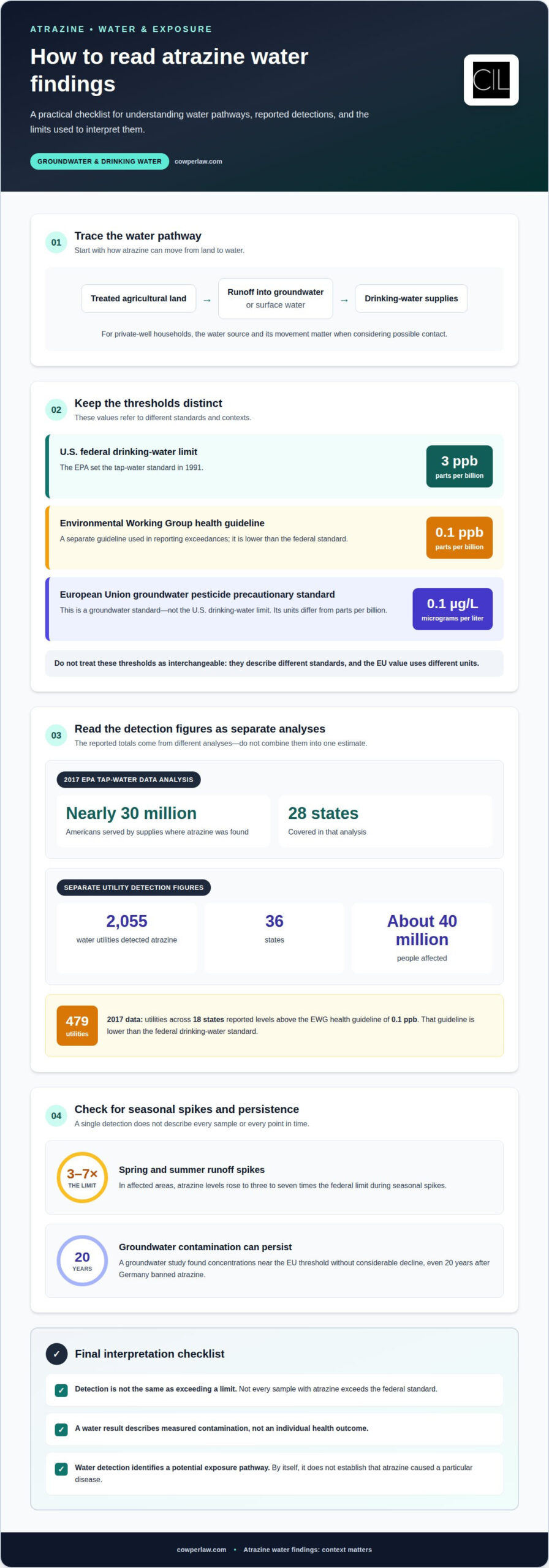
Atrazine can move from treated land into groundwater and surface water, then reach drinking-water supplies. Atrazine can be detected in groundwater in the United States. That finding describes detection, not the amount in every well or a person’s total exposure. For households using private wells, the source and movement of water matter when considering possible contact with this pesticide.
The federal drinking-water limit for atrazine is three parts per billion. The EPA set its tap-water standard in 1991. A 2017 analysis of EPA tap-water data found atrazine in supplies serving nearly 30 million Americans across 28 states. Separately, 2,055 water utilities in 36 states detected it, affecting about 40 million people. These figures describe different analyses and should not be combined as one estimate.
Detection doesn’t mean every sample exceeds the federal limit. Seasonal runoff can change concentrations: in affected areas, atrazine levels rose to three to seven times the limit during spring and summer spikes. In 2017 data, 479 utilities across 18 states reported levels above the Environmental Working Group’s health guideline of 0.1 parts per billion. That guideline is lower than the federal standard, so the two thresholds answer different questions.
The European Union groundwater pesticide precautionary standard is 0.1 µg/L. It is a groundwater standard, not the U.S. drinking-water limit, and the units differ: micrograms per liter versus parts per billion. A groundwater study also found concentrations near that EU threshold without considerable decline, even 20 years after Germany banned atrazine. These findings show why contamination can persist after use ends. Water detection alone doesn’t establish that atrazine caused a particular disease; it identifies a potential exposure pathway for further evaluation. IARC’s “probably carcinogenic” classification concerns cancer hazard, while a water result describes measured contamination, not an individual health outcome.
The chemical atrazine and its link to cancer remain subjects of scientific study. Current evidence doesn’t establish definitively whether atrazine causes cancer in humans. U.S. EPA reviews in 2003 and 2018 found that available evidence didn’t support a relationship between atrazine exposure and human cancers. IARC’s January 2026 classification differs, but a hazard category doesn’t prove that exposure caused a particular diagnosis.
A 2024 study of over 53,000 pesticide applicators found suggestive associations between atrazine and lung cancer and non-Hodgkin lymphoma. It also reported risks involving prostate cancer, soft-tissue sarcoma, pharyngeal cancer, and kidney cancer. These findings make occupational exposure an important area of research, but an association alone can’t show that the herbicide caused an individual’s disease.
Other studies have examined possible biological pathways. Research published in Ecotoxicology and Environmental Safety reported that atrazine promoted breast cancer development in study settings. The researchers described reduced immune-cell stimulation and function, alongside increased levels of enzymes involved in tumor development. A related report described faster tumor-cell cycling and growth, reduced lymphocyte infiltration, and changes in cytokine production. These findings suggest possible mechanisms, but do not prove that atrazine causes cancer in humans.
Understanding the chemical atrazine and its link to cancer also means distinguishing group-level evidence from an individual’s circumstances. Animal and laboratory research can help identify biological effects, while studies of people examine whether exposure patterns are associated with disease. Neither type of evidence alone establishes cause. Exposure duration, route, and level affect what a study can show and how closely its findings may relate to an individual.
If you’re considering whether an exposure history and cancer diagnosis may support a legal claim, review your potential legal options.
Atrazine exposure has been described as a disproportionate risk to women. Limited human and animal data suggest a possible link between atrazine exposure and various types of cancer, but do not establish that atrazine causes cancer.
Atrazine’s regulatory history shows why authorization and cancer classification answer different questions. The U.S. EPA reapproved atrazine for continued use in October 2025, while IARC’s assessment addresses cancer hazard. Neither decision determines whether a particular person’s cancer resulted from exposure. The distinction matters when interpreting agency actions alongside research findings and an individual’s history.
Between 2009 and 2011, the EPA held five Scientific Advisory Panel meetings to peer review atrazine’s cancer potential. Those meetings show that evaluating an herbicide involves scientific review, not a single test or finding. Separately, advocacy groups sued the EPA in 2020 over its reapproval of atrazine use. The lawsuit reflects continuing debate about how the agency weighs environmental risks and evidence.
Research involving pesticide-plant workers adds another part of that history. Syngenta research conducted more than 20 years ago found high rates of cancer among the company’s pesticide plant workers. That finding is relevant to occupational concerns, but it doesn’t by itself establish which chemical caused those cancers. Exposure records, work tasks, and other potential sources all matter when interpreting a workplace study.
For an individual, reconstructing exposure means identifying where and how contact could have occurred. Examples include handling atrazine as an applicator, working near treated fields, or living where groundwater or drinking water could be affected. Those circumstances suggest different exposure routes and patterns; they aren’t interchangeable. A careful review distinguishes documented use from assumed contact and considers the timing of exposure alongside the diagnosis. The 2024 applicator study discussed earlier offers one example of research examining cancer patterns in people who applied pesticides. Such studies inform the broader evidence, but the population-level finding cannot alone resolve an individual case.
California OEHHA announced its intent to list atrazine as a known carcinogen under Proposition 65. Nov. 9 marks the public-comment deadline; Proposition 65 is part of the Safe Drinking Water and Toxic Enforcement Act of 1986.
Understanding the chemical atrazine and its link to cancer is one part of that process. Cowper Law handles Atrazine Cancer Lawsuit cases involving alleged atrazine-related harm. Whether a claim may apply depends on the circumstances and evidence in the individual case.
Cowper Law can discuss your concerns and help you understand possible next steps. Contact Cowper Law to discuss your concerns. You don’t have to sort through complex questions alone; a clear conversation can help you decide how to move forward.
Atrazine is a synthetic herbicide used to control weeds in agriculture, including corn production. Scientists at CIBA-GEIGY invented it in 1958, and it has been widely used in the United States since the 1960s. Its use on agricultural land matters because rainfall and water movement can carry residues beyond treated fields into nearby streams or groundwater.
Yes. The EPA’s federal drinking-water standard for atrazine is three parts per billion, and the standard was set in 1991. It provides a benchmark for public drinking-water supplies, not a measure of whether a particular person will develop an illness. The EPA reapproved atrazine for continued use in October 2025, a separate decision from setting a water standard.
Start by identifying whether your household water comes from a public utility or a private well. Public-water customers can review available water-quality reports and ask about atrazine testing. For a private well, arranging water testing can help determine whether atrazine is present. Keep test results and dates together to make changes easier to track over time.
Medical tests can detect atrazine in blood and some other body tissues within 24 to 48 hours after the last exposure. However, those tests can’t predict whether someone will experience health effects. A result therefore cannot establish whether atrazine caused a later diagnosis. If exposure is a concern, share the possible timing and route with a healthcare professional.
Keep water-quality reports and note the sample dates, reported atrazine levels, and whether results describe a single test or a longer monitoring period. If a report is difficult to interpret, ask the water utility what its results mean for your household supply. For people relying on private wells, testing provides information that public-utility reports cannot.
In soil, atrazine may break down over days to months, but it can also move with water. Rainfall and runoff can carry residues into streams, while infiltration can transport them toward groundwater. The route depends on conditions such as soil type and water movement. Finding atrazine in water shows contamination, but does not by itself establish an individual’s exposure level or health outcome.