
If you’ve been diagnosed with non-Hodgkin lymphoma and exposed to atrazine, continue your medical care, document your exposure history, and preserve records that may help clarify the circumstances. Exposure alone does not prove what caused your illness. Start by organizing the dates, locations, and details you remember about possible contact with atrazine.
It’s understandable to want clear answers about what exposure means for your health and legal options. This article explains what atrazine is, how people may encounter it, and what research says about its potential health effects and possible relationship to non-Hodgkin lymphoma. It also explains why exposure details and medical records matter as you consider your next steps.
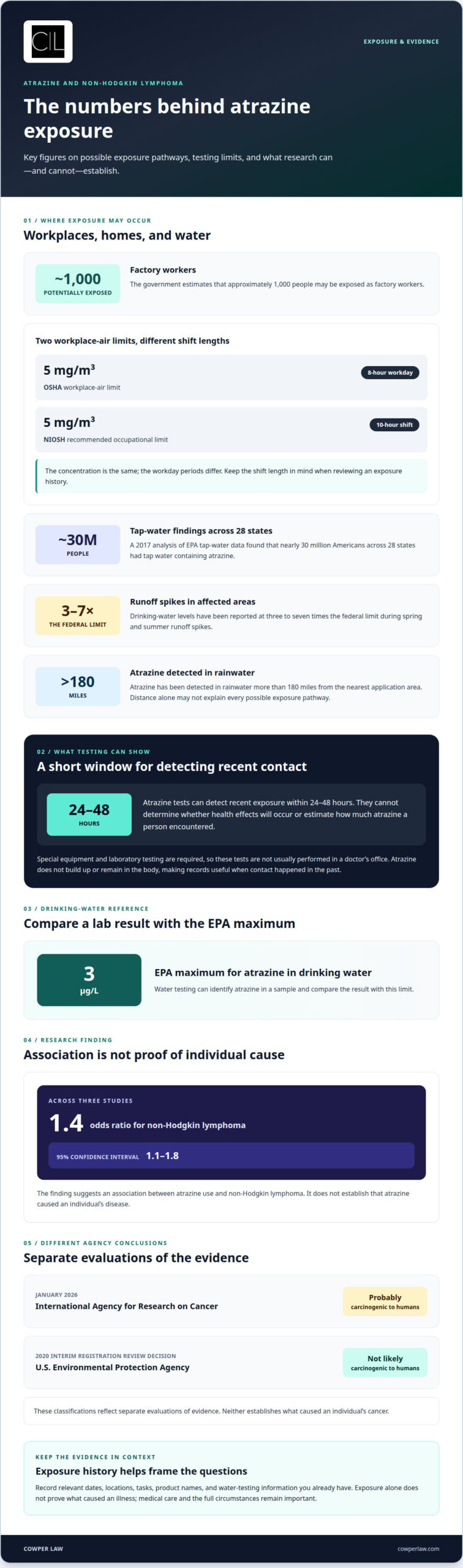
People who manufacture or handle atrazine may encounter it at work. The government estimates that approximately 1,000 people may be exposed as factory workers. OSHA set a workplace-air limit of 5 mg of atrazine per cubic meter for an 8-hour workday. NIOSH recommends an occupational exposure limit of 5 mg per cubic meter of workroom air during a 10-hour shift. These limits use different workday periods, so the distinction matters when reviewing an exposure history.
After learning of possible exposure, write down the job, worksite, dates, tasks, and product names you remember. Preserve employment records, safety documents, and any exposure reports. For pesticide exposure in the United States, call Poison Control at 800-222-1222 for additional treatment advice. If the exposure occurred at work, record the circumstances and any protective equipment used; those details can help clarify how contact may have happened.
Exposure can also happen at home. Atrazine may enter drinking water where it has been applied to nearby crops. A 2017 analysis of EPA tap-water data found that nearly 30 million Americans across 28 states had tap water containing atrazine. If you suspect a residential source, note where you lived, the relevant dates, nearby agricultural activity, and any water-testing records you already have.
Atrazine is not the only chemical exposure that may appear in an occupational history. Solvents such as trichloroethylene are a separate exposure to document, not a substitute for evidence about atrazine. A 2007 study in Germany found about double the risk of malignant lymphoma among people exposed to chlorinated hydrocarbons such as trichloroethylene. That finding concerns a different chemical group and does not establish what caused an individual cancer.
Keep your account factual: note what was applied, where contact may have occurred, and how often your work or residence brought you near it. Exposure records can support a careful evaluation, but they do not by themselves establish that a chemical caused cancer or caused it in a particular person.
Pesticide exposure may occur during agricultural work, application, or through environmental runoff. Research examines whether these exposure pathways are associated with lymphoma, while a detailed exposure history helps put the evidence in context.
An oncology discussion connects your treatment history with possible environmental or occupational exposures. Ask whether atrazine exposure changes any part of your care, what exposure details belong in your medical record, and whether testing could help. Atrazine tests can detect recent exposure within 24-48 hours, but cannot determine whether health effects will occur. A clear account of work, residence, and contact supports a more informed conversation.
Reporting suspected pesticide exposure creates a record of the incident and can help direct immediate questions. For pesticide exposure in the United States, Poison Control at 800-222-1222 can provide additional treatment advice. For suspected exposure connected to work or nearby agricultural activity, record the location, date, product name, and circumstances, then report them to the relevant workplace or local health authorities.
Atrazine is a Restricted Use Pesticide in the United States, meaning only certified pesticide applicators can use it. When reviewing who applied a pesticide and where contact may have occurred, keep product labels or application records if available. Note whether possible exposure involved fields, equipment, or a nearby residence.
Runoff can carry atrazine from treated fields into water. Levels in drinking water in affected areas have been reported at three to seven times the federal limit during spring and summer runoff spikes. Atrazine has also been detected in rainwater more than 180 miles from the nearest application area, showing why distance alone may not explain every possible pathway.
Studies offer evidence to evaluate, not a diagnosis of cause. Across three studies, atrazine use was associated with an odds ratio of 1.4 for non-Hodgkin lymphoma, with a 95% confidence interval of 1.1-1.8. The finding suggests an association, but does not establish that atrazine caused an individual’s disease. For a case-specific legal evaluation, explore atrazine cancer lawsuit information.
Atrazine’s possible health effects are assessed differently across agencies and studies. The EPA maximum for atrazine in drinking water is 3 µg/L; water testing can identify atrazine in a sample and compare the result with that limit.
Health evidence includes different findings, so an agency’s conclusion should be understood in context. In January 2026, the International Agency for Research on Cancer classified atrazine as probably carcinogenic to humans. The U.S. EPA concluded in its 2020 interim registration review decision that atrazine is not likely to be carcinogenic to humans. Those classifications reflect separate evaluations of evidence and do not establish the cause of an individual’s cancer.
Research also examines effects beyond cancer, including possible reproductive and hormonal changes. A 2024 study cited by IARC found oxidative stress and severe hormone disruption in male rats exposed to atrazine. Animal findings can identify areas for further study, but they do not by themselves show that people will experience the same effects. For a patient, the exposure route and timing remain important context.
Testing has limits, too. Atrazine exposure tests can detect recent exposure within 24-48 hours, but cannot estimate how much atrazine a person encountered or predict adverse health effects. Special equipment and laboratory testing are required, so these tests are not usually performed in a doctor’s office. Atrazine also does not build up or remain in the body, making exposure records valuable when contact occurred in the past.
For drinking water, compare a laboratory result with the EPA maximum of 3 µg/L. If atrazine is detected, EWG advises installing a filter certified to remove atrazine. Keep the result and its date with other exposure records, since a water measurement describes the sample tested, not a person’s lifetime exposure.
If you’re weighing how exposure evidence relates to a diagnosis, discuss an atrazine cancer lawsuit and the records that may inform an evaluation.
Research examines whether atrazine exposure is associated with non-Hodgkin lymphoma, but an association does not prove what caused one person’s cancer. If you’re asking what to do after being diagnosed with non-Hodgkin lymphoma and exposed to atrazine, keep your medical care and exposure documentation moving forward together. Research findings can inform questions, while your exposure history and medical records provide individual context.
Farming studies report different estimates. In Kansas, atrazine use among farmers was associated with an odds ratio of 2.7 for non-Hodgkin lymphoma. The Nebraska study reported 1.4, while the Iowa study reported 1.2. After adjustment for 2,4-D and organophosphate insecticide use, the odds ratio among atrazine-using male farmers was 1.2, with a 95% confidence interval of 0.9-1.7. These differences show why study populations and other exposures matter when interpreting results.
Exposure duration and route also shape the evidence. In Nebraska, farmers who used atrazine for more than 15 years had an approximately twofold increased risk. A University of Nebraska-Lincoln study reported elevated risk among people whose drinking water contained both atrazine and nitrate. For someone wondering what to do after a lymphoma diagnosis and possible atrazine exposure, distinguish occupational use from drinking-water contact in the personal exposure history. Neither study finding establishes the cause of an individual’s illness.
Atrazine exposure alone does not determine non-Hodgkin lymphoma prognosis or treatment. Those decisions depend on the diagnosed lymphoma and the patient’s clinical findings. Reproductive or animal research addresses different questions and cannot replace evidence about human lymphoma outcomes. The U.S. Environmental Protection Agency and other research organizations assess evidence for distinct purposes, so consider their conclusions in context.
To prepare for an evaluation, gather dates, locations, job duties, product names, water records, and diagnosis documents. Note the suspected exposure route and duration, and keep these materials together for medical and legal discussions. This can clarify what is documented, what remains uncertain, and which questions need careful attention. Beyond legal and medical preparations, individuals dealing with serious health diagnoses or occupational risks often evaluate financial protections; services like Special Risk Term assist in securing life insurance for those with pre-existing conditions or high-risk work histories.
Living with lymphoma is demanding, and unanswered questions about past exposure can add another burden. If you’re considering what to do after a non-Hodgkin lymphoma diagnosis and possible atrazine exposure, put the timelines together: when and where exposure may have occurred, and when diagnosis and treatment began. Cowper Law represents people harmed by drug and medical device injuries, and can review the available records and circumstances as part of a legal evaluation. Whether a claim may be available depends on the facts and applicable state law.
Cowper Law handles atrazine cancer lawsuit matters. The next step is a conversation about your circumstances and the documentation you have, so you can understand whether pursuing a legal claim makes sense for you. Contact Cowper Law to discuss your atrazine exposure and diagnosis.
You deserve a careful hearing and a clear explanation of your options. When you’re ready, contact Cowper Law to discuss your situation and the records you have gathered.
Atrazine is a herbicide used to control weeds on agricultural crops. It was first registered for use in 1958 and is applied to crops including corn. Its presence in a community or work history can prompt questions about exposure, but the chemical’s use alone doesn’t establish that a particular person encountered it. The product name, task, location, and timing help make an exposure account more specific.
Atrazine can enter through drinking water or skin contact, and most metabolites leave the body in urine within 24-48 hours. In a study of skin exposure, about 6% of an atrazine dose left on human skin for 24 hours was absorbed. These findings describe particular exposure routes and measurements; they don’t establish how much any individual absorbed. Record the suspected contact date and route for medical discussions.
Some agricultural studies have reported an association between atrazine use and non-Hodgkin lymphoma, but an association doesn’t prove that exposure caused an individual’s cancer. Evaluations differ: IARC classified atrazine as probably carcinogenic to humans in January 2026, while the U.S. EPA’s 2020 interim registration review concluded it is not likely to be carcinogenic to humans. Consider exposure records and medical history together.
Laboratory tests can detect recent atrazine exposure, generally within 24-48 hours. They cannot determine whether health effects will occur or estimate the amount of atrazine encountered. Special equipment and laboratory testing are needed, so the test isn’t usually performed in a doctor’s office. If testing is considered, the suspected exposure date and route are useful context for interpreting what a result can show.
Lymphoma develops when lymphocytes, a type of white blood cell, grow abnormally. A single cause may not be identifiable in an individual case, and an exposure history alone cannot establish why lymphoma developed. Research has examined possible associations with pesticides and other exposures, but findings vary across studies. The lymphoma type, medical records, and full history provide essential context for discussing an individual diagnosis.
Atrazine is an agricultural herbicide. People may encounter it through occupational contact or contaminated drinking water near treated crops. For example, someone might handle products during pesticide work or live where runoff reaches water sources. Keep available product labels, employment records, and water-test reports together. These documents can help distinguish a suspected exposure route from a confirmed exposure history.