
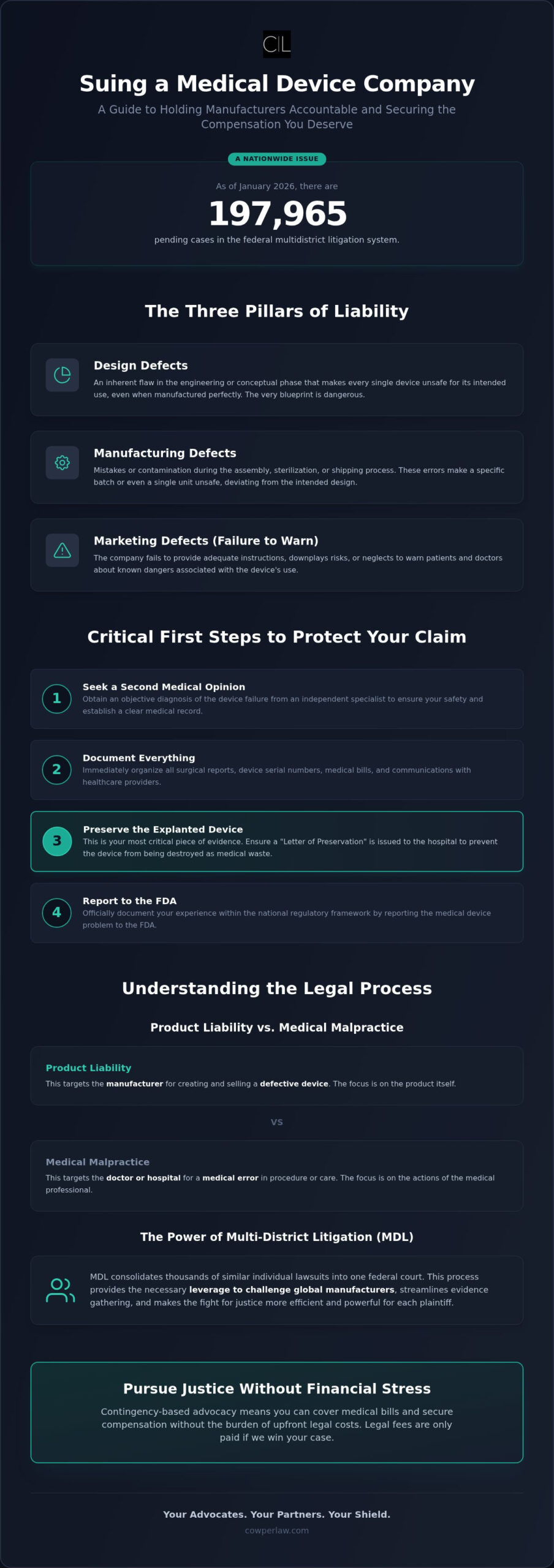
As of January 2026, there are 197,965 pending cases in the federal multidistrict litigation system, a staggering number that represents thousands of individuals fighting for their dignity. You likely feel the weight of these statistics every day through chronic pain, the stress of unexpected revision surgeries, and the frustration of being ignored by the very companies that promised you relief. Suing a medical device company is not just a legal filing; it's a structured battle to transform your personal tragedy into an undeniable evidentiary record. We understand the physical, financial, and emotional toll this takes on a family.
We are your advocates, your partners, and your shield against powerful corporations. In this guide, you'll learn the exact legal process for holding manufacturers accountable and securing the compensation you deserve to pay your medical bills. We'll walk through the impact of the 2026 FDA Quality Management System Regulation, the reality of federal court filing fees, and the strategic path to a trial-ready case. You deserve a future defined by stability, justice, and peace of mind.
Establishing the legal foundation is the first step in your journey toward accountability. When you're considering suing a medical device company, you aren't just fighting for a settlement; you're demanding that a corporation answers for the failure of its technology. Under the principles of product liability law, manufacturers are held to a high standard of safety because the consequences of their errors are personal, physical, and often permanent. We believe that no individual should carry the financial and physical burden of a corporate oversight.
To hold a manufacturer responsible, we focus on three specific areas where a device can fail. A design defect is an inherent flaw that makes a device unsafe for its intended use even when manufactured perfectly. This means the very blueprint of the device is dangerous from the start. For example, many individuals pursuing a hernia mesh revision surgery lawsuit argue that the base material of the mesh was fundamentally incompatible with human tissue, leading to unavoidable complications regardless of how well the surgery was performed.
You don't always have to prove the company was "careless" in the traditional sense. Most states apply strict liability in these cases. If the product is defective and that defect caused your injury, the company is liable regardless of their intent or internal safety protocols. This legal standard exists to protect the individual. It ensures that the burden of safety remains with the multi-billion dollar entity rather than the vulnerable patient.
An FDA recall acts as a powerful signal, but it's not a prerequisite for your claim. While a Class I recall—the most serious type indicating a high risk of death or injury—provides strong evidence of a defect, many successful lawsuits involve devices that were never officially recalled. We look beyond the regulatory labels to find the truth. You can check the FDA’s database for your specific lot number to see if your device has been flagged. However, don't be discouraged if your device isn't on the list. A lack of a recall often means the company hasn't been forced to admit the flaw yet. We are meticulous, strategic, and relentless in uncovering those hidden failures through expert testimony and internal document review.
Your health is the absolute priority. When a medical device fails, the physician who performed the original implantation may be hesitant to acknowledge a defect or admit a complication occurred. Seeking a second opinion from an independent specialist is often necessary to obtain an objective diagnosis of the failure and to ensure your physical safety. This medical transition provides the foundation for your recovery and your legal claim. Taking these proactive steps is vital before officially suing a medical device company, as it establishes a clear medical record outside of the manufacturer's influence.
We are here to help you find order, clarity, and strength during this chaotic time. Beyond medical care, you must begin organizing your digital documentation immediately. This includes surgical reports, device serial numbers, and every communication you have had with medical providers. It is also critical to report medical device problems to the FDA to ensure your experience is documented within the official regulatory framework. The physical device is often the most important piece of evidence in a product liability case.
If you require revision surgery, the device removed from your body becomes the most significant asset in your case. Hospitals frequently treat explanted hardware as medical waste and destroy it shortly after surgery. We prevent this by issuing a formal "Letter of Preservation" to the facility. You should never leave the hospital without confirming where the device is stored and ensuring it has been tagged for preservation. A detailed pathology report is equally essential; it provides the scientific proof that the device caused specific tissue damage, inflammation, or systemic toxicity. If you are unsure how to navigate these hospital protocols, our team provides specialized legal advocacy to ensure no evidence is lost.
While medical records provide the facts, a pain and symptom journal provides the human story. We encourage you to track your daily limitations, pain levels, and emotional distress with meticulous care. This record demonstrates the profound impact the injury has had on your quality of life, including lost wages and the strain placed on your family. Use photos and videos to document physical changes, surgical scars, or mobility issues that medical charts might fail to capture fully. This journal transforms abstract legal claims into a vivid, undeniable account of your journey toward justice. We use these details to build a case that is intellectually formidable and emotionally resonant.
Understanding who is truly responsible for your suffering is a pivotal moment in your legal journey. Many patients initially assume their surgeon made a mistake, but often the fault lies deep within the corporate boardroom of the manufacturer. When you're considering suing a medical device company, you're stepping into the legal definition of products liability, which focuses on the safety and integrity of the device itself. This is fundamentally different from medical malpractice, which centers on a healthcare professional's failure to meet a standard of care. Identifying the correct defendant is not just a technicality; it's the difference between a dismissed claim and a path toward justice.
Manufacturers frequently employ the "Learned Intermediary" defense to shield themselves from accountability. They argue that because they provided technical warnings to your doctor, any failure to inform you of the risks is the doctor's fault. We are experts at piercing this corporate shield. By suing the manufacturer, we gain access to internal testing data, safety memos, and clinical trial results that are otherwise hidden from the public. This discovery process allows us to prove the device was destined to fail long before it ever reached the operating room. We are focused, strategic, and relentless in following the evidence wherever it leads.
Distinguishing between a surgical error and a device failure requires a high level of technical scrutiny. A doctor may be liable if they committed a specific error during implantation or if they failed to screen you for known contraindications. For instance, if a surgeon recommends a device that is clearly inappropriate for your specific medical history, the claim may shift toward malpractice. We work with medical experts to review your surgical records and determine the root cause of your complications. If your case involves complex medical negligence, you need a trial lawyer for injured patients who understands how to navigate the intersection of medical care and product failure.
A manufacturer is responsible when they prioritize profits over patient safety. This often manifests as concealing adverse event reports from the FDA or engaging in off-label promotion. In 2026, we see these patterns frequently in high-stakes litigation where companies encourage doctors to use devices in unapproved and dangerous ways. A clear example of this trend is the breast implant illness lawsuit movement, where evidence suggests manufacturers were aware of systemic risks but failed to provide adequate warnings. We believe in holding these entities accountable for every hidden risk and every misleading claim. Our mission is to provide you with the clarity, direction, and justice you deserve.
Suing a medical device company is a marathon that requires endurance, precision, and an unyielding commitment to the truth. Once we file your claim, the process transitions into a rigorous initial investigation phase. We meticulously review thousands of pages of medical records, surgical notes, and device history logs to build an undeniable evidentiary record. This isn't just about filing paperwork; it's about constructing a narrative of corporate failure that can withstand the scrutiny of a multi-billion dollar legal team. We take this burden off your shoulders so you can focus on healing.
Most individual claims are eventually consolidated into Multi-District Litigation (MDL). As of early 2026, the federal system manages nearly 200,000 pending cases across various dockets. This centralization allows us to pool resources with other firms to confront the manufacturer more effectively. During the discovery phase, we force the corporation to hand over internal emails, safety memos, and testing results that they've fought to keep secret. This is where the "David vs. Goliath" battle becomes real, as we hunt for the "smoking gun" that proves they knew the device was dangerous. If you're ready to hold these entities accountable, our trial-ready team is prepared to fight for you.
The duration of a case depends on the complexity of the device and the manufacturer's willingness to accept responsibility. You can consult our comprehensive guide on how long does a medical device lawsuit take for a detailed month-by-month breakdown of the process. A critical part of this timeline is the "Bellwether Trial" phase. These are a handful of representative cases chosen to go to trial first. The results of these trials set the tone for the entire group, often determining the value of settlements and providing the leverage needed to secure a fair outcome for all plaintiffs. We prepare every case as if it's going to trial because that's the only way to ensure the manufacturer takes your injury seriously.
Time is your most silent and dangerous opponent. The statute of limitations is a strict deadline that, if missed, permanently bars your right to seek recovery. In most cases, the clock starts ticking the moment you "should have known" the device was the cause of your injury. This is known as the discovery rule, and it's a nuanced area of law that requires immediate attention. Waiting too long can be a catastrophic mistake, especially as companies often argue that your symptoms were unrelated to their product. We recommend referencing the statute of limitations for drug injury lawsuit for similar time-sensitive rules that may apply to your situation. We act quickly to preserve your rights and ensure your voice is heard before the window of opportunity closes.
Suing a medical device company is a deeply personal journey that requires more than just legal expertise; it requires a partner who is emotionally and intellectually invested in your recovery. We are not a high-volume practice that treats clients like case numbers. Instead, we are a dedicated team of advocates who provide the personalized, sophisticated, and durable support you deserve during what is often the most challenging time of your life. We combine elite trial strategies with a fierce sense of moral conviction to ensure that powerful corporations are held accountable for the harm they've caused. Our mission is to transform your struggle into a catalyst for change.
The legal industry is often filled with "settlement mills"; firms that prioritize volume and quick resolutions over the individual needs of the patient. We take a different, more meticulous path. We prepare every single case for the possibility of a jury trial from day one. This reputation for litigation readiness is our greatest strength; it forces manufacturers to take your claim seriously because they know we don't back down from a fight. This proactive stance provides you with the peace of mind, stability, and confidence needed to navigate a complex, multi-year battle. You aren't just hiring a passive advisor; you're partnering with a relentless defender who refuses to yield until justice is served.
We believe that your access to justice should never be limited by your bank account. Our firm operates on a contingency fee for medical device lawsuit model, which means you pay nothing unless we win your case. We shoulder the entire financial burden of the litigation, including the costs for world-class expert witnesses, comprehensive medical record retrieval, and necessary court filing fees. This allows you to focus on your physical rehabilitation without the added stress of out-of-pocket legal expenses. We are here to provide the protection and capability you need to face a powerful adversary.
When we evaluate potential outcomes, such as hernia mesh lawsuit settlement amounts, we utilize a meticulous evaluation checklist to ensure every future medical need is accounted for. We look at lost wages, ongoing pain management, and the potential necessity for multiple future surgeries. Your first step toward holding a negligent company accountable begins with a free initial consultation. During this conversation, we listen to your story, evaluate the merits of your claim, and provide the steady, reassuring guidance you need to move forward. We are ready to stand with you as a constant companion from the beginning to the end of this journey.
You've endured enough silence and pain. Moving forward with suing a medical device company is the definitive path to transforming your hardship into an undeniable record of corporate accountability. By preserving your physical evidence, identifying the correct manufacturer, and navigating the 2026 litigation landscape with strategic precision, you reclaim the narrative of your recovery. We are here to ensure you never walk this complex path alone. Our firm provides the intellectual strength and emotional support necessary to challenge multi-billion dollar entities on a national stage.
We operate on a contingency-fee basis, which means you benefit from elite representation with no recovery and no fee. Our experienced trial lawyers are dedicated to securing the justice and financial stability required to cover your medical bills and future care. You deserve a partner who is as relentless in the courtroom as they are compassionate with your family. Take the first step toward the peace of mind you've lost. Contact Cowper Law for a Free, Compassionate Case Evaluation today. You have the strength to fight back, and we have the total capability to win.
Yes, you can proceed even without an official FDA recall. Recalls often happen only after significant litigation has already exposed a defect to the public. We investigate internal corporate data to find proof of failure that the manufacturer might still be hiding from regulators. If your implant has caused physical pain or required revision surgery, the absence of a recall doesn't diminish your right to seek justice.
You don't pay any out of pocket costs when suing a medical device company through our firm. We operate on a contingency-fee model, which means our legal fees are only collected if we successfully recover damages for you. We shoulder the heavy financial burden of expert witness fees, medical record retrieval, and court filings. This ensures you can focus entirely on your physical recovery while we fight the corporate giants on your behalf.
You may still have a valid claim even if your surgery occurred many years ago. Most states follow the "discovery rule," which means the statute of limitations clock starts when you first realized the device was the cause of your injury. Because some defects, like those in hernia mesh or spinal cord stimulators, take years to manifest, the law often provides a window for late discovery. We help you navigate these complex deadlines.
There is no universal "average" settlement because every injury and every life impacted is unique. Compensation is calculated based on your specific medical bills, lost income, and the profound level of pain and suffering you've endured. We focus on a results-first framing, ensuring that any settlement or jury award covers your long term care needs. We refuse to treat your tragedy as a simple statistic or a high-volume case.
Most medical device cases are resolved through settlement negotiations, but we prepare every case to go before a jury. You might be required to give a deposition, which is a formal statement under oath. We stand by you as a constant companion throughout this process, providing the coaching and emotional support needed for these moments. Our reputation for being trial-ready often forces corporations to offer fair settlements without a courtroom battle.
You can certainly pursue claims against both the surgeon and the manufacturer if both contributed to your injury. This often involves a combination of medical malpractice and product liability law. We meticulously review your operative reports to determine if your complications stemmed from a surgical error, a fundamental device defect, or a combination of both. Identifying all negligent parties is essential for securing the total compensation you deserve for your recovery.
If a manufacturer files for bankruptcy, your claim typically moves into a specialized bankruptcy trust or is handled through their insurance carriers. This can alter the litigation timeline, but it doesn't mean your journey for justice is over. We have the expertise to navigate these complex corporate restructurings, ensuring your voice is still heard and your claim is properly filed within the bankruptcy court's specific requirements and deadlines to preserve your rights.
Your serial number is located within your hospital records, specifically in the "operative report" or a dedicated "implant log." These documents are vital when suing a medical device company as they prove exactly which product was used. If you don't have these records, we can help you obtain them. Your surgeon’s office should also have a copy of the device identification card that was filled out during your procedure for tracking purposes.