
Could persistent pain or another complication after hernia repair support a lawsuit, even when the cause isn’t clear? A Polypropylene hernia mesh complications lawsuit isn’t determined by the material name alone. Polypropylene identifies the mesh material; the specific product, the injury and the available evidence help shape the legal questions.
If you’re dealing with recurring symptoms, it’s understandable to wonder whether the mesh, the surgery or another condition played a role. A complication by itself doesn’t establish a legally actionable injury. This article explains what may matter in an evaluation, including your medical history, implant and surgical records, the timeline of symptoms, and whether you needed additional treatment.
You’ll also learn how product liability claims may address alleged design or manufacturing defects or inadequate warnings, why hernia mesh cases can proceed individually even when coordinated in federal litigation, and why filing deadlines vary by state. Cowper Law handles hernia mesh litigation with personalized advocacy. A conversation with counsel can help you understand which facts may be relevant and what steps to consider, without assuming that every complication qualifies for a claim.
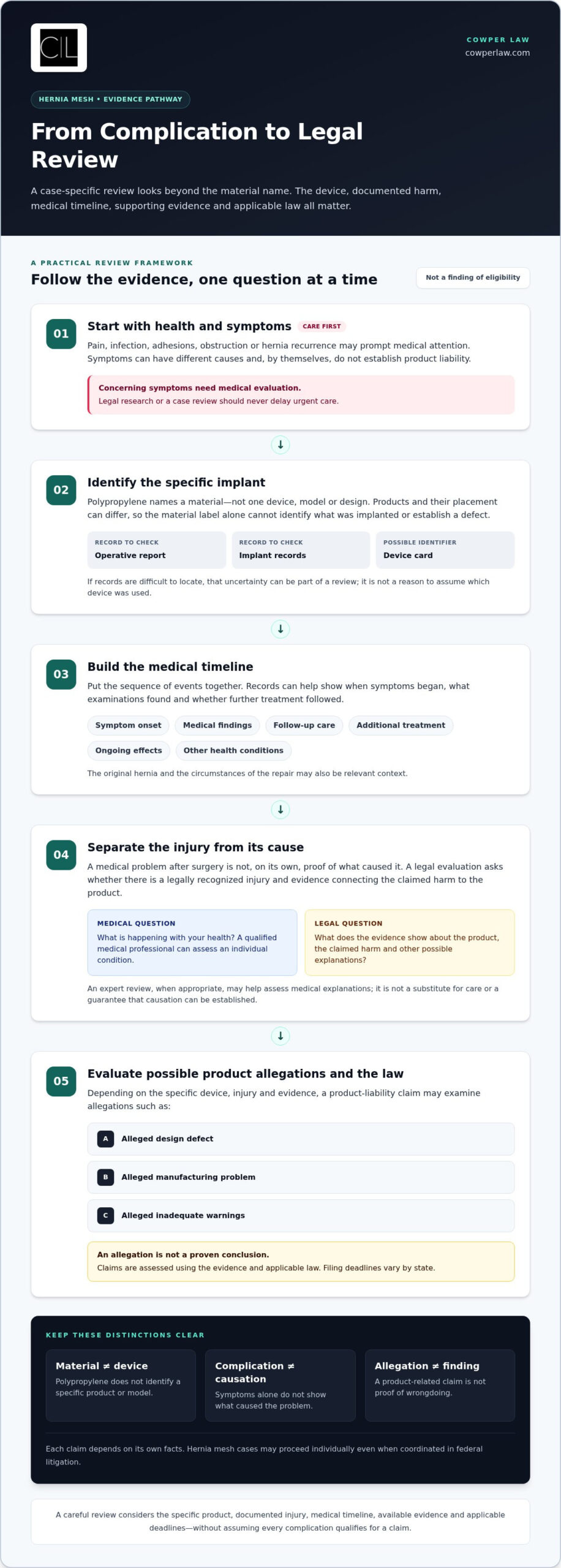
Polypropylene is a material used in some hernia mesh products, not the name of one device or a guarantee that every product made with it has the same design or risks. Mesh products may differ in construction, product name and intended placement. The repair also takes place within each patient’s medical history. A symptom after surgery can be serious and deserve attention without establishing what caused it or whether a legal claim exists.
Material identification alone doesn’t determine liability; the specific device, the harm, the evidence connecting them and the applicable law all matter. A Surgical mesh overview can provide general background on mesh materials and uses, but it can’t identify the product implanted in a particular person or resolve the facts of an individual case.
In plain terms, polypropylene is a synthetic material that may be used to make hernia mesh. The word describes a material, not a single design or model. Two implants described as polypropylene mesh may have different product names or features, and their placement and surgical circumstances may also differ. Operative reports, implant records or a device identification card may help show what was used. If those records are difficult to locate, that uncertainty can be part of a legal review. It isn’t a reason to assume which device was implanted.
Keep the details separate: the implant’s identity, where it was placed and the history of the repair may each help clarify what questions to ask. A material label by itself can’t establish whether a product was defective or contributed to a later problem.
A reported complication is a medical outcome, not a legal conclusion. Pain, infection, adhesions, obstruction or recurrence can occur in the context of hernia repair, but symptoms can have different causes. Only a qualified medical professional can assess an individual’s health. A legal evaluation considers separate questions, such as whether there was a legally recognized injury, what caused or contributed to it, whether a product-related allegation is supported and what law applies.
Product liability claims may allege a defect in design or manufacturing, or inadequate warnings about risks. An adverse outcome alone doesn’t establish any of those allegations, and a claim isn’t proof that a manufacturer acted improperly. The issues must be assessed using the evidence and applicable law. Disputed allegations are not established facts unless supported by the evidence or resolved by a court.
This distinction can make a Polypropylene hernia mesh complications lawsuit less confusing to assess. A complication is a reason to understand what happened, not an automatic finding of fault. A careful legal review connects the specific product and medical timeline with the claimed harm and available evidence, rather than treating the material name as the answer.
A medical problem after hernia repair deserves attention, but its timing alone can’t show what caused it. Pain, infection, adhesions, bowel obstruction and hernia recurrence are among reported concerns associated with mesh repair. Their presence, severity and course vary. Symptoms may relate to the mesh, the original hernia, the procedure, another condition or a combination of factors. A qualified medical professional can assess your health; a legal evaluation asks a separate set of questions.
Persistent or worsening symptoms, a diagnosed complication or additional treatment may prompt closer review, but none points to one cause in every case. The timing of symptoms, medical findings, treatment received and whether effects continue can help describe what happened. If you’re concerned about symptoms, contact a qualified medical professional. Don’t delay care for legal research or a case review.
Records can help distinguish a sequence of events from evidence of causation. For example, a file may show when discomfort was first reported, what examinations found and whether a later procedure identified a specific problem. Those details can be considered alongside other health conditions and the original reason for surgery. An expert review, when appropriate, may help assess medical explanations, but it isn’t a substitute for care or a guarantee that causation can be established.
A legal investigation may consider whether the evidence supports a product-related theory, such as an alleged design defect, a manufacturing problem or inadequate warnings. Which questions matter depends on the specific device, the claimed injury, the available evidence and applicable law. These are potential allegations, not conclusions about a product or manufacturer. Each claim must be evaluated on its own facts.
Different kinds of evidence may help clarify different parts of the picture:
A reported complication is evidence of a medical concern, not proof by itself that a product was defective or that a manufacturer is legally responsible. The questions are related but not interchangeable: what happened medically, what caused or contributed to it, and whether the evidence supports a claim under applicable law each require careful consideration. For someone considering a Polypropylene hernia mesh complications lawsuit, separating those questions can bring clarity without minimizing an injury or assuming an outcome.
A case-specific review can help organize the device, medical timeline and legal questions. Cowper Law represents people in hernia mesh litigation and provides personalized review of individual circumstances. If you’re considering a hernia mesh legal review, you can discuss relevant records and events with counsel.
No single fact decides whether someone may have a claim. A careful evaluation looks at the mesh involved, the reported injury, the medical timeline and the law that applies. Having polypropylene mesh or a complication after surgery doesn’t guarantee eligibility or recovery. Revision surgery may be important evidence of treatment and injury, but it isn’t a universal requirement for a legal claim.
The comparison below shows how information can help frame an evaluation and which questions require review of the individual facts.
| Potentially relevant facts | Questions for case-specific legal review |
|---|---|
| Implant records or a device identification card | Can the specific product and manufacturer be identified? |
| Operative reports and surgery dates | Where was the mesh placed, and what procedures followed? |
| Medical evaluations and treatment history | What injury was documented, and what possible causes were considered? |
| Records of ongoing symptoms or lasting harm | How did the condition affect the person, and what evidence supports that impact? |
| Revision surgery, if performed | What do the records show about the reason and findings? Is other evidence relevant even without revision surgery? |
Existing implant records, operative reports, medical assessments and treatment records can help create a clearer timeline. Note the repair date, when symptoms began, when they were reported, and any later procedures or ongoing effects. Missing device details don’t, by themselves, determine whether a claim exists. A case review can consider the records available and the questions that remain, without relying on generalized promises about eligibility.
Filing deadlines depend on applicable law and case-specific facts, including when an injury and its possible cause became known or reasonably discoverable. Rules can vary by jurisdiction, so don’t assume a deadline based on another person’s experience. An attorney can assess which law may apply and whether timing could affect a claim. Understanding relevant dates promptly may help preserve options.
Some federal hernia mesh cases proceed through multidistrict litigation, or MDL. An MDL coordinates certain pretrial proceedings for individual lawsuits; it isn’t automatically a class action, and each person’s claim remains tied to their own facts. Court procedures and case status can change, so current details should be checked before relying on them. Allegations in lawsuits are not findings of liability unless established through evidence or a court ruling.
A Polypropylene hernia mesh complications lawsuit evaluation is individual, not a checklist that guarantees an outcome. Cowper Law represents people in hernia mesh litigation and reviews the device, injury, records and applicable legal questions. If you want to discuss how these factors relate to your circumstances, a hernia mesh case review can be a measured next step.
Put your health first. If symptoms feel urgent or are worsening, seek medical care promptly. Legal research should never delay evaluation. A medical professional can assess your symptoms and discuss care. You don’t need to determine whether mesh caused a problem before asking for help.
Once immediate health needs are addressed, a few organized steps can make it easier to explain what happened. Focus on records and dates, not on trying to diagnose yourself or prove a claim.
Gather what you already have, such as implant identification, operative reports, follow-up notes, evaluations and records of later treatment. Missing paperwork doesn’t mean you must solve the device question alone. A short timeline can help counsel understand the sequence without requiring you to interpret medical terminology or reach your own diagnosis.
Your timeline doesn’t need to be perfect. Even a brief note such as “repair in spring, discomfort reported at a later visit, further evaluation afterward” can help organize a conversation. Medical records and qualified professionals, not guesswork, should guide medical conclusions.
A lawyer can review the available information to assess product identification, evidence of injury, possible causation questions and filing deadlines. That review can identify what is known and what remains uncertain; it can’t promise eligibility or recovery. For broader context on litigation involving medical devices, see the medical device injury lawyer overview.
A Polypropylene hernia mesh complications lawsuit depends on individual facts, so you don’t need to arrive with a complete file or a legal theory. Cowper Law represents people in hernia mesh litigation through personalized legal review. If you’re ready to discuss your circumstances, contact Cowper Law about your hernia mesh concerns.
A mesh complication can leave you facing uncertainty about your health, your records and what may come next. Cowper Law represents people in medical device injury litigation, including hernia mesh cases. The firm takes an individualized approach, seeking to understand the person behind the paperwork and assess the facts without assuming every complication points to a legal claim.
For a Polypropylene hernia mesh complications lawsuit, counsel may review the identified product, reported injury, medical records and timeline together. This broader view can help clarify which legal questions deserve attention, what information is available and what remains uncertain. The review is legal advocacy, not medical diagnosis or treatment.
An initial discussion can put your concerns and available information in context. Counsel may consider the mesh product, surgical and medical history, alleged harm, and records of evaluation or treatment, then assess questions such as product identification, causation and applicable law. You don’t need to arrive with every record or a complete explanation. A discussion isn’t a guarantee that a claim can be brought or that it will succeed.
Each person’s circumstances are different. A symptom, device label or later procedure may raise questions, but none is a legal conclusion on its own. A careful review looks at how the facts fit together rather than relying on a single detail or generalized checklist.
You can share what you know, explain what remains unclear and ask questions about possible legal options. Helpful starting points may include the approximate surgery date, when concerns began and any records you already have. If information is missing, say so. The review can begin with the circumstances available and identify what may be useful to understand next.
Cowper Law’s representation is contingency-based, with legal fees collected only upon successful recovery of damages. This describes how legal fees are handled; it isn’t a promise of recovery or a statement that every case expense is covered. The terms applicable to representation are matters to discuss directly.
If you’re weighing what to do, you can contact Cowper Law to discuss your hernia mesh concerns. You don’t need to predict the outcome before asking questions. A thoughtful conversation can help you understand how your records and circumstances may relate to a legal review, while keeping the decision in your hands.
Uncertainty can make it difficult to know what to do next. You don’t need to decide on your own whether a Polypropylene hernia mesh complications lawsuit is right for you. A conversation with counsel can put your questions in context and clarify whether further legal review may make sense, without assuming you qualify or predicting an outcome.
Cowper Law represents individuals in medical device injury and hernia mesh litigation. The firm’s representation is contingency-based, with legal fees collected only upon successful recovery of damages. If you’re ready to discuss what happened and ask about possible legal options, discuss your hernia mesh concerns with Cowper Law.
Your circumstances deserve careful attention. Taking one informed step at a time can help you move forward with greater clarity.
Symptoms can arise long after surgery, but timing alone can’t show that mesh caused them. A new ache, recurring discomfort or another health change may have several possible explanations, including conditions unrelated to the implant. Ask a qualified clinician to assess your health concerns and explain what evaluation may be appropriate. Note when changes began and how they affect you, but leave diagnosis to a medical professional.
No. The material alone doesn’t establish eligibility. A review may consider which product was implanted, what injury is alleged, what records support it, possible causation, applicable law and filing deadlines. For a Polypropylene hernia mesh complications lawsuit, these questions depend on your circumstances, not simply the mesh label. An attorney can assess the available facts and explain possible legal options, but no particular product or symptom guarantees a claim or recovery.
Lawsuits may involve allegations related to reported concerns such as persistent pain, infection, adhesions, bowel obstruction or hernia recurrence. These examples aren’t a complete list, and they don’t affect every patient in the same way. A symptom or diagnosis doesn’t by itself prove a product defect or legal responsibility. If you’re experiencing a health concern, seek medical assessment; legal questions about its cause require a separate, evidence-based review.
Revision surgery may provide relevant information about treatment or findings, but it isn’t a universal requirement for bringing a claim. An evaluation may also consider documented symptoms, medical assessments, the identified product and other evidence of injury. Whether those facts support a case depends on applicable law and individual circumstances. Don’t pursue or delay a medical procedure for legal reasons; treatment decisions belong between you and your qualified clinician.
There’s no single deadline that applies to every case. Limitation periods and the rules for determining when they begin can vary by jurisdiction and circumstances, including when an injury or its possible cause was discovered. Because a missed deadline may affect legal options, seek advice from an attorney promptly rather than relying on another person’s timeline or a general online estimate. Current law must be assessed for your situation.
They aren’t necessarily class actions. A class action brings claims forward on behalf of a defined group, while multidistrict litigation, or MDL, coordinates certain federal cases for pretrial proceedings. In an MDL, individual claims generally remain separate and may involve different injuries and evidence. Court proceedings and participation can change over time, so an attorney should verify the current status of specific litigation before explaining how it may relate to an individual claim.
Potentially useful materials include an implant card or product identification, operative reports, medical records, and records of follow-up or later treatment. A personal timeline noting surgery, symptom changes, evaluations and care may help organize the history. You don’t need to interpret clinical language or assemble a perfect file before asking questions. Missing records don’t automatically resolve whether a claim exists; a legal review can consider what’s available and what information may still be needed.