
Could a medical device malfunction point to a defect in the specific unit you received, even if there’s been no recall? A malfunction alone doesn’t prove a manufacturing flaw, but it may raise questions worth investigating. A Medical device manufacturing defect lawsuit examines whether a particular device departed from its intended design during production and whether that deviation contributed to someone’s injury.
FDA clearance and recall notices can offer useful context, but neither resolves whether a device was properly made or whether an injured patient may have a claim. The distinction matters: a manufacturing defect concerns an individual unit, while design-defect and failure-to-warn claims raise different questions. This article explains how manufacturing-defect claims differ, what device and medical records may help connect a suspected defect to an injury, and how a legal team can investigate the facts. Cowper Law represents people harmed by medical devices, providing determined advocacy and personalized support as they consider their legal options.
A medical device manufacturing defect lawsuit alleges that a particular device differed from its intended design or specifications because of a problem during production, assembly, or handling. The issue may involve one unit or a batch, rather than the entire product line. A device that stops working or performs unexpectedly may prompt questions, but the malfunction alone doesn’t establish what caused it or who is legally responsible.
In plain language, a manufacturing defect is a difference between how a device was supposed to be made and how the patient’s device was actually made. Establishing that difference may require looking beyond the symptoms of failure to the device’s condition and available records. The legal framework falls under Product liability law, but the rules that apply depend on the jurisdiction and facts of the case.
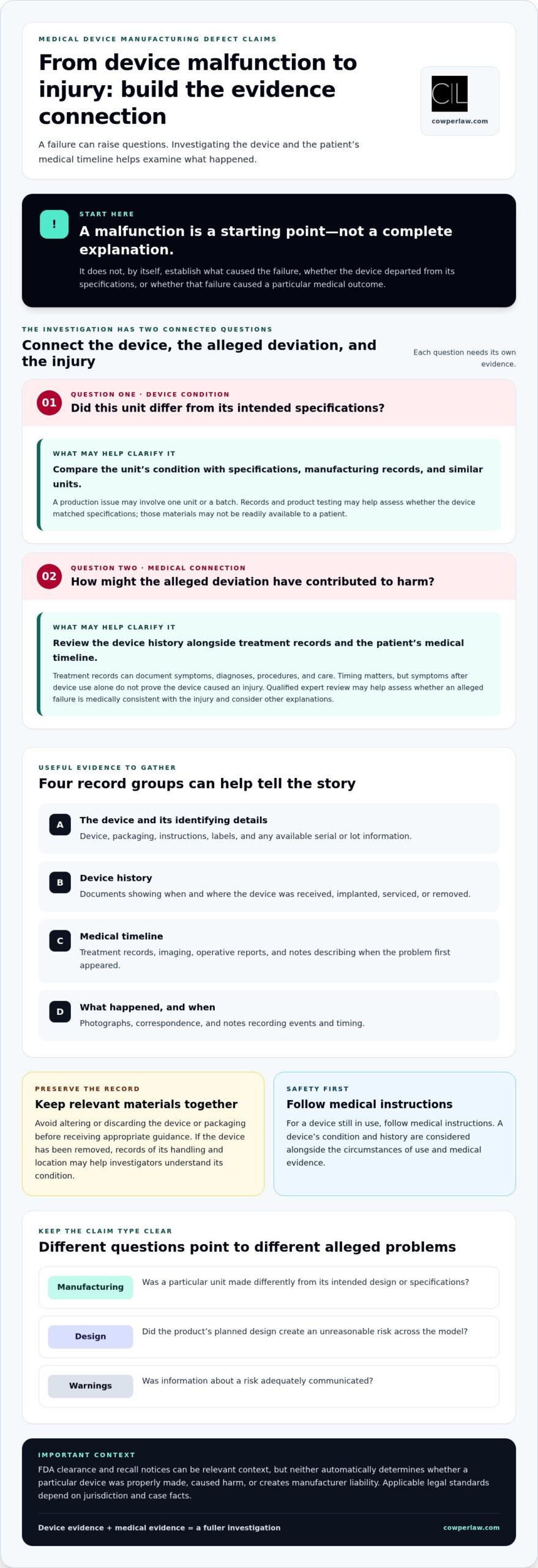
Consider a hypothetical infusion pump. If one unit has a connector assembled contrary to its specifications while other units are made as intended, that may point to a manufacturing issue. If the connector design itself creates an unreasonable risk across the model, the concern may instead involve a design defect. The key distinction is whether the alleged problem arose while making a particular unit or from the product’s planned design.
A warning claim asks a different question: whether information about a risk was adequately communicated. It doesn’t necessarily concern how the device was built. These legal theories can overlap. Depending on the evidence and applicable law, a case may raise questions about a production deviation, a design risk, and the warnings provided.
An evaluation typically examines several connected questions: What was the product’s condition? What specific departure from its intended design or specifications is alleged? How might that departure have contributed to the injury? A device malfunction is a starting point for investigation, not a complete explanation. The product’s history and condition, the circumstances of its use, and medical evidence may all help assess the connection.
The legal test is not identical everywhere. State law can shape what a patient must prove, the applicable burden of proof, and which legal theories are available. The device and alleged deviation matter too, as does the evidence that can be examined. A conclusion based only on the fact that a device failed can therefore be premature. A careful review considers the device, the alleged defect, and the injury together.
A strong investigation examines two connected questions: whether the device departed from its intended specifications, and whether that departure contributed to the patient’s harm. Evidence of an injury doesn’t, by itself, identify what went wrong inside a device. Evidence that a device malfunctioned doesn’t automatically show that the malfunction caused a particular medical outcome.
For a Medical device manufacturing defect lawsuit, relevant information may come from the device itself, its production history, and the patient’s medical timeline. Comparing the unit with specifications, manufacturing records, and similar units can help clarify whether a problem was isolated or appeared elsewhere. Production records may not be readily available to a patient, so obtaining and evaluating them can require formal investigation or litigation, during which legal teams often work with eDiscovery specialists like Trustpoint.One to review complex technical data and internal records efficiently.
Keep relevant materials together where possible, and avoid altering or discarding the device or packaging before receiving appropriate guidance. If the device has been removed, records of its handling and location may help investigators understand its condition. Follow medical instructions for any device still in use. Useful materials may include:
These materials serve different purposes. A serial or lot number may help identify a device and connect it to available production information, while treatment records document the patient’s condition and care. Manufacturing records and product testing may help assess whether the unit matched specifications, but access to those materials can depend on the investigation and legal process. The medical device injury documentation guide offers further record-preservation guidance. Broader medical device injury claim context can also help explain how device evidence fits into a potential case.
An injury that occurs after implantation or use is not proof, on its own, that the device caused it. A patient may have more than one medical issue, and the timing of symptoms is only part of the picture. Treating records can document symptoms, diagnoses, procedures, and the course of care. Device history can help establish when and how the alleged failure occurred.
Qualified expert review may help assess whether the alleged failure is medically consistent with the injury and whether other explanations need consideration. Experts may evaluate technical evidence about the device alongside clinical information, rather than treating either in isolation. Evidence that a device malfunctioned can help show what happened to the device; separate medical and expert evidence may be needed to explain whether that failure caused the patient’s injury.
Cowper Law investigates the device and the injury together, helping patients assess the evidence with determined advocacy and individualized support. An experienced medical device injury legal team can help evaluate which records and further investigation may matter in a particular case.
No. A recall or FDA status can add context, but neither answers every question in a potential Medical device manufacturing defect lawsuit. A recall may identify a safety concern or affected device versions. FDA clearance describes a regulatory pathway, not whether the specific unit used by a patient was made according to specifications or caused an injury. The device, alleged defect, and governing law still matter.
Status | What it may establish | What it does not decide on its own
Recalled device | A recall notice may identify affected versions, reported risks, or actions taken by a manufacturer or regulator. | It does not automatically prove that a particular unit was defective, that the manufacturer is liable, or that the recall caused an individual’s injury.
Non-recalled device | It indicates no recall has been identified for the device or version in question. | It does not establish that every unit was properly manufactured or rule out a claim based on case-specific evidence.
FDA-cleared device | It indicates the device entered the market through an applicable FDA clearance pathway. | It does not, by itself, settle whether a specific unit departed from specifications, caused harm, or can be the basis of a particular state-law claim.
A recall is a safety or compliance action, not an automatic finding about every unit or every patient’s experience. Its notice may help identify the device version involved, describe a concern, and show what response followed. Those details can guide further investigation. But a recall is neither required to explore a claim nor enough by itself to establish liability or individual causation.
That distinction matters in both directions. A recalled product may not have the alleged problem in every unit, while a unit-specific manufacturing issue may warrant examination even without a recall. The patient’s device condition, available production evidence, and medical facts remain central.
FDA clearance is not a blanket answer to every product-liability question. Regulatory pathways differ, and the legal effect may depend on the device’s pathway and the specific claim. Federal preemption can be a significant issue, particularly for certain Class III devices approved through the Premarket Approval process. The Supreme Court’s decision in Riegel v. Medtronic addressed preemption in that context; whether it applies requires careful, current analysis of the device and allegations.
Regulatory status describes a device’s path through FDA oversight; it does not, by itself, prove or disprove what happened to a patient’s particular device. While manufacturers work to meet FDA regulations and good manufacturing practices—often consulting industry specialists like apsinco.com to validate production processes—oversight alone cannot guarantee that every individual unit is free from defects. A lawyer evaluating a claim must consider the device’s regulatory history alongside the alleged manufacturing deviation, injury evidence, and applicable law. These issues are complex, and their answers can turn on details that a recall notice or clearance label cannot resolve.
A measured review starts with the facts, not an assumption that every malfunction means a lawsuit is viable. For a Medical device manufacturing defect lawsuit, the key questions are what device was involved, what may have gone wrong during production, what injury followed, and whether a claim can still be brought under the applicable law. Each answer helps shape the next step.
An initial review may ask what device was used, when the failure occurred, and what medical consequences followed. Model and serial or lot information can help identify the unit; treatment records can establish the timeline and injury. Manufacturer details and the circumstances of use may guide questions about the product’s history and the alleged production deviation. Missing information doesn’t answer the case by itself, but it can show what needs further investigation.
The review also considers the structure of a potential claim. Some matters proceed as individual cases, while others may be part of class or coordinated litigation. Neither route should be assumed based solely on a shared device or similar reported problem. The facts, claims, and procedural posture matter. For a separate explanation of group litigation, see this medical device class action guide.
Filing deadlines vary by jurisdiction, and relevant dates may depend on when an injury happened, when it was discovered, and other legal details. Different claims arising from the same device may also involve different rules. Because a missed deadline can affect legal options, have timing reviewed promptly rather than relying on a general online estimate.
Possible damages depend on documented losses and governing law. Records may help show medical expenses, lost income, or other effects of an injury, but no particular recovery is guaranteed. A careful review considers both the evidence and the legal framework before drawing conclusions.
If you have device information and treatment records, discuss how they fit together with a legal team experienced in medical device injury litigation. Ask Cowper Law to review your potential claim with individualized attention to the device, injury, and timing.
A suspected manufacturing problem raises difficult questions. Was the device made as intended? Could a specific deviation have contributed to the injury? What legal rules apply? Cowper Law represents people harmed by medical devices and takes on litigation against manufacturers. The firm can examine the device history, alleged production deviation, injury, and relevant legal issues as parts of one case-specific investigation.
That work starts with the facts, not a promised result. Records and other available information can help define what happened and what further investigation may be needed. A careful review may identify unanswered questions and help the legal team assess the evidence clearly.
An initial discussion can focus on the device, how and when it allegedly failed, the injury and treatment that followed, and what information is available. Model or serial details, medical records, correspondence, and the device itself may help establish a useful starting point. You don’t need every answer before beginning a conversation.
Legal analysis may consider which jurisdiction’s law applies, filing deadlines, causation, potential defendants, and whether the evidence supports a manufacturing-defect theory or another claim. These questions are connected: the device’s history may guide the investigation, while medical records help frame the alleged injury. Cowper Law pairs determined advocacy with individualized, compassionate support and attention to the person behind the evidence.
Cowper Law collects legal fees only upon successful recovery. This contingency-based arrangement does not promise that a case will succeed or that every matter will have the same outcome. The terms of representation can be discussed as you consider whether to move forward.
Exploring a claim is a measured step, not a commitment to a particular result. A legal team can review the device and injury together, explain issues that may affect your options, and help you understand what remains uncertain. Cowper Law brings focused medical device injury litigation experience to that process, with advocacy directed toward your individual circumstances.
Speak with Cowper Law about your device injury.
Uncertainty can make it difficult to know what to do next. You don’t have to resolve every technical or legal question on your own before seeking guidance. A focused review can help clarify what is known, what still needs investigation, and whether the facts may support a Medical device manufacturing defect lawsuit.
Cowper Law represents people harmed by medical devices and focuses on medical device injury litigation. The firm pairs determined advocacy with individualized, compassionate support. Legal fees are collected only upon successful recovery; this does not guarantee a recovery or outcome.
Share what happened and learn how your circumstances may be evaluated. Discuss your device injury with Cowper Law and consider your options with support.
Potentially, yes. A recall isn’t necessarily a prerequisite to exploring an individual claim, and waiting for one could delay a review of relevant evidence. For a Medical device manufacturing defect lawsuit, useful starting details may include the device’s model, when the problem occurred, and what medical care followed. An attorney can assess whether the available facts support further investigation under the law that applies.
No. FDA clearance doesn’t automatically resolve whether a manufacturer may face a particular product-liability claim. The device’s regulatory pathway, alleged defect, and legal theory can all matter, and federal preemption may affect some cases. Clearance and premarket approval are distinct regulatory pathways, so a general statement about one shouldn’t be applied to every device. A case-specific legal review can assess the relevant history and law.
Potentially. A device may function as intended for others while a particular unit or batch has an alleged production problem. For example, an assembly issue affecting one unit could raise different questions from a concern shared across the product’s design. The distinction needs evidence, not assumptions. Device records, testing, and information about similar units may help evaluate whether a specific deviation occurred and whether it contributed to the injury.
Your underlying condition may be relevant, but that statement alone doesn’t settle whether the device played a role. Ask for copies of records that explain the doctor’s assessment, including visit notes, test results, and treatment recommendations. A legal and medical review may compare those records with the device’s history and the timing of symptoms. Causation can be disputed, so preserve the information and discuss alternative explanations with counsel.
There isn’t one deadline for every medical device claim. Filing periods vary by state and may turn on the type of claim, when an injury occurred or was discovered, and other case-specific rules. A later medical diagnosis or device investigation doesn’t necessarily pause a deadline. Gather the dates of treatment, device use, and symptom onset, then seek prompt legal review to identify which time limits may apply.
Depending on state law and the circumstances, eligible family members or a representative of the estate may be able to pursue a wrongful-death or related claim. The law determines who has authority to file and what losses may be considered. Useful information can include the deceased person’s treatment history, device records, and documents identifying the appropriate representative. Deadlines and eligibility rules vary, so a prompt, case-specific review is important.
Possibly, but similar devices or allegations don’t automatically place every injured person in the same proceeding. A class action and multidistrict litigation have different procedures, and a court’s decisions and the claims involved may affect participation. Even in coordinated litigation, individual issues such as injury, medical history, and causation can remain important. A lawyer can explain how a proceeding may affect your choices, deadlines, and case-specific concerns.