
What if the percentage in a fee agreement isn’t the amount that determines what you take home? After an injury, medical bills and lost income can make legal costs feel like one more uncertainty. A personal injury contingency fee lawyer’s agreement explains how attorney fees are calculated, but case expenses may be treated separately. Knowing how both are handled can help you understand what may be deducted from a recovery.
It’s reasonable to want clear answers before pursuing a claim. Cowper Law collects legal fees only upon successful recovery of damages. Case expenses, however, may be addressed separately in the representation agreement. This article explains how contingency representation generally works, which expense and fee terms to review, and why gross and net recovery can differ. Understanding those details can help you make a more informed decision about your potential claim.
A personal injury contingency fee lawyer represents a client under an agreement that ties the attorney’s fee to a successful recovery, as defined by the agreement and applicable law. Because attorney fees generally aren’t paid by the hour as the case progresses, this arrangement can help people facing medical bills or lost income pursue legal representation. It doesn’t mean every case expense follows the same payment terms.
Quotable definition: A contingency fee is an attorney fee tied to a client’s recovery, while an hourly fee is based on the time a lawyer works, whether or not the matter results in compensation.
The term contingent fee describes this outcome-linked approach to payment. The written agreement explains what it means for a particular case, including how the fee is determined and how expenses are handled. Filing fees, expert witness charges, deposition costs, and medical-record expenses may be treated separately from the attorney’s fee. Don’t assume that no upfront attorney fees also means no case expenses could ever be owed.
The lawyer-client agreement is the main document for understanding payment and responsibilities. Review when a fee becomes payable, how it is calculated from a recovery, and how case expenses are treated. The precise terms and applicable law matter. “No win, no fee” alone doesn’t explain whether expenses may remain your responsibility if there’s no recovery, so read the expense provisions alongside the fee terms.
This structure can allow an injured person to pursue a claim without paying attorney fees by the hour as the matter progresses. The lawyer’s compensation is tied to a recovery under the agreement, while counsel invests time in investigating and presenting the claim. Cowper Law collects legal fees only upon successful recovery of damages. That describes the legal fee, not the separate treatment of case expenses.
Contingency arrangements are commonly associated with injury claims. Whether a particular matter is suitable depends on its facts, the agreement, and applicable law. Someone harmed by a medical device, for example, may want to understand the fee and expense terms before pursuing a claim. For context on this area, guidance about medical device injury claims can help explain the issues involved.
Cowper Law represents injured people in medical-device, drug-injury, catastrophic-injury, and negligence matters. Medical-device cases may involve complex evidence about an injury and its cause. A case-specific discussion can clarify the scope of representation, fee calculation, and expense terms before a client decides how to proceed. No single payment arrangement automatically applies to every claim.
A settlement figure isn’t automatically the amount you receive. To estimate what may remain, separate the total recovery from the attorney fee and any applicable case expenses. Then review the agreement to see how each item is calculated and handled. The sequence below is a framework for reviewing the figures, not a universal deduction order.
Recovery → Contractual attorney fee → Applicable expenses → Potential net amount
The agreement and applicable law determine how each step is applied, including when expenses are deducted.
Gross recovery and net recovery aren’t interchangeable: gross recovery is the total amount obtained before applicable deductions, while net recovery is what remains after deductions governed by the agreement and applicable law. A personal injury contingency fee lawyer should be able to explain how the written terms apply to a recovery. The actual calculation depends on the agreement and the circumstances of the case.
Gross recovery refers to the total amount recovered before applicable deductions. Net recovery is the amount remaining after the attorney fee and any expenses or other deductions addressed by the agreement are accounted for. The specific calculation depends on the contract and circumstances, so don’t assume the fee is based on the same amount you’ll ultimately receive.
When reviewing a proposed calculation, look for the fee basis and the point at which expenses are considered. The agreement may explain whether the fee is calculated from gross recovery or after certain expenses are deducted. That distinction can affect the estimated net amount. The contingency fee definition from Cornell Law School offers general background, but your signed terms are central to understanding your own calculation.
Case expenses are costs associated with developing or pursuing a claim, rather than the lawyer’s fee for representation. Depending on the case, examples may include obtaining medical records, filing documents, retaining expert witnesses, or conducting depositions. These costs aren’t automatically treated like attorney fees. Whether they’re charged, when they’re accounted for, and who may be responsible for them depend on the agreement and applicable law.
For a medical-device claim, expenses and recovery considerations may depend on the evidence and issues involved. Learning about factors that can shape a medical-device lawsuit can help put the recovery process in context, but a general overview cannot determine the net amount in an individual matter. A useful estimate should identify each proposed deduction and explain its basis in the agreement.
Before evaluating a settlement figure, request a clear breakdown showing the recovery, fee calculation, expense treatment, and estimated net amount. Cowper Law’s information about legal representation can help you understand the firm’s approach to injury claims.
If a claim ends without a recovery, attorney fees and case expenses may not be treated the same way. Whether any amount is owed depends on the signed agreement and applicable law. A contingency arrangement ties the attorney fee to a recovery as described in the contract, but it doesn’t automatically answer what happens to expenses already incurred during the case.
Understand that distinction before agreeing to representation, not only after a case ends. A personal injury contingency fee lawyer should explain the written terms in plain language, including how the agreement addresses a result with no compensation. Don’t rely on a phrase like “no win, no fee” as a complete explanation of every possible financial responsibility.
No single answer applies to every agreement or jurisdiction. An attorney fee may depend on a successful recovery, while separate expense terms determine whether expenses are owed, by whom, and when. Read the contract rather than inferring the answer from a slogan, and ask for an explanation before signing if anything is unclear.
Focus on the agreement’s language about a case that produces no settlement or award. Does it address expenses incurred on your behalf? Does it distinguish them from the attorney’s fee? Are there terms that apply if representation ends before the claim concludes? The answers can vary, so another client’s experience or a general online explanation cannot settle your own obligations.
Medical-device litigation can involve technical records and questions about how a device relates to an injury. Depending on the facts, reviewing those issues may involve specialized evidence or expert input, but no two cases necessarily require the same investigation or procedures. The agreement, not a general expectation about device cases, governs how potential expenses are handled.
Before representation begins, get a clear explanation of how expenses are treated if the case does not recover. Written clarity can help you understand financial responsibilities while weighing a difficult legal decision. Consider asking:
These questions don’t predict the outcome or determine what the law requires in a particular jurisdiction. They help you identify what the agreement says and which terms may need clarification. If an explanation is unclear, ask for it before signing and keep the written agreement for reference throughout the case.
That statement concerns legal fees; it isn’t a promise that case expenses are never owed if there’s no recovery. Reviewing both parts of the agreement can give you a clearer understanding of the risks, responsibilities, and terms before moving forward.
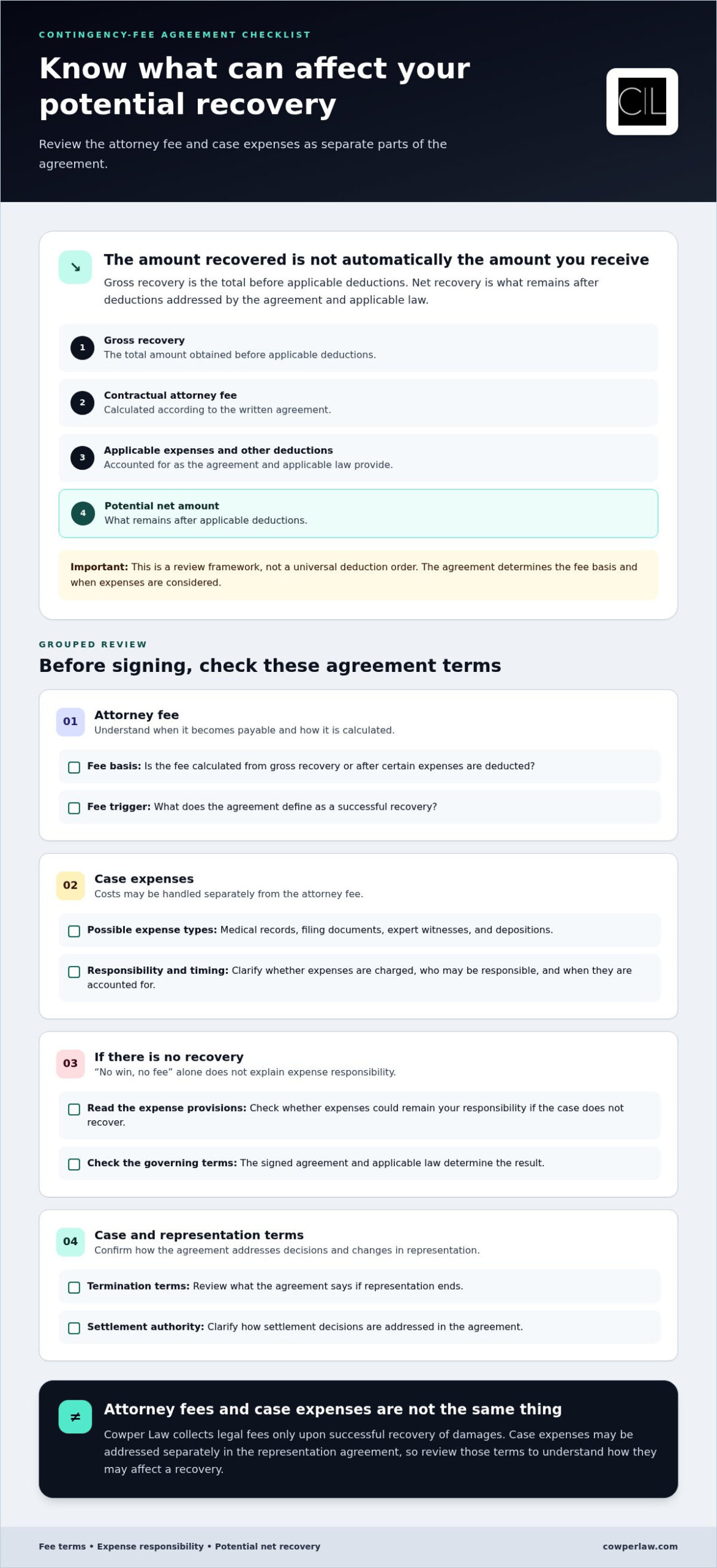
Before signing, make sure you can explain the agreement’s key terms in your own words. A personal injury contingency fee lawyer’s written agreement should give you a clear picture of how the fee is calculated, what expenses may arise, and what happens if the relationship or case ends. Contract requirements vary by jurisdiction, so general information cannot replace a review of the terms that apply to your matter.
Use this checklist to focus your review:
Don’t stop at the percentage or fee formula. Read the surrounding provisions to see how expenses are treated at each stage and whether the agreement addresses them differently if representation ends early or the case concludes without recovery. If wording is unfamiliar, ask for a plain-language explanation and compare it with what the document actually says.
Keep a copy of the signed agreement and any written clarification. That gives you a reference if questions arise later about an expense, a deduction, or the status of the representation. Requirements for legal agreements also differ across jurisdictions and practice areas; for those navigating corporate, commercial, or family matters under different fee arrangements, Everything Legal provides dedicated legal services online and in person.
A settlement can affect both the resolution of a claim and the calculation of a potential recovery. Read the agreement’s terms about offers, decision-making, and consent, and ask how the process works under the law that applies to your case. Don’t rely on assumptions about who has authority or what consent requires without understanding the relevant terms.
For example, if an insurer makes an offer, you should know how the offer will be communicated, what role you have in deciding whether to accept it, and how acceptance would affect the fee and expenses. The agreement and applicable law inform those answers; this example isn’t a statement of a universal rule.
Clear answers before signing can prevent avoidable uncertainty later. Cowper Law provides information about its representation, including the fee and expense terms that apply to a potential claim.
Once you understand how fees, expenses, and agreement terms can affect a potential recovery, the next question is who will represent you through the claim. Cowper Law represents injured people in personal injury matters involving medical devices, drugs, catastrophic injuries, wrongful death, and negligence. The firm focuses on trial advocacy for individuals harmed by products or negligence, representing people whose claims may involve large companies.
That statement applies to legal fees, not necessarily to case expenses, which are addressed by the representation agreement and applicable law. Discussing your circumstances and the agreement can help clarify the terms, potential responsibilities, and how the firm’s representation relates to your claim. No fee arrangement promises that a claim will qualify or produce a particular result.
Medical-device and drug-injury claims can involve questions about products, treatment, and the harm a person experienced. Cowper Law advocates for people who have been injured, with a focus on trial advocacy. Its work includes matters involving medical devices such as spinal cord stimulators, hernia mesh, and breast implants, as well as drug injury, catastrophic injury, and wrongful death. The approach considers the individual’s situation, not just the claim category.
If you’re exploring medical-device injury representation, organize what happened, the treatment received, and the device involved. These details provide a starting point for discussing the claim and identifying questions that may need careful review.
Begin with a simple record of the key facts. You don’t need every document gathered before raising questions, but a clear timeline can make an initial discussion more focused. Note when the injury occurred, what treatment followed, and any relevant product or medication details you know.
These materials don’t determine whether a claim can proceed. They can help counsel understand the situation and explain what further information may matter. When discussing your claim with a personal injury contingency fee lawyer, address both the legal issues and the agreement’s practical terms, including how attorney fees and expenses are treated separately.
If you’re considering a claim, a conversation with Cowper Law can help you understand the representation agreement and decide on an informed next step, without assuming a particular outcome.
Deciding whether to pursue an injury claim can feel like another burden while you’re focused on healing. You don’t need every answer before taking a first step. Bring the questions that matter most to you, including what representation would involve and which terms you want explained. A personal injury contingency fee lawyer can discuss how the proposed agreement relates to your circumstances, helping you consider the path ahead with a clearer view.
Cowper Law represents individuals harmed by medical devices, drugs, or negligence through contingency-based representation and a trial-focused practice. The next step isn’t a promise of a particular result. It’s a chance to have your situation heard and understand what pursuing a claim may involve.
Discuss your injury claim with Cowper Law. A conversation can help you understand the proposed terms and make a better-informed decision about what to do next.
The proposed terms can often be discussed before you sign, though applicable rules and the lawyer’s agreement practices may affect what can be changed. Ask how the fee is calculated, whether it changes at different stages, and whether expense terms are also open to discussion. If you agree to different terms, make sure they appear in the final written agreement rather than relying on an informal conversation.
Requirements vary by jurisdiction, so there isn’t one rule that can safely be applied nationwide. Ask for the complete agreement in writing and keep a signed copy, even where local rules may differ. Review the fee formula, expense provisions, and termination terms before signing. If any clause is hard to understand, request a plain-language explanation and make sure it matches the document you’re being asked to accept.
Settlement authority depends on the applicable professional rules and the circumstances, but you should understand clearly how your decision is handled before representation begins. Ask how offers will be shared, who communicates with the opposing party, and how your consent is documented. For example, if an offer arrives while you’re considering ongoing treatment, clarify how the decision process works before responding. Don’t assume silence or a general clause means you’ve agreed.
You can generally end an attorney-client relationship, but changing counsel may raise questions about fees, expenses, file transfer, and responsibility for work already completed. The agreement and applicable law may affect how those matters are resolved, including whether a former lawyer asserts a claim against a later recovery. Before making a change, review the termination clause and discuss timing, case deadlines, and an orderly transfer of records with counsel.
It can be an option for some medical-device injury claims, but whether a claim can proceed and what arrangement applies depend on the facts and applicable rules. A personal injury contingency fee lawyer may need to assess the device involved, the injury, treatment history, and available evidence before discussing representation. Records identifying the implanted or prescribed device may help frame the initial review, but they don’t determine the claim’s outcome.
A judgment establishes a legal obligation, but it doesn’t guarantee the defendant can pay it. The practical ability to collect may depend on available insurance, assets, other claims, and applicable collection rules. Coverage may be disputed or limited, and an individual or company may have few reachable assets. Before deciding how to proceed, discuss collectability as a separate issue from the strength of the claim and potential value of a judgment.