
Imagine waking up to a sharp, electrical jolt or the sudden, crushing return of the chronic pain you thought was gone forever. For many, an implanted device represents a hard-won promise of relief, yet a spinal cord stimulator battery defect claim often begins with this exact moment of betrayal. You aren't just dealing with a technical glitch. You're facing the physical trauma of internal burns, the fear of another invasive surgery, and the deep frustration of a manufacturer's failure. With more than 107,000 complaints filed with the FDA, you're certainly not alone in this struggle.
We agree that no patient should ever have to trade one form of suffering for another because a corporation took shortcuts. This guide provides the clarity, stability, and expert answers you need during this chaotic time. We are committed to being your constant companion. We'll explore the current 2026 recalls involving major manufacturers like Abbott and Boston Scientific, explain your right to financial recovery for medical bills, and show you how a dedicated legal partnership can hold these entities accountable. You've fought long enough for your health; let us fight for your justice.
A spinal cord stimulator is designed to be a silent, reliable partner in your journey toward pain relief. When the battery fails, that partnership is shattered. These defects typically manifest as premature depletion, dangerous overheating, or internal chemical leakage. While spinal cord stimulators are complex machines, the battery is their heart. If it stops beating too soon, the therapy dies with it, often leaving you in a state of physical and emotional crisis.
In lithium-ion implants, a specific defect can trigger "thermal runaway." This is a catastrophic chain reaction where an internal short circuit causes the battery temperature to rise uncontrollably. The heat generates more heat, which can lead to the battery casing melting or venting toxic chemicals into your body. It isn't just a technical glitch; it's a life-altering medical emergency that requires immediate intervention. We are here to ensure that the companies responsible for these dangerous malfunctions are held to account.
Manufacturers often promise a device lifespan of seven to ten years. When a battery fails in two or three years, it's rarely a result of patient behavior. A spinal cord stimulator battery defect claim often centers on design flaws where the device draws excessive power, or manufacturing flaws where contaminants were sealed inside the battery cell during production. These are not accidents. They are failures in quality control and corporate responsibility.
Manufacturing errors are frequently the primary culprit. Microscopic metal particles left during the assembly process can pierce internal separators, creating a short circuit. Software glitches represent another silent threat. If the device firmware fails to regulate energy draw, it can drain the battery to a point of "deep discharge," making it impossible to recharge. Additionally, structural compromises in the casing can allow body fluids to seep in, triggering corrosive, dangerous failures that compromise the entire system.
Your body is the most reliable witness to a device's failure. Recognizing these signs early is the first step in building a successful spinal cord stimulator battery defect claim. Look for these critical indicators:
If you experience these symptoms, the device is no longer a tool for healing. It has become a source of risk. We are committed to standing by your side as you seek the answers and compensation you deserve.
When a medical device fails, the consequences aren't merely technical; they're deeply personal. For patients living with chronic pain, the sudden loss of stimulation therapy is a physiological shock that can leave them reeling. The pain doesn't just return; it often feels more intense because the body has lost its primary mechanism for relief. This immediate rebound of suffering is frequently accompanied by the physical trauma of the malfunction itself. If you've experienced these symptoms, filing a spinal cord stimulator battery defect claim is often the only way to secure the resources needed for recovery.
Device malfunctions frequently manifest as unpredictable electrical jolts or "shocks" that radiate into the spine. These sensations are jarring and painful, often occurring without warning during daily activities. Beyond the shocks, a failing battery can cause significant internal damage. Because these devices are implanted deep within the tissue, any hardware failure requires professional medical intervention. Clinical guidance on spinal cord stimulator removal and device failure highlights that revision surgery is not a simple fix. It's an invasive procedure that carries risks of infection, scarring, and further nerve irritation.
Internal thermal injuries are among the most serious physical risks of a defective battery. When a lithium-ion cell enters a state of thermal runaway, it can reach temperatures that cause internal burns and tissue necrosis. This heat damage creates dense, painful scar tissue around the implant site, which can make future surgeries significantly more complex. In the most severe cases, erratic electrical discharges from a compromised battery can lead to permanent nerve damage, leaving the patient with new, irreversible neurological deficits.
The emotional impact of a device failure is a unique form of betrayal. Patients spend months or years seeking a solution for their pain, only to have the very tool they trusted become a source of injury. This experience often leads to profound anxiety regarding the reliability of future implants and the necessity of additional surgeries. We understand that your journey toward justice involves more than just medical bills; it's about reclaiming your sense of safety. We stand as a Compassionate Warrior for those whose lives have been upended by corporate negligence, providing the fierce advocacy and steady support required to navigate this crisis. If you're struggling with the aftermath of a device failure, our team at Cowper Law is ready to help you hold the manufacturer accountable.
The 2026 landscape for spinal cord stimulation reveals a troubling pattern of hardware instability across the industry's major players. Medtronic, Abbott, and Boston Scientific have all faced significant scrutiny as patients report device failures far earlier than the promised seven to ten year lifespan. A spinal cord stimulator battery defect claim often hinges on proving that a device didn't just wear out, but failed due to a fundamental flaw in its design, software, or assembly. While manufacturers frequently dismiss these incidents as expected complications, there is a stark difference between a routine battery replacement and a high risk revision surgery caused by a malfunctioning unit.
Corporate entities often use the FDA's incremental approval process to push through hundreds of battery and firmware modifications without conducting new clinical trials. This practice can lead to "silent" defects that remain hidden until thousands of patients are already at risk. We believe in holding these companies to a higher standard of accountability. We are protective, capable, and deeply committed to ensuring that no patient is left to suffer the consequences of a manufacturer's quest for profit over safety.
Abbott's Proclaim and Infinity systems have been at the center of intense litigation, with over 155,028 units affected by defects that can trap devices in a permanent lockout mode. Similarly, Medtronic has accumulated more than 23 recalls across its neuromodulation lines, including issues with its Intellis and Vanta systems. These aren't just technical statistics; they represent thousands of individuals left in physical and emotional turmoil. Corporate negligence often precedes these public announcements by days, months, or years. If you've been injured, choosing a Spinal Cord Stimulator Recall Lawyer who understands these specific manufacturer histories is essential for a successful spinal cord stimulator battery defect claim.
Identifying whether your device is part of a known failure group begins with your patient identification card. This card contains the serial and lot numbers critical for cross-referencing against official databases, such as the FDA MedWatch adverse event reporting program. However, many battery failures haven't yet triggered a formal Class I or II recall. We use the power of legal discovery to uncover internal manufacturer documents that may reveal known defects long before they become public knowledge. You shouldn't wait for a government notice to protect your health. Consulting a lawyer even in the absence of a formal recall provides the clarity, stability, and professional guidance you need to move forward in your journey toward justice.
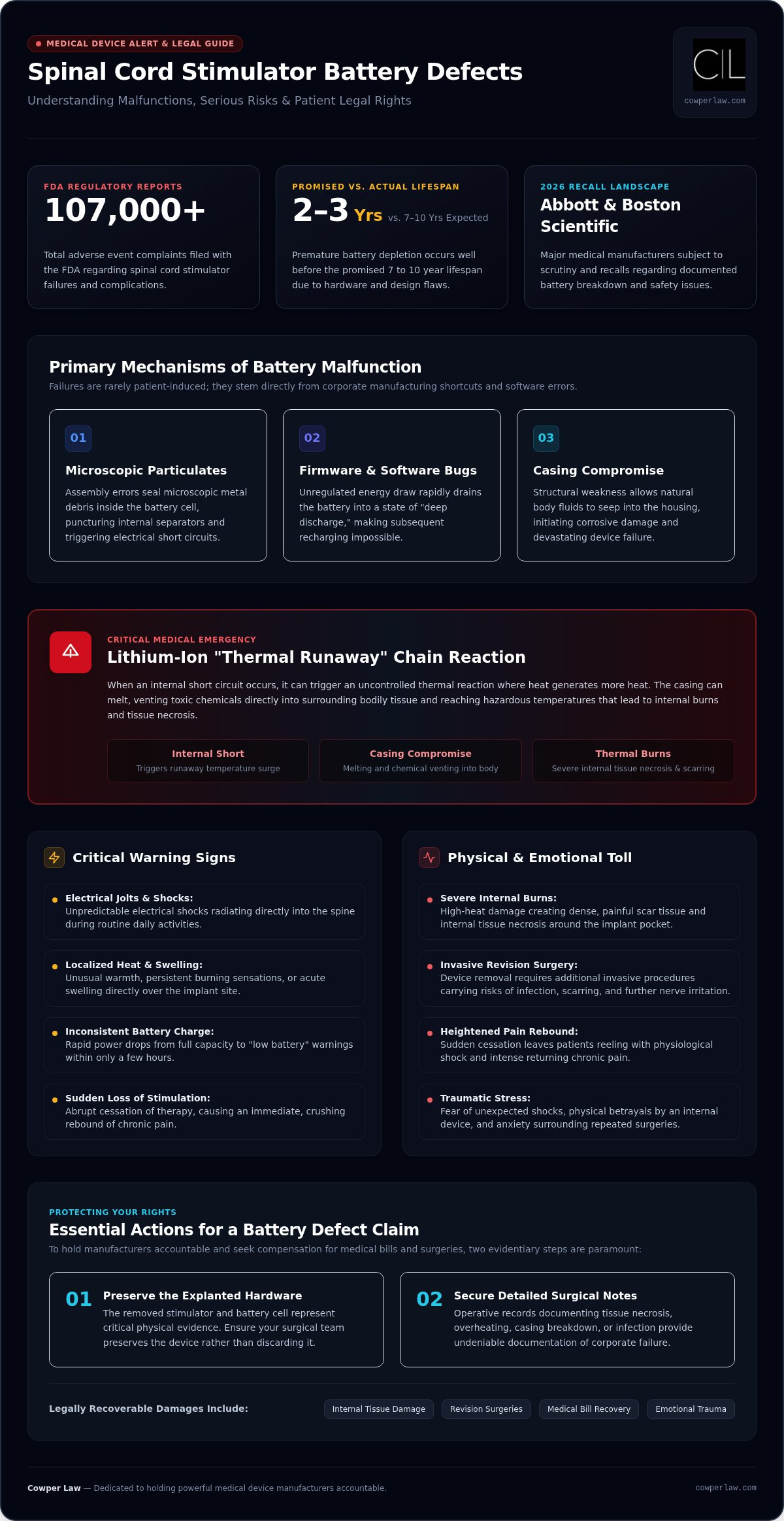
A successful spinal cord stimulator battery defect claim is built on a foundation of unyielding evidence and meticulous detail. We understand that you are currently in pain, but the actions you take today will define the strength of your recovery tomorrow. The physical battery is the single most important piece of proof in your journey. Hospitals often have a standard policy of returning failed hardware to the manufacturer for analysis, which essentially hands the evidence back to the party that harmed you. We intervene immediately to ensure the device is preserved, secured, and analyzed by independent experts.
Beyond the hardware, your records must tell a complete story. This includes surgical imaging, hospital logs, and your own contemporaneous notes. Documenting the frequency of charging errors or the specific sensation of electrical jolts provides a human perspective that corporate data logs often omit. We help you quantify the full scope of your damages, from the mounting medical bills and lost wages to the profound pain and suffering caused by the return of your chronic condition. We are serious, focused, and intensely loyal to our clients, ensuring that every loss is documented with precision.
The explant procedure is a vital evidentiary window. Your surgeon needs to provide detailed notes regarding the appearance of the implant pocket, any signs of thermal tissue damage, and the visible condition of the battery casing. This clinical documentation links the physical hardware failure directly to your physical injuries. For those navigating this process, understanding how to join a medical device class action lawsuit can provide necessary context for how your individual injury fits into a larger pattern of corporate negligence.
Determining the worth of your case involves analyzing both tangible losses and intangible human costs. We look at factors similar to BioZorb lawsuit settlement amounts, where the severity of the implant failure and the necessity of revision surgery play a major role in the final outcome. A permanent nerve injury carries a far higher human cost than a successful, uncomplicated revision. At Cowper Law, we evaluate the long-term impact on your quality of life, your family, and your future. We are relentless advocates who refuse to yield until you receive the stability and support you deserve. If you are ready to hold the manufacturer accountable, reach out to our trial attorneys to discuss your path forward.
We are trial lawyers who refuse to yield when facing off against the giants of the medical device industry. A spinal cord stimulator battery defect claim is not just a legal transaction; it's a fight for your quality of life, your dignity, and your future. We understand the weight of this journey. While large corporations often treat injured patients as mere statistics, we provide a tailored, high-end service that prioritizes your peace of mind. We are serious, focused, and intensely loyal to every individual we represent, ensuring that you never have to face these powerful entities alone. Our commitment is a sophisticated blend of authoritative confidence and deep-seated empathy.
Operating on a contingency fee basis, we align our success entirely with yours. We don't believe in adding financial stress to an already chaotic time; therefore, we only recover fees if we secure compensation for you. This results-first framing ensures that our team is emotionally and professionally invested in your outcome from the very first day. We are your constant companion through the complexities of litigation, handling the heavy lifting so you can focus on healing and reclaiming your strength. When you bring a spinal cord stimulator battery defect claim to us, you're gaining a partner who values your recovery as much as the final verdict.
Large corporations rarely offer fair settlements to those they perceive as unwilling to go the distance. We are a trial-ready firm, which means we prepare every case with the expectation of appearing before a judge and jury. This level of preparation provides you with a position of strength, strategy, and stability. Our "Compassionate Warrior" persona is designed to protect your interests fiercely while providing the softness required for client support. We have a long history of taking on powerful entities, acting as a dedicated defender for the individual in a classic David vs. Goliath struggle. Being ready for court isn't just a tactic; it's our mission.
The path to justice begins with a simple, reassuring conversation. Our initial consultation is a space where you can share your story without judgment or pressure. When you partner with a medical device injury lawyer from our firm, you aren't just hiring a legal advisor; you're enlisting an active, relentless advocate. We take the time to understand the nuances of your injury, the depth of your pain, and the specific failures of your device. We are here to provide order during what is often the most difficult chapter of your life. Contact Cowper Law today to discuss your battery defect claim.
You shouldn't have to carry the weight of a manufacturer's negligence alone. A spinal cord stimulator battery defect claim is your mechanism for restoring the stability, health, and peace of mind that was taken from you. We've explored how these technical failures manifest as physical trauma and how the 2026 legal landscape is shifting to hold massive corporations accountable. Justice is achievable when you have a partner who refuses to yield. We are national trial lawyers specializing in complex medical device failures, providing the elite representation you deserve.
Our team operates on a contingency-based fee structure; you pay nothing unless we recover for you. This allows you to focus on healing while we handle the intense litigation required to challenge powerful entities. We embrace the role of the Compassionate Warrior, blending intellect, strategy, and heart to protect your future. Begin your journey toward justice with a free case evaluation from Cowper Law. You have fought through the pain for long enough; now let us fight for your rights.
Yes, you can pursue a spinal cord stimulator battery defect claim if the premature failure led to additional medical expenses or physical injury. While batteries eventually wear out, a failure within just a few years of implantation often indicates a manufacturing or design flaw. We focus on holding corporations accountable for these shortfalls, especially when they result in a return of chronic pain or the need for invasive revision surgery.
Common symptoms include a sudden loss of pain relief, unusual heat at the implant site, or unpredictable electrical jolts. You might also notice that the device fails to hold a charge or requires frequent recharging despite being full. These signs often point to internal short circuits or software glitches. If you experience these issues, it's essential to document the dates and specific sensations for your potential legal claim.
You don't need to have the device removed to begin the legal process, but the explanted hardware often serves as the most critical piece of evidence. If your doctor recommends a revision surgery, we take immediate steps to ensure the hospital preserves the defective unit. This physical proof allows our experts to identify the exact mechanism of failure, which significantly strengthens your position against the manufacturer during litigation.
We operate on a contingency fee basis, meaning there are no upfront costs or out-of-pocket expenses for you. Our firm only collects a legal fee if we successfully recover compensation through a settlement or jury verdict. This model ensures that high-end legal representation is accessible to everyone, regardless of their current financial situation. We are emotionally and professionally invested in your success because we only win when you win.
Yes, every state has a statute of limitations that dictates how long you have to file a lawsuit. These deadlines typically range from one to six years, but most often fall between two and three years from the date you discovered the battery defect. Because these timelines are strict and vary based on your specific circumstances, consulting with a trial lawyer early is the best way to protect your right to seek justice.
You can still file a spinal cord stimulator battery defect claim even if the FDA hasn't issued a formal recall. Many dangerous defects are identified through private litigation and adverse event reports long before a manufacturer admits to a problem publicly. We use the discovery process to uncover internal corporate documents that prove the company knew about the battery failures but failed to warn patients or physicians in a timely manner.
While many medical device claims are resolved through settlements, we prepare every case with the total certainty that it will go to trial. This trial-ready approach signals to large corporations that we won't accept an unfair or low-ball offer. You may need to provide a deposition, but our team acts as your constant companion throughout the process, providing the protection and stability you need during what can feel like an intimidating journey.
The duration of a lawsuit varies depending on the complexity of the defect and the manufacturer's willingness to negotiate. Most cases take between one and three years to reach a resolution. This timeline includes the phases of investigation, filing, discovery, and potential trial. We move methodically and steadily to ensure no detail is overlooked, prioritizing a result that provides long-term peace of mind rather than a rushed, insufficient outcome.