
A test can detect atrazine only within a short window after exposure. According to the Agency for Toxic Substances and Disease Registry, tests for atrazine are useful only for detecting recent exposures within 24-48 hours. Most atrazine metabolites leave the body within 24-48 hours, primarily in urine and, to a lesser extent, feces, so timing matters when considering an atarzine toxicology test.
It’s understandable to want a test result that clarifies what happened. Testing may examine samples such as blood, fat, semen, or breast milk, but a result cannot fully establish how much atrazine entered the body or whether it caused a health effect. This article explains how exposure can occur, how atrazine leaves the body, which samples may be tested, and what results can and cannot tell you. Understanding these limits can help you assess the evidence and consider appropriate next steps for your situation.
Atrazine testing may involve different body samples, but timing can limit what a result reveals. Exposure concerns also need to be considered alongside environmental findings and the limits of evidence from laboratory models.
Testing may examine blood, fat, semen, or breast milk for atrazine or its metabolites. The sample type matters because a result reflects what was detectable in that sample when it was collected. A result from one tissue does not automatically describe levels in another or establish the amount a person encountered. Both the sample and collection timing shape what the result can show.
Tests for atrazine are useful only for detecting recent exposures within 24-48 hours because the chemical is removed from the body relatively quickly, according to the Agency for Toxic Substances and Disease Registry. Most metabolites leave within 24-48 hours, primarily in urine and, to a lesser extent, feces. A delayed sample may therefore fail to capture an earlier exposure. A negative result cannot rule out past contact.
Developmental findings require careful interpretation. Atrazine exposure at 0.1 μg/L has been associated with dramatic changes in sexual differentiation in amphibians. That finding concerns amphibians; it does not, by itself, establish developmental effects in people.
Cell studies also examine possible effects. Atrazine exposure at 12-300 μM altered the morphology of N27 rat dopaminergic cells after 48 hours. These are rat cells studied in a laboratory, not a clinical test result or proof of harm in an individual.
Environmental measurements can help explain possible exposure routes. Atrazine has been detected up to 21 ppb in groundwater and 42 ppb in surface waters. Stream concentrations have reached 224 ppb, and rainwater detections have occurred more than 180 miles from the nearest application area.
After suspected exposure, contact the Poison Control Center at 800-222-1222 for additional treatment advice. Share what happened and when, since timing matters when considering testing.
A toxicology result measures a particular sample; it does not reconstruct exposure. An atrazine test cannot estimate how much atrazine a person encountered or determine whether adverse health effects will occur. Detecting atrazine does not, by itself, establish the dose, route, or duration of contact. Likewise, a result with no atrazine detected cannot establish that earlier exposure did not happen.
Health effects must be considered separately from chemical detection. A test result cannot establish that atrazine caused a symptom or predict whether illness will develop. For example, a detected metabolite may show that the body processed atrazine, but it does not identify the exposure source or link it to a specific health outcome. Interpreting a result therefore requires context, including the sample type, collection timing, exposure history, and health information.
Laboratory studies of intestinal cells illustrate why experimental findings must be interpreted carefully. Atrazine concentrations of 1-10 μM increased proliferation of human intestinal epithelial cells after 72 hours. At concentrations of 50 μM and above, atrazine caused substantial cytotoxic effects in human intestinal Caco-2 cells. These findings describe effects under specific laboratory conditions. They are not a measurement of a person’s exposure, a diagnosis, or proof that the same effects occur in a person.
Concentration and duration matter in those experiments. A result from cells exposed to 1-10 μM for 72 hours cannot be treated as equivalent to a test from someone’s blood or urine. Nor does a laboratory observation at 50 μM establish that a person encountered that concentration. The tested cell type, exposure conditions, and measured outcome all shape what a study can show.
Keep the distinction clear: a test can provide evidence about atrazine in a sample, while exposure history and health findings address different questions. This helps prevent a single result from being given more weight than it supports.
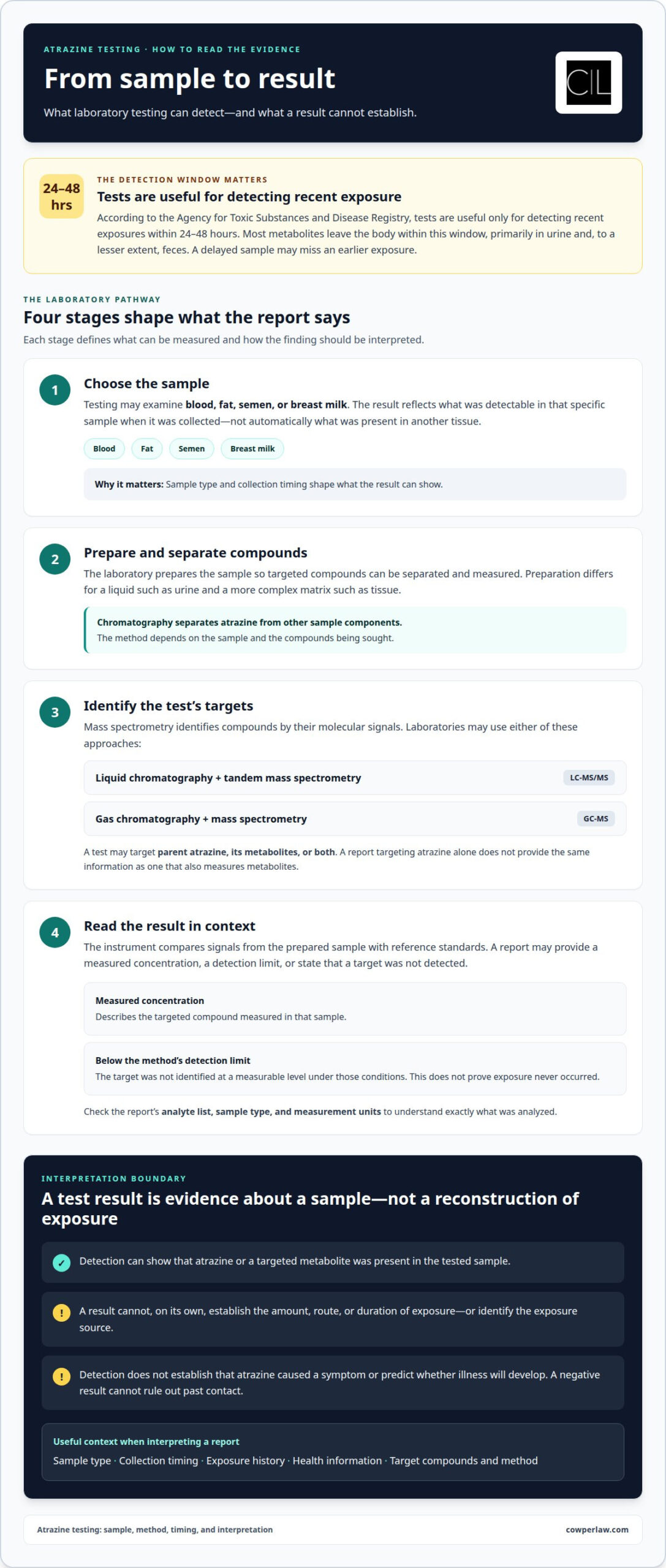
Laboratories can analyze samples using chromatography and mass spectrometry. Liquid chromatography separates atrazine from other sample components before tandem mass spectrometry identifies compounds by their molecular signals. Gas chromatography coupled with mass spectrometry is another analytical approach. The method depends on the sample and the specific compounds being sought.
These methods can target parent atrazine, its metabolites, or both. The distinction matters: a test aimed at atrazine alone may not report the same information as one designed to measure metabolites. The laboratory’s target list and the sample type shape what appears in the final result. Read any reported finding alongside the method’s stated analytes.
Before analysis, a laboratory prepares the sample so the compounds of interest can be separated and measured. Preparation differs for a liquid sample, such as urine, and a more complex matrix, such as tissue. The instrument then compares signals from the prepared sample with reference standards. This process helps identify and quantify targeted compounds; it does not reveal every possible exposure source or route.
Results may report a measured concentration, a detection limit, or that a target was not detected. These terms describe the analysis, not a health diagnosis. A result below the method’s detection limit means the instrument did not identify the target at a measurable level under those conditions. It does not prove that exposure never occurred. The laboratory report’s analyte list, sample type, and measurement units are essential context.
For example, a report naming atrazine and a specific metabolite gives different information from one naming atrazine alone. Ask what compounds the test measured and how the reported result is expressed. If an atrazine-related cancer diagnosis raises legal concerns, explore an atrazine cancer claim and the evidence relevant to your circumstances.
There isn’t one fixed cost for atrazine testing in the United States. The total depends on what is tested, which sample is analyzed, and whether the test measures atrazine, its metabolites, or both. Blood and water analyses involve different samples and laboratory procedures, so their costs aren’t directly comparable.
Before arranging testing, identify its purpose. Testing a person’s sample addresses a different question from analyzing drinking water or soil. For suspected personal exposure, a healthcare professional can help determine whether testing is relevant and which sample may suit the question. Environmental testing focuses on the water or material in question, rather than a person’s body.
Availability can depend on the sample and the laboratory’s analytical capabilities. A general medical laboratory may not perform every pesticide analysis, while a specialized analytical laboratory may handle specific chemical measurements. Confirm that the test covers atrazine or the relevant metabolites, rather than assuming a broad toxicology panel includes them.
Ask about the full scope of the analysis before comparing costs. Useful details include:
A quoted amount may change if the requested sample or analytes differ. For example, a test focused on atrazine alone may not provide the same information as an analysis that also targets metabolites. Clarifying the purpose and requested compounds makes cost estimates more meaningful.
Testing availability and cost are separate from what a result can prove. A laboratory can measure a target compound, but the report still needs to be interpreted in context. The sample, analytes, collection timing, and reason for testing all shape what the result can tell you.
A test result is one piece of a larger personal and medical record. If exposure concerns are connected to a cancer diagnosis, the next step may be understanding what evidence matters beyond an atarzine toxicology test. Keep relevant records together, including diagnosis documents, employment or residence history, and information about possible atrazine contact. A clear timeline can help frame the questions that deserve careful attention.
Cowper Law represents people pursuing atrazine cancer lawsuits. The firm can help assess the legal questions surrounding a potential claim and explain how the available evidence relates to your circumstances. Testing alone does not have to bear the weight of proving your entire experience.
If you’re ready to discuss your situation, contact Cowper Law. You deserve a thoughtful review of the facts and a clear path toward deciding what comes next.
Atrazine can enter the body by swallowing contaminated water, breathing pesticide particles, or through skin contact. After exposure, the body processes it into metabolites and eliminates them mainly in urine, with some leaving in feces. For example, someone concerned about a water source should distinguish possible ingestion from workplace contact, since the route and timing help explain what a test might detect.
Yes, laboratory analysis can look for atrazine or its metabolites in biological samples. However, testing is most useful soon after suspected contact, and a result cannot determine the total amount of exposure or establish whether atrazine caused a health condition. If you’re considering testing, discuss the suspected route and timing with a healthcare professional so the purpose and sample are clear.
Atrazine is a pesticide used in the United States. It is a restricted-use pesticide, meaning certified pesticide applicators may use it. People may encounter it through environmental contamination, including affected water. For a specific concern, identify whether it involves drinking water, work, or another possible source; the suspected setting can help frame what information is relevant.
An atrazine toxicology test is a laboratory analysis that looks for atrazine, its metabolites, or both in a sample. The exact target depends on the test ordered. For example, a report that measures a metabolite answers a different analytical question from one that measures atrazine itself. The test detects compounds in the submitted sample; it does not, by itself, establish cause or health effects.
A laboratory prepares the submitted sample, separates target compounds, then uses an analytical instrument to identify or measure them. Chromatography paired with mass spectrometry can be used for chemical analysis. Sample preparation and targeted compounds vary by sample type. When reviewing a report, note the sample, analytes, units, and detection limit, since these details determine what the result means.
There isn’t a single normal level that applies to every atrazine test and sample. A laboratory report may show a measured concentration or indicate that a target wasn’t detected above that method’s detection limit. For example, results from different sample types or tests targeting different compounds aren’t directly interchangeable. Interpret the reported units and threshold in light of the test’s purpose and collection context.