
Atrazine testing may detect recent exposure within 24-48 hours because the chemical leaves the body relatively quickly. An atrazine blood test may not answer every question, so timing and the type of sample matter when evaluating possible contact.
Wanting clear answers about atrazine exposure and your legal rights is understandable. This article explains what testing can and cannot show, how atrazine moves through the body, and what research says about a possible connection with non-Hodgkin lymphoma.
Understanding an atrazine blood test and your legal rights can help you assess what evidence may matter and decide what steps to take next.
Testing may look for atrazine or its breakdown products, but the timing and sample type matter. Some studies measure atrazine mercapturate in urine; a blood test may not answer the same question. An atrazine blood test can contribute to an assessment of exposure and legal rights, but its result alone cannot establish where contact occurred or what caused an illness.
People in the United States can discuss possible exposure with a healthcare professional, who can assess whether testing fits their exposure history and symptoms. For workplace contact, an occupational health clinician can consider job tasks and timing. Note whether the concern involves application work, drinking water, or another possible source. These details can inform the medical assessment and any later discussion of legal rights related to atrazine exposure.
Atrazine exposure can happen through agricultural work, drinking water, or food. Atrazine is used primarily on corn, and runoff can carry the chemical into water. The federal drinking-water limit is 3 µg/L. That limit describes the concentration in water, not how much entered one person’s body. A test result must be interpreted in light of its sample and purpose.
The U.S. Environmental Protection Agency’s 2022 proposal would prohibit atrazine application when a forecast storm event likely to produce runoff is expected within 48 hours. This proposed measure addresses runoff risk; it doesn’t establish whether a particular person was exposed or experienced health effects.
The available information does not establish a single nationwide rule requiring every employer, landlord, or water provider to arrange atrazine testing in every situation. Whether testing can be required depends on the circumstances and applicable law. Potential claims include personal injury or, for eligible surviving family members, wrongful death. An atrazine blood test and related records may be relevant, but exposure evidence, medical records, and the connection between exposure and harm also matter.
The evidence is developing, and a disease diagnosis alone can’t establish its cause. In November 2025, the International Agency for Research on Cancer classified atrazine as probably carcinogenic to humans, Group 2A. That classification signals a concern based on scientific evidence; it does not prove that atrazine caused an individual person’s non-Hodgkin lymphoma.
Testing has a narrow window. Atrazine is removed from the body relatively quickly, and tests may detect recent exposure within 24-48 hours. A blood test may not be the right test for every exposure question. Testing can measure atrazine or breakdown products in biological samples, including urine, so timing and the test’s purpose matter. Tell the healthcare professional when exposure may have happened and whether it involved work, water, or another source.
Studies of farmers have also examined kidney function. One study found male farmers still using atrazine had about 9% lower kidney filtration than farmers with little or no use. In another study, recent users in the highest exposure tier had roughly 2.4 times the odds of chronic kidney disease; a separate study associated ever-use with about 1.8 times the odds. These findings concern associations, not proof that the pesticide caused disease in a particular person.
For a private well, arrange water testing through a laboratory that analyzes atrazine, and follow its sample-collection instructions. A water result measures the sample, not a person’s internal exposure. After suspected contact, seek medical advice, record the date and circumstances, and preserve relevant work or water records. Avoid further contact with a suspected source while the concern is being assessed.
Testing costs vary by laboratory and test type; insurance coverage depends on plan terms and the reason for testing. For a closer look at the research on atrazine and non-Hodgkin lymphoma, consider how exposure evidence and medical records fit together.
The World Health Organization classified atrazine as “Probably Carcinogenic” on December 5th, 2025; that classification does not automatically change U.S. regulations. In one dataset, atrazine mercapturate appeared in fewer than 5% of people.
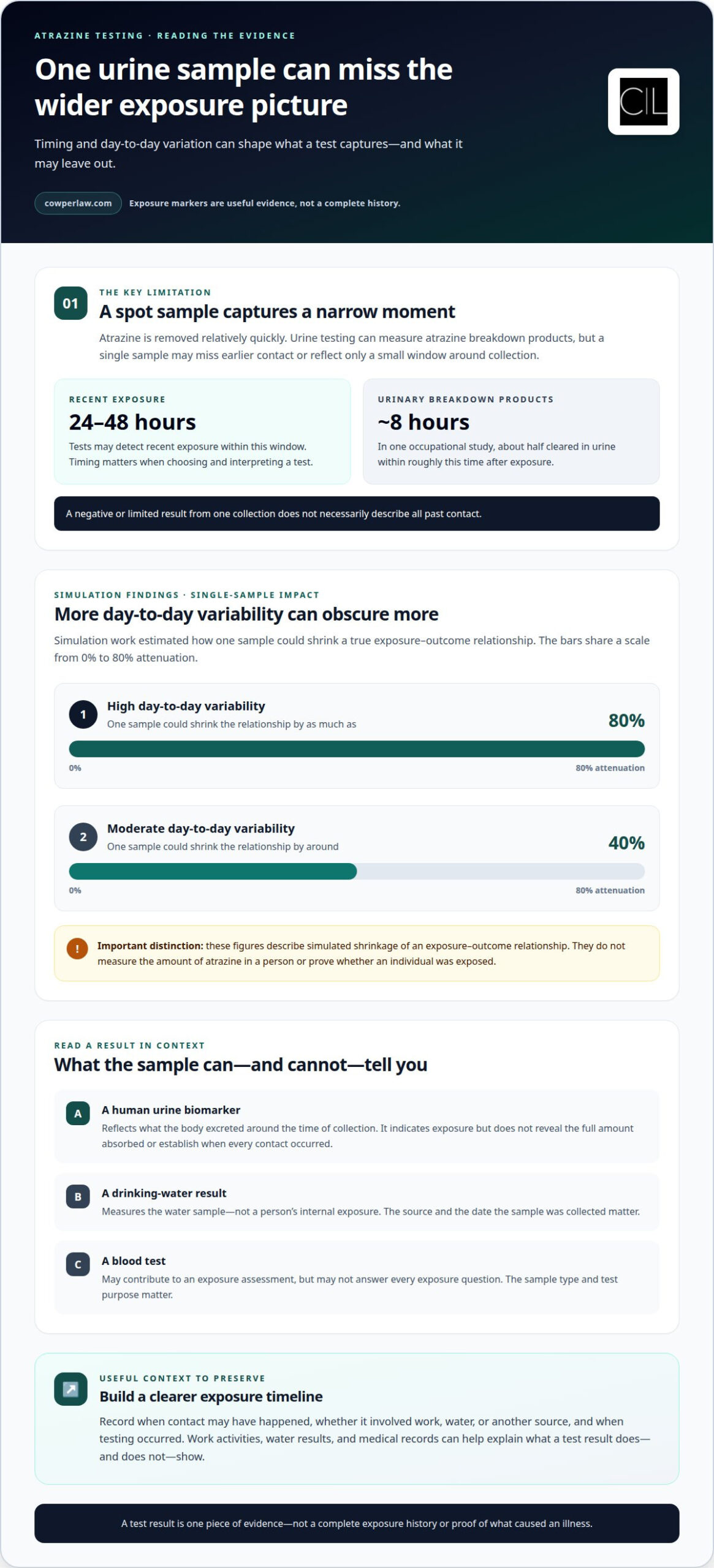
Atrazine exposure can occur during agricultural work, including contact while the herbicide is applied. Once absorbed, the body breaks some of it down into biomarkers that can be measured in urine. These markers indicate exposure but do not reveal the full amount absorbed or establish when every contact occurred. Drinking-water exposure also depends on the water source and when the sample was collected.
Urine testing has important limits. In one occupational study, about half of atrazine breakdown products cleared in urine within roughly 8 hours after exposure. A single spot sample may therefore miss earlier contact or capture only a narrow moment. Simulation work found one sample could shrink a true exposure-outcome relationship by around 40% with moderate day-to-day variability, and by up to 80% when variability was high. Biomarkers are useful evidence, not a complete exposure history.
That distinction matters for public health assessments and legal records. A drinking-water result measures the sampled water, while a human biomarker reflects what the body excreted around the time of collection. An animal study or environmental measurement cannot replace an individual medical assessment. Dates, work activities, water results, and test timing can help clarify what a result does and does not show.
Legal deadlines need separate attention. Filing deadlines for atrazine lawsuits depend on the state law governing a personal injury or wrongful death claim. State statutes of limitations differ, and discovery rules may affect when a deadline begins, depending on the governing law and case circumstances. A test result alone does not determine that date. Preserve relevant records and seek case-specific legal guidance promptly, especially if exposure and diagnosis occurred at different times.
If exposure has led to a serious diagnosis, discuss your atrazine claim and how state deadlines may apply.
Broader use helps explain why exposure questions arise, but it does not establish that any individual was exposed. Approximately 80 million pounds of atrazine are applied each year in the United States, and atrazine is applied to approximately 65 percent of planted corn acres in the United States. Atrazine has been found at at least 20 of the 1,636 current or former National Priorities List sites in the United States; these figures provide context, not a personal exposure measurement.
Whether atrazine causes non-Hodgkin lymphoma is a question about evidence, not a result one exposure test can settle. The International Agency for Research on Cancer review involved 22 cancer research experts from 12 countries. A cancer hazard classification describes concern about a substance; it does not prove that atrazine caused a particular person’s cancer. Individual causation requires examining exposure history, diagnosis, and other evidence together.
Researchers assess possible links using different kinds of evidence. Human studies can compare reported exposure and disease patterns; laboratory research can examine biological pathways, including questions about hormone activity. Environmental measurements, such as atrazine levels in water, help describe possible exposure but cannot establish who drank that water or how much entered their body. Each type of evidence answers a different question.
For an individual claim, a useful timeline connects potential contact with health records. For example, agricultural work, use of a private well, and a later lymphoma diagnosis are separate facts that need reliable documentation. A test result may support recent exposure, but it cannot reconstruct every past contact or independently establish that exposure caused cancer. The full record, not one result, informs the strength of a claim.
Public health evaluations and individual legal claims ask different questions. An agency may assess risks across populations in the United States, while an individual case examines specific circumstances, records, and evidence. Environmental levels can identify a possible source; medical documentation can establish the diagnosis; exposure records can help connect the two. Preserving dates, work history, water results, and treatment records gives qualified reviewers a clearer basis for assessing possible risks and legal options.
Uncertainty about exposure and illness can make it hard to know what to do next. Start by organizing the facts in a clear timeline that connects suspected contact, changes in health, and decisions made along the way. This gives a legal review a fuller starting point than a test result alone.
If you have questions about an atrazine blood test and your legal rights, Cowper Law handles atrazine cancer claims. The strength and timing of a claim depend on the facts and applicable law. Getting guidance early can help you understand your options.
Contact Cowper Law about your rights. You deserve clear answers and steady support as you decide what comes next.
Atrazine is a herbicide used primarily on corn in the United States. It is applied to control weeds, so exposure questions may arise around agricultural work and nearby water sources. The chemical can move beyond the application area through environmental pathways. Whether someone encountered it depends on the circumstances, such as work activities or a specific drinking-water source.
The article provides no verified cost information, so a specific amount cannot be stated. Factors relevant to a claim may include the alleged exposure, the health condition, available records, and the legal work involved. The type of claim alone does not establish a cost. Before deciding how to proceed, seek clear information about the proposed representation and any costs.
The U.S. Environmental Protection Agency sets the maximum allowable atrazine concentration in drinking water at 3 µg/L. This is a regulatory limit for water, not a threshold that measures an individual’s exposure or predicts illness. For a private well, a laboratory water result can help show atrazine concentration in that sample; interpretation depends on where and when it was collected.
There is no single deadline that applies to every atrazine case nationwide. The governing state’s law controls, and discovery rules may affect when a filing period begins. A person’s location, claim type, and when the injury was discovered can matter. Keep diagnosis and exposure records together, and seek case-specific legal guidance promptly, since waiting can affect available options.
Testing may look for atrazine itself or its breakdown products in biological samples, including urine; environmental testing can examine water. These tests answer different questions: a urine result concerns a person’s sample, while water testing concerns the sampled source. Before testing, clarify which sample is being analyzed and whether the purpose is to document recent exposure, assess a water source, or support medical evaluation.
A test’s usefulness depends on the sample, timing, and question it is meant to answer. A detected marker can support evidence of exposure, but it cannot by itself establish the source, total past exposure, or cause of an illness. A healthcare professional can interpret the result alongside symptoms and medical history. For legal purposes, preserve the report and details about its collection.