
Atrazine has been linked most notably to non-Hodgkin lymphoma, but the evidence doesn’t establish that it causes cancer in people. In January 2026, the International Agency for Research on Cancer classified atrazine as probably carcinogenic to humans, citing limited human evidence for non-Hodgkin lymphoma alongside animal and mechanistic evidence. Other cancer associations have been reported, but they don’t prove cause and effect.
Conflicting assessments can make the relationship between atrazine and cancer difficult to understand. The Joint FAO/WHO Meeting on Pesticide Residues (JMPR) concluded that epidemiological evidence does not support a causal association between atrazine exposure and cancer in humans. For regulatory and public-health purposes, it recommended treating atrazine as unlikely to pose a cancer risk. Understanding why assessments differ is central to making sense of atrazine and cancer.
This article explains what human and animal studies have found, how JMPR’s review differs from IARC’s hazard classification, and how atrazine can reach drinking water. It also covers practical ways families can reduce exposure and clarifies what the findings do and do not establish about cancer risk.
Families can limit contact by staying away from fields recently sprayed with atrazine and considering private-well testing in areas where its use is high. In January 2026, the International Agency for Research on Cancer classified atrazine as probably carcinogenic to humans. This hazard classification informs the atrazine-and-cancer discussion, but doesn’t measure the risk at a person’s actual exposure level.
IARC’s classification differs from regulatory assessments because the organizations address different questions. IARC identifies cancer hazards; it doesn’t determine the likelihood of cancer at realistic exposure levels or set policy. Its Group 2A examples include very hot beverages, red meat, night shift work, and occupations such as hairdressing. Group 1 includes alcoholic beverages, processed meats, and UV-emitting tanning devices. Group 2B includes aloe vera whole leaf extracts, pickled vegetables, and gasoline. These groups describe evidence of a hazard, not equal risk from each agent or exposure.
The U.S. Environmental Protection Agency’s Cancer Assessment Review Committee classified atrazine as not likely to be carcinogenic to humans. The EPA maintains that atrazine does not pose a cancer risk at current exposure levels and reviewed hundreds of studies in its assessment. These conclusions differ from IARC’s, so atrazine and cancer findings should be understood in light of each agency’s methods and purpose.
Beyond cancer, a 2024 animal study cited by IARC found oxidative stress and severe hormone disruption in male rats exposed to atrazine. These are animal-study findings, not established symptoms in people.
For a private well, arrange testing that specifically measures atrazine, especially in areas where its use is high. Families can also reduce possible contact by avoiding fields that have been recently sprayed with the pesticide.
Studies have examined several cancers in relation to atrazine exposure, but findings vary across types of evidence. Human research has focused especially on non-Hodgkin lymphoma; animal experiments and biological findings add evidence about potential carcinogenicity.
Epidemiologic evidence studies patterns of disease in people and whether exposure and illness are associated. It matters because an observed link between atrazine and cancer can guide further investigation, but doesn’t by itself establish that exposure caused the disease. Two case-control studies reported strong positive associations between atrazine exposure and non-Hodgkin lymphoma among exposed farm workers. The reported association involved lymphoma positive for the chromosomal translocation t(14;18).
A 2024 study of more than 53,000 pesticide applicators found suggestive associations with lung cancer and non-Hodgkin lymphoma. It also reported risks involving prostate cancer, soft-tissue sarcoma, and pharyngeal and kidney cancers. These are cancers studied in connection with exposure, not proof that atrazine caused them. The U.S. Environmental Protection Agency’s reviews in 2003 and 2018 concluded that available evidence didn’t support a relationship between atrazine exposure and human cancers.
Mechanistic evidence examines biological changes that could help explain how an agent might contribute to cancer. It adds context to human and animal findings when researchers assess atrazine and cancer. IARC cited strong mechanistic evidence in its evaluation, but this evidence does not establish that a particular person’s exposure caused disease.
IARC also found sufficient evidence of cancer in experimental animals, while human evidence was limited and centered on non-Hodgkin lymphoma. A 2024 animal study cited in the assessment found oxidative stress and severe hormone disruption in male rats exposed to atrazine. Together, epidemiology, animal findings, and mechanistic evidence inform assessments, while each addresses a different part of the question.
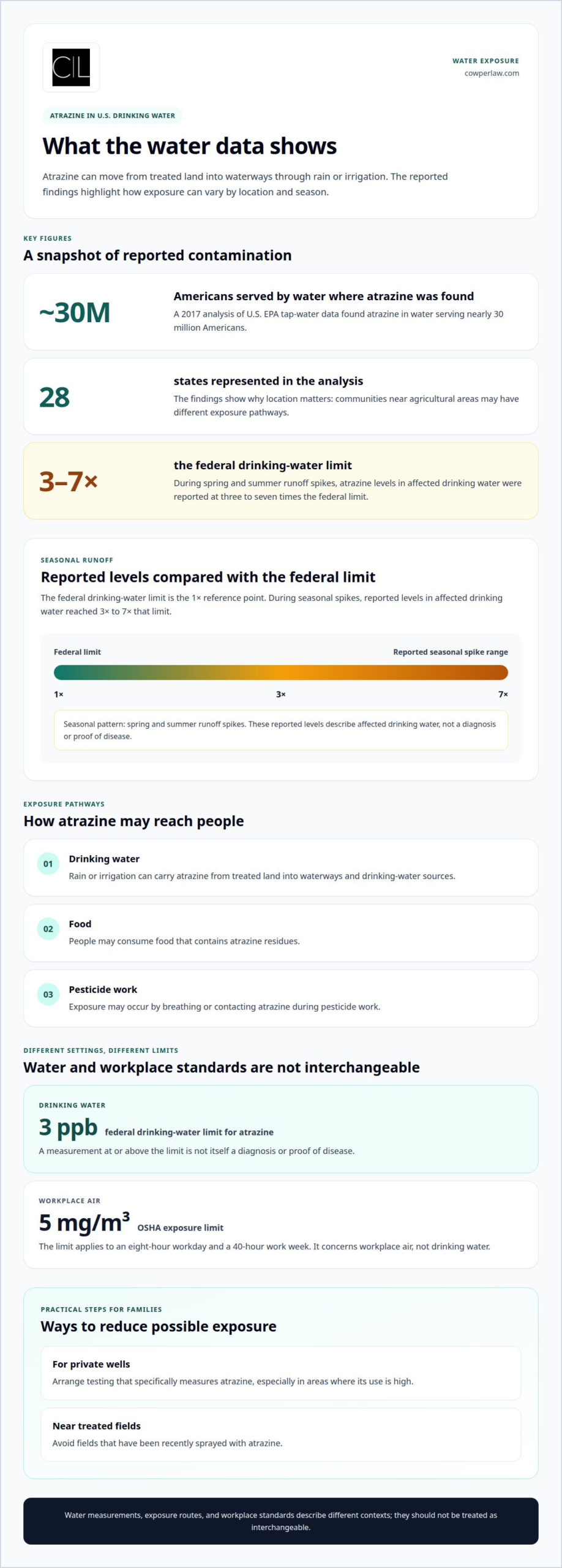
Atrazine use can create environmental exposure through water, food, and certain jobs. How people may be exposed depends on where the herbicide is applied and how it is handled.
Atrazine can enter drinking-water sources when rain or irrigation carries it from treated land into waterways. A 2017 analysis of U.S. EPA tap-water data found atrazine in water serving nearly 30 million Americans across 28 states. The findings show why location matters: communities near agricultural areas may face different exposure pathways than places where atrazine use is limited. During spring and summer runoff spikes, atrazine levels in affected drinking water were reported at three to seven times the federal limit. That seasonal pattern can shape environmental monitoring and research on cancer exposure.
The federal drinking-water limit for atrazine is three parts per billion. This standard provides a reference for public water systems, but a measurement at or above the limit is not itself a diagnosis or proof of disease. For workplace air, OSHA’s exposure limit is five milligrams per cubic meter for an eight-hour workday and a 40-hour work week. These limits apply to different routes and settings, so water and workplace results shouldn’t be treated as interchangeable. The international and regulatory context also differs from an individual exposure history.
People may encounter atrazine by drinking contaminated water, consuming food with residues, or breathing or contacting it during pesticide work. The U.S. EPA has determined maximum atrazine levels allowed in food of 0.02-15 parts per million. In the Corn Belt, up to 60 million pounds of atrazine is applied to crops each year, making location and occupation relevant when considering possible contact. Farm workers may have direct work-related exposure, while residents may encounter it through water after runoff. These routes help explain how exposure can vary among people and states.
For help understanding a potential exposure-related claim, explore atrazine cancer lawsuit representation.
The Joint FAO/WHO Meeting on Pesticide Residues (JMPR) reached a cautious public-health conclusion: epidemiological evidence does not support a causal association between atrazine exposure and cancer in humans. At the same time, JMPR stated that available information is inadequate to determine definitively whether this chemical causes cancer in people. Those findings are not contradictory. One describes what population studies support; the other recognizes limits in drawing a final causal conclusion.
JMPR also addressed occasional studies reporting positive links between atrazine and cancer. Its review attributed those findings to bias or chance rather than treating them as evidence of a consistent causal relationship. A reported link in one study does not, by itself, establish that atrazine caused disease. Results need to be understood in the context of the broader epidemiological evidence JMPR reviewed.
For regulatory and public-health purposes, JMPR recommended treating atrazine as an agent unlikely to pose a cancer risk to humans. This is a risk-management conclusion, not a declaration that every question about cancer has been resolved. JMPR also identified atrazine as a candidate for a category of herbicides with a probable absence of cancer risk. The measured wording conveys the review’s overall judgment while retaining its stated uncertainty about definitively determining cancer causation.
When weighing reports about atrazine and cancer, distinguish a possible association from evidence of cause and effect. JMPR’s conclusion reflects its view that epidemiological findings do not establish a causal link, while the available information remains inadequate for a definitive answer. Its recommendation addresses how the chemical should be treated for regulatory and public-health purposes. It does not describe an individual’s exposure, drinking-water levels, or personal cancer risk. Those are separate from the population-level evidence JMPR assessed.
When considering a possible connection between atrazine and cancer, focus on the facts of your own history. A useful next step is to assemble a timeline of diagnosis, work or residential exposure, and records that may help explain where contact could have occurred. This can give a legal review a clearer starting point without treating a scientific classification as proof about one person.
The evidence is complex, and the circumstances of each potential claim matter. Cowper Law represents people pursuing atrazine cancer lawsuits, including claims involving non-Hodgkin lymphoma. If you’re considering a claim, share what happened with Cowper Law to discuss how your circumstances may be assessed. You don’t have to navigate these questions alone.
Contact Cowper Law to discuss your situation and possible next steps. You deserve a careful review and a steady path forward.
The U.S. Environmental Protection Agency’s position is that atrazine does not pose a cancer risk at current exposure levels. Its Cancer Assessment Review Committee classified atrazine as not likely to be carcinogenic to humans. Separately, the Joint FAO/WHO Meeting on Pesticide Residues recommends treating atrazine as unlikely to pose a cancer risk for regulatory and public-health purposes. IARC identifies cancer hazards; it does not set federal policy.
Atrazine can be detected in blood and some other body tissues within 24 to 48 hours after the last exposure. Timing matters, because this finding concerns a limited period after contact, not a permanent record of past exposure. Detection can indicate that atrazine was present in the body, but it doesn’t establish that exposure caused cancer or another disease.
Atrazine is a herbicide, a type of pesticide used to control weeds. In the United States, it is used on crops such as corn and on turf and lawns. Because treated land can be near waterways, runoff is one route by which atrazine may reach drinking-water sources. Agricultural use also makes work-related contact relevant to exposure concerns.
Yes, assessments differ. In January 2026, IARC classified atrazine as probably carcinogenic to humans, Group 2A. The EPA’s Cancer Assessment Review Committee classified it as not likely to be carcinogenic to humans. JMPR recommends treating it as unlikely to pose a cancer risk for regulatory and public-health purposes. These conclusions reflect different assessments, not a single agreed classification.
Current evaluations describe limited human evidence, with non-Hodgkin lymphoma among the cancers studied. IARC’s 2026 classification weighs that evidence alongside animal and mechanistic findings. JMPR, by contrast, concludes that epidemiological evidence doesn’t support a causal association between atrazine exposure and cancer in humans. A reported association in a study is not, on its own, proof that exposure caused cancer.
Human epidemiological evidence is limited, and studies can report associations without establishing cause and effect. JMPR attributes occasional positive findings to bias or chance, while IARC also considers animal and mechanistic evidence in its hazard classification. The EPA and IARC reach different conclusions because their assessments address different questions. These differences make exposure history and the type of evidence important context when interpreting findings.